
Ethereum Foundation Sets Up a "Dead Man's Switch," Will the Community Buy It?

Original Article Title: "Ethereum Foundation Issues a 'Life-or-Death Promise,' Will the Community Buy It?"
Original Article Author: KarenZ, Foresight News
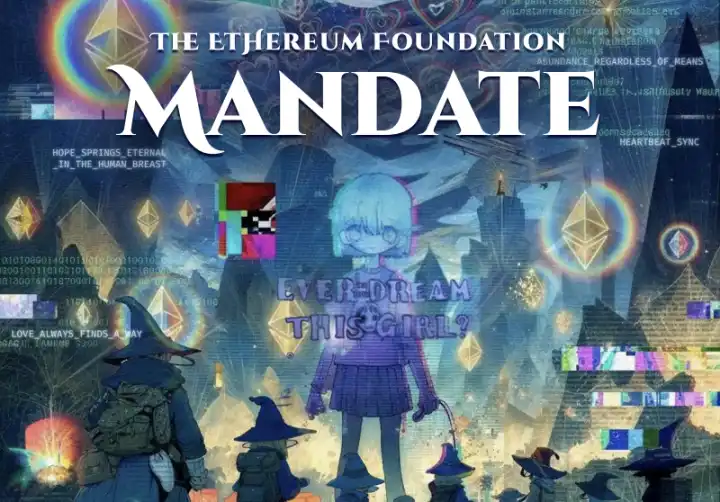
On the evening of March 13, the Ethereum Foundation (EF) board of directors released a mission statement called the "EF Mandate."
As you unfold this mission statement, you may wonder if you've entered the wrong set—the screen full of stars, elves, wizards, and a layout resembling an anime poster. Beneath this cool outer layer lies the current Ethereum ecosystem's "ideological manifesto."
TL;DR
· EF Core Positioning: Guardians, Not Rulers. EF's ultimate goal is to pass the "Walkaway Test"—even if the Ethereum Foundation dissolves in place tomorrow, the Ethereum network can still function perfectly.
· CROPS Immutable Law is the Baseline: Any technical development must meet Censorship Resistance, Open Source, Privacy, and Security. These four attributes are indispensable, and no development priority can outweigh them.
· EF Working Philosophy: The foundation subtracts so Ethereum can be more resilient. When the ecosystem is mature enough, the Ethereum Foundation will gradually decentralize.
· What Not to Do: Not to be a "kingmaker," not to be a rating agency, not to engage in pump-and-dump marketing, and certainly not to encourage Ethereum's use as a "big casino."
· Ultimate Vision: Looking 1,000 years into the future, providing a "digital sanctuary" free from exploitation by power, capital, AI, or even families.
What Exactly Does Ethereum Aim to Solve?
The EF believes that in the digital age, there are two infrastructural essentials: self-sovereignty—controlling one's own data, identity, and assets—and the ability to collaborate with others without being "choked" by anyone (preservation of sovereignty through coordination).
If you only pursue the first point, running a local app is sufficient; if you only pursue the second point, the traditional internet is adequate. Ethereum's unique value lies in achieving both simultaneously.
A passage in the manifesto states: Ethereum's existence is to ensure that no one can "rug" you—whether it's a government, company, institution, or AI.
Around this goal, EF has proposed an acronym: CROPS. This word appears 32 times in the manifesto.
· Censorship Resistance: No one can stop you from doing legal things; even under pressure, cryptographic neutrality holds.
· Open Source & Free: All code and rules are laid out; there are no hidden black boxes.
· Privacy: Your data belongs to you, not the platform. You decide what information to share with whom.
· Security: Protecting the system and users from technological failures and coercion are paramount.
These four attributes are defined in the document as an "indivisible whole," the highest priority, a baseline that must not be compromised for any reason.
The EF's attitude is clear: They would rather go slower but get these things right from day one because once surrendered, it's almost impossible to get them back.
What Does the Foundation Do? What Doesn't It Do?
The EF is treating "making itself unnecessary" as the ultimate success criterion.
There is a term in the document called the "walkaway test," which means: If EF disappeared tomorrow, could Ethereum keep running and evolving on its own? EF's goal is to make the answer to this question "yes."
Therefore, the EF is following a philosophy of "subtractive development": focusing on key tasks in the ecosystem that no one else can or wants to do—core protocol upgrades, long-term technical research, public security. Once a community in a certain area can take over, the EF hands it off, further reducing its relative influence.
At the same time, the EF has drawn up a long list of "don'ts" for itself, reading like a solemn disclaimer: not a company, not a kingmaker, not a certifying body, not a product studio, not a marketing company, not a boss, not a government agency, not a casino, not an opportunist.
When There Is No Standard Answer, How Will EF Decide?
Many lofty principles have been discussed: CROPS, sovereign individuality, subtractive philosophy. But what to do when faced with specific problems? This chapter is the answer.
It's a bit like the foundation's "decision-making algorithm": When faced with two paths, how do you choose without betraying your original intention?
· When choosing a technical solution, choose the one that "won't bottleneck in the future," even if it's slower now. An example in the document is transaction propagation: one solution performs well but relies on a private relay network (whitelist), while another decentralized solution advances slowly. The EF's answer may be the latter because once the former is implemented, the process of "decentralizing later" is unlikely to occur.
· When designing or evaluating proposals, don't just look at the immediate layer; consider the impact on other layers. Some solutions may seem fine in isolation, even aligning with CROPS principles, but when viewed in the entire ecosystem, they may create new issues elsewhere. Don't solve one problem and create ten more.
· User security is crucial, but don't make decisions for users. Only provide users with tools for self-defense, never impose "paternalistic" restrictions. No one should restrict users under the guise of "protecting users" and undermine users' autonomy. For example, some wallets may default to "security mode," covertly block certain contracts, lead users to specific platforms, or even use opaque AI to determine "risky operations" while secretly collecting user behavior—actions that the foundation opposes. Real protection means giving users verifiable filtering tools, publicly available blacklists/whitelists; regardless of the tool, privacy protection is the default, and AI components are no exception.
· Insistent on having intermediaries? Lower the barriers, leave an exit: If some areas currently cannot operate without intermediaries, then minimize entry barriers, allow full market competition, while ensuring users have an "intermediary-free" alternative that is user-friendly and practical.
· When choosing which teams to support, ignore social glamour and focus on actual technical choices. Many projects claim to follow CROPS, but their actual designs hide closed-source core components, impose whitelist restrictions, and guide users along specific paths—these should be approached with caution.
Ideals are lofty, reality is stark
This manifesto is written with great conviction, but the relentless interrogations of reality never cease.
Does this document represent the consensus of all, or just the ideals of some authors? If the EF undergoes personnel changes, does it still hold? Who will oversee the execution?
The more pressing issues are:
· The EF's operational funds heavily rely on holding ETH assets. If the price of ETH dips, the budget will be compressed. "Not caring about the price" is just a mindset discipline, not a financial reality.
· The CROPS rule is an ideal rule, but the world does not operate on CROPS.
· What most users truly care about is: speed, cost-effectiveness, and user-friendliness.
· The EF insists on being "fully CROPS from day one," but will this cause Ethereum to lag behind more "pragmatic" competitors in terms of user experience and commercialization?
· How is the EF's "do" and "don't do" assessed? How is accountability ensured? How is it judged whether "coordination" is good or not?
Community in Turmoil: Punk Idealism vs. Real-World Disconnect
Less than 24 hours since the manifesto was published, community feedback has already polarized:
Critics:
· Eigen Labs researcher Kydo bluntly stated that the EF's current direction is a 180-degree turn, overturning the previous "pragmatic approach" supporting stablecoins, institutional involvement, and RWAs, marginalizing the currently most marketable applications;
· Forward Ind. Chairman mocked: "They build what they want to build, not what you want"—accusing the EF of only building according to idealism, disregarding community and market demands;
· Hazeflow founder Pavel Paramonov called it "another bunch of ideological nonsense," failing to clarify Ethereum's specific direction going forward.
Supporters:
· Namefi founder Zainan Victor Zhou believes this is a constraint on the EF organization, not a restriction on the entire ecosystem;
· Columbia Business School professor Omid Malekan points out that CROPS is precisely the foundation that makes Ethereum a leader in the financial field—it provides true "access + verifiability + property rights protection."
Facing controversy, Vitalik personally stepped in to clarify: This manifesto "is not surprising to many," and is the direction the EF has been contemplating over the past few months. The EF only acts as Ethereum's steward, leaving the rest to the broader ecosystem—this is the starting point of a new chapter.
To conclude, ending with an Italian phrase: "E quindi uscimmo a riveder le stelle" — from Dante's Divine Comedy - Inferno, literally meaning "And so we came forth, and once again beheld the stars."
The EF also created a "SOURCE SEPPUKU LICENSE" meme, stating: "If the Foundation fails to uphold its solemn promise to Ethereum, let it face the consequences and take responsibility."
The EF likened itself to a traveler through hell, willing to endure the trials and doubts of reality in order to advance towards the "digital freedom" star. Of course, only time will tell.
You may also like

Meet the new WEEX trial fund—your gateway to greater profits

WEEX Labs Lands at Dutch Blockchain Week: A Disruptive Crypto × AI Conversation Sets Sail in Amsterdam

SK Hynix Reportedly Plans U.S. ADR Listing as Early as August, With SEC Approval Possible in Late June
SK Hynix may pursue a U.S. ADR listing as early as August, with SEC approval reportedly possible in late June amid strong AI chip supply chain demand.

SpaceX vs Tesla vs xAI: Which Elon Musk Trade Has the Biggest Upside in 2026?
OpenAI Reveals It Has Confidentially Submitted an S-1 to the SEC, Keeping the Door Open for a Future IPO
On June 9, according to an OpenAI announcement, the company recently confidentially submitted a draft S-1 registration statement to the U.S. Securities and Exchange Commission (SEC), beginning the preliminary compliance process for a potential initial public offering. OpenAI said it chose to disclose this proactively because it expected the news might leak; however, the company has not yet set a specific listing timeline, and related arrangements may still take some time.

Latest research from 13 top universities including Cornell University: The current state, challenges, and misconceptions of the fusion of Crypto and AI
Deconstructing Anthropic: The Best AI Company, Possibly Also a Type of Organizational Invention
Apollo and Blackstone Reportedly Back $35 Billion Anthropic Chip Financing as Deal Details Remain Unclear
On June 9, according to currently available news alerts, Apollo and Blackstone Group participated in a $35 billion financing for an Anthropic “chip project.” Based on the original wording of the report, the funding has already been raised, but public information remains limited. The financing structure, use of proceeds, project entity, and whether Apollo and Blackstone participated through equity, debt, or project financing have not yet been disclosed.

Humanity Protocol Security Incident Escalates: More Than $31 Million Stolen From Related Addresses as Attacker Continues Selling H for ETH
On June 9, according to monitoring by Onchain Lens, more than $31 million has been stolen from addresses linked to Humanity Protocol, and the attack is still ongoing, with the hacker continuously swapping H tokens for ETH. Project founder Terence Kwok later confirmed the security incident on X, saying the issue involved a private key leak.

Bloomberg: As Bitcoin Weakens, Stablecoins and RWA Continue to Drive Expansion in Crypto Businesses
In June, Bloomberg reported that despite Bitcoin falling below $60,000 last week, wiping out about $235 billion in market value within seven days, and dropping close to 50% from last year’s peak, some core businesses in the crypto industry are still expanding, mainly in stablecoins, real-world asset tokenization (RWA), payments, and infrastructure. The report also noted that overall altcoin activity has contracted significantly: altcoin market capitalization has fallen from a peak of about $431 billion in November 2021 to around $170 billion, and among the tens of millions of tokens issued in recent years, fewer than 1,700 still maintain meaningful trading activity.

Galaxy Deep Research Report: How Hyperliquid's HIP-4 Upgrade Changes the Landscape of Prediction Markets?
Binance Research: RWA Market Expected to Expand Nearly 6x from Early 2025, with Public Equities and Onchain Payments Heating Up Together
In June, Binance Research said in its monthly market report that the real-world asset (RWA) market is expected to grow by about 589% from the beginning of 2025. Bond- and money market fund-related RWA expanded by about $6.5 billion, up 83% year over year, while publicly traded equity RWAs grew by about 422%. The report also noted that monthly crypto debit card transaction volume exceeded $747 million in May, up 48.6% year to date.

Japan to Assess a Framework for Yen Stablecoins and Crypto ETFs as Asia’s Compliant Payments Narrative Heats Up
Recently, according to the original report, Japan is considering the launch of yen stablecoins and cryptocurrency ETFs. Public information remains limited at this stage, and there is still no complete policy text, regulatory draft, or clear implementation timeline, so this is better characterized as a “policy discussion” rather than formal implementation. The original wording also noted that advancing stablecoin regulation in Asia is driving XRP usage and supporting growth in the XRPL ecosystem. However, based on currently available public information, there is not enough evidence to directly establish a clear causal relationship between this round of discussion in Japan and XRP or XRPL.

ZachXBT: Humanity private key leak and abnormal surge in H token should be viewed separately
On June 9, according to related disclosures, on-chain investigator ZachXBT posted an update on Humanity’s roughly $31 million security incident, saying that after further analyzing fund flows, he currently tends to believe the project team was not involved in an “inside job” or a self-staged attack. According to him, the official explanation about the private key leak was broadly accurate, but before the token unlock, the price of H had been artificially pushed higher, and the hacker later took advantage of that market environment; therefore, the private key leak and the earlier abnormal price pumping should be regarded as two separate and independent events. This reframing has shifted the market’s understanding of the nature of the incident. Earlier discussion around Humanity had focused on whether the team directly participated in the attack or used the security incident to cover up internal operations. ZachXBT’s latest remarks shift the focus from “whether it was self-theft” to “whether there were pre-unlock market structure issues.” He also questioned whether the team may have.

Morning Report | OpenAI has submitted an S-1 registration statement draft to the U.S. SEC; Morpho completes $175 million financing

Morning Report | BitMine increased its holdings by 126,971 ETH last week; trader Eugene announced his exit from the crypto market

Wang Chuan: How can one not feel anxious after the neighbor Old Wang made thirty times profit by investing in storage stocks? (Seven) - A quarter-century cycle
Cryptocurrency CEXs are flocking to sell US stocks, and traditional brokerages are facing an "uninvited guest."
Meet the new WEEX trial fund—your gateway to greater profits
WEEX Labs Lands at Dutch Blockchain Week: A Disruptive Crypto × AI Conversation Sets Sail in Amsterdam
SK Hynix Reportedly Plans U.S. ADR Listing as Early as August, With SEC Approval Possible in Late June
SK Hynix may pursue a U.S. ADR listing as early as August, with SEC approval reportedly possible in late June amid strong AI chip supply chain demand.
SpaceX vs Tesla vs xAI: Which Elon Musk Trade Has the Biggest Upside in 2026?
OpenAI Reveals It Has Confidentially Submitted an S-1 to the SEC, Keeping the Door Open for a Future IPO
On June 9, according to an OpenAI announcement, the company recently confidentially submitted a draft S-1 registration statement to the U.S. Securities and Exchange Commission (SEC), beginning the preliminary compliance process for a potential initial public offering. OpenAI said it chose to disclose this proactively because it expected the news might leak; however, the company has not yet set a specific listing timeline, and related arrangements may still take some time.
Latest research from 13 top universities including Cornell University: The current state, challenges, and misconceptions of the fusion of Crypto and AI


