
Venus Exploit Post-Mortem: How to Profit in a Flash Loan Window?

Original Article Title: "Retrospect of How I Profited from the Venus THE Attack"
Original Article Author: Weilin (William) Li, Crypto Trader
Editor's Note: Last night, the BNB Chain's leading lending protocol, Venus Protocol, was attacked, with abnormal activity in THE liquidity pool. THE experienced a short-lived spike of 116% to $0.6, followed by a rapid drop of over 60%. The Venus Protocol team responded, stating: "We are actively investigating the abnormal activity in THE liquidity pool, and to prevent further abuse, we have taken precautionary measures: immediately suspending all borrowing and withdrawal operations for THE. Other markets remain unaffected and will continue to operate as normal."
Amidst THE's sharp price swings, many traders seized the brief opportunity window to profit. This article, from crypto trader Weilin (William) Li, recounts the Venus Protocol attack and the profits made. The original content is as follows:
Two hours ago, VenuV's THE suffered a very typical Mango Markets-style price manipulation attack.
The attacker targeted the low liquidity collateral asset THE:
· Initially collateralize THE
· Borrow other assets
· Further buy THE with borrowed assets
· Continuously push THE price up
· Upon average oracle update, obtain higher collateral value, then continue the borrowing loop.
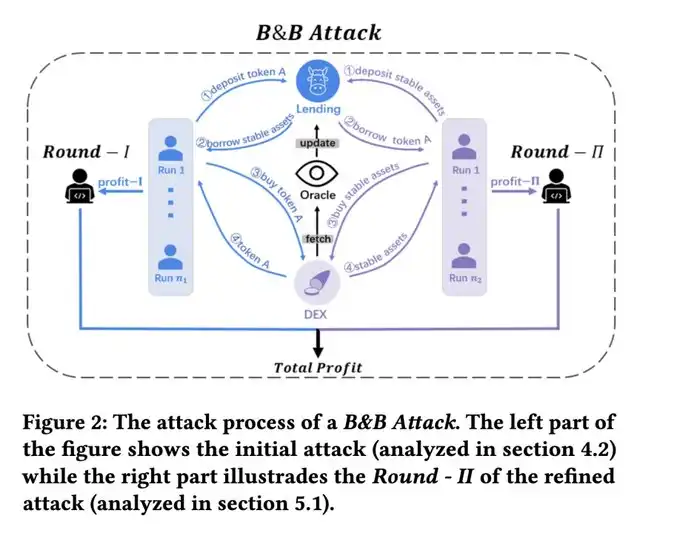
From my paper: Unmasking Role-Play Attack Strategies in Exploiting Decentralized Finance (DeFi) Systems (https://dl.acm.org/doi/10.1145/3605768.3623545)
Due to THE on-chain illiquidity, the price was brutally dragged from $0.27 to nearly $5. The oracle price was then updated to 0.5 (time-weighted average), allowing the attacker to further leverage up.
More crucially, THE itself has a supply cap.
Normally, this would restrict the attacker from further expanding their position. But they used a classic trick to bypass this: the Compound fork's donation attack. After depositing a large amount of THE, directly transferring THE to the vTHE contract, they continued raising the recognized collateral value through a "donation" to further surpass the cap.
Attack Transaction: 0x4f477e941c12bbf32a58dc12db7bb0cb4d31d41ff25b2457e6af3c15d7f5663f
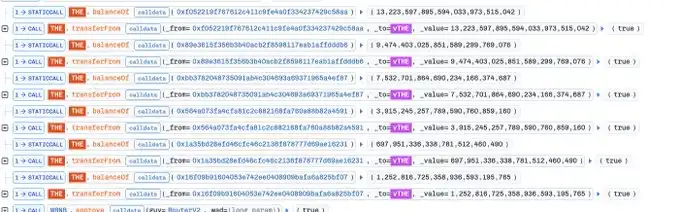
Attack Transaction: 0x4f477e941c12bbf32a58dc12db7bb0cb4d31d41ff25b2457e6af3c15d7f5663f. Expanding collateral through donation
After the first wave of attacks, THE price roughly stabilized around $0.5.
By this point, the attacker could have already walked away with the borrowed assets. However, they evidently wanted to maximize profits and continued to pour the borrowed assets into buying THE, attempting another round of surge.
But here's the issue: While the price was exceptionally high, the market selling pressure also became extremely exaggerated. The attacker kept buying but could hardly move the price further. Eventually, he nearly depleted his own collateral capacity, with a health factor close to 1, on the brink of liquidation.
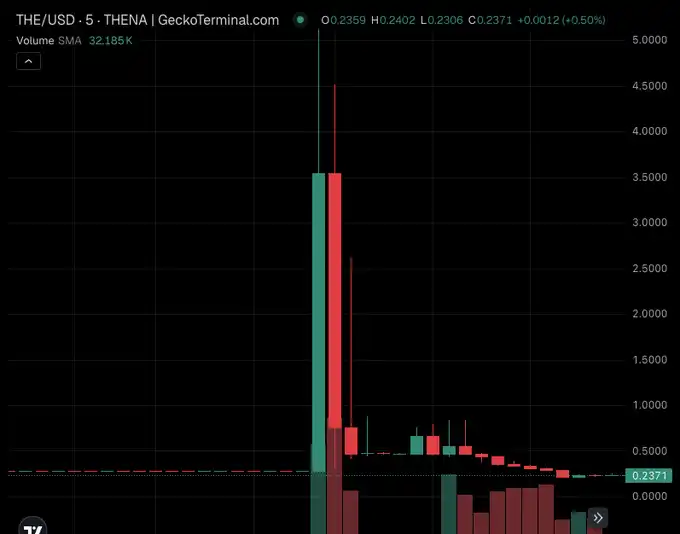
THE Price Movement
At this point, the situation became very clear: The collateral in the attacker's possession, including their pre-allocated assets and the THE purchased during the attack, had a nominal value of approximately 30M. However, the core issue with this collateral was — there was simply not enough liquidity to absorb it. Once the liquidation began, this THE could only be aggressively dumped on the market. Yet in the market, no one would be willing to buy such a large amount at that inflated price.
So what did I do?
At the start of the liquidation, I directly opened a short position on THE. And this position could actually have a relatively higher leverage.
The reason is very simple: overvaluation, low liquidity, massive passive selling pressure, no buyers.
The result was not surprising either: after the liquidation, THE price plummeted to around $0.24, even lower than the price before the attack, as the original holder also sold during the process.
Here, I closed the short position, making a profit of about 15K.
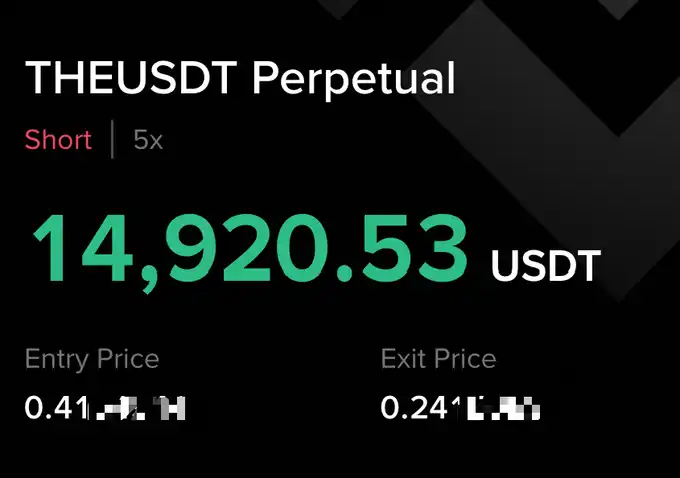
My Short Position
In the end, Venus was left with around 2M bad debt.
As for how much the attacker actually made, I have not completed a full calculation yet; but from the operations of some of the addresses, he most likely barely made any money, and may have even wrecked himself. However, the attacker may still have off-exchange perpetual positions to make money (just like our operation).
Venus's around 2M bad debt address: https://debank.com/profile/0x1a35bd28efd46cfc46c2136f878777d69ae16231
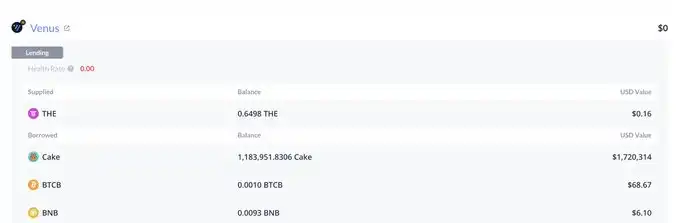
Venus's ~2M Bad Debt:
https://debank.com/profile/0x1a35bd28efd46cfc46c2136f878777d69ae16231
This incident once again illustrates:
In DeFi, “Nominal Collateral Value” does not equal “Liquidation Value.” When the collateral itself lacks liquidity, the system may see 30M, but what the market can truly realize may be close to zero.
I published a paper in my 23rd year, titled Unmasking Role-Play Attack Strategies in Exploiting Decentralized Finance (DeFi) Systems, where I provided a detailed mathematical model of this attack. Interested readers can refer to: https://dl.acm.org/doi/10.1145/3605768.3623545
You may also like

Meet the new WEEX trial fund—your gateway to greater profits

WEEX Labs Lands at Dutch Blockchain Week: A Disruptive Crypto × AI Conversation Sets Sail in Amsterdam

SK Hynix Reportedly Plans U.S. ADR Listing as Early as August, With SEC Approval Possible in Late June
SK Hynix may pursue a U.S. ADR listing as early as August, with SEC approval reportedly possible in late June amid strong AI chip supply chain demand.

SpaceX vs Tesla vs xAI: Which Elon Musk Trade Has the Biggest Upside in 2026?
OpenAI Reveals It Has Confidentially Submitted an S-1 to the SEC, Keeping the Door Open for a Future IPO
On June 9, according to an OpenAI announcement, the company recently confidentially submitted a draft S-1 registration statement to the U.S. Securities and Exchange Commission (SEC), beginning the preliminary compliance process for a potential initial public offering. OpenAI said it chose to disclose this proactively because it expected the news might leak; however, the company has not yet set a specific listing timeline, and related arrangements may still take some time.

Latest research from 13 top universities including Cornell University: The current state, challenges, and misconceptions of the fusion of Crypto and AI
Deconstructing Anthropic: The Best AI Company, Possibly Also a Type of Organizational Invention
Apollo and Blackstone Reportedly Back $35 Billion Anthropic Chip Financing as Deal Details Remain Unclear
On June 9, according to currently available news alerts, Apollo and Blackstone Group participated in a $35 billion financing for an Anthropic “chip project.” Based on the original wording of the report, the funding has already been raised, but public information remains limited. The financing structure, use of proceeds, project entity, and whether Apollo and Blackstone participated through equity, debt, or project financing have not yet been disclosed.

Humanity Protocol Security Incident Escalates: More Than $31 Million Stolen From Related Addresses as Attacker Continues Selling H for ETH
On June 9, according to monitoring by Onchain Lens, more than $31 million has been stolen from addresses linked to Humanity Protocol, and the attack is still ongoing, with the hacker continuously swapping H tokens for ETH. Project founder Terence Kwok later confirmed the security incident on X, saying the issue involved a private key leak.

Bloomberg: As Bitcoin Weakens, Stablecoins and RWA Continue to Drive Expansion in Crypto Businesses
In June, Bloomberg reported that despite Bitcoin falling below $60,000 last week, wiping out about $235 billion in market value within seven days, and dropping close to 50% from last year’s peak, some core businesses in the crypto industry are still expanding, mainly in stablecoins, real-world asset tokenization (RWA), payments, and infrastructure. The report also noted that overall altcoin activity has contracted significantly: altcoin market capitalization has fallen from a peak of about $431 billion in November 2021 to around $170 billion, and among the tens of millions of tokens issued in recent years, fewer than 1,700 still maintain meaningful trading activity.

Galaxy Deep Research Report: How Hyperliquid's HIP-4 Upgrade Changes the Landscape of Prediction Markets?
Binance Research: RWA Market Expected to Expand Nearly 6x from Early 2025, with Public Equities and Onchain Payments Heating Up Together
In June, Binance Research said in its monthly market report that the real-world asset (RWA) market is expected to grow by about 589% from the beginning of 2025. Bond- and money market fund-related RWA expanded by about $6.5 billion, up 83% year over year, while publicly traded equity RWAs grew by about 422%. The report also noted that monthly crypto debit card transaction volume exceeded $747 million in May, up 48.6% year to date.

Japan to Assess a Framework for Yen Stablecoins and Crypto ETFs as Asia’s Compliant Payments Narrative Heats Up
Recently, according to the original report, Japan is considering the launch of yen stablecoins and cryptocurrency ETFs. Public information remains limited at this stage, and there is still no complete policy text, regulatory draft, or clear implementation timeline, so this is better characterized as a “policy discussion” rather than formal implementation. The original wording also noted that advancing stablecoin regulation in Asia is driving XRP usage and supporting growth in the XRPL ecosystem. However, based on currently available public information, there is not enough evidence to directly establish a clear causal relationship between this round of discussion in Japan and XRP or XRPL.

ZachXBT: Humanity private key leak and abnormal surge in H token should be viewed separately
On June 9, according to related disclosures, on-chain investigator ZachXBT posted an update on Humanity’s roughly $31 million security incident, saying that after further analyzing fund flows, he currently tends to believe the project team was not involved in an “inside job” or a self-staged attack. According to him, the official explanation about the private key leak was broadly accurate, but before the token unlock, the price of H had been artificially pushed higher, and the hacker later took advantage of that market environment; therefore, the private key leak and the earlier abnormal price pumping should be regarded as two separate and independent events. This reframing has shifted the market’s understanding of the nature of the incident. Earlier discussion around Humanity had focused on whether the team directly participated in the attack or used the security incident to cover up internal operations. ZachXBT’s latest remarks shift the focus from “whether it was self-theft” to “whether there were pre-unlock market structure issues.” He also questioned whether the team may have.

Morning Report | OpenAI has submitted an S-1 registration statement draft to the U.S. SEC; Morpho completes $175 million financing

Morning Report | BitMine increased its holdings by 126,971 ETH last week; trader Eugene announced his exit from the crypto market

Wang Chuan: How can one not feel anxious after the neighbor Old Wang made thirty times profit by investing in storage stocks? (Seven) - A quarter-century cycle
Cryptocurrency CEXs are flocking to sell US stocks, and traditional brokerages are facing an "uninvited guest."
Meet the new WEEX trial fund—your gateway to greater profits
WEEX Labs Lands at Dutch Blockchain Week: A Disruptive Crypto × AI Conversation Sets Sail in Amsterdam
SK Hynix Reportedly Plans U.S. ADR Listing as Early as August, With SEC Approval Possible in Late June
SK Hynix may pursue a U.S. ADR listing as early as August, with SEC approval reportedly possible in late June amid strong AI chip supply chain demand.
SpaceX vs Tesla vs xAI: Which Elon Musk Trade Has the Biggest Upside in 2026?
OpenAI Reveals It Has Confidentially Submitted an S-1 to the SEC, Keeping the Door Open for a Future IPO
On June 9, according to an OpenAI announcement, the company recently confidentially submitted a draft S-1 registration statement to the U.S. Securities and Exchange Commission (SEC), beginning the preliminary compliance process for a potential initial public offering. OpenAI said it chose to disclose this proactively because it expected the news might leak; however, the company has not yet set a specific listing timeline, and related arrangements may still take some time.
Latest research from 13 top universities including Cornell University: The current state, challenges, and misconceptions of the fusion of Crypto and AI

Popular coins
Latest Crypto News


