
Google's biggest acquisition ever, why Wiz?

Author | Beca Sauce, Jaleel G6
Editor | Sleepy.txt
Cloud wars are incredibly expensive. This is Google's largest acquisition in history.
Last week, Google officially completed its acquisition of the cloud security company Wiz for $3.2 billion, setting a new record for Google surpassing the $12.5 billion acquisition of Motorola Mobility in 2012, and becoming the highest-value exit in Israeli high-tech history.
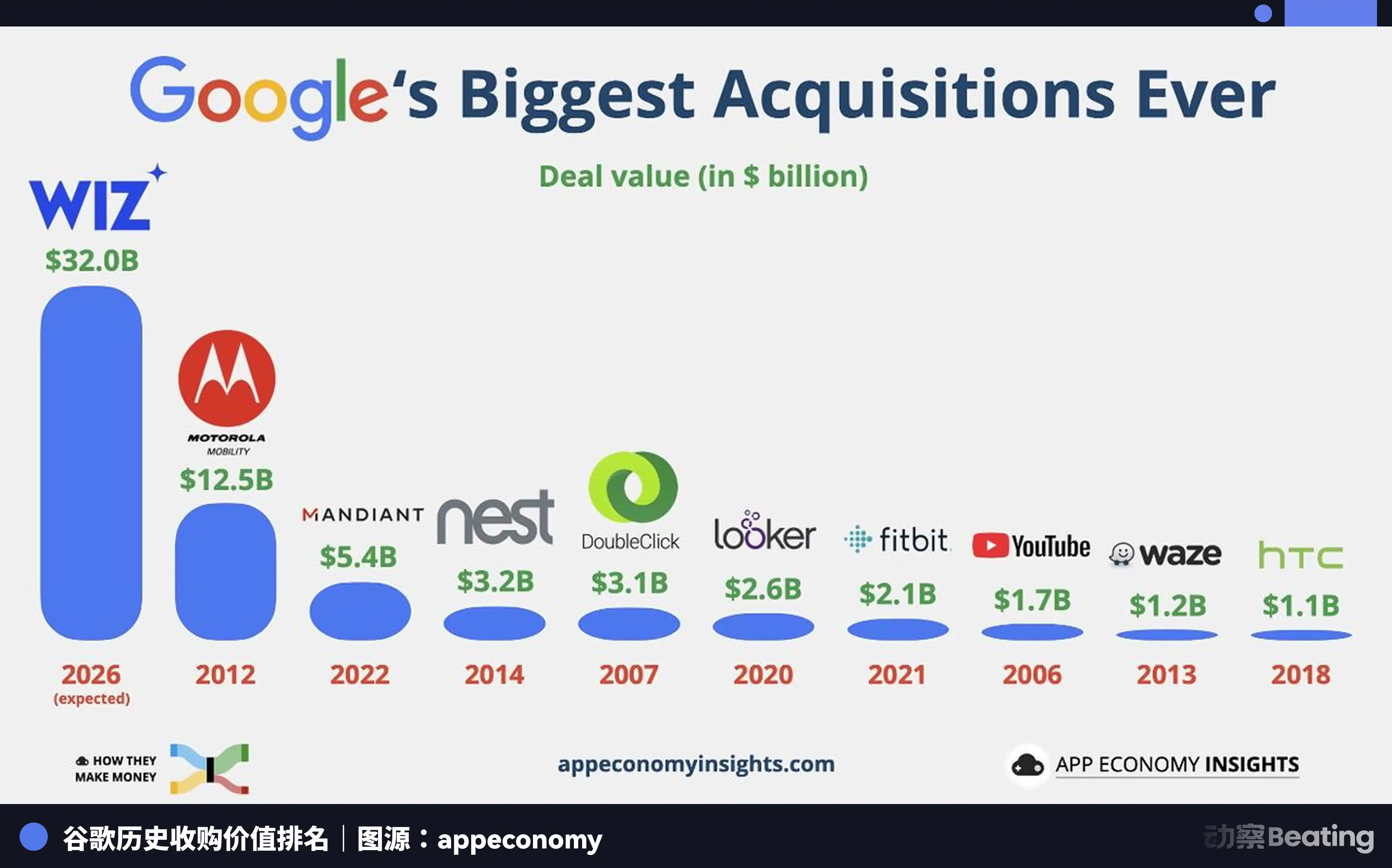
An Apparently Unprofitable Deal
From any traditional financial model, this transaction seems somewhat absurd.
Wiz was founded in 2020. Initially just an ordinary cybersecurity startup, it quickly pivoted a year later to focus on providing a cloud security platform for large enterprises. At the time of the acquisition, its annual revenue was approximately $700 million. However, Google paid $3.2 billion for it.
That is to say, the market-to-sales ratio (P/S) of this transaction exceeded 45x. For comparison, already public and mature security companies like CrowdStrike and Palo Alto Networks typically have a P/S ratio of only 15 to 25 times. Google paid almost double the premium for this.
Independent analyst Frank Wang once did the math: even if Wiz grows in the coming years to the size of security companies like CrowdStrike and Palo Alto Networks, the combined revenue would only be between $10 billion to $12 billion.
From a purely financial return perspective, this seems to be an extremely "bad deal."
Why did Google make such a decision? To answer this question, we first need to understand the journey Google has taken in the cloud computing race.
In the cloud computing race, Google's role has always been somewhat subtle. It is both one of the earliest innovators and the latest player to commercialize. For a long time, Google Cloud was more like a technical laboratory than a true commercial product. But it was in this lab that Google created many technologies that later became industry standards.
The most typical example is Kubernetes. Google originally had an internal system, code-named Borg, for managing a large number of server containers. It was later transformed into an open-source project, becoming the Kubernetes (K8s) that now almost dominates the entire cloud-native world. This step almost changed the entire technical landscape of the cloud computing industry—AWS and Azure ultimately had to fully support K8s.
Google may not have been the first to profit in the cloud wars, but it set many rules.
Before the AI wave, Google was already preparing for the next round of competition, developing a chip specifically for machine learning computation: the TPU (Tensor Processing Unit). Compared to a general-purpose GPU, the TPU has a higher energy efficiency ratio in large-scale AI training. Many processes, such as the training of AlphaGo back then and later the inference of Gemini, ran on this architecture. This has given Google Cloud a very unique trump card in the AI computing field.
However, technological superiority does not automatically translate into market share. Google later gradually realized that cloud services are not only about technology but also about the art of sales.
The change happened after Thomas Kurian took office. This executive, who had been with Oracle for 22 years, was poached by Google to serve as the Google Cloud CEO. One of the first things he did after taking office was to rapidly expand the sales team, operating vertical industries such as finance, retail, healthcare, and manufacturing separately. The traditional Google approach of "engineer-led culture, let customers figure it out from the documentation themselves" has been gradually rewritten.
In 2023, Google Cloud finally achieved its first quarterly profit.
It was at this juncture that a company entered their field of vision. That company is called Wiz.
One of the Fastest-Growing Software Companies in History
Even in Silicon Valley, few companies have grown as fast as Wiz.
The company was founded 18 months ago, and its Annual Recurring Revenue (ARR) has exceeded $100 million. This speed is almost unprecedented in SaaS history: Slack took about 3 years, Shopify took nearly 5 years, while Wiz only took a year and a half.
Over the next few years, its growth almost took an exponential leap. ARR quickly surged towards $500 million, then approached $1 billion. More importantly, its customer quality, nearly half of the Fortune 100 companies are using Wiz's product. BMW, Morgan Stanley, Salesforce, are all on the list.
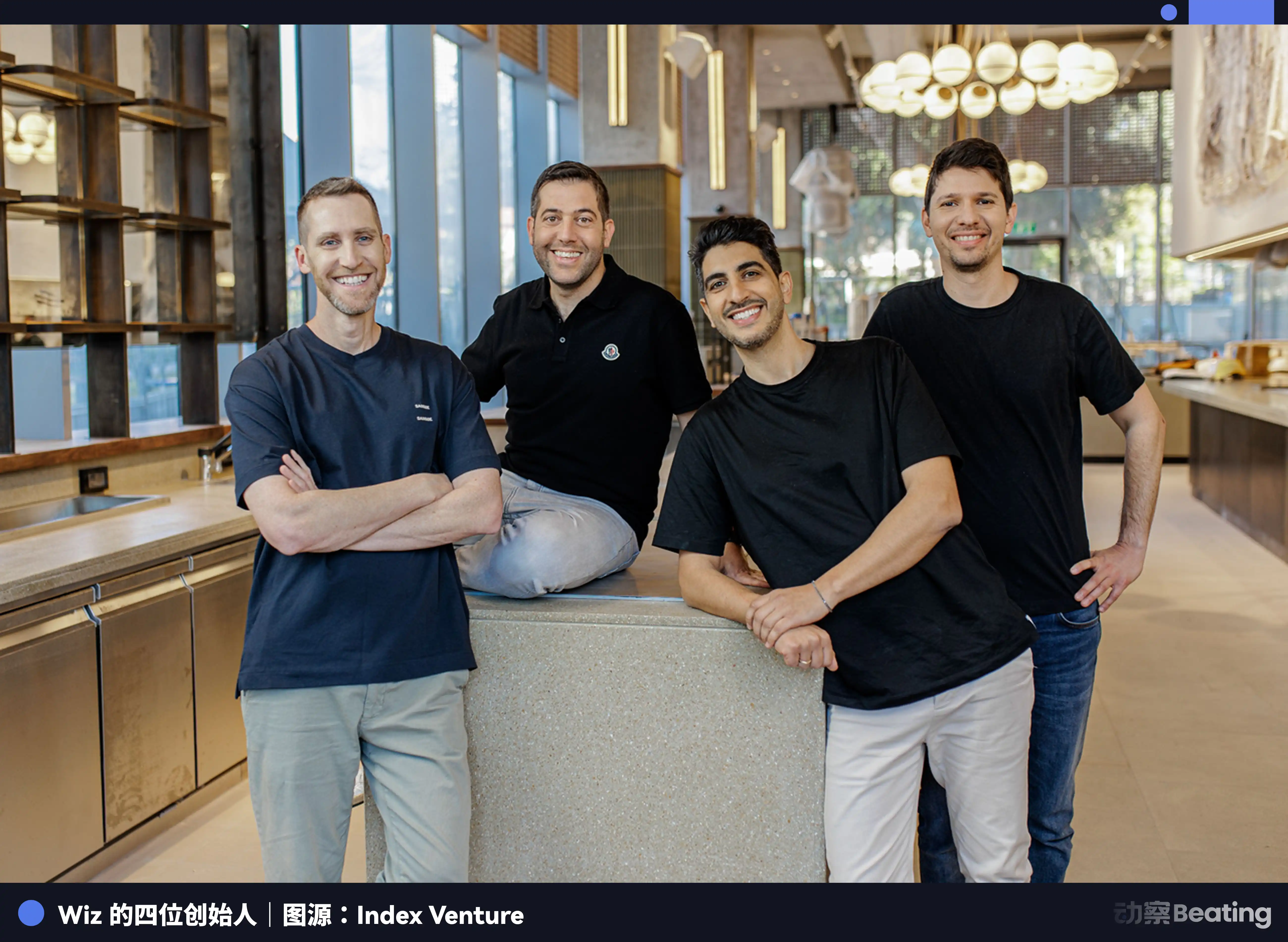
Wiz's four founders, Assaf Rappaport, Ami Luttwak, Roy Reznik, Yinon Costica, have a somewhat legendary background. They initially served in the Israeli Defense Forces' renowned Intelligence Unit 8200, which is equivalent to the U.S. NSA or the UK's GCHQ - top-tier elite units. Many founders of leading global security companies like Check Point, Palo Alto Networks, Armis, have their origins here.
But these four individuals were not first-time entrepreneurs. In 2012, they founded the cloud security company Adallom, which was acquired by Microsoft for $320 million three years later. After the acquisition, Rappaport even took on the role of head of the Microsoft Israeli R&D center, managing thousands of engineers. However, they did not stay at Microsoft for long. In March 2020, they resigned together, took some of the old team, and started afresh. This time, with bigger ambitions.
In the summer of 2024, the temperature in Silicon Valley was high, and the AI entrepreneurship wave was at its craziest. Wiz had just raised $1 billion in Series E funding in May of that year, with extremely ample cash reserves, not lacking money at all. It was at this time that Google extended an olive branch to Wiz.
In fact, as early as March of that year, Google CEO Sundar Pichai had personally sent an email to Rappaport expressing acquisition interest. But Rappaport had not seen it until their official meeting at Google Headquarters in May.
Google promptly offered a price of $23 billion.
In Silicon Valley at the time, this was already a staggering figure, enough to make the vast majority of startup founders achieve financial freedom on the spot. It was widely believed to be a done deal.
But Wiz declined.
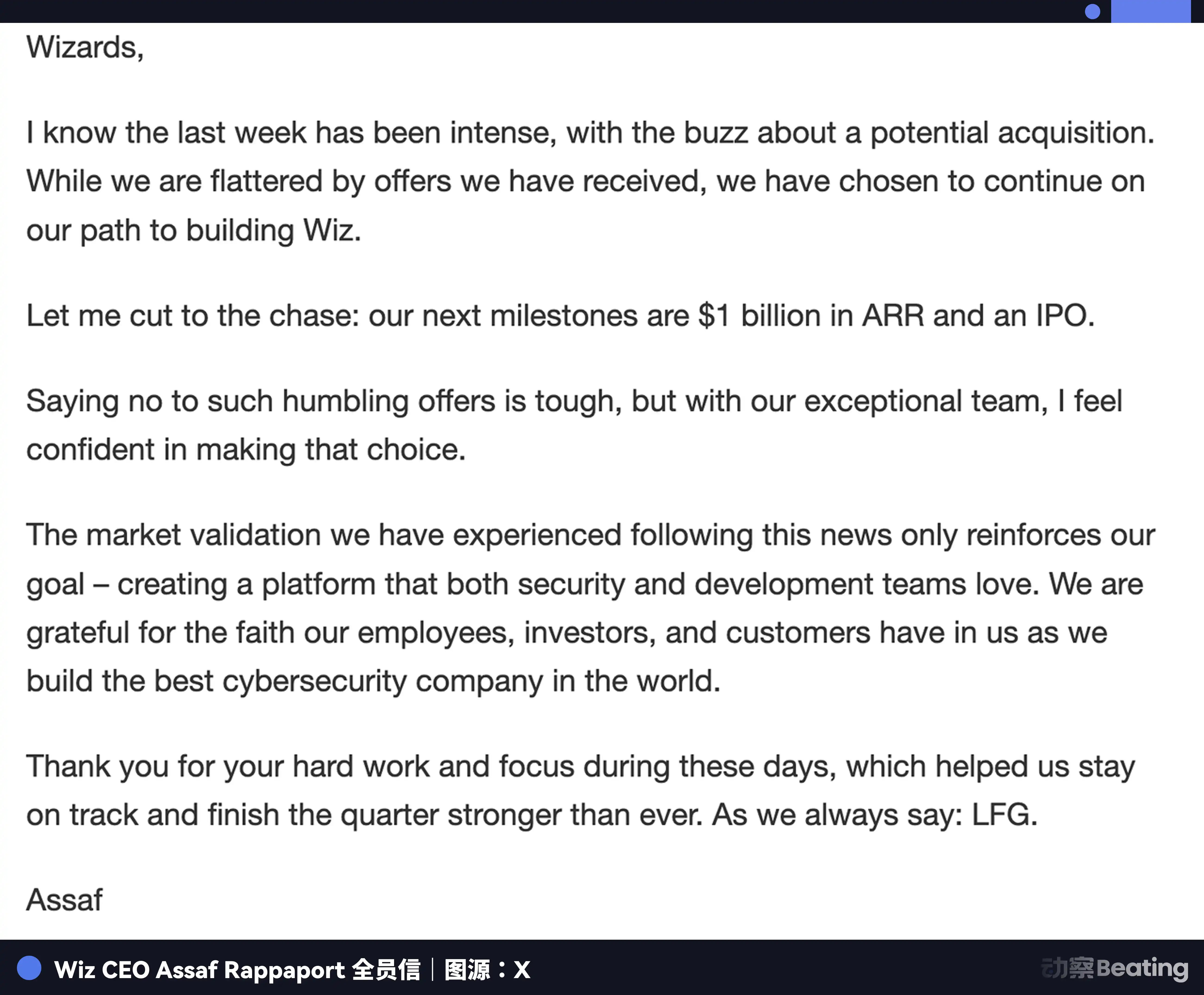
"I know the past week has been very tense, with continuous rumors surrounding a potential acquisition. Although we are honored by the invitation, we choose to continue building Wiz's path," Wiz CEO Assaf Rappaport said in an email to all employees, stating that Wiz's next milestone is $1 billion in annual recurring revenue and an IPO.
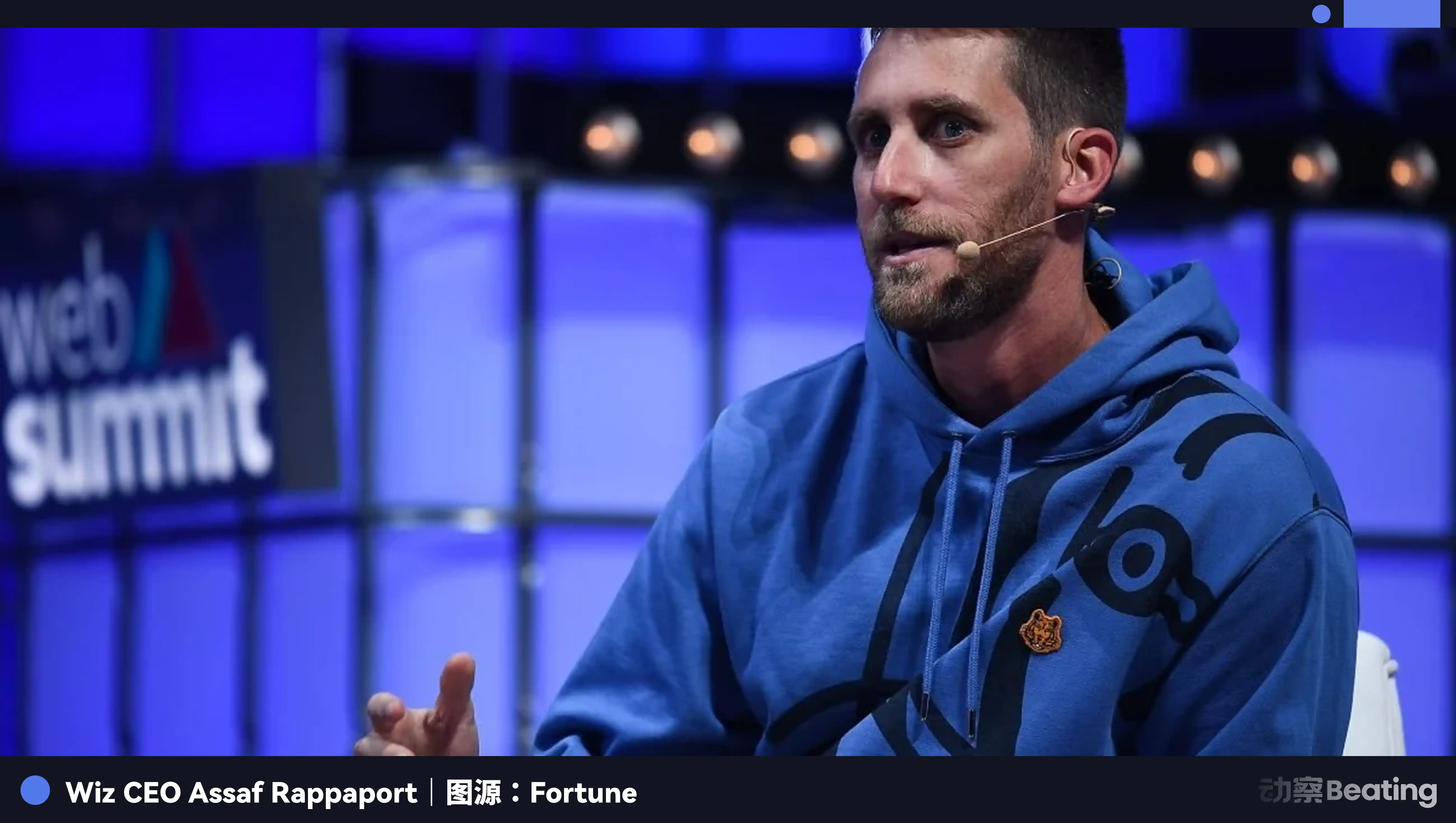
He later recalled at the TechCrunch Disrupt conference, "That was probably the toughest decision of my life."
At that time, Wiz's annualized revenue was approaching $1 billion, with no sign of slowing down in growth. "The fastest-growing software startup in history" was the shiniest label on Wiz and one of the media's favorite titles to quote.
Before being fully acquired by Google, Wiz was still in the typical high-growth, high-investment stage. As a company aiming for an IPO, it invested the majority of its revenue and funding (total funding of about $1.9 billion) into R&D, global sales network expansion, and acquisitions of small companies like Gem Security. In Q2 of 2024, the overall market size was about $700 million, with Wiz's year-over-year growth rate reaching 94%. Compared to competitors, Palo Alto Networks had an ARR of about $8 billion (20% growth), and CrowdStrike had an ARR of about $2.6 billion (49% growth).
Although Wiz is still small in size, its growth rate is significantly off the charts. The capital market generally believes that once this company goes public, its valuation could easily exceed 500 billion U.S. dollars.
Google has not turned a blind eye and has been closely monitoring Wiz's growth curve from the sidelines. In just half a year, Wiz has increased its ARR from 350 million to 500 million U.S. dollars, successfully onboarding nearly half of the Fortune 100 enterprise clients.
If action is not taken now, the next price tag will only be higher, or perhaps the opportunity will be lost entirely.
Google, Why Wiz Is Irreplaceable
Most billion-dollar acquisitions usually involve a mix of stock and cash. For example, when Meta (then Facebook) acquired WhatsApp for 19 billion U.S. dollars in 2014, only 4 billion was in cash, and the rest was in stock; Google's acquisition of Motorola in 2012 also involved some cash.
Prior to acquiring Wiz, Google had a cash flow of approximately 110 billion U.S. dollars. This 32 billion U.S. dollar deal was notably an all-cash transaction. Wiz took nearly a third of Google's cash reserves.
Furthermore, the most common practice after large tech company acquisitions is "Rebranding" and "Organizational Restructuring." However, Google has granted Wiz significant autonomy. Wiz does not need to change its name and can operate independently to the greatest extent possible. In Google's history, only YouTube and early-stage Android have enjoyed similar long-term privileges. Google has committed to maintaining Wiz's approximately 1,800 employees as an independent team structure, even with their own separate offices.
It is said that at the negotiation table, the party showing more urgency will receive more privileges.
To understand why Google was willing to pay 32 billion U.S. dollars for Wiz, besides the aforementioned "Wiz is one of the fastest-growing software companies in history," we must also shift our focus back a bit and look at the entire CNAPP (Cloud-Native Application Protection Platform) industry.
Prior to Wiz's acquisition, the cloud security market was at a delicate turning point. The entire market could roughly be divided into three major forces.
The first force comes from traditional security giants, let's call them the "old guard." The most typical are Palo Alto Networks and CrowdStrike. They rose to prominence in the era of traditional network security and gradually consolidated a comprehensive security platform through years of mergers and acquisitions—Palo Alto acquired companies like Twistlock, Bridgecrew, etc., to integrate disparate security tools into Prisma Cloud. This model is akin to a massive aircraft carrier, highly functional, covering endpoint security, network firewalls, cloud scanning, vulnerability management, and more. However, it also has a distinct disadvantage: it's too heavy. Deployment is complex, the system is large, and upgrades are slow. In the rapidly changing environment of cloud computing, this "heavyweight architecture" seems somewhat clumsy.
The second force is represented by a new generation of cloud security companies, with Wiz at the forefront. Both Wiz and Orca Security fall into this category, and their core idea is that cloud security should not be as complex as traditional security. Prior to Wiz's emergence, most cloud security products required the installation of an "Agent" on each virtual machine, a small monitoring program. If a company had tens of thousands of servers, they would need to install tens of thousands of Agents, a deployment process that often took weeks or even months. Wiz did something very bold: they eliminated the need for an Agent. The experience difference brought about by this Agentless technology is enormous, reducing deployment time from weeks to minutes.
The third force is the cloud providers themselves. AWS, Microsoft Azure, Google Cloud, all have their own security tools. These products have a natural advantage: being part of the cloud platform, security features are often readily available as companies use cloud services. However, they have a structural weakness: they can only manage their own turf, with very limited cross-cloud capabilities.
With so many choices in the market, why didn't Google acquire Wiz's competitors, such as Palo Alto Networks or CrowdStrike?
Size is a significant reason. Palo Alto's market capitalization has been stable at $100 billion to $120 billion around 2025, while CrowdStrike quickly rebounded to over $60 billion after experiencing widespread outages in 2024.
For Google, this size is hard to swallow.
Another key issue is "asset purity." Palo Alto Networks is following the platform integration path, with a large amount of firewall hardware and traditional network security business. CrowdStrike's core stronghold is endpoint security, carrying a significant burden.
However, every line of code in Wiz is written for the cloud environment, perfectly aligned with Google Cloud's needs. Google doesn't need to trim outdated hardware businesses; they can directly inject Wiz's agentless scanning capabilities into the GCP infrastructure. This is what Google truly wants: a clean, native tool that can be directly integrated into its strategic framework.
That means Google Cloud services can be sold better.
Today, within enterprises, the decision-makers for cloud service purchases are no longer IT departments but rather Chief Information Security Officers in charge of the security department. This has led to a change in the buying path and logic:
Initially, companies would choose a cloud platform first and then configure security tools. But now, security has become a prerequisite for cloud selection, so companies will assess security first and then choose a cloud platform.
As the security partner of 50% of the Fortune 100 companies, these Chief Information Security Officers are already familiar faces to Wiz, which can help Google expand its sales channel—a very short sales cycle. In the business of enterprise cloud procurement, which often involves tens of millions of dollars and decision cycles measured in years, this advantage is extremely valuable.
So, from another perspective, what Google is truly acquiring is not Wiz's current profit and market value, but its vast enterprise customer base and the growth momentum of this fast-growing company. If Wiz continues to maintain a close to 100% annual growth rate, its revenue scale may approach $2 billion in two years—and the synergies brought by these customers once they migrate to the Google Cloud ecosystem will be far more than that.
Looking back then, $32 billion may not seem so expensive.
At the same time, in today's era, the ubiquity of AI is fundamentally changing the complexity of the enterprise cloud environment. Although there is no shortage of voices in the market that believe AI's development will impact the growth logic of traditional software and cloud service companies, Google's acquisition, through action, has demonstrated the answer: the expansion of AI has not weakened the value of cloud security; instead, it has greatly magnified its necessity.
Model training data is in the cloud, AI Agents automatically call various APIs in the cloud, data flows between different clouds are becoming more and more frequent, and the attack surface is exponentially expanding. The previous cloud environment was relatively static and structurally clear; now, the cloud environment has become extremely dynamic and blurred at the boundaries because of AI.
Therefore, products that can uniformly manage the security posture of all clouds will shift from being an "optional" choice to a "mandatory" one in the next few years.
Wiz's product design naturally fits this complex multi-cloud, hybrid cloud environment. And this $32 billion acquisition is essentially Google's preemptive acquisition of the best ticket before the incremental market matures.

After a series of regulatory lobbying tug-of-wars, on March 11, 2026, the acquisition was formally completed. About 2,700 Wiz employees joined the Google Cloud system. Index Ventures benefited approximately $3.8 billion, Sequoia Capital about $3.2 billion, Insight Partners about $2.9 billion, and the total value of employee-held equity was about $3 billion, with Google additionally committing $1.5 billion in retention incentives.
“We Reward Risk”
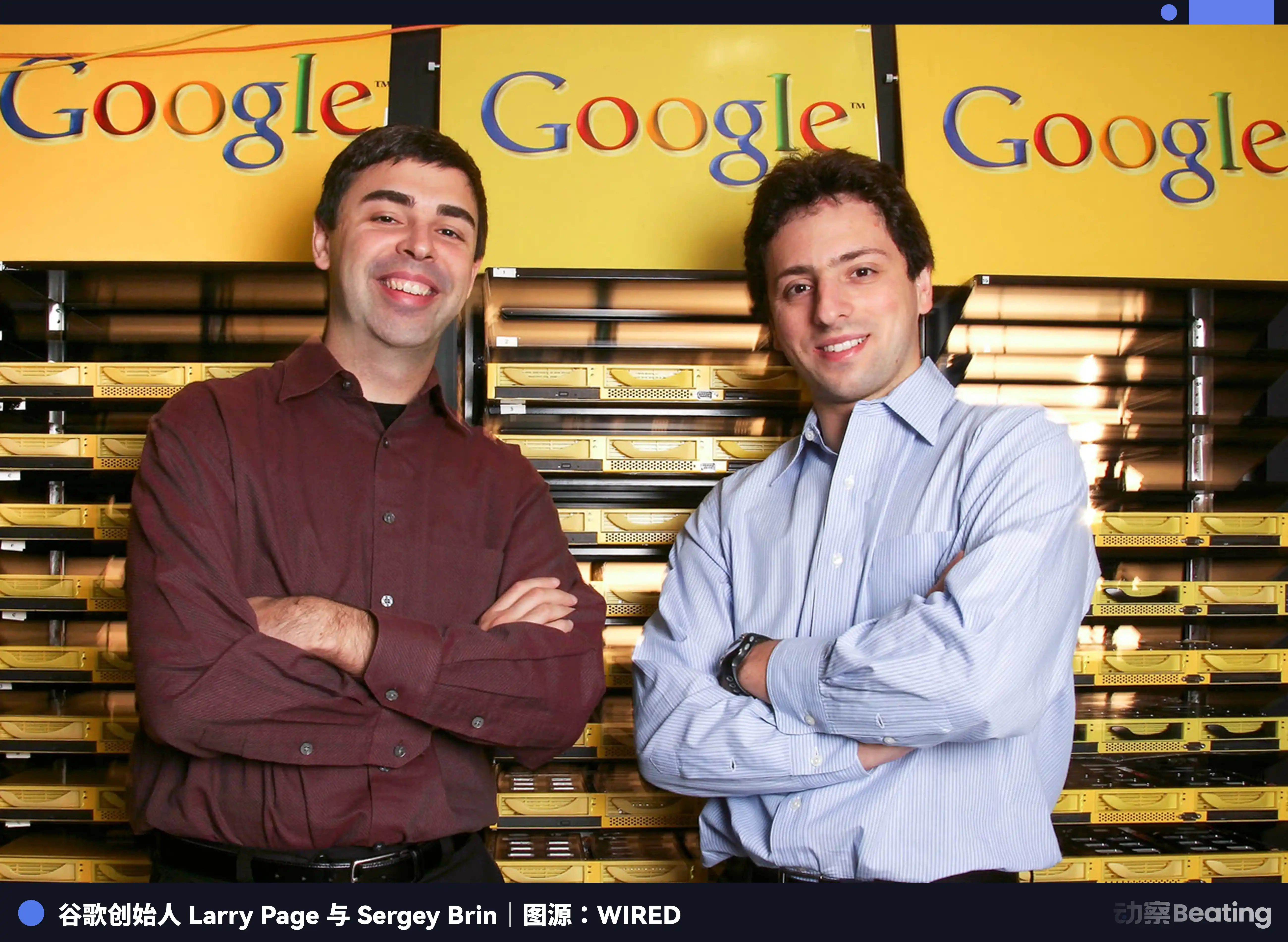
In 2004, the first sentence in Google's founders' IPO Letter, written by Larry Page and Sergey Brin, became the most fundamental guiding principle for Google over the two decades: "Google is not a conventional company. We do not intend to become one. We will not shy away from high-risk, high-reward projects because of short-term earnings pressure."
Carrying on this DNA, their successor Sundar Pichai, in a 2023 interview, was asked, "How do you balance the responsibility of steering a behemoth organization like Google/Alphabet with so many vested interests, and yet keep that spirit of innovation alive without being overly cautious?"
This was against the backdrop of the ChatGPT AI frenzy, with Google facing intense external scrutiny over being "slow to react and risk-averse due to its giant size."
Sundar Pichai's response at the time seems today like the perfect annotation for this $32 billion acquisition. He believed that the driving force of innovation comes from rewarding risk, even if the results may not be immediate: "I encourage others, I uplift others because I know they took risks, they tried hard, they made thoughtful decisions."
Indeed, the challenges faced by this deal are more intricate and harder to quantify than just the financial premium.
Google's real challenge in this acquisition is more covert and harder to quantify than just the financial premium. Those who have watched "Succession" may have a sense that a large-scale acquisition is often not just an asset transfer but a crisis of identity. And this time, that crisis had a very specific source: Wiz, an Israeli company.
In Israeli entrepreneurial culture, there's a word that's challenging to translate: Chutzpah.
This word roughly conveys a mixed temperament: bold, audacious, even a bit arrogant, with little reverence for authority and rules.
In many Israeli tech companies, junior engineers can interrupt the CEO's speech directly to point out mistakes. Meetings are heated with loud voices, but after the debate, everyone still gathers for coffee as if nothing happened. This culture is highly effective in the startup phase.
However, when it encounters the organizational structure of large American tech companies, friction is almost inevitable. Big corporations emphasize consensus, processes, and emotional intelligence. Expressing differing opinions often requires tact, restraint, and consideration for everyone's feelings. Hence, the two cultures can easily clash. Google employees may find the Israeli team too direct, even somewhat pushy; while Wiz's engineers may find the big company's discussion style too indirect and inefficient.
In history, there have been countless cases of core teams leaving after being acquired by large companies, leading to a gradual decline in product quality. Google has offered generous retention incentives, but money can retain people, not necessarily the entrepreneurial spirit.
Aside from cultural issues, there is another, more subtle challenge: Wiz's neutrality.
Prior to the acquisition, Wiz was able to serve enterprise customers on AWS, Azure, and Google Cloud simultaneously, and the most important reason was its independent identity.
It did not belong to any cloud provider, without any positional baggage, allowing enterprises to confidently let it scan the entire cloud environment's security posture. However, when Wiz put on the Google jersey, this relationship became delicate.
If you are an enterprise with core operations deployed on AWS, would you be willing to let a Google-owned product scan all your security vulnerabilities? These concerns will not erupt overnight, but will quietly seep into the most subtle business metrics: customer renewal rates, contract cycles, speed of acquiring new customers.
Wiz or $32 Billion Cash: Which is More Important?
Prior to the acquisition, besides Google, there were actually rumors in the industry that Amazon had also expressed acquisition interest in Wiz. It was similarly rejected.
Some also speculated that as the "original home" of the Wiz founding team, Microsoft internally may have seriously evaluated the possibility of re-acquiring this team.
In other words, Google was not the only one interested in this card. This is also the truly delicate part of this deal.
Superficially, Google spent $32 billion to acquire a company with only $700 million in annual revenue. But from another perspective, Google did not buy Wiz itself. What it bought was a kind of vague certainty.
$32 billion in cash is not fatal for a company like Google.
Looking at it another way: if Wiz ultimately fell into the hands of Microsoft or Amazon, the situation would be completely different. Once a security platform with cross-cloud visibility is held by a competitor, Google not only loses this ace but also faces the prospect of this ace being used against them.
So if you ask Google: Wiz or $32 billion, which is more important?
The answer may be: for Google, neither is so important. But ensuring that Wiz does not fall into the hands of Microsoft or Amazon is important to Google.
This transaction may not guarantee Google's absolute victory in the cloud wars. But at least, it makes it tough for Google to lose.
You may also like

Every exchange is a "Universal Exchange."

The counterattack of traditional finance: Alliance chains are quietly reviving

CryptoQuant Says Bitcoin Profitable Supply Is Near 45% Pressure Zone as On-Chain Data Points to Market Repricing
CryptoQuant said Bitcoin’s profitable supply is nearing the 45% pressure zone, signaling rising market stress, unrealized losses, and a possible on-chain repricing phase.

Bitcoin Falls Below 200-Week Moving Average as On-Chain Data Shows Over Half of Supply in Loss
Bitcoin dropped below its 200-week moving average as on-chain data showed over 50% of circulating supply is now in loss, signaling rising market stress.

CFTC Reportedly Plans New Prediction Market Rules Focused on Manipulation Risk and Public Interest Review
The CFTC is reportedly preparing new prediction market rules focused on manipulation risk, public interest review, and retail trader protections.

Meet the new WEEX trial fund—your gateway to greater profits

WEEX Labs Lands at Dutch Blockchain Week: A Disruptive Crypto × AI Conversation Sets Sail in Amsterdam

SK Hynix Reportedly Plans U.S. ADR Listing as Early as August, With SEC Approval Possible in Late June
SK Hynix may pursue a U.S. ADR listing as early as August, with SEC approval reportedly possible in late June amid strong AI chip supply chain demand.

SpaceX vs Tesla vs xAI: Which Elon Musk Trade Has the Biggest Upside in 2026?
OpenAI Reveals It Has Confidentially Submitted an S-1 to the SEC, Keeping the Door Open for a Future IPO
On June 9, according to an OpenAI announcement, the company recently confidentially submitted a draft S-1 registration statement to the U.S. Securities and Exchange Commission (SEC), beginning the preliminary compliance process for a potential initial public offering. OpenAI said it chose to disclose this proactively because it expected the news might leak; however, the company has not yet set a specific listing timeline, and related arrangements may still take some time.

Latest research from 13 top universities including Cornell University: The current state, challenges, and misconceptions of the fusion of Crypto and AI
Deconstructing Anthropic: The Best AI Company, Possibly Also a Type of Organizational Invention
Apollo and Blackstone Reportedly Back $35 Billion Anthropic Chip Financing as Deal Details Remain Unclear
On June 9, according to currently available news alerts, Apollo and Blackstone Group participated in a $35 billion financing for an Anthropic “chip project.” Based on the original wording of the report, the funding has already been raised, but public information remains limited. The financing structure, use of proceeds, project entity, and whether Apollo and Blackstone participated through equity, debt, or project financing have not yet been disclosed.

Humanity Protocol Security Incident Escalates: More Than $31 Million Stolen From Related Addresses as Attacker Continues Selling H for ETH
On June 9, according to monitoring by Onchain Lens, more than $31 million has been stolen from addresses linked to Humanity Protocol, and the attack is still ongoing, with the hacker continuously swapping H tokens for ETH. Project founder Terence Kwok later confirmed the security incident on X, saying the issue involved a private key leak.

Bloomberg: As Bitcoin Weakens, Stablecoins and RWA Continue to Drive Expansion in Crypto Businesses
In June, Bloomberg reported that despite Bitcoin falling below $60,000 last week, wiping out about $235 billion in market value within seven days, and dropping close to 50% from last year’s peak, some core businesses in the crypto industry are still expanding, mainly in stablecoins, real-world asset tokenization (RWA), payments, and infrastructure. The report also noted that overall altcoin activity has contracted significantly: altcoin market capitalization has fallen from a peak of about $431 billion in November 2021 to around $170 billion, and among the tens of millions of tokens issued in recent years, fewer than 1,700 still maintain meaningful trading activity.

Galaxy Deep Research Report: How Hyperliquid's HIP-4 Upgrade Changes the Landscape of Prediction Markets?
Binance Research: RWA Market Expected to Expand Nearly 6x from Early 2025, with Public Equities and Onchain Payments Heating Up Together
In June, Binance Research said in its monthly market report that the real-world asset (RWA) market is expected to grow by about 589% from the beginning of 2025. Bond- and money market fund-related RWA expanded by about $6.5 billion, up 83% year over year, while publicly traded equity RWAs grew by about 422%. The report also noted that monthly crypto debit card transaction volume exceeded $747 million in May, up 48.6% year to date.

Japan to Assess a Framework for Yen Stablecoins and Crypto ETFs as Asia’s Compliant Payments Narrative Heats Up
Recently, according to the original report, Japan is considering the launch of yen stablecoins and cryptocurrency ETFs. Public information remains limited at this stage, and there is still no complete policy text, regulatory draft, or clear implementation timeline, so this is better characterized as a “policy discussion” rather than formal implementation. The original wording also noted that advancing stablecoin regulation in Asia is driving XRP usage and supporting growth in the XRPL ecosystem. However, based on currently available public information, there is not enough evidence to directly establish a clear causal relationship between this round of discussion in Japan and XRP or XRPL.
Every exchange is a "Universal Exchange."
The counterattack of traditional finance: Alliance chains are quietly reviving
CryptoQuant Says Bitcoin Profitable Supply Is Near 45% Pressure Zone as On-Chain Data Points to Market Repricing
CryptoQuant said Bitcoin’s profitable supply is nearing the 45% pressure zone, signaling rising market stress, unrealized losses, and a possible on-chain repricing phase.
Bitcoin Falls Below 200-Week Moving Average as On-Chain Data Shows Over Half of Supply in Loss
Bitcoin dropped below its 200-week moving average as on-chain data showed over 50% of circulating supply is now in loss, signaling rising market stress.
CFTC Reportedly Plans New Prediction Market Rules Focused on Manipulation Risk and Public Interest Review
The CFTC is reportedly preparing new prediction market rules focused on manipulation risk, public interest review, and retail trader protections.
Meet the new WEEX trial fund—your gateway to greater profits


