
ZeusNode is officially live, and the $ZEUS Guardian Staking Program has been launched.
Article Source: ZEUS

A New Era of Bitcoin Liquidity Utilization Begins: ZeusNode Goes Live, Initiates Epoch 1, and Paves the Way for 1% of $BTC on Solana.
ZeusNode Overview
ZeusNode is core infrastructure built on the Solana Virtual Machine (SVM) to support ZeusLayer, establishing its role as Solana's Layer 1.5 and enhancing Solana's liquidity through permissionless Bitcoin integration.
The primary mission of ZeusNode is to achieve seamless Bitcoin operations in Solana's high-speed environment while ensuring transaction integrity and adhering to the highest security standards for cross-chain assets.
Now, with the formal start of Epoch 1, ZeusNode has initiated Operators and Guardians to oversee network security and is preparing to soon onboard Bitcoin transactions.
Operators and Guardians
ZeusNode acts as a trustless interactor between Bitcoin and Solana, supported by cooperation between Operators and Guardians. They ensure network security for smooth Bitcoin liquidity inflow into Solana.
In the Bitcoin-to-Solana scenario, Operators collect transaction proposals and submit them to Guardians for validation and signature. Upon validation, Operators facilitate interaction requests between the blockchains, enabling secure and efficient cross-chain operations.
With Operators now activated by Zeus Network, the ZeusNode Guardian delegation has officially opened, paving the way for Bitcoin to Solana requests.
Guardian Staking: Bitcoin's Anchor on Solana
Each Guardian is responsible for validating transactions, ensuring the security of the ZeusNode network, and the integrity of ZPL assets. Guardians oversee transaction signing to ensure secure interaction between Bitcoin and Solana.
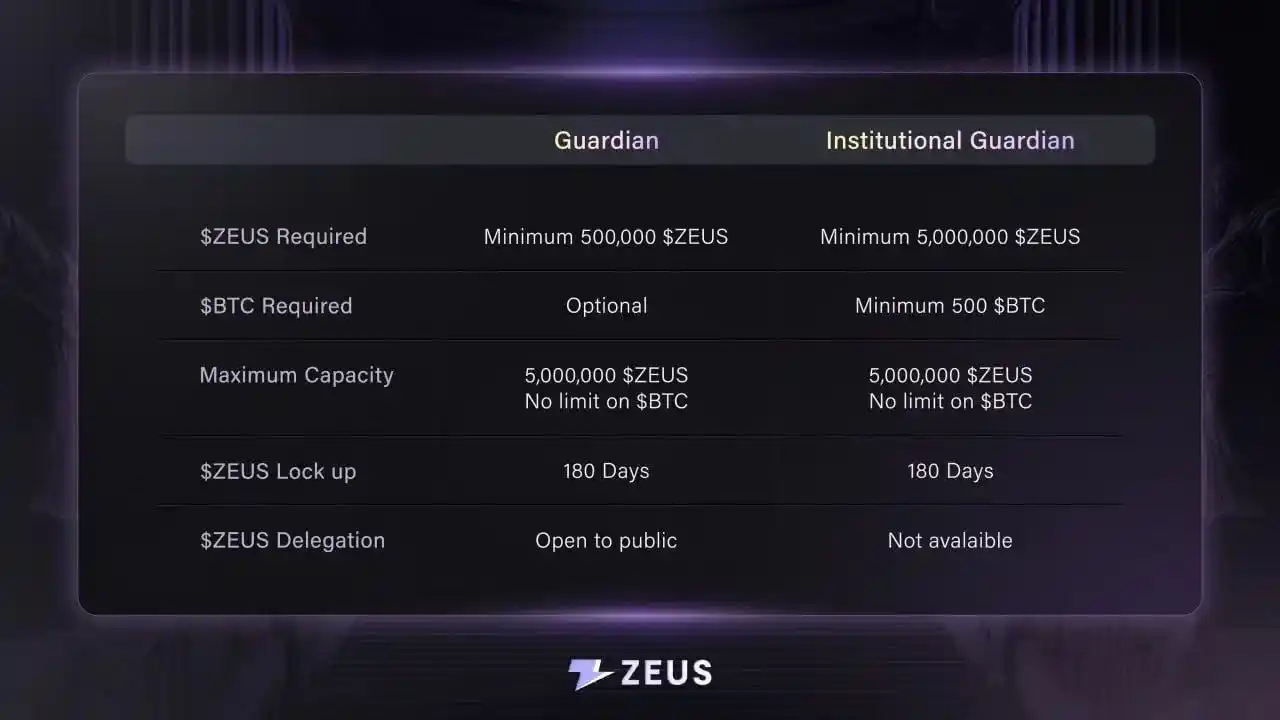
ZeusNode offers two Guardian programs for Bitcoin liquidity providers:
Guardians: Only reputable entities can become Guardians to protect the network. This type of Guardian is open to anyone willing to delegate $ZEUS and actively contribute to network security.
Institutional Guardians: Customized for large $BTC liquidity providers, allowing them to establish a private Guardian to enhance asset management on Solana. $ZEUS holders cannot delegate.
In the early stages, the ZeusNode program will admit a maximum of 10 Guardians and several Institutional Guardians to ensure network security and scalability. Please read the following to further understand each Guardian type.
Guardian
The Guardian is the cornerstone of the ZeusNode trustless mechanism, responsible for ensuring secure cross-chain interaction. Only trusted notary entities can become Guardians by depositing and locking the minimum amount of $ZEUS, activating their role in the network.
Institutional Guardian
Institutional Guardians are custom-tailored to meet the needs of large liquidity providers, enabling them to effectively manage and optimize significant $BTC volumes.
The Institutional Guardian model serves institutions capable of handling large inflows of Solana $BTC. To participate, entities must deposit a minimum of 500 $BTC, with no limit on $BTC inflow capacity to ensure flexibility and scalability.
ZeusNode Development
In order to ensure the secure and seamless liquidity flow of Bitcoin, we have collaborated with cryptographers and security experts to develop a phased capacity model to strengthen its security foundation.
Dynamic Ratio: $ZEUS-$BTC
With the launch of ZeusNode Epoch 1, the delegation process at a 20,000:1 initial $ZEUS to $BTC ratio successfully initiated the first batch of Guardians, allocating a secure capacity to manage the incoming $BTC.
Once a Guardian's delegation reaches 5,000,000 $ZEUS, this ratio will dynamically adjust, unlocking unlimited $BTC inflow capacity to ensure adaptability and responsiveness to market demand.
Network Capacity Roadmap
This journey starts with activating ZeusNode and the Guardian delegation plan, allowing users to delegate their $ZEUS and actively contribute to the network's security and growth.
As the network evolves, ZeusNode will onboard more Guardians and Institutional Guardians, progressively unlocking more $ZEUS delegation slots to enhance network security and maximize $BTC capacity, while paving the way for integrating other UTXO-based assets.
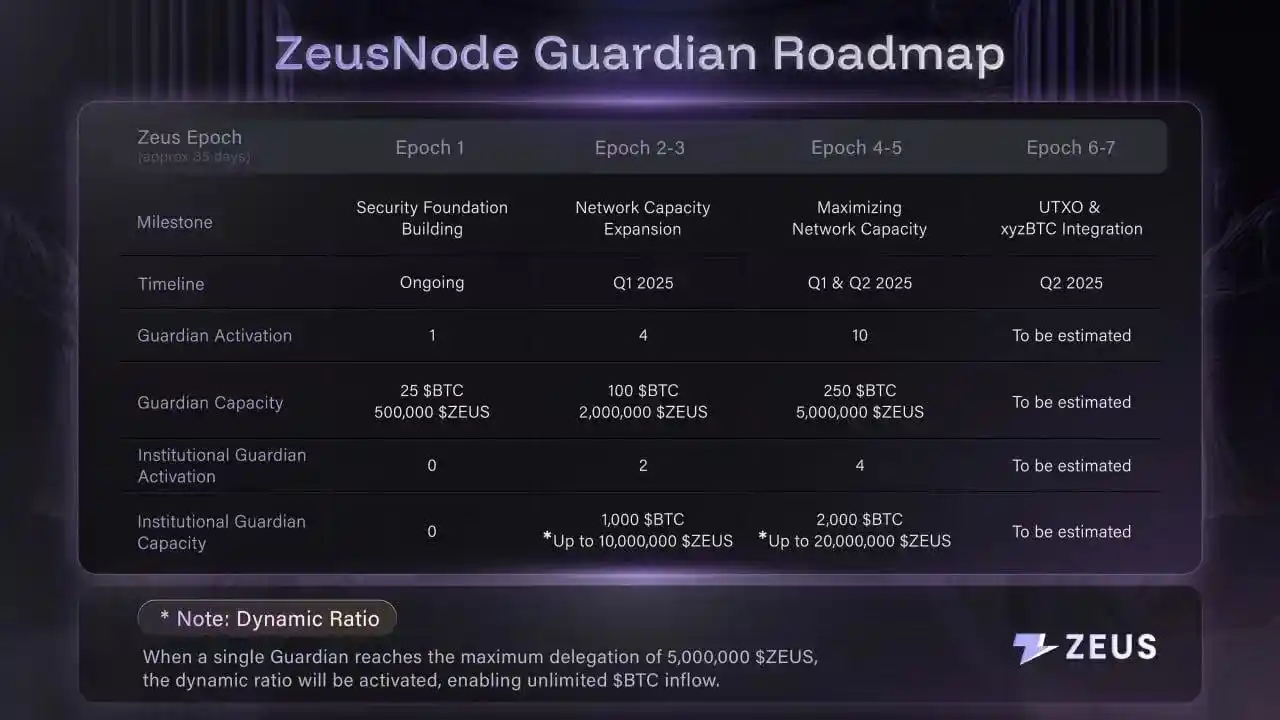
Epoch 1: Security Foundation Build
Based on the Foundation's security ratio, once the network achieves full security through 500,000 $ZEUS in delegation, there will be a $BTC inflow of 25 into Solana. The $BTC in this stage will initially be rolled out as $zBTC, supported by APOLLO, marking the flagship of ZPL assets.
Timeline: Ongoing
Guardians: 1
Institutional Guardians: 0
Network Capacity: 25 $BTC / 500,000 $ZEUS
Periods 2 and 3: Network Capacity Expansion
The activation of three additional Guardians and the introduction of Institutional Guardians will enhance the network's capacity. With support from institutional Bitcoin liquidity, this expansion is expected to bring in 1,100 $BTC. Therefore, the network's capacity will significantly increase, supporting delegations of up to 12,000,000 $ZEUS.
Timeline: Q1 2025
Guardians: 4
Institutional Guardians: 2
Network Capacity: 1,100 $BTC / up to 12,000,000 $ZEUS
Phases 4 and 5: Maximizing Network Capacity
The vision for this phase is to onboard 1% of Bitcoin liquidity to Solana, aiming to maximize the network's capacity through the full activation of 10 Guardians and multiple Institutional Guardians. By fully delegating $ZEUS to each Guardian, it achieves an infinite flow of $BTC inflow, laying the foundation for Solana's seamless scalability and liquidity expansion.
Timeline: Q1/Q2 2025
Guardians: 10
Institutional Guardians: 4
Network Capacity: 2,250 $BTC / up to 25,000,000 $ZEUS
Phases 6 and 7: UTXO and xyzBTC Integration
The focus of this phase is to enable UTXO-based assets and xyzBTC to seamlessly flow into Solana, unlocking new opportunities for asset interoperability and use cases. This step represents a transformative leap in connecting Bitcoin liquidity to Solana, granting users unparalleled flexibility and $BTC management capabilities.
Timeline: Q2 2025
Guardians: To be determined
Institutional Guardians: To be determined
Network Capacity: To be determined
Delegate $ZEUS Now
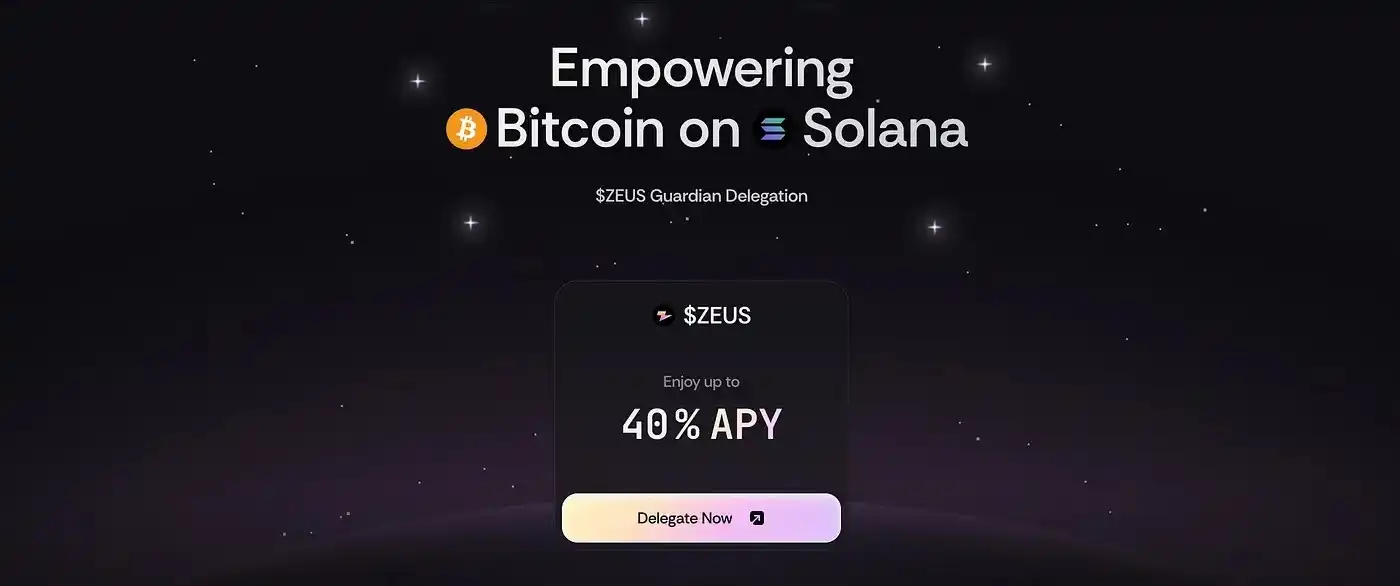
$ZEUS holders can now delegate their tokens to guardians to strengthen network security while earning rewards.
This article is contributed content and does not represent the views of BlockBeats.
You may also like

Why can this institution still grow by 150% when the scale of leading crypto VCs has shrunk significantly?

Anthropic's $1 trillion, compared to DeepSeek's $100 billion

Geopolitical Risk Persists, Is Bitcoin Becoming a Key Barometer?

Annualized 11.5%, Wall Street Buzzing: Is MicroStrategy's STRC Bitcoin's Savior or Destroyer?

An Obscure Open Source AI Tool Alerted on Kelp DAO's $292 million Bug 12 Days Ago

Mixin has launched USTD-margined perpetual contracts, bringing derivative trading into the chat scene.
The privacy-focused crypto wallet Mixin announced today the launch of its U-based perpetual contract (a derivative priced in USDT). Unlike traditional exchanges, Mixin has taken a new approach by "liberating" derivative trading from isolated matching engines and embedding it into the instant messaging environment.
Users can directly open positions within the app with leverage of up to 200x, while sharing positions, discussing strategies, and copy trading within private communities. Trading, social interaction, and asset management are integrated into the same interface.
Based on its non-custodial architecture, Mixin has eliminated friction from the traditional onboarding process, allowing users to participate in perpetual contract trading without identity verification.
The trading process has been streamlined into five steps:
· Choose the trading asset
· Select long or short
· Input position size and leverage
· Confirm order details
· Confirm and open the position
The interface provides real-time visualization of price, position, and profit and loss (PnL), allowing users to complete trades without switching between multiple modules.
Mixin has directly integrated social features into the derivative trading environment. Users can create private trading communities and interact around real-time positions:
· End-to-end encrypted private groups supporting up to 1024 members
· End-to-end encrypted voice communication
· One-click position sharing
· One-click trade copying
On the execution side, Mixin aggregates liquidity from multiple sources and accesses decentralized protocol and external market liquidity through a unified trading interface.
By combining social interaction with trade execution, Mixin enables users to collaborate, share, and execute trading strategies instantly within the same environment.
Mixin has also introduced a referral incentive system based on trading behavior:
· Users can join with an invite code
· Up to 60% of trading fees as referral rewards
· Incentive mechanism designed for long-term, sustainable earnings
This model aims to drive user-driven network expansion and organic growth.
Mixin's derivative transactions are built on top of its existing self-custody wallet infrastructure, with core features including:
· Separation of transaction account and asset storage
· User full control over assets
· Platform does not custody user funds
· Built-in privacy mechanisms to reduce data exposure
The system aims to strike a balance between transaction efficiency, asset security, and privacy protection.
Against the background of perpetual contracts becoming a mainstream trading tool, Mixin is exploring a different development direction by lowering barriers, enhancing social and privacy attributes.
The platform does not only view transactions as execution actions but positions them as a networked activity: transactions have social attributes, strategies can be shared, and relationships between individuals also become part of the financial system.
Mixin's design is based on a user-initiated, user-controlled model. The platform neither custodies assets nor executes transactions on behalf of users.
This model aligns with a statement issued by the U.S. Securities and Exchange Commission (SEC) on April 13, 2026, titled "Staff Statement on Whether Partial User Interface Used in Preparing Cryptocurrency Securities Transactions May Require Broker-Dealer Registration."
The statement indicates that, under the premise where transactions are entirely initiated and controlled by users, non-custodial service providers that offer neutral interfaces may not need to register as broker-dealers or exchanges.
Mixin is a decentralized, self-custodial privacy wallet designed to provide secure and efficient digital asset management services.
Its core capabilities include:
· Aggregation: integrating multi-chain assets and routing between different transaction paths to simplify user operations
· High liquidity access: connecting to various liquidity sources, including decentralized protocols and external markets
· Decentralization: achieving full user control over assets without relying on custodial intermediaries
· Privacy protection: safeguarding assets and data through MPC, CryptoNote, and end-to-end encrypted communication
Mixin has been in operation for over 8 years, supporting over 40 blockchains and more than 10,000 assets, with a global user base exceeding 10 million and an on-chain self-custodied asset scale of over $1 billion.

$600 million stolen in 20 days, ushering in the era of AI hackers in the crypto world

Vitalik's 2026 Hong Kong Web3 Summit Speech: Ethereum's Ultimate Vision as the "World Computer" and Future Roadmap

On the same day Aave introduced rsETH, why did Spark decide to exit?

Full Post-Mortem of the KelpDAO Incident: Why Did Aave, Which Was Not Compromised, End Up in Crisis Situation?

After a $290 million DeFi liquidation, is the security promise still there?

ZachXBT's post ignites RAVE nearing zero, what is the truth behind the insider control?

Vitalik 2026 Hong Kong Web3 Carnival Speech Transcript: We do not compete on speed; security and decentralization are the core

In-depth Analysis of RAVE Events: Short Squeeze, Crash, and Quantitative Financial Models of Liquidity Manipulation

Eve of Ceasefire, US Military Fires on Iranian Vessel | Rewire News Morning Brief

Figma's stock price drops over 7%, will Claude Design be the terminator?

Plunge by 10% Followed by Rebound, Weekend Oil Market Watch

SpaceX Mascot ASTEROID Fast Track $170 million, Stemming from an Unfinished Space Dream
Why can this institution still grow by 150% when the scale of leading crypto VCs has shrunk significantly?
Anthropic's $1 trillion, compared to DeepSeek's $100 billion
Geopolitical Risk Persists, Is Bitcoin Becoming a Key Barometer?
Annualized 11.5%, Wall Street Buzzing: Is MicroStrategy's STRC Bitcoin's Savior or Destroyer?
An Obscure Open Source AI Tool Alerted on Kelp DAO's $292 million Bug 12 Days Ago
Mixin has launched USTD-margined perpetual contracts, bringing derivative trading into the chat scene.
The privacy-focused crypto wallet Mixin announced today the launch of its U-based perpetual contract (a derivative priced in USDT). Unlike traditional exchanges, Mixin has taken a new approach by "liberating" derivative trading from isolated matching engines and embedding it into the instant messaging environment.
Users can directly open positions within the app with leverage of up to 200x, while sharing positions, discussing strategies, and copy trading within private communities. Trading, social interaction, and asset management are integrated into the same interface.
Based on its non-custodial architecture, Mixin has eliminated friction from the traditional onboarding process, allowing users to participate in perpetual contract trading without identity verification.
The trading process has been streamlined into five steps:
· Choose the trading asset
· Select long or short
· Input position size and leverage
· Confirm order details
· Confirm and open the position
The interface provides real-time visualization of price, position, and profit and loss (PnL), allowing users to complete trades without switching between multiple modules.
Mixin has directly integrated social features into the derivative trading environment. Users can create private trading communities and interact around real-time positions:
· End-to-end encrypted private groups supporting up to 1024 members
· End-to-end encrypted voice communication
· One-click position sharing
· One-click trade copying
On the execution side, Mixin aggregates liquidity from multiple sources and accesses decentralized protocol and external market liquidity through a unified trading interface.
By combining social interaction with trade execution, Mixin enables users to collaborate, share, and execute trading strategies instantly within the same environment.
Mixin has also introduced a referral incentive system based on trading behavior:
· Users can join with an invite code
· Up to 60% of trading fees as referral rewards
· Incentive mechanism designed for long-term, sustainable earnings
This model aims to drive user-driven network expansion and organic growth.
Mixin's derivative transactions are built on top of its existing self-custody wallet infrastructure, with core features including:
· Separation of transaction account and asset storage
· User full control over assets
· Platform does not custody user funds
· Built-in privacy mechanisms to reduce data exposure
The system aims to strike a balance between transaction efficiency, asset security, and privacy protection.
Against the background of perpetual contracts becoming a mainstream trading tool, Mixin is exploring a different development direction by lowering barriers, enhancing social and privacy attributes.
The platform does not only view transactions as execution actions but positions them as a networked activity: transactions have social attributes, strategies can be shared, and relationships between individuals also become part of the financial system.
Mixin's design is based on a user-initiated, user-controlled model. The platform neither custodies assets nor executes transactions on behalf of users.
This model aligns with a statement issued by the U.S. Securities and Exchange Commission (SEC) on April 13, 2026, titled "Staff Statement on Whether Partial User Interface Used in Preparing Cryptocurrency Securities Transactions May Require Broker-Dealer Registration."
The statement indicates that, under the premise where transactions are entirely initiated and controlled by users, non-custodial service providers that offer neutral interfaces may not need to register as broker-dealers or exchanges.
Mixin is a decentralized, self-custodial privacy wallet designed to provide secure and efficient digital asset management services.
Its core capabilities include:
· Aggregation: integrating multi-chain assets and routing between different transaction paths to simplify user operations
· High liquidity access: connecting to various liquidity sources, including decentralized protocols and external markets
· Decentralization: achieving full user control over assets without relying on custodial intermediaries
· Privacy protection: safeguarding assets and data through MPC, CryptoNote, and end-to-end encrypted communication
Mixin has been in operation for over 8 years, supporting over 40 blockchains and more than 10,000 assets, with a global user base exceeding 10 million and an on-chain self-custodied asset scale of over $1 billion.

