
X Space Review | WLD's Biggest Competitor Humanity Protocol to Launch Its Token, Will Identity Authentication Become the New Narrative in the New Year?


On January 3rd, BlockBeats invited Humanity Protocol founder Terence Kwok to discuss the topic "Humanity Protocol to Launch Token: Will Identity Verification Become a New Narrative in the New Year?" and explore the new opportunities for Humanity Protocol, the biggest competitor to WLD.
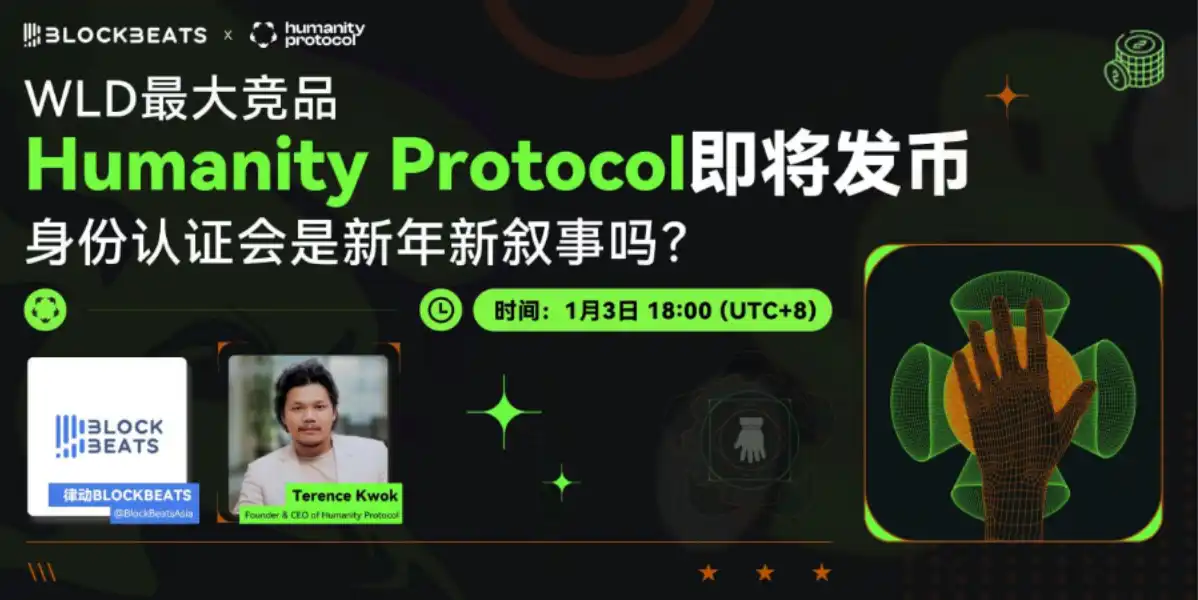
BlockBeats: Please briefly introduce yourself and the Humanity Protocol project.
Terence Kwok: Hello, everyone. I'm Terence, the founder and CEO of Humanity Protocol. I was born in the United States and grew up in Hong Kong. Prior to this, I founded an internet company, which can be considered a unicorn in the Hong Kong market. A few years ago, during the pandemic, I entered the crypto world and started researching identity verification-related content. Humanity Protocol completed a $30 million financing round in mid-2024, with a valuation of $1 billion. Our testnet went live about two months ago, with over 2 million users participating. We plan to launch the mainnet in the first quarter of 2025 and conduct a TGE.
Over the past year, we have received support from many investors, including Animoca, Shima Capital, Hashed, and Mechanism Capital, and we have also received support from several well-known angel investors.
Since the ICO era in 2017, some have said that blockchain identity verification is a promising track, but no one has truly brought this track to life and developed a product until the emergence of Worldcoin. In fact, this is also a crucial area for the future. Many people compare us to Worldcoin, but in reality, there are significant differences between us, and our visions are also different.
BlockBeats: Could you please introduce the key mechanisms and core technology of Humanity Protocol, such as palm vein scanning, which is quite different from Worldcoin's iris scanning? And what is Proof of Humanity (PoH)?
Terence Kwok: People often compare us to Worldcoin mainly because we use biometric technology for human identity verification. However, from a technical perspective, biometrics come in various forms, including facial recognition and fingerprint recognition. Worldcoin uses iris recognition, while we use palm print and palm vein recognition.
In fact, these biometric technologies are already quite mature. Many people have been researching this technology for the past couple of decades, and many companies have been working in this area. It's just that recently, iris recognition, palm print, and palm vein recognition have been applied in the Web3 domain for identity authentication. In comparing these two technologies, from an accuracy perspective, they are basically similar. However, palm print and palm vein recognition have one advantage: they are not as intimidating or invasive as iris recognition. Scanning one's palm is a more comfortable way for most people.
Currently, even Web2 companies are using this technology. For example, Amazon and Tencent also leverage palm print and palm vein recognition to create some application scenarios. So, this technology is quite mature. Apart from the different biometric methods, our main difference from Worldcoin lies in our different goals. Worldcoin aims to create a Universal Basic Income (UBI) product; they believe that if AI replaces all human jobs, they need to unconditionally give money to the unemployed, which is the idea behind their product. In contrast, our idea is different; we believe that there are already many use cases starting from identity authentication, and UBI is just one of them.
Whether at the Web3 or Web2 level, there are many places that require human identity authentication. In the Web3 domain, many people engage in airdrops and even mining. Many studios can now systematically engage in airdrop hunting, which is not very friendly to project teams. They want to attract users who have a long-term interest in the project. Therefore, from an ideal perspective, human identity authentication is very useful.
At the Web2 level, the current situation we see is that many websites, such as Facebook and Twitter, often require human authentication, such as clicking traffic lights or entering a CAPTCHA to prove that you are human. This is because there are now a large number of bots generating content. Many people do not like to see content created by AI or bots. From a business model perspective, the business model of most Web2 companies is related to advertising. If all the content is fake—actually, about 40%-50% is already fake—then it is not attractive to advertisers.
From the perspective of human proof, I believe that in the current environment, AI or bots are becoming increasingly important. We have built a foundational credential system. Our chain is different from World Chain; we not only provide identity authentication, but we also introduce various validators. Validators could be different universities, different companies, or even banks to verify relevant information. For example, if you graduated from Harvard University or Tsinghua University, these universities can publish your graduation certificate or related information on our system to prove that you indeed graduated from Harvard. If you work at Animoca, then Animoca can issue a certificate on our platform to prove that you have indeed worked at this company. Banks or exchanges can also issue credentials in the system to prove that you have never been sanctioned. In this way, other platforms or applications no longer need to perform their own full KYC.
BlockBeats: What achievements has Humanity Protocol's testnet made since launching in early October?
Terence Kwok: In fact, our testnet is still relatively simple at the moment. About 2 weeks ago, our self-manufactured hardware devices have been shipped out. The first batch consisted of around 10 devices, and we expect to produce several tens more next week. After the Spring Festival, we will ramp up production, with an estimated 2,000 or more devices being put into use.
Our users are distributed in different regions, mainly in Europe. In two weeks, we will allow users to connect their social media accounts to verify their identity information on the testnet. A person has many attributes, with the first and most important attribute being to confirm whether you are human. Other attributes may include workplace, nationality, or online activity level. We will gradually verify these different attributes. Currently, our testnet address is https://testnet.humanity.org/. If you are interested, you can go there to register and experience it.
After registration, you can invite friends to join. When your friends join, you will receive reward coins on the testnet, and after referring others, you will receive additional rewards. We plan to airdrop at the TGE, with the main condition for receiving the airdrop being that you need to scan your palm print or palm vein, or verify other attributes to confirm that you are not a robot.
BlockBeats: Can palm prints or palm veins only be scanned offline?
Terence Kwok: Palm prints can be scanned on the app, while palm vein scanning requires specific hardware devices. We have already set up collection points for palm vein scanning in several cities in Europe. We plan to launch the app in the first quarter of 2025, with palm vein scanning requiring offline scanning. Our goal is to have around 2,000 to 2,500 devices globally distributed in the second quarter, and currently, we have 2,500 devices in production. In comparison, Worldcoin currently operates around 1,000 Orb devices globally.
BlockBeats: Humanity Protocol is about to have its TGE. How does the RWT on the testnet convert to governance tokens? What are the use cases of Humanity Protocol's native token in the ecosystem?
Terence Kwok: I can briefly introduce the basic principle. The more people you recommend and the higher the activity level, the more reward RWT you will receive, and the more governance tokens you can exchange for. At the same time, we have set up mechanisms to prevent users from creating a large number of fake accounts. We do not want the system to be flooded with a large number of bots or fake accounts. One of the use cases of the native token is for paying Gas fees. The native token is also used for verification fees. For example, if you are a developer working on an application and want to verify whether an address or account has passed human identity authentication, you need to pay a fee, which you can do using the native token. This fee will be distributed to different parties. The issuer of the certificate will receive a portion, blockchain validators will get a share, and nodes providing ZK proof will also receive a portion.
BlockBeats: Worldcoin, a competitor of the Humanity Protocol, often encounters restrictions imposed by sovereign states during the development of iris validation due to concerns over national identity protection. How does the Humanity Protocol navigate regulation and handle user information storage?
Terence Kwok: We never store users' original palm or vein pattern information. We encrypt these patterns and convert them into hash values. Then, using ZK proof technology, we compare these hash values. We are unable to access users' raw palm print data, and other credentials follow a similar process. For example, if an institution issues a certificate proving your graduation date, major, and grades, if an application requires this information, user consent must be obtained first. Users can decide whether to provide this information, and all data is encrypted.
We store the encrypted hash values in a decentralized system. The reason for this is that we always give users the right to delete their information. Even though the information is encrypted, users can still choose to delete it if they wish. Worldcoin's biggest mistake is not in collecting user information but rather in not granting users the right to delete their personal information. This is crucial under European law, where users have the right to have their information or data deleted. We have a large legal team to ensure compliance with operations in different countries and regions. Besides compliance, we also ensure the secure protection of user information.
Our team has been researching palm print recognition technology for almost 2 years and has conducted extensive research globally. We have acquired several companies that have focused on biometrics research for over 10 years, providing us with a solid foundation in building data models. Worldcoin, on the other hand, is developing this technology from scratch, with few ventures into iris recognition. Their main issue is that in operation, they not only scan the iris but also take photos, retaining the original images. These iris images are kept for machine learning training purposes. However, they did not disclose this to users, which is their major problem.
BlockBeats: Can you introduce the verification process of the Humanity Protocol?
Terence Kwok: We have a hardware device where you can go to an offline operation point to scan your palm print and palm vein. If you already have a Human ID, you can link your palm print and palm vein to your Human ID. Interestingly, our data is not stored in the cloud but on the hardware device. The data is encrypted and converted into hash values before being uploaded to decentralized storage. If an application needs to verify if an address has been validated, it needs to match a ZK Proofer. In the future, we will have many ZK Proof nodes for verification to ensure information accuracy. Throughout the process, all raw data remains confidential and will never be accessed.
In addition, data encryption and zero-knowledge proof have been applied to the testnet. Now when you register and bind an email on the testnet, we cannot see your email address. Many testnets or platforms will directly store your email address and some other information in the database, but we do not store this information at all. Unless we have the user's permission, we cannot access this information.
BlockBeats: Undoubtedly, AI is the hottest track in 2025. As the unicorn in the privacy track, will Humanity Protocol explore and lay out in the AI data field?
Terence Kwok: We have actually made some progress in the AI field, but I don't want to reveal too many details at the moment. One issue we are focusing on is how to prove who should be responsible for AI as it becomes more powerful. We are also considering releasing a credential to prove that this AI is actually controlled by a certain entity. We are researching and developing these, but we are still in the early stages. Verification can be used not only for humans but also for AI technology. Regarding the combination of data and AI you mentioned, we haven't really considered it yet because the project is still in its early stages. Currently, we need to focus on doing well in biometrics and identity verification. The next step is the credential system, and we will introduce a group of validators to issue credentials to people. I think we should take it one step at a time.
BlockBeats: After the rise of AI technology, digital identity will also rise. How big do you think the market size of human identity verification track, led by palmprint verification, will be?
Terence Kwok: We are the first Web3 project to use palmprint and palm vein for identity verification, but we do not rule out the possibility of adding some new things. Before the TGE, we had already established partnerships with several projects and may use other methods for identity authentication. Actually, what we care most about is the authenticity of the data because it is very easy to falsify data now. For example, finding my photo or video online and using face recognition to fake it is very simple. Voice can also be faked; if you record my voice now, you can later use voice-changing technology to make me say anything. So we believe that offline, hard-to-imitate authentication methods are very important.
Currently, there are blue verification badges on Instagram or X (Twitter), but even if you are a bot, you can get the blue badge. We are currently in discussions and collaborations with some large Web2 platforms. At least Humanity Protocol can prove that a certain account has undergone human identity verification, which is very important. AI is developing rapidly now, and using an AI agent to automatically send messages on Twitter is already a simple thing. Ordinary people actually find it very difficult to distinguish whether the content is written by a machine or a human. Whether from the perspective of content creation or consumption, it is valuable to distinguish the authenticity of the content. This is not to say that machine-produced content has no value; we believe it is important to have the ability to distinguish whether the content is created by a human or a machine.
Advertising and other business models have been affected by fake content, so human authentication is actually very important. We not only focus on human authentication, but also involve authentication in areas such as education, employment, medical records, etc., creating an immutable identity graph where the attributes are definitely true and cannot be easily changed.
BlockBeats: What is the current business model of the Humanity Protocol?
Terence Kwok: The model of Worldcoin is a UBI model, printing its own money and distributing it, and we mainly want to establish a sustainable business model. We have already had quite a few validators coming in one after another, and will announce them before the TGE. These validators can be a university, a company, if they want to prove that a person is a journalist or an employee of a certain company, they can stake tokens to issue credentials. For example, if an institution wants to verify if another person is indeed a BlockBeats journalist, they need to pay a small fee in tokens, which will be distributed to various parties, with BlockBeats receiving a portion of the money, the chain receiving a portion, and the ZK Proof nodes also receiving a portion. This model provides incentives for all participants and helps drive the project forward.
We found that previous blockchain projects focusing on identity verification were too idealistic, as they believed that all credentials should be public and free, which is actually not feasible. We are in talks with some large financial institutions, which can issue credentials to their tens of millions of users, proving that these individuals have passed the institution's KYC and are not sanctioned. This means that in the future, if a DeFi platform wants to ensure its platform is more compliant, it may set up a pool that only accepts people certified by financial institutions to trade, which is an important narrative in the long run. We are gradually cooperating with various institutions and companies to collaborate on this plan, and we have also started developing and promoting SDKs and APIs for use by different developers.
Currently, the authenticity of authentication information has become increasingly important. For example, if I create a profile introducing myself as where I am from, where I studied, and where I have worked, others have no way to know the truth of this information. Similarly, if I send an email from an email address, the recipient also finds it difficult to confirm my identity. Especially with AI and LLMs (Large Language Models) being able to easily mimic various scenarios, the authenticity of authentication information is really crucial.
BlockBeats: Can you please share the upcoming roadmap or development plans for the Humanity Protocol?
Terence Kwok: Our foundation will soon be established, and after its establishment, we are preparing for the TGE. Before the TGE, we will announce some news about our collaborations with Web3 and traditional financial institutions. Recently, we also completed a fundraising round, and this news will be announced soon.
BlockBeats: In the current hot trend of AI technology, how do you think AI and Crypto will be combined? What role will the Humanity Protocol play?
Terence Kwok: This is purely my personal opinion. A few days ago, CoinDesk published an article mentioning that the threshold for launching AI Agent-related meme coins is now very low. My own coding skills are actually very poor. In the current situation, it is similar to the first time using ChatGPT, where everyone thinks the AI Agent is very powerful, but in reality, there is actually no technical threshold to create an AI Agent meme coin. I believe that for AI to continue to develop, it is also inseparable from the advancement of infrastructure. I have also bought some AI Agent coins, but in the long run, it still relies on infrastructure development.
I'll add that many people think Worldcoin is overvalued, but I think it is actually undervalued. For example, if you look at Ripple, it is solving the problem of fund liquidity, but identity verification is actually solving the problem of information liquidity. Especially in the AI era, many people have not yet realized the importance of this issue.
Space Link: https://twitter.com/i/spaces/1YqxovpXzLMJv
You may also like

Morning Report | BitMine increased its holdings by 126,971 ETH last week; trader Eugene announced his exit from the crypto market

Wang Chuan: How can one not feel anxious after the neighbor Old Wang made thirty times profit by investing in storage stocks? (Seven) - A quarter-century cycle

Cryptocurrency CEXs are flocking to sell US stocks, and traditional brokerages are facing an "uninvited guest."

$75 billion in foreign capital has fled, and South Korean retail investors have absorbed it all using leverage

Japan’s Three Megabanks Plan Joint Stablecoin Issuance in Fiscal 2026
MUFG, SMBC, and Mizuho reportedly plan to jointly issue fiat-pegged stablecoins in fiscal 2026, signaling Japan’s growing push into bank-led digital payment infrastructure.

Humanity Discloses H Token Dual-Chain Attack Details, With Losses on Ethereum and BSC Exceeding $36 Million
Humanity said the H token attack across Ethereum and BSC caused more than $36 million in losses after leaked ProxyAdmin keys enabled malicious contract upgrades and token minting.
White House Discusses CLARITY Act With Law Enforcement Ahead of Senate Vote
The White House discussed the CLARITY Act with law enforcement ahead of a Senate vote, focusing on illicit finance risks and developer protections.

Bitcoin Trading Guide 2026: Strategies for Experienced Traders

What Is XAUT and PAXG? Why Tokenized Gold Is Booming in 2026

Will the SpaceX IPO Hurt Bitcoin? Here's What Traders Are Watching

Foreign selling in the South Korean stock market accelerates, with cumulative net sales reportedly reaching $75 billion this year
On June 9, The Kobeissi Letter, citing Goldman Sachs data, reported that global investors are selling South Korean stocks at an unusually rapid pace. In the latest trading session, foreign investors sold about $801 million worth of Kospi constituent stocks again; total foreign outflows last week reached about $10 billion, and the market has been in net foreign selling on nearly every trading day over the past month. According to the data cited in the report, foreign investors have sold about $75 billion worth of South Korean stocks so far this year. Meanwhile, South Korean retail and institutional investors together recorded roughly $69 billion in net buying over the same period, suggesting that the market’s main buying support has come from domestic capital rather than returning overseas funds. The information currently disclosed still mainly comes from The Kobeissi Letter’s retelling and Goldman Sachs data summaries, while public details on the statistical period and the specific definition of “selling” remain relatively limited.

Fortune Warns of Strategy’s Financing Structure Risks as Bitcoin Premium Narrows
Fortune warned that Strategy’s Bitcoin treasury model faces growing financing risks as MSTR’s net asset premium narrows and preferred stock dividend pressure increases.

Ferrari Challenge Le Mans: Carl Moon to Dominate in WEEX Livery

Sahara AI Responds to SAHARA’s Sharp Drop: No Contract or Product Security Issues Found, Internal Investigation Underway
Sahara AI responded to SAHARA’s 60% price drop, saying no token contract or product security issues have been found and an internal investigation is underway.

WEEX Deposit/Withdrawal Dynamic Island: Your Asset Status, Always in Sight
Scaling Crypto Derivatives: The Digital Asset Infrastructure Behind High-Volume Trading
In the fast-moving digital asset ecosystem, derivatives platforms face an extreme architectural test. High-leverage futures markets demand more than just standard security—they require absolute operational precision, zero-latency matching engines, and ironclad structural scalability, all while navigating intense market volatility.
As global platforms scale to meet these demands, the industry is shifting away from rigid, monolithic setups toward a more agile, "decoupled" infrastructure philosophy.
The Blueprint for High-Volume Copy TradingFor elite global exchanges like WEEX (founded in 2018), this architectural choice becomes critical when scaling high-volume retail features like social copy trading. When thousands of users automatically mirror the real-time strategies of elite traders simultaneously, it triggers sudden, monumental spikes in concurrent transactional volume.
To prevent execution latency or settlement bottlenecks during these peak volatility events, a platform's primary engine must remain entirely dedicated to risk management, copy-trade synchronization, and order matching.
The Architectural Rule: New-generation platforms must separate front-end user execution engines from heavy backend infrastructural overhead to eliminate operational friction.
By separating these layers, platforms can maintain complete sovereignty over their trading environments and user experiences while strategically aligning with institutional-grade infrastructure ecosystems. This strategic framework allows modern exchanges to leverage advanced Digital Asset Custody infrastructure such as Cobo’s behind the scenes, ensuring that backend wallet management scales elastically alongside trading spikes.
Capitalizing on Market Momentum and 400× LeverageIn a derivatives arena where platforms offer up to 400× leverage on perpetual contracts, capital efficiency and market agility are core business metrics. To capture market momentum, an exchange needs the ability to rapidly expand its asset offerings, supporting everything from legacy crypto assets to sudden, trending altcoins across a massive library of trading pairs.
Adopting a flexible, scalable Wallet-as-a-Service (WaaS) solution such as Cobo’s could completely rewrite the development timeline for high-growth exchanges. Instead of spending months of engineering capital building out custom backend wallet architectures for every new blockchain network, platforms can deploy localized infrastructure in days.
This agility allows platforms to instantly scale their listings to over a thousand trading pairs without compromising security or delaying time-to-market. It mirrors the exact operational advantages seen during high-velocity market events, similar to how advanced wallet infrastructure empowers platforms during sudden asset surges; allowing exchanges to pass that speed and liquidity directly to their global user base.
A Mature Foundation for GrowthThe synergy between trusted infrastructure ecosystems and global trading platforms represents the natural evolution of a maturing crypto market. As WEEX continues to scale its global spot and derivatives offerings for over 6 million users, adopting robust backend paradigms proves that platforms no longer have to compromise between cutting-edge trading velocity and uncompromised structural security.

Get Paid to Onboard? Try WEEX’s New Homepage with Rewards for Registration, Deposit & Trade
WEEX Custom Layout: Build Your Perfect Trading Workspace in Seconds
Morning Report | BitMine increased its holdings by 126,971 ETH last week; trader Eugene announced his exit from the crypto market
Wang Chuan: How can one not feel anxious after the neighbor Old Wang made thirty times profit by investing in storage stocks? (Seven) - A quarter-century cycle
Cryptocurrency CEXs are flocking to sell US stocks, and traditional brokerages are facing an "uninvited guest."
$75 billion in foreign capital has fled, and South Korean retail investors have absorbed it all using leverage
Japan’s Three Megabanks Plan Joint Stablecoin Issuance in Fiscal 2026
MUFG, SMBC, and Mizuho reportedly plan to jointly issue fiat-pegged stablecoins in fiscal 2026, signaling Japan’s growing push into bank-led digital payment infrastructure.
Humanity Discloses H Token Dual-Chain Attack Details, With Losses on Ethereum and BSC Exceeding $36 Million
Humanity said the H token attack across Ethereum and BSC caused more than $36 million in losses after leaked ProxyAdmin keys enabled malicious contract upgrades and token minting.


