
Vitalik wrote a proposal teaching you how to secretly use AI large models


Original Title: "Vitalik Wrote a Proposal to Teach You How to Secretly Use AI Large Models"
Original Translation: Deep Tide TechFlow
The whole world is talking about AI, and the discussion about crypto on the timeline has quieted down a lot.
At the same time, ETH has been hovering around 2000 for almost two months, and it seems like not many people care about what Vitalik says or does.
However, when I recently dug into his updates, I found out that AI has influenced more than just us. In the past month, a significant portion of what he has posted is related to AI, and it has gone into the level of technical solutions.
One of the most worthy of discussion is a proposal he and Ethereum Foundation's AI lead Davide Crapis jointly posted on ethresear.ch on February 11, titled "ZK API Usage Credits."
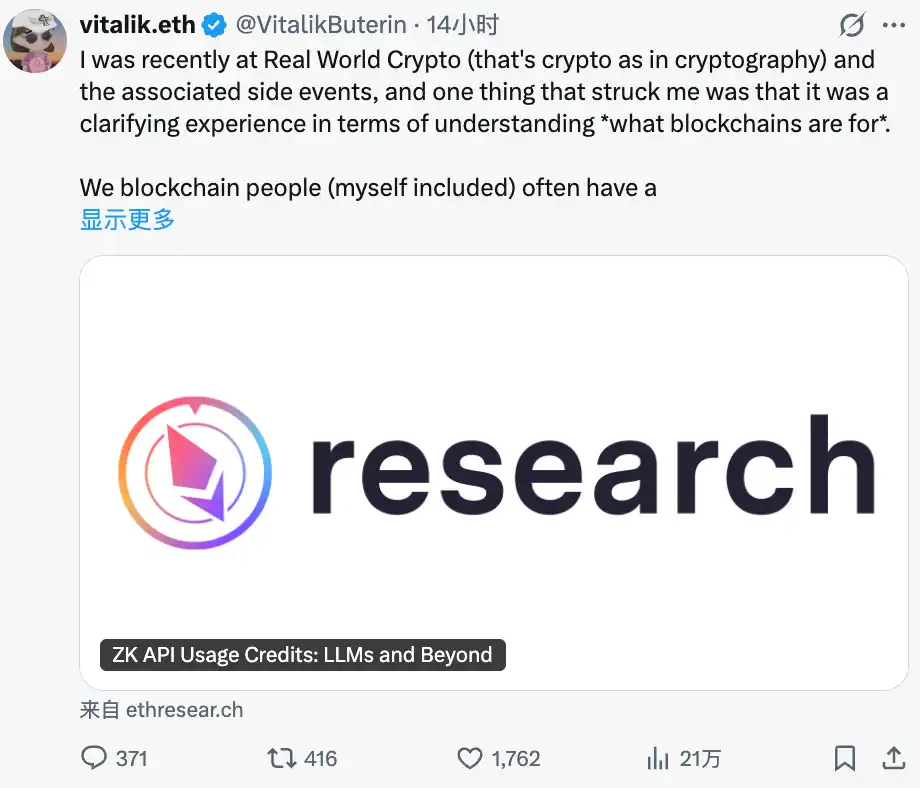
In one sentence: Using zero-knowledge proofs to anonymously call AI large models.
Currently, whether you use ChatGPT or call Claude's API, there is only one payment method:
Register an account, link an email, link a credit card.
Every conversation, every prompt, the platform knows it's from you. What you asked, when you asked, how many times you asked, all tied to your real identity.
Vitalik and Crapis's proposal offer another path.
1. The user deposits some money into a smart contract, for example, 100 USDC.
2. The contract records this deposit in an on-chain encrypted whitelist. Each time you call the API, you don't have to reveal your identity; you just need to generate a zero-knowledge proof.
3. It can prove two things to the service provider: you are on the whitelist, and your balance is sufficient. But the proof itself does not reveal which one you are on the list.
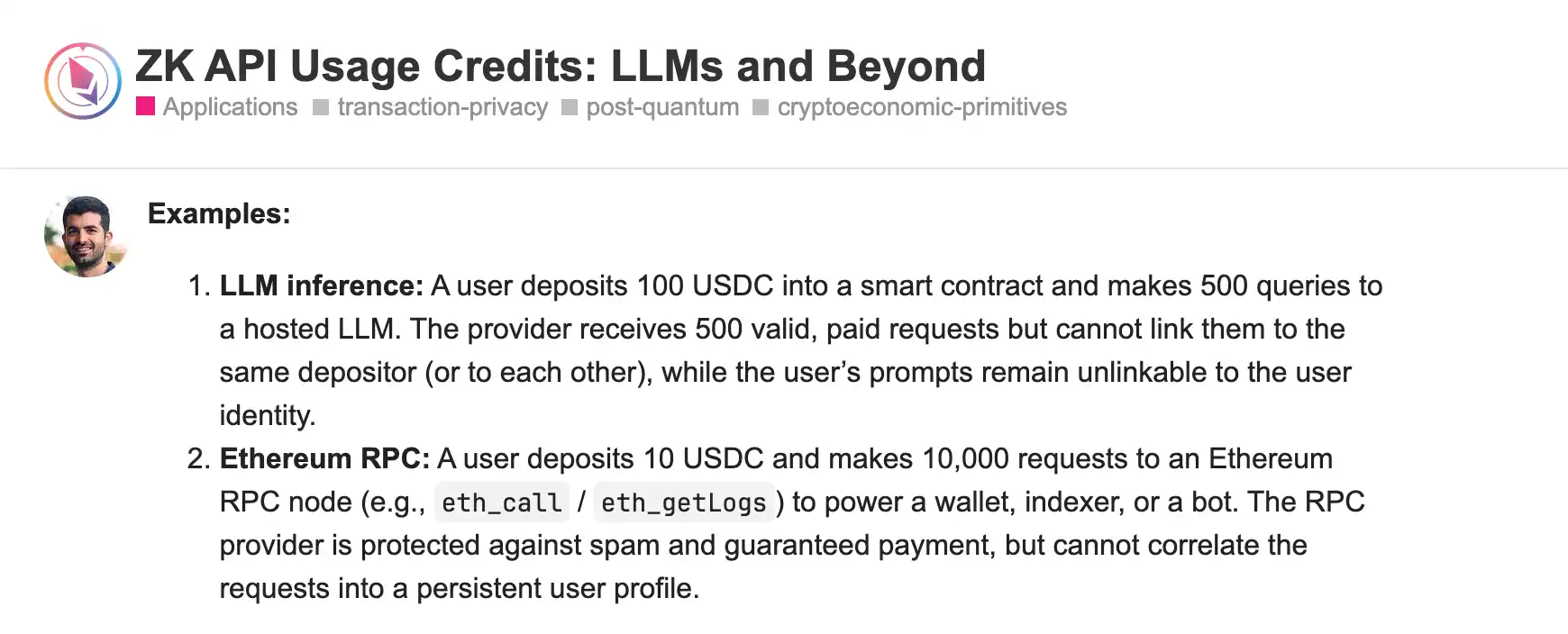
The service provider can receive the money, prevent abuse, but never know who you are throughout the process.
You can think of this proposal as something Vitalik believes in the AI age, users should not have to give up their identity to use an AI tool.
This proposal is currently at the research stage and is still far from being implemented. Major model manufacturers may not agree with this approach; at the same time, the proposal's comment section is full of rebuttals and questions, suggesting that AI model manufacturers will always find ways to know your true identity.
However, the significance of this proposal is not solely about whether it can be implemented or not.
Privacy has been Vitalik's focus for ten years. From early support for Tornado Cash to driving zero-knowledge proofs to be a core technical route of Ethereum, this line has never been interrupted. It's just that in the past few years, in the context of the cryptocurrency industry, privacy has always lacked a large enough story to carry it forward.
AI has filled in that story. When you talk to large models more than anyone else every day, privacy is a real need.
Vitalik Embracing AI
From February to now, a considerable part of what Vitalik has posted on X is related to AI, so dense that it doesn't seem like casual chat.
Yesterday he posted a long thread, saying that he recently went to a cryptography conference, where people care about privacy, care about open source, care about anti-censorship... but have no feelings for blockchain.
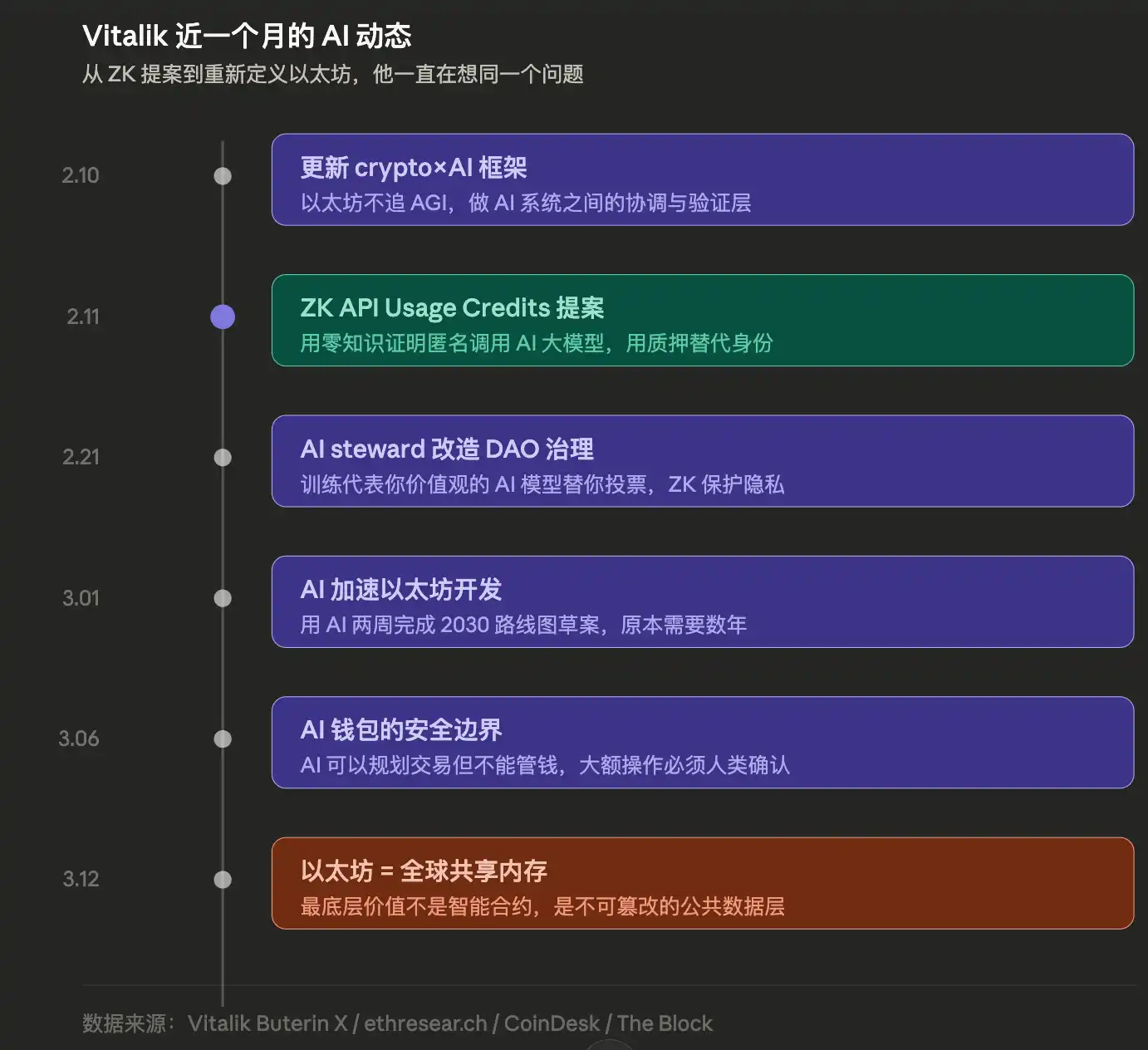
Among that group, he did a thought experiment:
Forget "we are the Ethereum community," start from scratch and think about where Ethereum is most useful.
His conclusion is that Ethereum's most fundamental value is as a bulletin board. A place where anyone can write, anyone can read, no one can change, and no one can delete.
In the context of AI, this may be the most important thing Vitalik has said in the past two years.
We are entering an era of infinite generation at almost no cost. Text, images, videos, identities—AI can mass-produce them. When everything can be forged, what will become scarce?
All these questions will ultimately point to the same place: a public, persistent, irreversible data layer. And a record that no one can tamper with is precisely what Ethereum can do.
Over the past two years, Ethereum's scrutiny can be summed up in one question: What do you have that can't be replaced by others?
Looking back, Vitalik has not provided a direct answer to this question.
However, the Ethereum Foundation has quietly done a few things over the past year: formed a 50-person privacy team, established a nearly 50-person privacy research cluster, released the Kohaku privacy framework, and appointed a dedicated AI lead; in the 2026 roadmap, institutional-grade privacy and faster transaction finality are listed as top priorities.
Looking back at his intensive output this month, most of it is basically about discussing Ethereum's privacy and scalability issues in the context of AI.
I think Vitalik is betting on one thing: the more powerful AI becomes, the more rigid the demand for privacy and validation infrastructure. Whether Ethereum can meet this demand is another matter, but he has clearly chosen his table.
ETH is still hovering around 2000. Most people still don't pay much attention to what he has been saying recently.
But perhaps in a few years, looking back, what should have been paid attention to is this current period.
You may also like

Morning Report | OpenAI has submitted an S-1 registration statement draft to the U.S. SEC; Morpho completes $175 million financing

Galaxy Deep Research Report: How Hyperliquid's HIP-4 Upgrade Changes the Landscape of Prediction Markets?

Latest research from 13 top universities including Cornell University: The current state, challenges, and misconceptions of the fusion of Crypto and AI

Deconstructing Anthropic: The Best AI Company, Possibly Also a Type of Organizational Invention

Every exchange is a "Universal Exchange."

The counterattack of traditional finance: Alliance chains are quietly reviving
Pantera Capital Partner: How Tokenization is Restructuring the Private Equity and Early Investment Ecosystem?

Mastercard Launches Agent Pay for AI, Plans to Record AI Agent Payment Authorizations on Polygon
Mastercard launched Agent Pay for AI, a new payment protocol designed to help AI agents make small payments such as pay-per-use access to data and APIs. The system plans to record human-granted AI agent permissions on Polygon, focusing on verifiable authorization, identity, and payment controls.

Curve Deploys Llamalend v2 on Optimism With 250,000 OP Incentives
Curve launched Llamalend v2 on Optimism with 250,000 OP incentives from the Optimism Foundation. The upgrade expands Llamalend beyond its earlier crvUSD-focused model, adding broader collateral support, LlamaRisk market reviews, and the ability to use Curve LP tokens as collateral.

Raydium Old Liquidity Pool Reportedly Exploited, With $1.34 Million Moved to Ethereum and Tornado Cash
An old Raydium liquidity pool was reportedly exploited for around $1.34 million in USDC, RAY, and wSOL, with the stolen funds bridged to Ethereum and deposited into Tornado Cash. The incident highlights the tail risks of legacy DeFi pools, old contracts, and cross-chain fund laundering paths.
Kalshi Executive Challenges “SBF Backed AI Unicorns” Narrative, Says Leopold Aschenbrenner Was Key Figure
Kalshi executive John Wang questioned the “SBF backed AI unicorns” narrative, saying Leopold Aschenbrenner was the key figure behind major AI investment decisions.

New York Proposes Stricter Stablecoin Issuer Rules Aligned With Federal GENIUS Act
NYDFS proposed stricter stablecoin issuer rules aligned with the GENIUS Act, covering reserves, custody, redemption timelines, audits, and capital buffers.

CryptoQuant Says Bitcoin Profitable Supply Is Near 45% Pressure Zone as On-Chain Data Points to Market Repricing
CryptoQuant said Bitcoin’s profitable supply is nearing the 45% pressure zone, signaling rising market stress, unrealized losses, and a possible on-chain repricing phase.

Bitcoin Falls Below 200-Week Moving Average as On-Chain Data Shows Over Half of Supply in Loss
Bitcoin dropped below its 200-week moving average as on-chain data showed over 50% of circulating supply is now in loss, signaling rising market stress.

CFTC Reportedly Plans New Prediction Market Rules Focused on Manipulation Risk and Public Interest Review
The CFTC is reportedly preparing new prediction market rules focused on manipulation risk, public interest review, and retail trader protections.

Meet the new WEEX trial fund—your gateway to greater profits

WEEX Labs Lands at Dutch Blockchain Week: A Disruptive Crypto × AI Conversation Sets Sail in Amsterdam
SK Hynix Reportedly Plans U.S. ADR Listing as Early as August, With SEC Approval Possible in Late June
SK Hynix may pursue a U.S. ADR listing as early as August, with SEC approval reportedly possible in late June amid strong AI chip supply chain demand.
Morning Report | OpenAI has submitted an S-1 registration statement draft to the U.S. SEC; Morpho completes $175 million financing
Galaxy Deep Research Report: How Hyperliquid's HIP-4 Upgrade Changes the Landscape of Prediction Markets?
Latest research from 13 top universities including Cornell University: The current state, challenges, and misconceptions of the fusion of Crypto and AI
Deconstructing Anthropic: The Best AI Company, Possibly Also a Type of Organizational Invention
Every exchange is a "Universal Exchange."
The counterattack of traditional finance: Alliance chains are quietly reviving


