
VC Asset Bubble History: Why Does Every New Coin Seem to Go to Zero?

Original Title:《The Great Crypto VC Bubble: Why Every New Token Trends to Zero (Part 1)》
Original Author: 0xLouisT
Original Translator: DeepTech TechFlow
Shitcoins are continuing to bleed out — why? Is it due to high FDV, or the CEX listing strategy? Should Binance and Coinbase just directly TWAP their funds into new shitcoins? The real culprit isn't new — it all traces back to the 2021 crypto VC bubble.
In this article, I will dissect how we got to where we are today. In the upcoming articles, I will explore the impact of this phenomenon on projects, the liquid market, possible future trends, and provide some advice for entrepreneurs in the current environment.
ICO Craze (2017-2018)
The crypto industry is fundamentally a highly liquid industry — projects can mint tokens at any time, these tokens can represent anything, regardless of its stage. Before 2017, most trading activity happened on public markets, where anyone could directly purchase tokens through centralized exchanges.
Then, the ICO (Initial Coin Offering) bubble arrived: a wild speculative era quickly exploited by scammers. Its ending was like any other bubble: lawsuits, fraud, and regulatory crackdowns. The U.S. Securities and Exchange Commission (SEC) intervened, almost making ICOs illegal. To evade the U.S. judicial system, founders had to seek other ways to raise funds.
VC Craze (2021-2022)
As retail investors were forced out, founders turned to institutional investors. From 2018 to 2020, the crypto VC space gradually expanded — some companies were pure VC firms, while others were hedge funds, allocating a small part of their Assets Under Management (AUM) to VC bets. At the time, investing in shitcoins was a contrarian move — many believed these tokens would eventually go to zero.
Then came 2021. The bull market rapidly skyrocketed the portfolios of VC investments (at least on paper). By April, many funds had already seen returns of 20x or even 100x. Crypto VC suddenly looked like a "money printer." Limited Partners (LPs) flocked in, eager to catch the next wave. VC firms raised new funds, 10 times, even 100 times the size of previous ones, believing they could replicate these astounding returns.
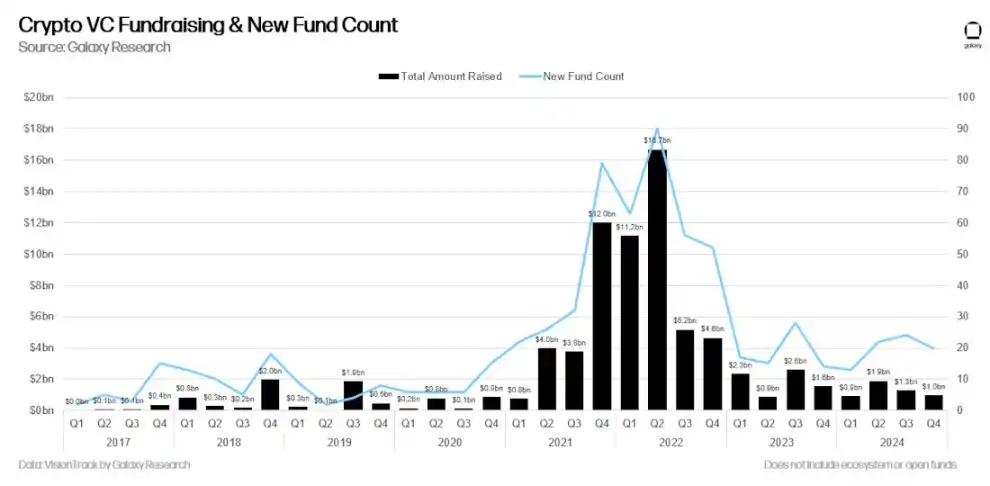
Source: Galaxy Research
In addition, there are also some psychological reasons that explain why venture capital is so attractive to LPs. I have analyzed this in detail in a previous article: The True Reason Venture Capital Prevails Over Liquidity in the Crypto Space.

Hangover Period (2022-2024): The Dilemma and Transformation of Crypto Venture Capital
Then, in quick succession came 2022: the Luna collapse, 3AC bankruptcy, FTX closure—billions of dollars in paper gains evaporated overnight.
Contrary to popular belief, most VCs did not cash out at the market peak. Like everyone else, they went through the market crash downturn together.
And now, they face two major challenges:
· Disappointed Limited Partners (LPs): LPs who once cheered for 100x returns are now demanding quick exits, putting pressure on the funds to de-risk early and lock in gains.
· Too Much Capital: There is a significant amount of untapped venture capital (dry powder) in the market, but high-quality projects are in short supply. Many funds, to meet investment thresholds and pave the way for the next funding round, choose to invest in economically unreasonable projects rather than return capital to LPs.
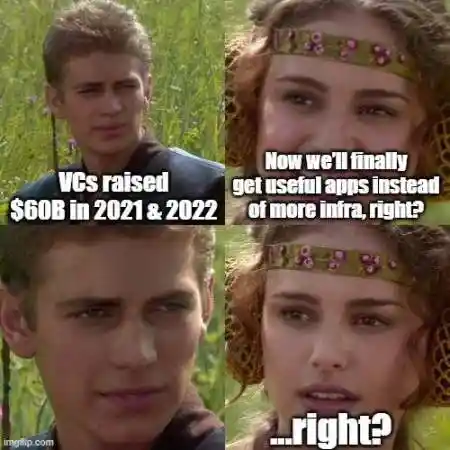
Today, most crypto VCs are in a dilemma: unable to raise new funds, holding a pile of low-quality projects destined to follow the "high FDV to zero" script. Under LP pressure, these VCs have shifted from long-term vision supporters to short-term exit chasers. They frequently sell off large-cap tokens supported by VCs (such as alternative L1s, L2s, and infrastructure tokens), whose high valuations were artificially inflated by themselves.
In other words, the incentive structure and timeframe of crypto VCs have undergone significant changes:
2020: VCs were contrarians, capital-constrained, focused on long-term development. 2024: VCs have become crowded, capital-abundant, and more short-sighted.
I believe that the performance of VC funds from 2021 to 2023 will mostly fall below expectations. VC returns follow a power-law distribution, where a few winners make up for the majority of losers. But due to forced early selling, this pattern will be disrupted, leading to overall weakened performance.
If you want to learn more about average venture capital returns, I have previously written a related article.
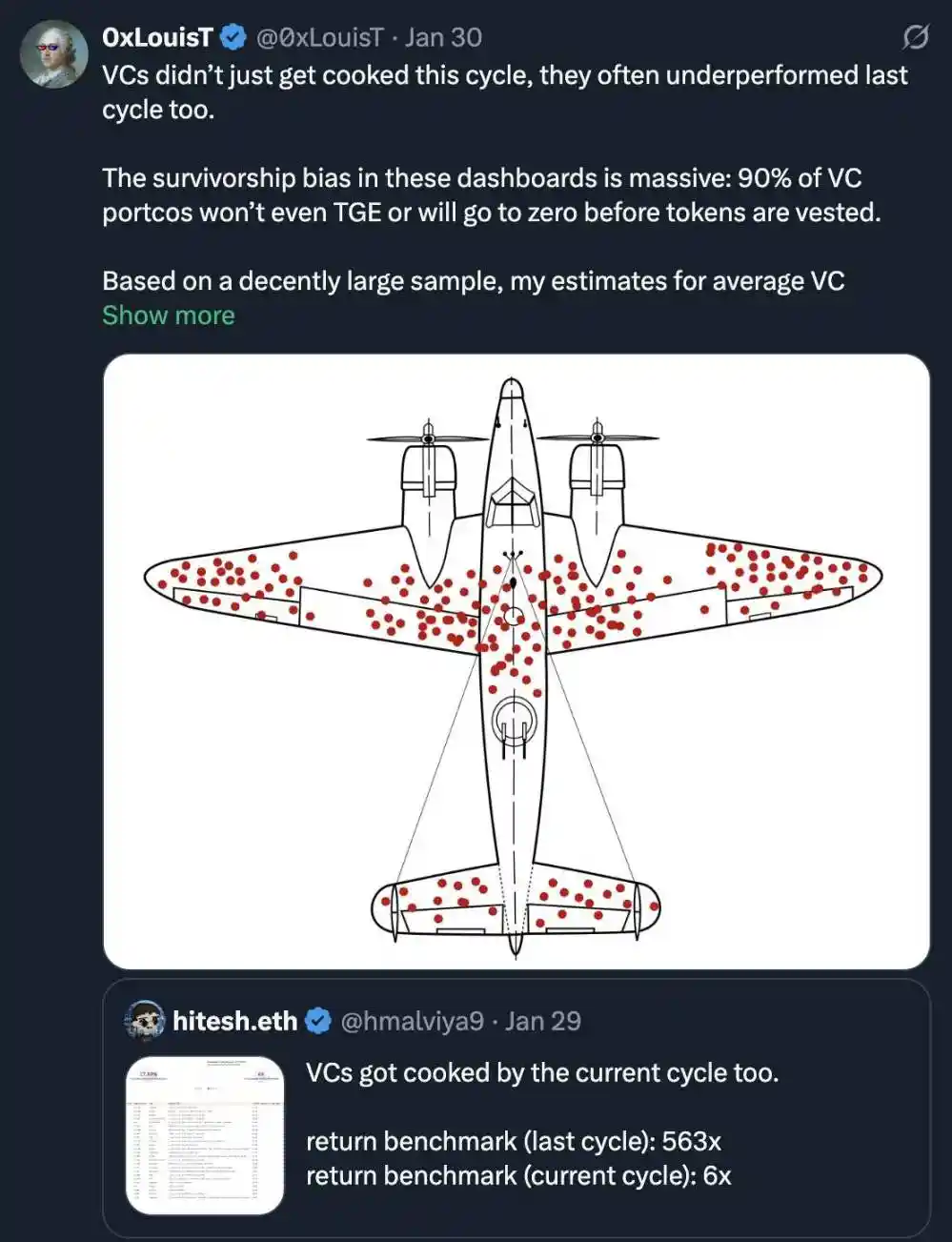
It is not difficult to understand why more and more founders and communities are skeptical of venture capital. The incentive structure and timeline of venture capital are not aligned with the founders' goals, leading to a shift in the following trends:
· Community-Driven Funding: Projects are more inclined to raise funds through community support rather than relying on venture capital.
· Long-Term Support with Liquidity: Compared to venture capital, liquidity is gradually becoming the primary source of long-term support for tokens.
Evaluating Liquidity / Venture Capital Cycles
Tracking the capital flow between venture funding and the liquid market is crucial. I use an indicator to assess the state of the venture capital market. While it is not perfect, it is very informative.
I assume that venture capital will linearly deploy 70% of its funds over three years—this seems to be the trend for most venture capital.
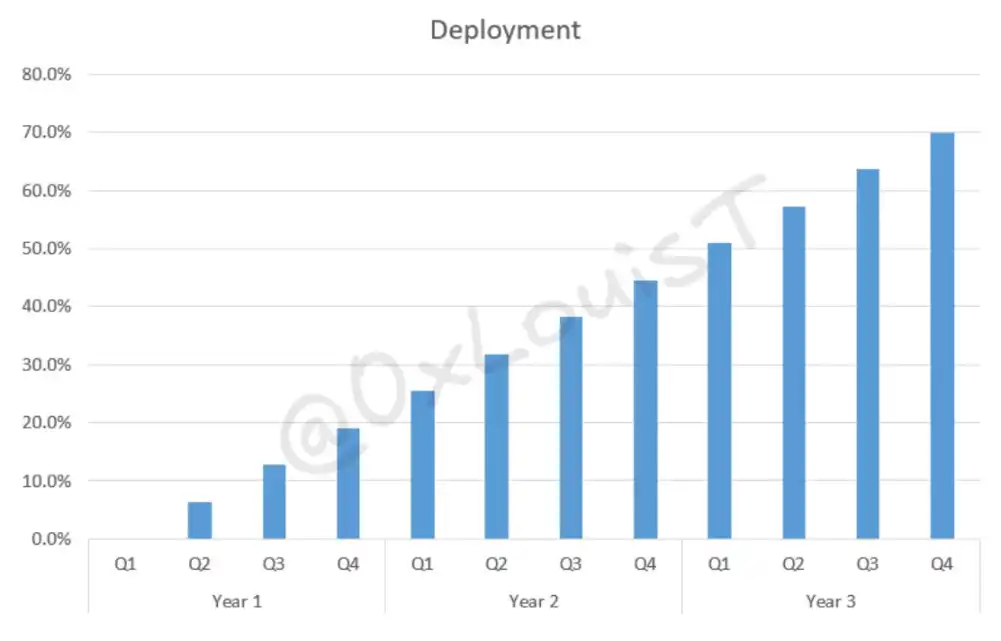
VC 3y Linear Deployment Visualization
Based on the venture capital fundraising data provided by @glxyresearch, I applied a weighted sum model, combining 16 quarters of deployment rates to estimate the remaining untapped funds (dry powder) in the system. By the fourth quarter of 2022, around $48 billion of venture capital funds remained undeployed. However, with a stall in new fundraising, this number has halved at least and continues to decrease.
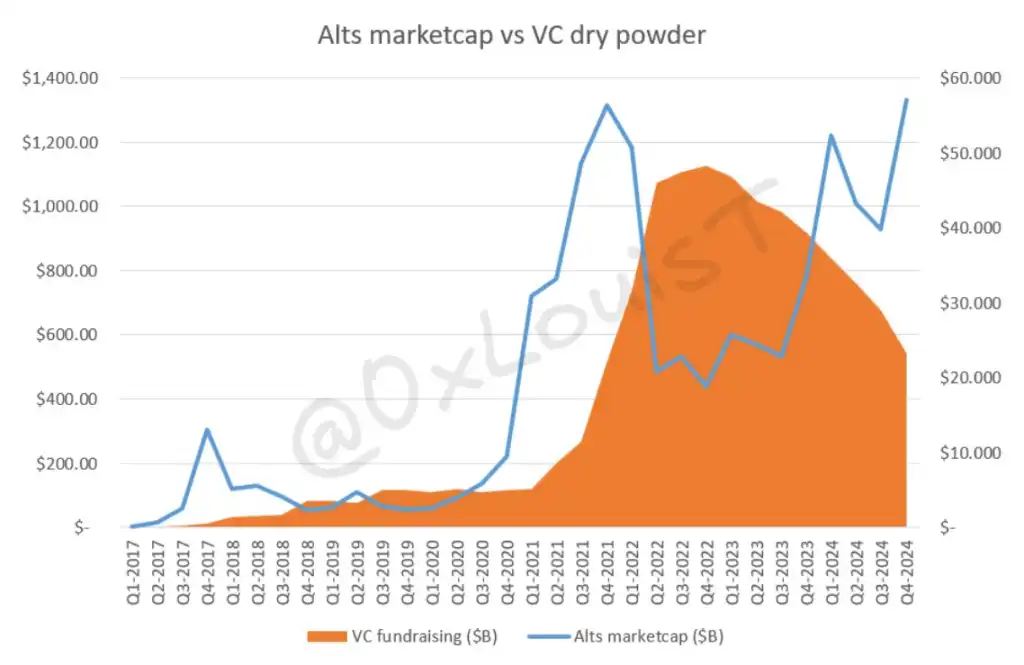
VC Undeployed Capital Visualization Chart
Next, I will compare the remaining venture capital funds each quarter with TOTAL2 (total crypto market cap excluding Bitcoin). Since venture capital typically invests in altcoins, TOTAL2 is the best proxy indicator. If venture capital funds are disproportionately high relative to TOTAL2, the market will not be able to absorb future token generation events (TGEs). Normalizing this data can reveal the cyclical nature of the liquidity/venture capital ratio.
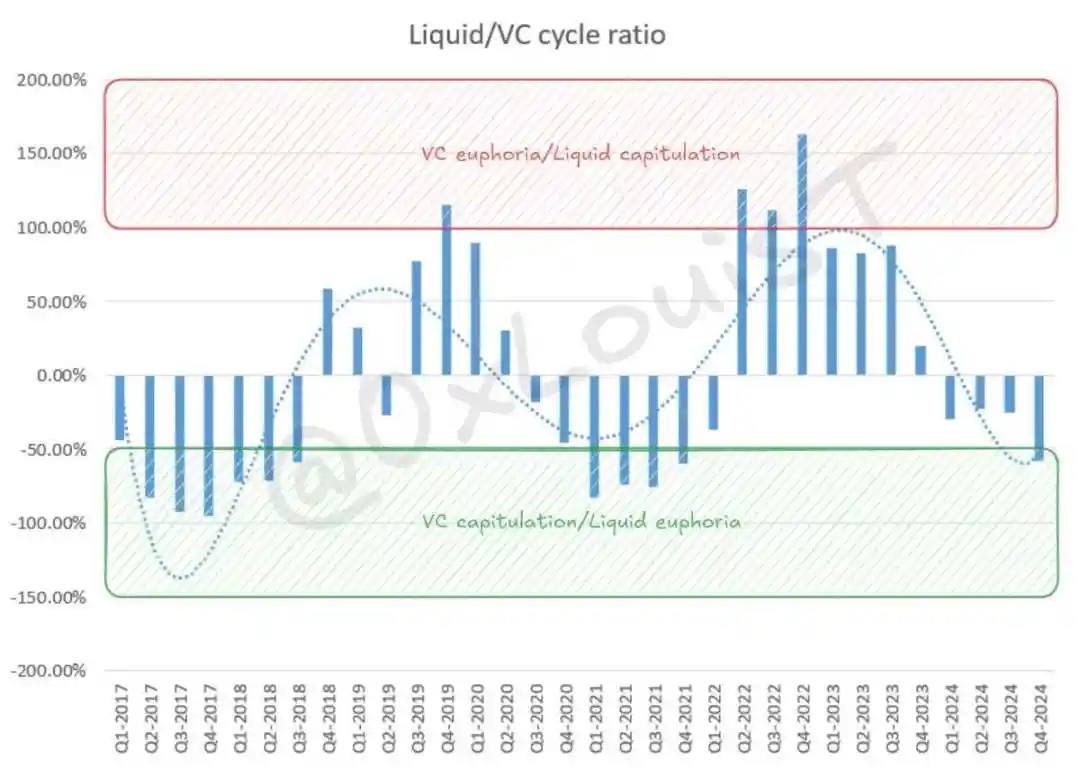
Crypto Venture Capital and the Liquid Market: Cyclical Patterns and Future Outlook
Usually, when in the "VC euphoria" range, the risk-adjusted return of the liquid market tends to outperform venture capital. The "VC capitulation" range, however, is more complex—it may signify VCs giving up or indicate an overheated liquid market.
Like all markets, crypto venture capital and the liquid market follow cyclical patterns. The excess capital accumulated in 2021/2022 is rapidly being depleted, making fundraising more challenging for founders. At the same time, cash-strapped VC firms are becoming more selective in trades and terms.

I will end it here, and the next article will delve deeper into the impact of this phenomenon on the liquid market.
Summary
In recent years, VC fund performance has been lackluster, with VC firms shifting towards short-term sell-offs to return capital to LPs. Many prominent crypto VC firms may not survive in the coming years.
The misalignment between VC firms and founders is driving founders to seek alternative financing channels.
The oversupply of VC capital has led to irrational resource allocation, and I will delve into this in detail in subsequent articles.
To be continued...
You may also like

Perp DEX: The Next Generation Exchange "War"

10 Counterintuitive Insights on Latin American Payments

The AI gamble of mining companies: Valuations enter a phase of differentiation, and it's hard to turn the tide

A letter from Alliance to entrepreneurs: Written on the occasion of Cursor selling for 60 billion dollars

Stablecoins Finally Find Real Returns: On-Chain Reinsurance Re Explained | Interview with Re Founder Karan Saroya

The impossible triangle is simply a pseudo problem

Will MicroStrategy fall into a death spiral? What will the macro trend be in the second half of the year?

Blockchain Capital Partner: The Core Secret of Arbitrage
STRC unanchored by 11%, can the perpetual motion machine of Strategy still operate?

Bitcoin Market Analysis 2026: Can BTC Reach $150K by Year-End?
Bitcoin ETF Outflows Hit a Record $4.4 Billion: What Are Traders Doing With Their Cash?
WEEX App Just Got Smarter – New Tabs for Faster Trades & Easy Asset Management

WEEX All-New Search Features: Find, Trade & Earn Faster Than Ever

Morning Report | Illinois signs the strictest digital asset tax law in the U.S.; RWA tokenization market size surpasses $43 billion, institutions accelerate the migration of on-chain assets
Full version of the debut Q&A! Federal Reserve Chairman Waller: Sticking to the 2% inflation target, establishing five special working groups, individual did not submit the dot plot

From Disruptor to Shadow Market: The Crypto Market is Becoming a Colony of Traditional Finance
Dalio's important long article: How to position in the current market environment?
OKX Star analyzes Binance's competitive advantages: when regulation levels the playing field, competition has just begun
Perp DEX: The Next Generation Exchange "War"
10 Counterintuitive Insights on Latin American Payments
The AI gamble of mining companies: Valuations enter a phase of differentiation, and it's hard to turn the tide
A letter from Alliance to entrepreneurs: Written on the occasion of Cursor selling for 60 billion dollars
Stablecoins Finally Find Real Returns: On-Chain Reinsurance Re Explained | Interview with Re Founder Karan Saroya
The impossible triangle is simply a pseudo problem


