
Upstream and downstream are starting to fight, all for the sake of everyone being able to "Lobster"

「What truly brings crab to the table of millions of households is not the first person who ate crab, but the chefs who are dedicated to making crab even more delicious.」
This quote is used to describe the rapid development caused by OpenClaw, and it couldn't be more appropriate. The novel AI species "Lobster" has created a new narrative of AI assistants/employees, elevating people's expectations and outlook on AI to a new level. However, due to its rapid popularity, a considerable number of newcomers to the "Lobster" are not deeply understanding it, so we also see news like this:
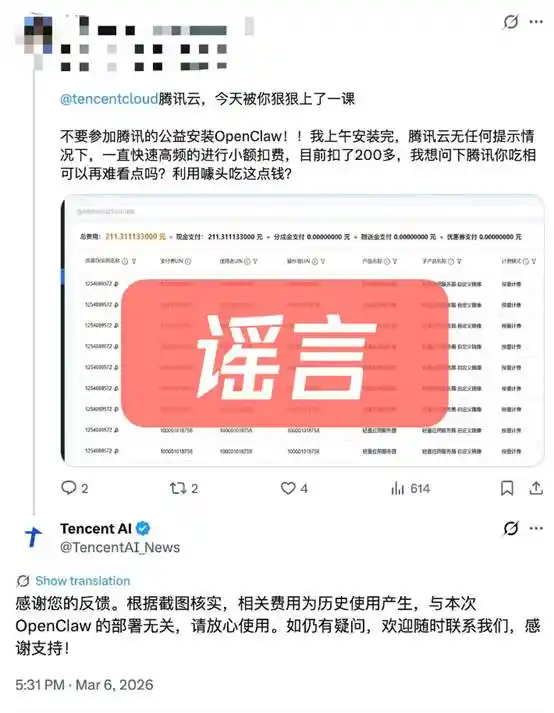
And the two new things that garnered widespread attention yesterday, Perplexity's Personal Computer and Base44's Superagents, have shown us a new trend that is rapidly brewing—from "Lobster" to "AI assistant," the narrative is quickly upgrading. People may soon no longer be entangled in "raising lobsters" because the arrival of mass-market, accessible AI assistants will happen even faster than we imagine.
Personal Computer
According to Perplexity, the Personal Computer is an AI assistant that combines Perplexity Computer and runs locally 24/7 on a device (Mac Mini). It can access local files, apps, and sessions on the Mac Mini, enabling a mode where an instruction is given to the device, and AI operates across files and apps, combining all local data to complete tasks.
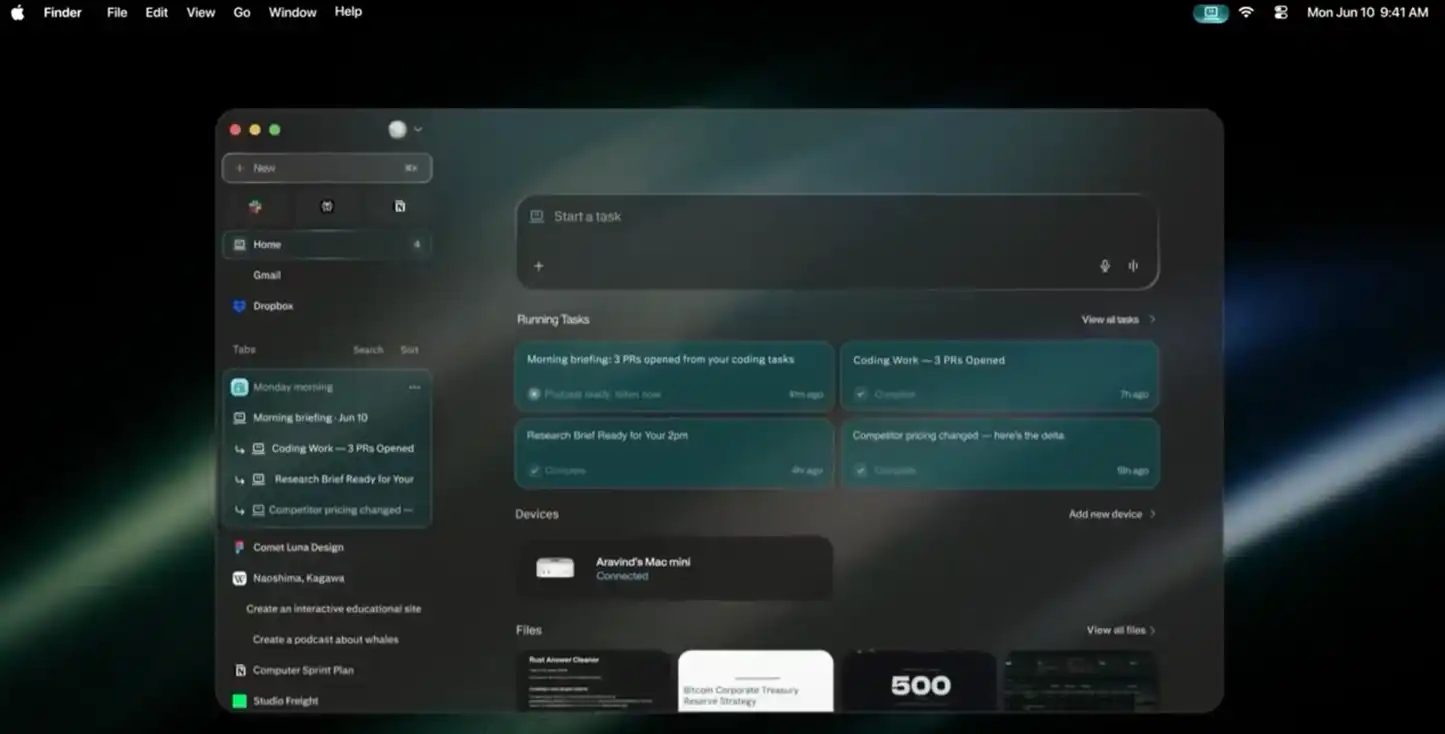
In terms of security, every sensitive operation requires user approval, all operations are logged, and there is a forced shutdown mechanism. At the same time, users can control the Personal Computer anytime, anywhere from any device, just like a boss in real life can direct employees' work anytime, anywhere.
Perplexity's previous work was AI-driven search and research tools. It does not have large models of its own but combines search engines and AI to generate responses, routing search queries to multiple models for in-depth research.
As a downstream application, when the "Lobster" brings a steady stream of revenue to upstream model providers, Perplexity, this AI search unicorn, with a valuation exceeding $20 billion, and its 2025 revenue estimated by many to exceed a billion dollars, can be said to have a unique position.
But they keenly grasped the pain point of "lobster farming," taking the lead in the "lobster use" track with a Personal Computer closer to a mature product form.
Superagents
If using a Personal Computer requires buying a Mac Mini, Base44's Superagents provide a cheaper option—without spending "Apple money" on local service, achieving the same effect directly through the browser.
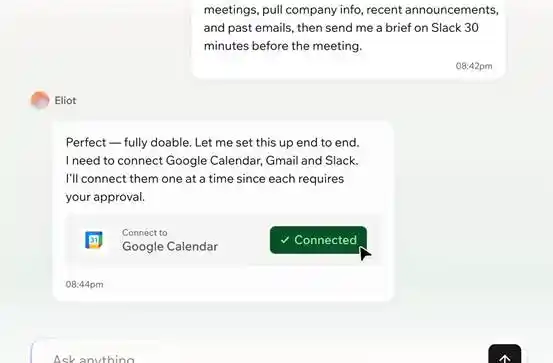
By using Superagents through a browser, connecting the app accounts that need to be managed to Superagents (such as the Google suite, Whatsapp, Telegram, Slack, and more), Superagents can autonomously work based on the user's task schedule.
Directly using an AI assistant through a webpage and app is definitely a major trend of the future.
Base44's annual recurring revenue has already exceeded one billion dollars, but the company was acquired by Wix for $80 million in June last year. Such a brilliant move seems unsurprising and expected in this AI era.
Domestic Tech Giants Have Also Taken Action Early
Prior to Perplexity and Base44, "lobster farming" had already brought a "golden age" to upstream large model manufacturers:
- Kimi's 20-day cumulative revenue exceeded the total revenue for the entire year of 2025, with a post-investment valuation breaking $10 billion directly from the $5 billion C-round financing completed on December 31, 2025.
- Minimax had an annual total revenue of approximately $79 million in 2025, with a massive loss of up to $1.872 billion for the year. However, its ARR (Annual Recurring Revenue) for just one month in February this year exceeded $150 million, with the company's monthly subscription volume surpassing the total revenue for all of 2025. Since its Hong Kong stock market listing in January, the stock price has more than doubled, and the market value has surpassed Baidu.
- Zhipu also listed on the Hong Kong stock market in January this year, in a burning cash loss state as well. However, at its peak, the stock price increased more than five times compared to the listing price, and the market value once exceeded Baidu's.
However, the deployment, use, and maintenance barriers of "Lobster" itself have significantly hindered the general public from transforming the novelty and enthusiasm of "raising lobsters" into practical use. It has not easily evolved into a mature, consumer-friendly product. Similar to Google's Nexus phones with the most native Android system, but most people are not custom ROM enthusiasts; they just find the native Android experience too primitive compared to various major manufacturers' customized Android.
Whether it is the domestic large-scale model giants thriving in the token industry or other domestic major factories that are less prominent in the "Lobster" craze, everyone seems to have realized this — the true significance of "Lobster" is actually opening up the "AI Assistant" track at the user awareness level. Various devices around the general public, from large (car infotainment systems) to small (a smart desk lamp on a desk), in the future, AI's integration into our lives is not just a more advanced and efficient search and answering tool but plays a role in all aspects of work and life.
This reminds me of when Wi-Fi was not yet widely available, and people would think whether a phone had Wi-Fi capability was irrelevant because even if it did, there might not necessarily be a hotspot to connect to. However, the march of time and technology development do not pause for any manufacturer. What may seem like a "nice-to-have" now could be an irrecoverable market share loss in the future.
Therefore, not only overseas projects like Perplexity and Base44, when the English-speaking community is excited about these two projects, the domestic layout has long been underway. Various major manufacturers have successively integrated "Lobster" into their own ecosystems:
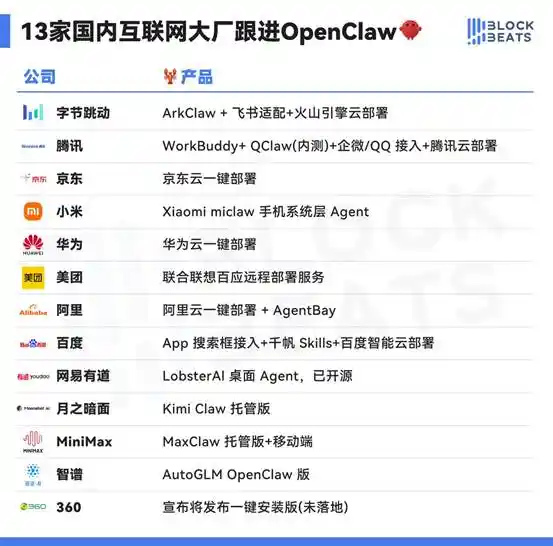
Users only need to have and use a handy AI assistant/employee through a daily high-frequency channel (such as WeChat, QQ, Feishu, Baidu search, etc.), and whether this employee is called "Lobster" is not important.
Conclusion
The general public is not AI experts, and it's also challenging to make everyone understand the pros and cons of large models. They may not even grasp what cross-application or contextual means. However, for technology to mature into a product form, it needs to permeate everyone's lives and become commonplace for everyone.
Just like how in the 3G era, we might have thought that even faster mobile internet was useless, but now we are used to watching various high-definition, and even 4K, content on our phones.
Everyone can become a boss, directing AI as their own employee, era. From asking AI for things to having AI do things for them, this significant user experiential change is initiated by "Lobster" and will also be meticulously packaged by various major manufacturers in the market into a truly user-oriented "delicacy."
AI has become a part of everyone's life, and this era has already begun. Upstream and downstream AI vendors are also about to start fighting for this era of transformation.
You may also like

Morning Report | OpenAI has submitted an S-1 registration statement draft to the U.S. SEC; Morpho completes $175 million financing

Galaxy Deep Research Report: How Hyperliquid's HIP-4 Upgrade Changes the Landscape of Prediction Markets?

Latest research from 13 top universities including Cornell University: The current state, challenges, and misconceptions of the fusion of Crypto and AI

Deconstructing Anthropic: The Best AI Company, Possibly Also a Type of Organizational Invention

Every exchange is a "Universal Exchange."

The counterattack of traditional finance: Alliance chains are quietly reviving
Pantera Capital Partner: How Tokenization is Restructuring the Private Equity and Early Investment Ecosystem?

Mastercard Launches Agent Pay for AI, Plans to Record AI Agent Payment Authorizations on Polygon
Mastercard launched Agent Pay for AI, a new payment protocol designed to help AI agents make small payments such as pay-per-use access to data and APIs. The system plans to record human-granted AI agent permissions on Polygon, focusing on verifiable authorization, identity, and payment controls.

Curve Deploys Llamalend v2 on Optimism With 250,000 OP Incentives
Curve launched Llamalend v2 on Optimism with 250,000 OP incentives from the Optimism Foundation. The upgrade expands Llamalend beyond its earlier crvUSD-focused model, adding broader collateral support, LlamaRisk market reviews, and the ability to use Curve LP tokens as collateral.

Raydium Old Liquidity Pool Reportedly Exploited, With $1.34 Million Moved to Ethereum and Tornado Cash
An old Raydium liquidity pool was reportedly exploited for around $1.34 million in USDC, RAY, and wSOL, with the stolen funds bridged to Ethereum and deposited into Tornado Cash. The incident highlights the tail risks of legacy DeFi pools, old contracts, and cross-chain fund laundering paths.
Kalshi Executive Challenges “SBF Backed AI Unicorns” Narrative, Says Leopold Aschenbrenner Was Key Figure
Kalshi executive John Wang questioned the “SBF backed AI unicorns” narrative, saying Leopold Aschenbrenner was the key figure behind major AI investment decisions.

New York Proposes Stricter Stablecoin Issuer Rules Aligned With Federal GENIUS Act
NYDFS proposed stricter stablecoin issuer rules aligned with the GENIUS Act, covering reserves, custody, redemption timelines, audits, and capital buffers.

CryptoQuant Says Bitcoin Profitable Supply Is Near 45% Pressure Zone as On-Chain Data Points to Market Repricing
CryptoQuant said Bitcoin’s profitable supply is nearing the 45% pressure zone, signaling rising market stress, unrealized losses, and a possible on-chain repricing phase.

Bitcoin Falls Below 200-Week Moving Average as On-Chain Data Shows Over Half of Supply in Loss
Bitcoin dropped below its 200-week moving average as on-chain data showed over 50% of circulating supply is now in loss, signaling rising market stress.

CFTC Reportedly Plans New Prediction Market Rules Focused on Manipulation Risk and Public Interest Review
The CFTC is reportedly preparing new prediction market rules focused on manipulation risk, public interest review, and retail trader protections.

Meet the new WEEX trial fund—your gateway to greater profits

WEEX Labs Lands at Dutch Blockchain Week: A Disruptive Crypto × AI Conversation Sets Sail in Amsterdam
SK Hynix Reportedly Plans U.S. ADR Listing as Early as August, With SEC Approval Possible in Late June
SK Hynix may pursue a U.S. ADR listing as early as August, with SEC approval reportedly possible in late June amid strong AI chip supply chain demand.
Morning Report | OpenAI has submitted an S-1 registration statement draft to the U.S. SEC; Morpho completes $175 million financing
Galaxy Deep Research Report: How Hyperliquid's HIP-4 Upgrade Changes the Landscape of Prediction Markets?
Latest research from 13 top universities including Cornell University: The current state, challenges, and misconceptions of the fusion of Crypto and AI
Deconstructing Anthropic: The Best AI Company, Possibly Also a Type of Organizational Invention
Every exchange is a "Universal Exchange."
The counterattack of traditional finance: Alliance chains are quietly reviving


