
Two days later, Microsoft, holding $784 billion, will decide whether to invest in BTC
Original Article Title: "After 36 Hours, Microsoft Holding $78.4 Billion Will Decide Whether to Invest in BTC"
Original Article Author: Azuma, Odaily Planet Daily
On December 10th at 8:30 AM PST (December 11th at 0:30 AM Beijing Time), Microsoft will advance a significant shareholder proposal regarding Bitcoin—namely, to assess through a shareholder vote whether adding Bitcoin to the balance sheet is in the long-term interests of the shareholders. With BTC hovering around $100,000, this vote is widely regarded by the market as another key event this week that will impact the cryptocurrency market, in addition to the CPI and the situation in South Korea.
Background of the Proposal
The shareholder proposal was initially submitted by the American conservative think tank, the National Center for Public Policy Research (NCPPR).
At that time, NCPPR's rationale was that during a period of ongoing inflation, a company's success depends not only on its operational performance but also on its profit preservation. According to the Consumer Price Index (CPI), the average inflation rate in the United States over the past four years has been 5% (NCPPR believes the actual inflation rate may be higher). Therefore, in addition to increasing profits, companies have a fiduciary responsibility to protect profits from devaluation. However, as Microsoft has most of its assets invested in US government securities and corporate bonds, it has not been able to effectively protect its assets from devaluation.
NCPPR emphasized in the proposal that although Bitcoin has a certain level of volatility, "Bitcoin is still an excellent, even the best, hedge against inflation," therefore recommending that Microsoft consider allocating at least 1% of its assets to Bitcoin.
According to documents now filed with the US Securities and Exchange Commission (SEC), the proposal is expected to be subject to shareholder voting on December 10th, along with several other proposals.
Will the Vote Pass?
While the cryptocurrency community is highly anticipating this vote, the approval of the proposal by Microsoft's shareholders still remains uncertain, considering the current situation.
In the documents submitted to the SEC, the Microsoft board of directors clearly expressed opposition to the proposal, citing that the Microsoft management had previously evaluated this topic but believed that corporate funds require stable and predictable investments to ensure liquidity and operational capital.
While the upper echelon has already made its stance clear, key organizations/personalities supporting this proposal are actively advocating for it, attempting to drive the proposal's implementation.
On one hand, BlackRock, holding a 7% stake in Microsoft, is expected to directly participate in the vote with a high likelihood of casting a supporting vote; MicroStrategy's co-founder Michael Saylor has also presented a 44-page PPT to Microsoft's CEO Satya Nadella and board, emphasizing the changing Bitcoin regulatory landscape in hopes of influencing Microsoft's top management.
On the other hand, atop the Reddit forums known for their radical inclinations, there is a significant number of proposal supporters actively urging Microsoft's mid and small-scale shareholders to cast affirmative votes.
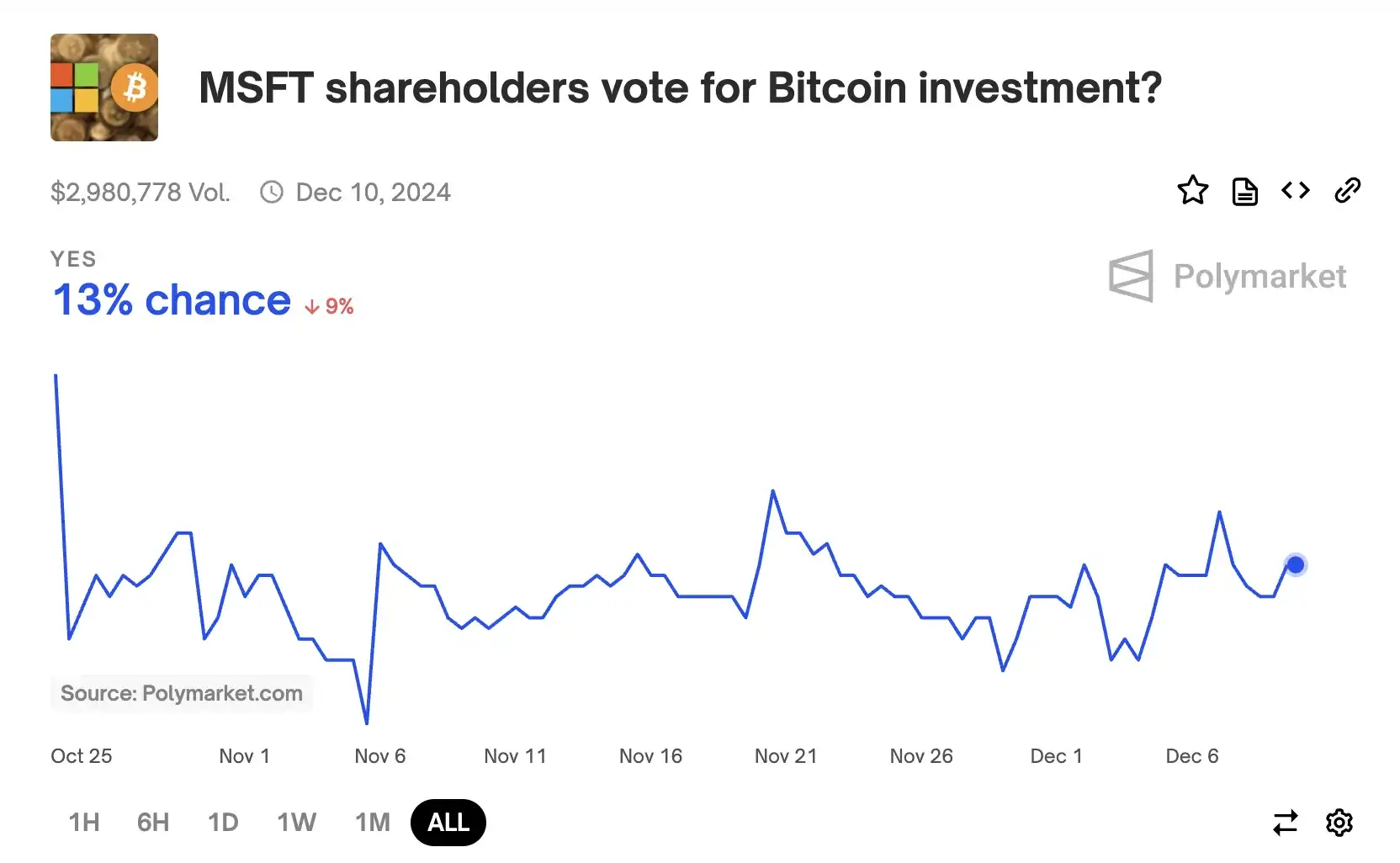
However, despite these efforts, the market outlook for the proposal's approval remains bleak. Real-time prediction market data from Polymarket indicates a mere 13% probability of the proposal's success.
If Approved, How Significant Would the Potential Buy-side Pressure Be?
Although the voting outcome remains uncertain, we can still glean an initial insight into how much buying power Microsoft could wield to purchase BTC postulated if the proposal goes through by examining Microsoft's reserves.
According to Macrotrends data, as of September 30, 2024, Microsoft's cash reserves amount to $78.428 billion.
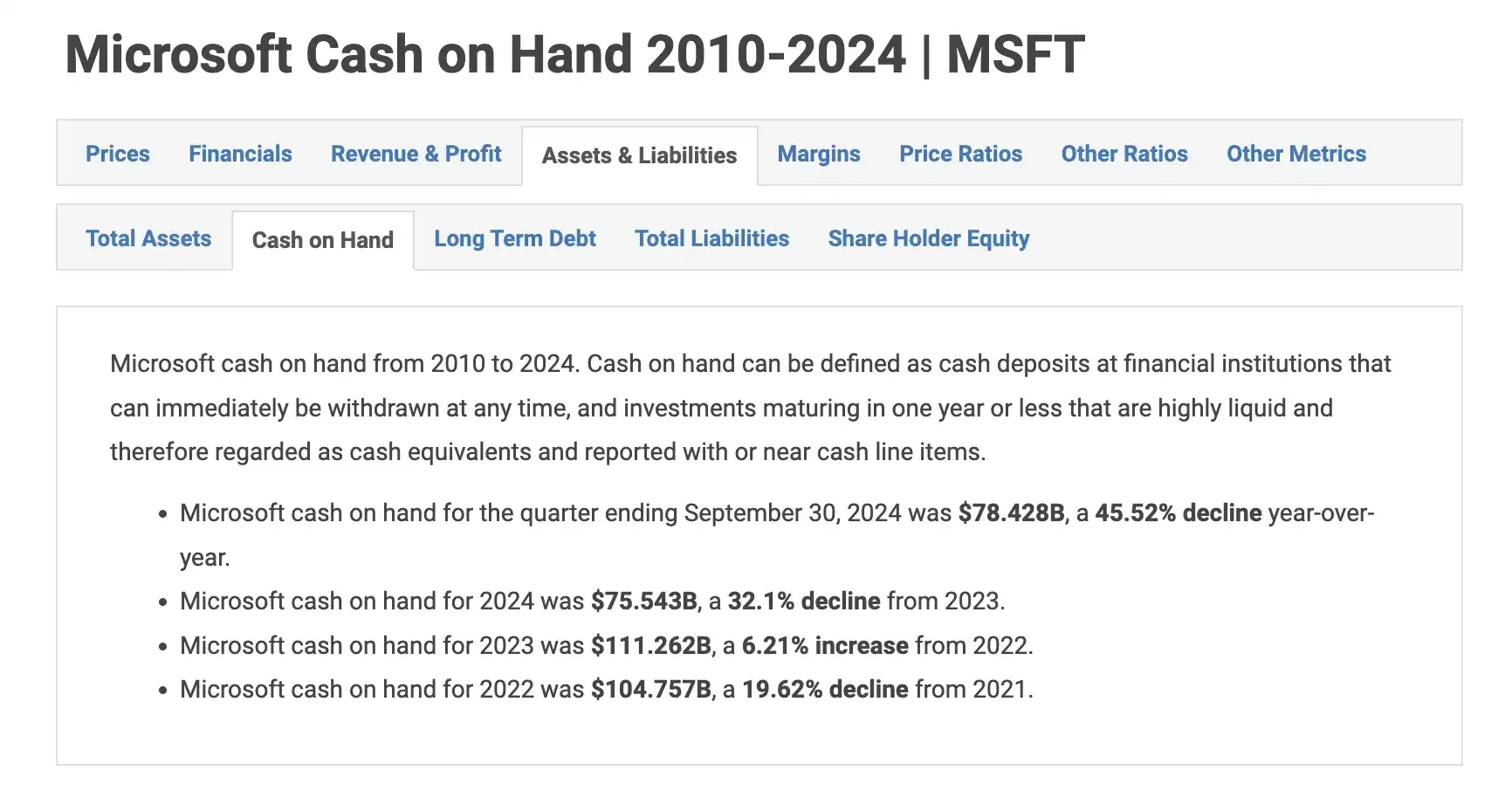
This implies that if the proposal is successfully approved and the funds are allocated as suggested by NCPPR, at least 1% of the funds, this would translate to a buy-side pressure of at least $7.8 billion.
NCPPR Continues Its Efforts, Is Amazon Next After Microsoft?
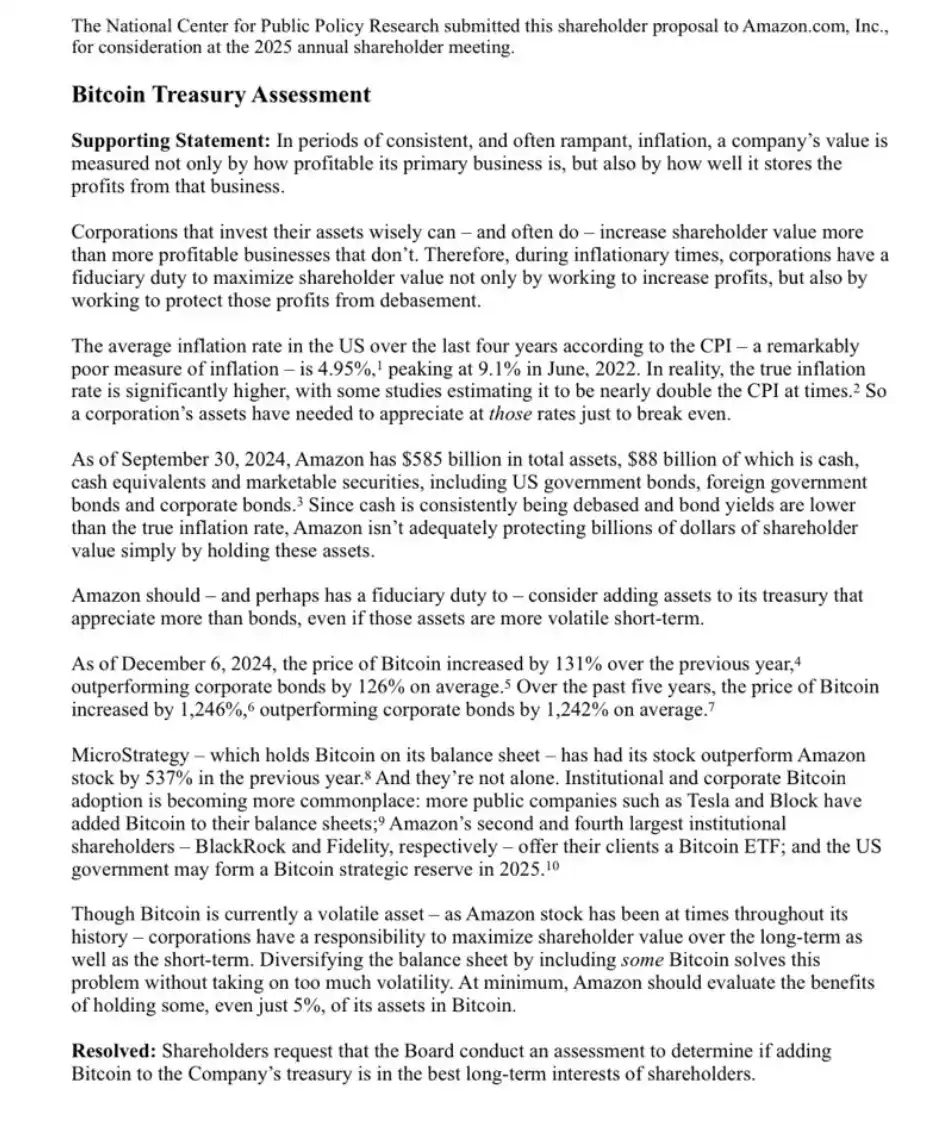
This morning, NCPPR once again submitted a similar shareholder proposal to another tech behemoth, Amazon, proposing Amazon evaluate incorporating Bitcoin into the company's asset reserves. This time, NCPPR suggests Amazon allocate at least 5% of its total assets.
CZ also commented on this development through his personal X account, inquiring when Amazon would start accepting Bitcoin payments.
While the SEC has not yet outlined the progression of this proposal, Jubilee Royalty's founder and CEO Tim Kotzman has stated that the related announcement is expected to be made in April 2025 and may be deliberated at the 2025 annual shareholders' meeting.
From the already involved MicroStrategy and Tesla, to the potentially involved Microsoft and Amazon, the pace of Bitcoin's expansion into the mainstream world seems to be accelerating. Although the upcoming Microsoft event is unlikely to immediately endorse this vote, from a trend perspective, it may just be a matter of time.
You may also like

Why can this institution still grow by 150% when the scale of leading crypto VCs has shrunk significantly?

Anthropic's $1 trillion, compared to DeepSeek's $100 billion

Geopolitical Risk Persists, Is Bitcoin Becoming a Key Barometer?

Annualized 11.5%, Wall Street Buzzing: Is MicroStrategy's STRC Bitcoin's Savior or Destroyer?

An Obscure Open Source AI Tool Alerted on Kelp DAO's $292 million Bug 12 Days Ago

Mixin has launched USTD-margined perpetual contracts, bringing derivative trading into the chat scene.
The privacy-focused crypto wallet Mixin announced today the launch of its U-based perpetual contract (a derivative priced in USDT). Unlike traditional exchanges, Mixin has taken a new approach by "liberating" derivative trading from isolated matching engines and embedding it into the instant messaging environment.
Users can directly open positions within the app with leverage of up to 200x, while sharing positions, discussing strategies, and copy trading within private communities. Trading, social interaction, and asset management are integrated into the same interface.
Based on its non-custodial architecture, Mixin has eliminated friction from the traditional onboarding process, allowing users to participate in perpetual contract trading without identity verification.
The trading process has been streamlined into five steps:
· Choose the trading asset
· Select long or short
· Input position size and leverage
· Confirm order details
· Confirm and open the position
The interface provides real-time visualization of price, position, and profit and loss (PnL), allowing users to complete trades without switching between multiple modules.
Mixin has directly integrated social features into the derivative trading environment. Users can create private trading communities and interact around real-time positions:
· End-to-end encrypted private groups supporting up to 1024 members
· End-to-end encrypted voice communication
· One-click position sharing
· One-click trade copying
On the execution side, Mixin aggregates liquidity from multiple sources and accesses decentralized protocol and external market liquidity through a unified trading interface.
By combining social interaction with trade execution, Mixin enables users to collaborate, share, and execute trading strategies instantly within the same environment.
Mixin has also introduced a referral incentive system based on trading behavior:
· Users can join with an invite code
· Up to 60% of trading fees as referral rewards
· Incentive mechanism designed for long-term, sustainable earnings
This model aims to drive user-driven network expansion and organic growth.
Mixin's derivative transactions are built on top of its existing self-custody wallet infrastructure, with core features including:
· Separation of transaction account and asset storage
· User full control over assets
· Platform does not custody user funds
· Built-in privacy mechanisms to reduce data exposure
The system aims to strike a balance between transaction efficiency, asset security, and privacy protection.
Against the background of perpetual contracts becoming a mainstream trading tool, Mixin is exploring a different development direction by lowering barriers, enhancing social and privacy attributes.
The platform does not only view transactions as execution actions but positions them as a networked activity: transactions have social attributes, strategies can be shared, and relationships between individuals also become part of the financial system.
Mixin's design is based on a user-initiated, user-controlled model. The platform neither custodies assets nor executes transactions on behalf of users.
This model aligns with a statement issued by the U.S. Securities and Exchange Commission (SEC) on April 13, 2026, titled "Staff Statement on Whether Partial User Interface Used in Preparing Cryptocurrency Securities Transactions May Require Broker-Dealer Registration."
The statement indicates that, under the premise where transactions are entirely initiated and controlled by users, non-custodial service providers that offer neutral interfaces may not need to register as broker-dealers or exchanges.
Mixin is a decentralized, self-custodial privacy wallet designed to provide secure and efficient digital asset management services.
Its core capabilities include:
· Aggregation: integrating multi-chain assets and routing between different transaction paths to simplify user operations
· High liquidity access: connecting to various liquidity sources, including decentralized protocols and external markets
· Decentralization: achieving full user control over assets without relying on custodial intermediaries
· Privacy protection: safeguarding assets and data through MPC, CryptoNote, and end-to-end encrypted communication
Mixin has been in operation for over 8 years, supporting over 40 blockchains and more than 10,000 assets, with a global user base exceeding 10 million and an on-chain self-custodied asset scale of over $1 billion.

$600 million stolen in 20 days, ushering in the era of AI hackers in the crypto world

Vitalik's 2026 Hong Kong Web3 Summit Speech: Ethereum's Ultimate Vision as the "World Computer" and Future Roadmap

On the same day Aave introduced rsETH, why did Spark decide to exit?

Full Post-Mortem of the KelpDAO Incident: Why Did Aave, Which Was Not Compromised, End Up in Crisis Situation?

After a $290 million DeFi liquidation, is the security promise still there?

ZachXBT's post ignites RAVE nearing zero, what is the truth behind the insider control?

Vitalik 2026 Hong Kong Web3 Carnival Speech Transcript: We do not compete on speed; security and decentralization are the core

In-depth Analysis of RAVE Events: Short Squeeze, Crash, and Quantitative Financial Models of Liquidity Manipulation

Eve of Ceasefire, US Military Fires on Iranian Vessel | Rewire News Morning Brief

Figma's stock price drops over 7%, will Claude Design be the terminator?

Plunge by 10% Followed by Rebound, Weekend Oil Market Watch

SpaceX Mascot ASTEROID Fast Track $170 million, Stemming from an Unfinished Space Dream
Why can this institution still grow by 150% when the scale of leading crypto VCs has shrunk significantly?
Anthropic's $1 trillion, compared to DeepSeek's $100 billion
Geopolitical Risk Persists, Is Bitcoin Becoming a Key Barometer?
Annualized 11.5%, Wall Street Buzzing: Is MicroStrategy's STRC Bitcoin's Savior or Destroyer?
An Obscure Open Source AI Tool Alerted on Kelp DAO's $292 million Bug 12 Days Ago
Mixin has launched USTD-margined perpetual contracts, bringing derivative trading into the chat scene.
The privacy-focused crypto wallet Mixin announced today the launch of its U-based perpetual contract (a derivative priced in USDT). Unlike traditional exchanges, Mixin has taken a new approach by "liberating" derivative trading from isolated matching engines and embedding it into the instant messaging environment.
Users can directly open positions within the app with leverage of up to 200x, while sharing positions, discussing strategies, and copy trading within private communities. Trading, social interaction, and asset management are integrated into the same interface.
Based on its non-custodial architecture, Mixin has eliminated friction from the traditional onboarding process, allowing users to participate in perpetual contract trading without identity verification.
The trading process has been streamlined into five steps:
· Choose the trading asset
· Select long or short
· Input position size and leverage
· Confirm order details
· Confirm and open the position
The interface provides real-time visualization of price, position, and profit and loss (PnL), allowing users to complete trades without switching between multiple modules.
Mixin has directly integrated social features into the derivative trading environment. Users can create private trading communities and interact around real-time positions:
· End-to-end encrypted private groups supporting up to 1024 members
· End-to-end encrypted voice communication
· One-click position sharing
· One-click trade copying
On the execution side, Mixin aggregates liquidity from multiple sources and accesses decentralized protocol and external market liquidity through a unified trading interface.
By combining social interaction with trade execution, Mixin enables users to collaborate, share, and execute trading strategies instantly within the same environment.
Mixin has also introduced a referral incentive system based on trading behavior:
· Users can join with an invite code
· Up to 60% of trading fees as referral rewards
· Incentive mechanism designed for long-term, sustainable earnings
This model aims to drive user-driven network expansion and organic growth.
Mixin's derivative transactions are built on top of its existing self-custody wallet infrastructure, with core features including:
· Separation of transaction account and asset storage
· User full control over assets
· Platform does not custody user funds
· Built-in privacy mechanisms to reduce data exposure
The system aims to strike a balance between transaction efficiency, asset security, and privacy protection.
Against the background of perpetual contracts becoming a mainstream trading tool, Mixin is exploring a different development direction by lowering barriers, enhancing social and privacy attributes.
The platform does not only view transactions as execution actions but positions them as a networked activity: transactions have social attributes, strategies can be shared, and relationships between individuals also become part of the financial system.
Mixin's design is based on a user-initiated, user-controlled model. The platform neither custodies assets nor executes transactions on behalf of users.
This model aligns with a statement issued by the U.S. Securities and Exchange Commission (SEC) on April 13, 2026, titled "Staff Statement on Whether Partial User Interface Used in Preparing Cryptocurrency Securities Transactions May Require Broker-Dealer Registration."
The statement indicates that, under the premise where transactions are entirely initiated and controlled by users, non-custodial service providers that offer neutral interfaces may not need to register as broker-dealers or exchanges.
Mixin is a decentralized, self-custodial privacy wallet designed to provide secure and efficient digital asset management services.
Its core capabilities include:
· Aggregation: integrating multi-chain assets and routing between different transaction paths to simplify user operations
· High liquidity access: connecting to various liquidity sources, including decentralized protocols and external markets
· Decentralization: achieving full user control over assets without relying on custodial intermediaries
· Privacy protection: safeguarding assets and data through MPC, CryptoNote, and end-to-end encrypted communication
Mixin has been in operation for over 8 years, supporting over 40 blockchains and more than 10,000 assets, with a global user base exceeding 10 million and an on-chain self-custodied asset scale of over $1 billion.

