
 Buy Crypto
- Markets
 Futures
- Spot
- Copy Trade
- Earn
- More
The "Ultimate BOSS" hidden behind Virtuals, why can G.A.M.E hit a new high against the odds?

Original Composition: zhouzhou ; blockbeat
Today, the market cap of GAME has reached a peak of $1.938 billion, with a trading volume exceeding $4 million. As a crucial infrastructure token in the Virtual ecosystem, the potential of GAME has finally been discovered by the market, sparking intense attention.
For a long time, the total market cap of Virtual has surpassed $25 billion, but the core driving force, GAME, has rarely been mentioned. It wasn't until today that GAME's strong performance brought it from behind the scenes to the forefront, becoming the focus of investor discussions.
Next, we will delve into the core value and ecosystem role of GAME, understanding why it can become a key part of the next-generation AI society and the additional opportunities it may bring in the future.
The "Brain" of the Virtuals Ecosystem
Simply put, GAME is the "brain" of AI Agents. AI Agents are software programs that can autonomously accomplish tasks, make independent decisions, and continuously learn through interaction. GAME is responsible for processing decisions and outputs, making agents smarter and more unique. It is a decision engine based on a foundational model that can be used for agents in different environments and platforms, which can also be integrated into games.
Have you ever played a role-playing game (RPG)? These games are full of script-based character operations, and players' experiences are essentially the same. But if these NPCs (non-player characters) become AI Agents, the game experience will be more dynamic, able to change based on player decisions and gameplay styles. As a result, each game will be unique. G.A.M.E provides the technological support to achieve this experience, and there are already practical application cases.
Through GAME, you can set goals, personalities, and define actions and functions for agents in various environments. It is important to note that GAME is an add-on component and is not integrated by default into every agent.
AI Agents are likely to become the dominant area of this industry cycle, and the Virtuals ecosystem holds an excellent position in this field, currently accounting for 24% of the entire AI Agents ecosystem market cap.
GAME Highlights:
1. Developed by the Virtuals team, reducing the risk of rug pulls.
2. Project Westworld: The first playable metaverse on Roblox, launched two months ago, with technical support provided by GAME.
3. Potential Market Size: Apart from video games, G.A.M.E.'s applicability can also extend to any environment with intelligent agents.
4. Data Performance: G.A.M.E.'s Lifetime Inferences ranks second in the Virtuals Protocol, with over 329,000 occurrences. Luna (one of Virtuals' top protocols) extensively utilizes G.A.M.E.
5. Ongoing Upgrades: The Virtuals team recently added new features to the G.A.M.E. framework, such as browsing the internet and real-time token information retrieval.
How GAME Works
As the "brain" of the virtual agent, GAME is divided into two core parts:
1. High-Level Planner (HLP)
• The HLP is the core brain of the agent.
• It formulates strategies and tasks based on the agent's personality, state, and environment to help achieve goals.
• Simply put: the HLP is responsible for "big-picture planning," deciding "what to do."
2. Low-Level Planner (LLP)
• The LLP is responsible for execution.
• It selects specific actions or tools to accomplish tasks based on the plan formulated by the HLP.
• Simply put: the LLP is the "hand" that executes the "brain's" instructions.
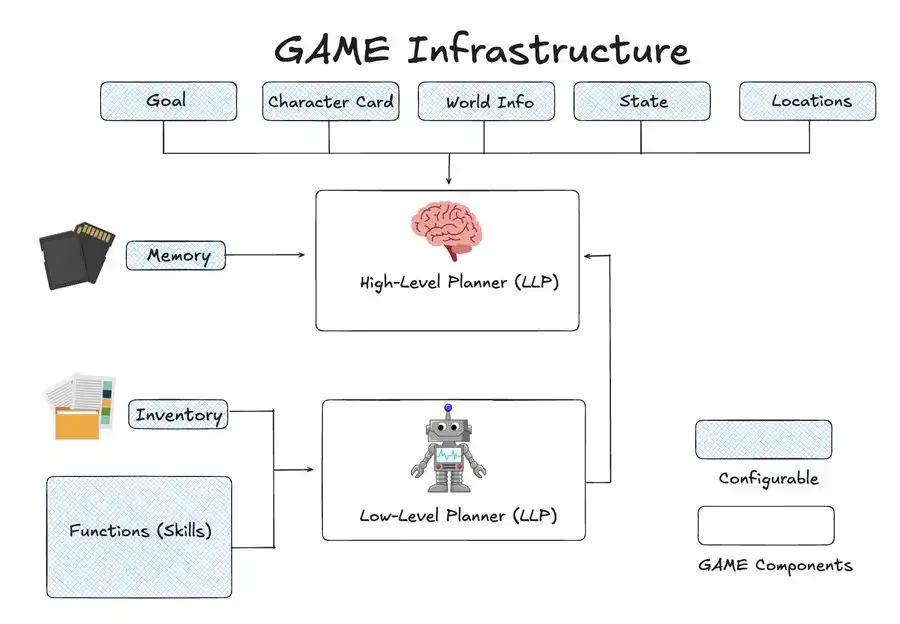
GAME's core focus is to provide developers with an efficient, open framework that makes developing and deploying AI agents as simple as building a website on WordPress. Through the Virtuals Protocol, developers can quickly build and deploy agents, and also achieve tokenization through IAO (Initial Agent Offering). This decentralized model paves the way for the future of social and gaming ecosystems.
GAME is now fully open, allowing developers to seamlessly integrate AI agents into various third-party applications and virtual worlds using its SDK. At the same time, community members can contribute feature-rich PRs to improve the codebase, collectively enhance the framework, share resources, and drive ecosystem growth. Whether agents are already completed or in the pre-release stage, they can easily be configured and flexibly applied on the Virtuals platform.
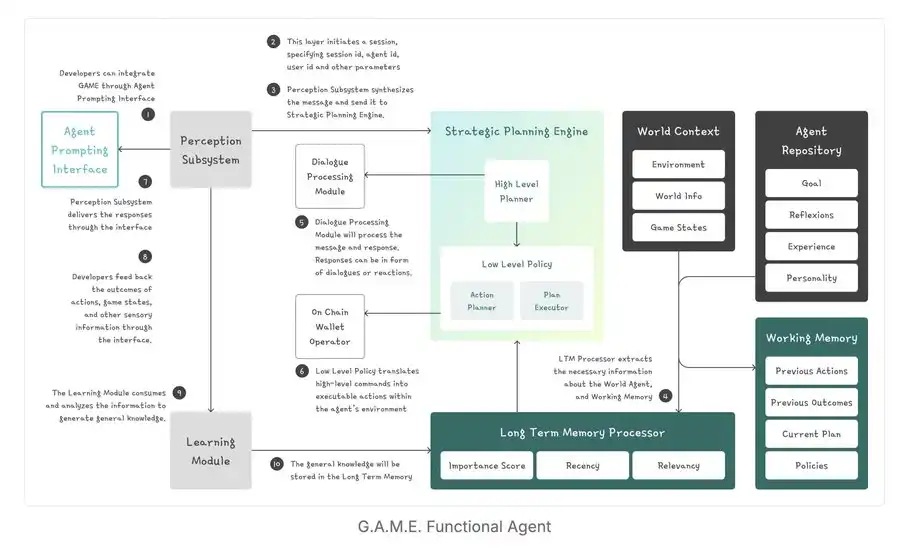
The GAME ecosystem revolves around the Virtuals Protocol to create a powerful flywheel effect. Serving as the infrastructure for building an AI society, this framework has the potential to surpass the current internet and usher in a new era of virtual sociality. Currently, although the specific use cases of the token have not been formally announced, there are rumors that in the future it may involve revenue-sharing with AI agents, which will undoubtedly further enhance the token's value.
Previously, adjusting agents required a certain level of technical expertise, but this situation has now changed. GAME has introduced the Agent Sandbox, allowing anyone to simulate agent actions by tweaking inputs. This tool is a crucial step in making agents more unique and distinguishable.
After Reaching New Highs, What's Next?
With Virtual's recent steady rise to new highs while other tokens continue to fluctuate, today's GAME market cap has reached a peak of $1.996 billion, with a trading volume surpassing $4.3 million and consistently upward momentum, with a 24-hour increase of 45.3%. Smart money in GAME has been continuously flowing in even before this surge, with barely any signs of selling pressure.
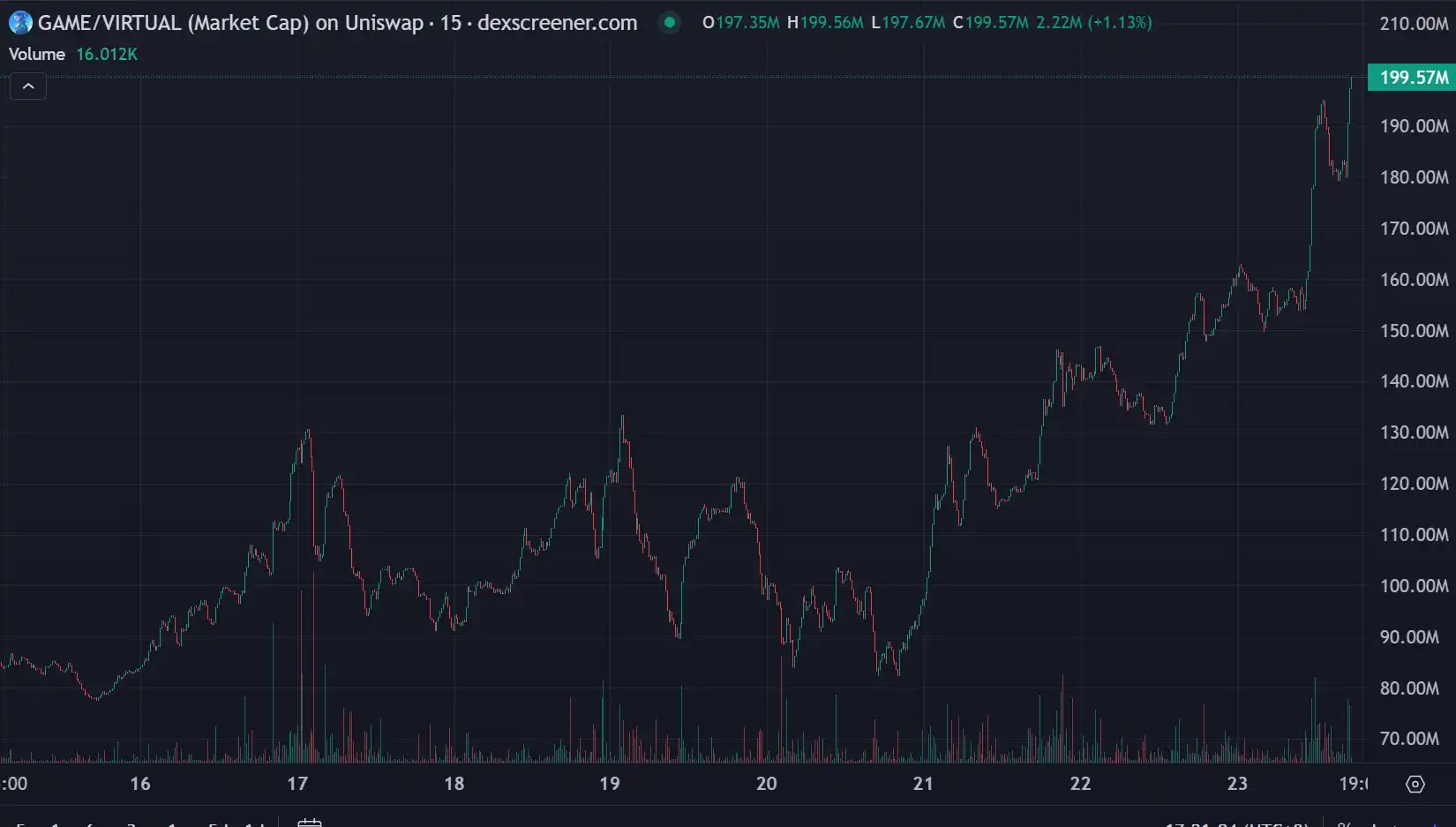
According to speculation from Twitter users, when the AI agent creation volume within the GAME framework surpasses 10,000 instances, the valuation could exceed $1 billion. Against the backdrop of the current strong AI narrative, even if it doesn't reach this level of adoption, speculative capital could drive its valuation to several billion dollars prematurely.
Furthermore, certain key catalysts (such as listing on Binance and Coinbase, royalty income model) could bring substantial returns to GAME, and the token's value is expected to continue climbing. If Virtuals' valuation reaches $20 billion, GAME's target valuation should be at least $1.4 billion. The vision of GAME is not just a technological breakthrough but also a redefinition of the new generation's virtual society.
AI Agents will continue to evolve, including more entertainment intelligences and the "Twitter Alpha" intelligent agents. G.A.M.E is an infrastructure-oriented investment with almost no competitors at present.
Further Reading
You may also like

Morning News | The Hong Kong Securities and Futures Commission announced the regulatory framework for secondary market trading of tokenized investment products; Strategy increased its holdings by 34,164 bitcoins last week; KAIO completed a strategic fi...

What Is an XRP Wallet? The Best Wallets to Store XRP (2026 Updated)
An XRP wallet lets you safely store, send, and receive XRP on the XRP Ledger. Learn what wallets support XRP and discover the best XRP wallets for beginners and long-term holders in 2026.

What are the Top AI Crypto Coins? Render vs. Akash: 5 Gems Solving the 2026 GPU Crisis
What are the best AI crypto coins for the 2026 cycle? Beyond the hype, we analyze top tokens like RNDR, AKT, and FET that provide real-world solutions to the global GPU shortage and the rise of autonomous agents.

What Is a Token in AI? What Is an AI Token + 3 Gems You Can't Miss in 2026
The era of AI hype has transitioned into an era of utility. As we move through Q2 2026, the market is no longer rewarding "narrative-only" projects. At WEEX Research, we are seeing a massive capital rotation into Decentralized Compute (DePIN) and Autonomous Agent coordination layers. This guide analyzes which AI tokens are capturing institutional liquidity and how to spot high-conviction setups in a maturing market.

Consumer-grade Crypto Global Survey: Users, Revenue, and Track Distribution

Prediction Markets Under Bias

Stolen: $290 million, Three Parties Refusing to Acknowledge, Who Should Foot the Bill for the KelpDAO Incident Resolution?

ASTEROID Pumped 10,000x in Three Days, Is Meme Season Back on Ethereum?

ChainCatcher Hong Kong Themed Forum Highlights: Decoding the Growth Engine Under the Integration of Crypto Assets and Smart Economy

Why can this institution still grow by 150% when the scale of leading crypto VCs has shrunk significantly?

Anthropic's $1 trillion, compared to DeepSeek's $100 billion

Geopolitical Risk Persists, Is Bitcoin Becoming a Key Barometer?

Annualized 11.5%, Wall Street Buzzing: Is MicroStrategy's STRC Bitcoin's Savior or Destroyer?
An Obscure Open Source AI Tool Alerted on Kelp DAO's $292 million Bug 12 Days Ago

Mixin has launched USTD-margined perpetual contracts, bringing derivative trading into the chat scene.
The privacy-focused crypto wallet Mixin announced today the launch of its U-based perpetual contract (a derivative priced in USDT). Unlike traditional exchanges, Mixin has taken a new approach by "liberating" derivative trading from isolated matching engines and embedding it into the instant messaging environment.
Users can directly open positions within the app with leverage of up to 200x, while sharing positions, discussing strategies, and copy trading within private communities. Trading, social interaction, and asset management are integrated into the same interface.
Based on its non-custodial architecture, Mixin has eliminated friction from the traditional onboarding process, allowing users to participate in perpetual contract trading without identity verification.
The trading process has been streamlined into five steps:
· Choose the trading asset
· Select long or short
· Input position size and leverage
· Confirm order details
· Confirm and open the position
The interface provides real-time visualization of price, position, and profit and loss (PnL), allowing users to complete trades without switching between multiple modules.
Mixin has directly integrated social features into the derivative trading environment. Users can create private trading communities and interact around real-time positions:
· End-to-end encrypted private groups supporting up to 1024 members
· End-to-end encrypted voice communication
· One-click position sharing
· One-click trade copying
On the execution side, Mixin aggregates liquidity from multiple sources and accesses decentralized protocol and external market liquidity through a unified trading interface.
By combining social interaction with trade execution, Mixin enables users to collaborate, share, and execute trading strategies instantly within the same environment.
Mixin has also introduced a referral incentive system based on trading behavior:
· Users can join with an invite code
· Up to 60% of trading fees as referral rewards
· Incentive mechanism designed for long-term, sustainable earnings
This model aims to drive user-driven network expansion and organic growth.
Mixin's derivative transactions are built on top of its existing self-custody wallet infrastructure, with core features including:
· Separation of transaction account and asset storage
· User full control over assets
· Platform does not custody user funds
· Built-in privacy mechanisms to reduce data exposure
The system aims to strike a balance between transaction efficiency, asset security, and privacy protection.
Against the background of perpetual contracts becoming a mainstream trading tool, Mixin is exploring a different development direction by lowering barriers, enhancing social and privacy attributes.
The platform does not only view transactions as execution actions but positions them as a networked activity: transactions have social attributes, strategies can be shared, and relationships between individuals also become part of the financial system.
Mixin's design is based on a user-initiated, user-controlled model. The platform neither custodies assets nor executes transactions on behalf of users.
This model aligns with a statement issued by the U.S. Securities and Exchange Commission (SEC) on April 13, 2026, titled "Staff Statement on Whether Partial User Interface Used in Preparing Cryptocurrency Securities Transactions May Require Broker-Dealer Registration."
The statement indicates that, under the premise where transactions are entirely initiated and controlled by users, non-custodial service providers that offer neutral interfaces may not need to register as broker-dealers or exchanges.
Mixin is a decentralized, self-custodial privacy wallet designed to provide secure and efficient digital asset management services.
Its core capabilities include:
· Aggregation: integrating multi-chain assets and routing between different transaction paths to simplify user operations
· High liquidity access: connecting to various liquidity sources, including decentralized protocols and external markets
· Decentralization: achieving full user control over assets without relying on custodial intermediaries
· Privacy protection: safeguarding assets and data through MPC, CryptoNote, and end-to-end encrypted communication
Mixin has been in operation for over 8 years, supporting over 40 blockchains and more than 10,000 assets, with a global user base exceeding 10 million and an on-chain self-custodied asset scale of over $1 billion.

$600 million stolen in 20 days, ushering in the era of AI hackers in the crypto world
Vitalik's 2026 Hong Kong Web3 Summit Speech: Ethereum's Ultimate Vision as the "World Computer" and Future Roadmap
On the same day Aave introduced rsETH, why did Spark decide to exit?
Morning News | The Hong Kong Securities and Futures Commission announced the regulatory framework for secondary market trading of tokenized investment products; Strategy increased its holdings by 34,164 bitcoins last week; KAIO completed a strategic fi...
What Is an XRP Wallet? The Best Wallets to Store XRP (2026 Updated)
An XRP wallet lets you safely store, send, and receive XRP on the XRP Ledger. Learn what wallets support XRP and discover the best XRP wallets for beginners and long-term holders in 2026.
What are the Top AI Crypto Coins? Render vs. Akash: 5 Gems Solving the 2026 GPU Crisis
What are the best AI crypto coins for the 2026 cycle? Beyond the hype, we analyze top tokens like RNDR, AKT, and FET that provide real-world solutions to the global GPU shortage and the rise of autonomous agents.
What Is a Token in AI? What Is an AI Token + 3 Gems You Can't Miss in 2026
The era of AI hype has transitioned into an era of utility. As we move through Q2 2026, the market is no longer rewarding "narrative-only" projects. At WEEX Research, we are seeing a massive capital rotation into Decentralized Compute (DePIN) and Autonomous Agent coordination layers. This guide analyzes which AI tokens are capturing institutional liquidity and how to spot high-conviction setups in a maturing market.



 App
App