
 Buy Crypto
- Markets
 Futures
- Spot
- Copy Trade
- Earn
- More
The technical team RIG entered the market to issue coins, $arc reached a market value of 50 million in half a day

Original title: "Half-day quick pass 50 million market value, is $arc really a technical team behind it? | Recent quick pass review"
Original source: TechFlow
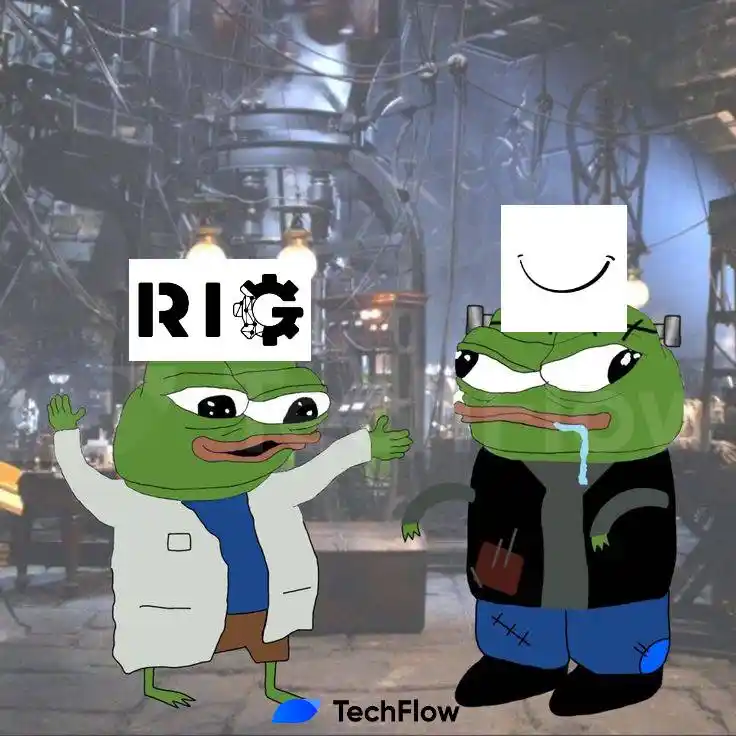
With the violent leverage wash (temporarily) over, the cottage industry has begun to pick up. Looking at it, the first to rebound are still Solana's AI Memes, not only $GOAT and $ACT that have been listed on major exchanges, but also some AI Memes with large trading volumes on the chain are rising uncontrollably.
Coincidentally, December 11th is exactly two months since the birth of $GOAT, and it is also the two months when the market officially began to contact AI Memes and went crazy for them. After two months of rapid learning and precipitation, the market's focus on AI Memes has gradually upgraded from "fun" to "practical". $ai16z, which was previously criticized, broke through the market value of 800 million US dollars today, successfully flipping $GOAT and $ACT. Obviously, the underlying infrastructure concept of the AI sector has grabbed some of the attention of AI Agent.
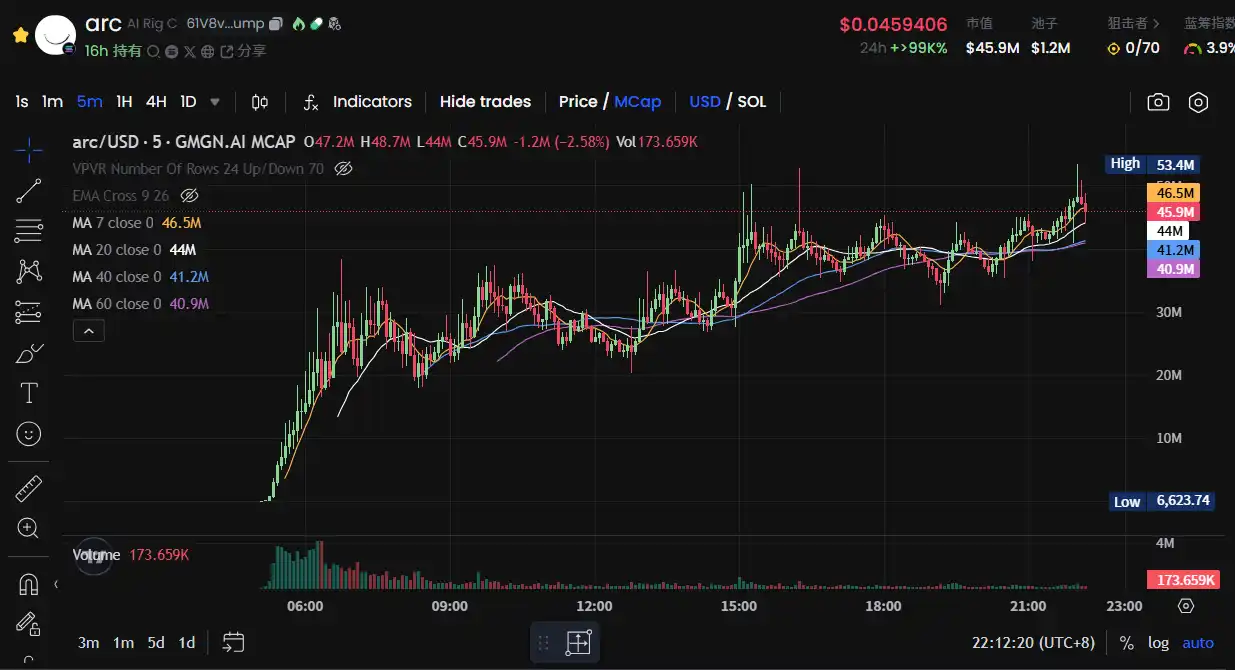
Talking back to the market, with the overall recovery of the Solana chain market, the "speed pass" has obviously improved in both quality and quantity. In the early morning of the 11th, the Solana token named $arc had a market value of 20 million US dollars in 6 hours after its launch, and the highest market value was close to 50 million US dollars as of writing.
By reviewing the background of $arc, we found that the $arc team is strongly related to the developers of an AI development framework called "rig", which is a real hardcore AI sector infrastructure concept. This overnight speed pass may also coincide with the market's shift in perception of AI concept tokens.
Note: The price of Meme tokens fluctuates violently and there is a high risk. Investors should fully assess the risks and participate with caution. This article only shares information based on market hotspots. The author and the platform do not guarantee the completeness and accuracy of the content of the article. At the same time, this article does not contain any investment advice.
Is it really a coin issued by the RIG development team?
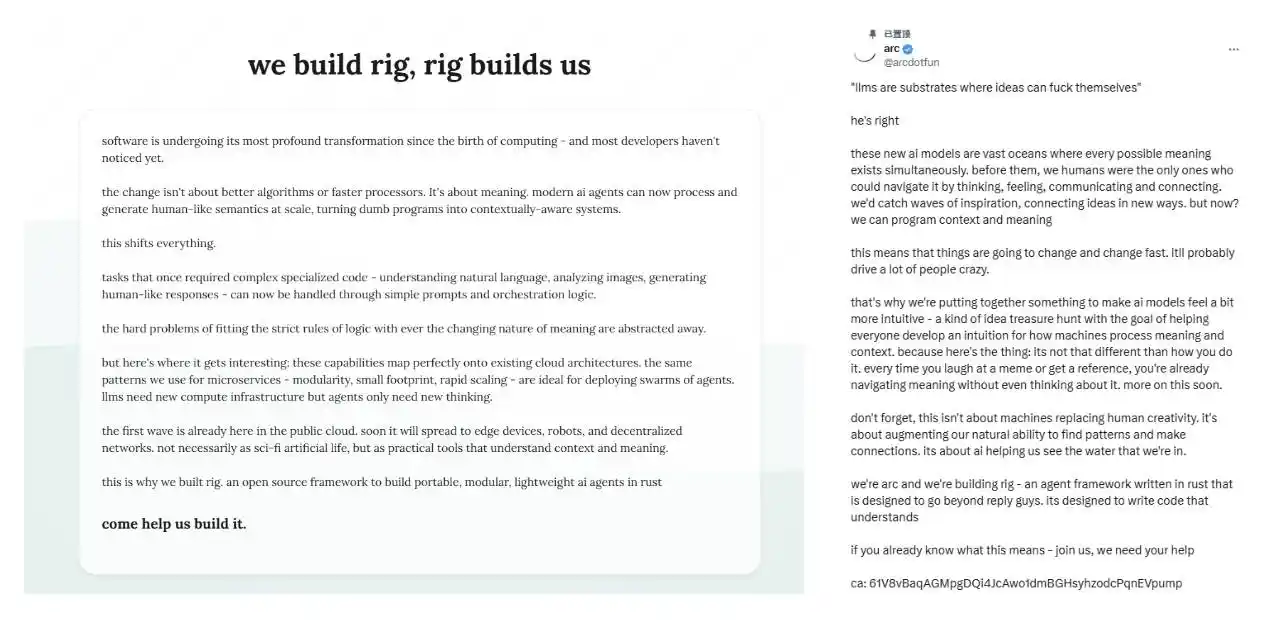
arc’s official website declaration is quite straightforward: "we build rig, rig builds us" directly points out the direct connection between the project and the RIG framework. At the same time, two articles on the official website and official Twitter briefly explained the significance of the project: "We are experiencing a transformation in "meaning"."
The team believes that LLMs (Large Language Models) are like a vast sea of meaning, where all possible concepts coexist and collide with each other. This feature is gradually similar to the way humans understand the world - just like when we understand memes and allusions, the brain can naturally process meaning and context.
Based on this cognition, the arc team is continuing to develop the rig framework - an AI development framework written in Rust. This is not just an agent framework written in Rust, but a tool designed to help developers navigate the "sea of meaning". Their goal is not to replace human creativity with AI, but to enhance our ability to discover patterns and make connections, to help people better understand and use the way AI processes meaning, representing a major shift in the software development paradigm from pure logic construction to meaning processing, which is what the team calls "a revolution about "meaning"".
To put it bluntly, the team's two articles are just saying: Don't you like to hype AI? Well, we are going to do big things in the field of AI development now.
Then at the end of the long article, the newly released $arc token contract was posted.
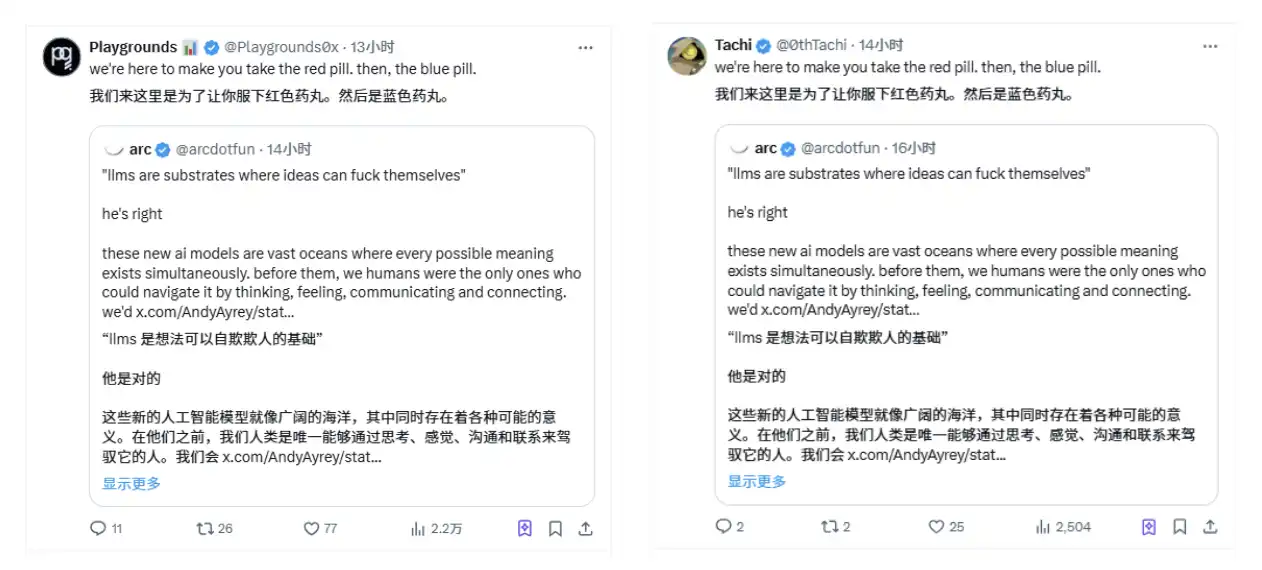
But after all, there are endless scams about the concept of AI, and the arc team alone cannot make the market so FOMO. The real FOMO point of the market is that the developer of the rig framework @Playgrounds0x and Co Founder @0thTachi both enthusiastically forwarded the official tweet of arc to "claim" the project, and by the way, they also played a red and blue pill stalk from The Matrix, implying that the project will bring about incredible changes.
What exactly is the rig framework?
As mentioned earlier, rig (Rust Inference Gateway) is an AI development framework written in Rust. Here is a brief introduction to it:
Many people should have heard of the Rust language that wrote the rig framework. Solana uses the RUST language to develop smart contracts, so many big developers on Solana and engineers who use Rust for AI development should be familiar with rig.
In short, rig is like an "intelligent housekeeper" that helps developers build and manage AI applications more easily. If an AI model (such as GPT-4) is compared to a powerful engine, then rig is the gearbox and transmission system that allows this engine to run stably and efficiently.
In the current AI framework field, LangChain based on Python language has always dominated. However, as the scale of applications expands, the performance of LangChain has gradually become a bit inadequate, and developers are faced with an awkward choice:
1. Either use a simple but performance-limited Python framework
2. Or directly deal with complex underlying APIs
The Rust framework provides developers with a better choice with its higher execution efficiency and high security based on the Rust language.
If we use building a house to compare AI development:
· Traditional Python frameworks (such as LangChain) are like houses built with wood: they are fast to build, but they have limited load-bearing capacity
· Rig is like a building built with reinforced concrete: although the initial investment is large, it can support more complex structures
With a relatively solid narrative support, the trend of $arc's 50M speed pass seems to be relatively "real".
Summary
The wave of AI Agents has brought a huge amount of wealth appreciation effects and more practical imaginations of AI+Crypto, but it is also accompanied by team evil and fraud. In the early stages of emerging narratives, those who make money are not necessarily truly kind and useful teams. However, as the concept of the sector and market awareness gradually mature, more and more teams with real stuff like Rig developers have begun to issue their own coins, which also means that more "regular troops" have entered the market.
Applying the current market situation, with the ecological development brought by ai16z and Virtuals as a precedent, the rig framework that has just appeared in the market may also have large-scale applications in the future, bringing more practical possibilities to AI and encrypted narratives, and the entry threshold of the AI concept will become higher and higher.
You may also like

Consumer-grade Crypto Global Survey: Users, Revenue, and Track Distribution

Prediction Markets Under Bias

Stolen: $290 million, Three Parties Refusing to Acknowledge, Who Should Foot the Bill for the KelpDAO Incident Resolution?

ASTEROID Pumped 10,000x in Three Days, Is Meme Season Back on Ethereum?

ChainCatcher Hong Kong Themed Forum Highlights: Decoding the Growth Engine Under the Integration of Crypto Assets and Smart Economy

Why can this institution still grow by 150% when the scale of leading crypto VCs has shrunk significantly?

Anthropic's $1 trillion, compared to DeepSeek's $100 billion

Geopolitical Risk Persists, Is Bitcoin Becoming a Key Barometer?

Annualized 11.5%, Wall Street Buzzing: Is MicroStrategy's STRC Bitcoin's Savior or Destroyer?

An Obscure Open Source AI Tool Alerted on Kelp DAO's $292 million Bug 12 Days Ago

Mixin has launched USTD-margined perpetual contracts, bringing derivative trading into the chat scene.
The privacy-focused crypto wallet Mixin announced today the launch of its U-based perpetual contract (a derivative priced in USDT). Unlike traditional exchanges, Mixin has taken a new approach by "liberating" derivative trading from isolated matching engines and embedding it into the instant messaging environment.
Users can directly open positions within the app with leverage of up to 200x, while sharing positions, discussing strategies, and copy trading within private communities. Trading, social interaction, and asset management are integrated into the same interface.
Based on its non-custodial architecture, Mixin has eliminated friction from the traditional onboarding process, allowing users to participate in perpetual contract trading without identity verification.
The trading process has been streamlined into five steps:
· Choose the trading asset
· Select long or short
· Input position size and leverage
· Confirm order details
· Confirm and open the position
The interface provides real-time visualization of price, position, and profit and loss (PnL), allowing users to complete trades without switching between multiple modules.
Mixin has directly integrated social features into the derivative trading environment. Users can create private trading communities and interact around real-time positions:
· End-to-end encrypted private groups supporting up to 1024 members
· End-to-end encrypted voice communication
· One-click position sharing
· One-click trade copying
On the execution side, Mixin aggregates liquidity from multiple sources and accesses decentralized protocol and external market liquidity through a unified trading interface.
By combining social interaction with trade execution, Mixin enables users to collaborate, share, and execute trading strategies instantly within the same environment.
Mixin has also introduced a referral incentive system based on trading behavior:
· Users can join with an invite code
· Up to 60% of trading fees as referral rewards
· Incentive mechanism designed for long-term, sustainable earnings
This model aims to drive user-driven network expansion and organic growth.
Mixin's derivative transactions are built on top of its existing self-custody wallet infrastructure, with core features including:
· Separation of transaction account and asset storage
· User full control over assets
· Platform does not custody user funds
· Built-in privacy mechanisms to reduce data exposure
The system aims to strike a balance between transaction efficiency, asset security, and privacy protection.
Against the background of perpetual contracts becoming a mainstream trading tool, Mixin is exploring a different development direction by lowering barriers, enhancing social and privacy attributes.
The platform does not only view transactions as execution actions but positions them as a networked activity: transactions have social attributes, strategies can be shared, and relationships between individuals also become part of the financial system.
Mixin's design is based on a user-initiated, user-controlled model. The platform neither custodies assets nor executes transactions on behalf of users.
This model aligns with a statement issued by the U.S. Securities and Exchange Commission (SEC) on April 13, 2026, titled "Staff Statement on Whether Partial User Interface Used in Preparing Cryptocurrency Securities Transactions May Require Broker-Dealer Registration."
The statement indicates that, under the premise where transactions are entirely initiated and controlled by users, non-custodial service providers that offer neutral interfaces may not need to register as broker-dealers or exchanges.
Mixin is a decentralized, self-custodial privacy wallet designed to provide secure and efficient digital asset management services.
Its core capabilities include:
· Aggregation: integrating multi-chain assets and routing between different transaction paths to simplify user operations
· High liquidity access: connecting to various liquidity sources, including decentralized protocols and external markets
· Decentralization: achieving full user control over assets without relying on custodial intermediaries
· Privacy protection: safeguarding assets and data through MPC, CryptoNote, and end-to-end encrypted communication
Mixin has been in operation for over 8 years, supporting over 40 blockchains and more than 10,000 assets, with a global user base exceeding 10 million and an on-chain self-custodied asset scale of over $1 billion.

$600 million stolen in 20 days, ushering in the era of AI hackers in the crypto world
Vitalik's 2026 Hong Kong Web3 Summit Speech: Ethereum's Ultimate Vision as the "World Computer" and Future Roadmap
On the same day Aave introduced rsETH, why did Spark decide to exit?
Full Post-Mortem of the KelpDAO Incident: Why Did Aave, Which Was Not Compromised, End Up in Crisis Situation?

After a $290 million DeFi liquidation, is the security promise still there?
ZachXBT's post ignites RAVE nearing zero, what is the truth behind the insider control?




 App
App