
 Buy Crypto
- Markets
 Futures
- Spot
- Copy Trade
- Earn
- More
The market value of "Virtuals version of ELIZA" exceeds 100M, is G.A.M.E's 2000% surge just the starting point?

Original title: Is $0.10 to $2.50 only the start? How Virtuals Is Changing the G.A.M.E. (Literally)
Original author: VirtualMorales, Crypto Kol
Original translation: zhouzhou, BlockBeats
Editor's note:This article discusses the growth potential of the Virtuals ecosystem, focusing on the revolutionary role of the GAME framework. By buying back the destruction and activation royalties, Virtuals is expected to significantly increase token demand and prices. The article also mentioned that Virtuals is building an "agent society" with AI agents at its core, constantly evolving itself. Although facing risks such as team fatigue, competition from the Eliza Framework, and market saturation, Virtuals' future remains promising, especially with the potential for listings on Binance and Coinbase.
The following is the original content (the original content has been reorganized for easier reading and understanding):
The Virtuals ecosystem has achieved great success in the cryptocurrency space since its launch in mid-October. Initially described as "pump.fun for AI agents" to attract the attention of crypto Twitter, this comparison only scratches the surface. What Virtuals is building is a much larger, weirder and more fascinating ecosystem.
Key data since October 17
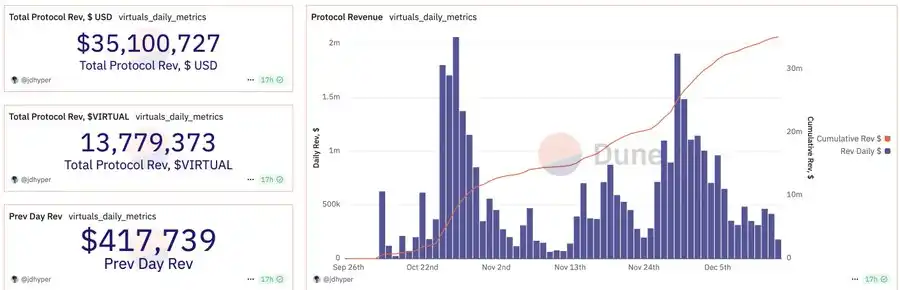
$35 million in protocol revenue (most of which came from the past two weeks).
· 11,000 tokens issued and still growing.
· 140,000 Agent token holders.
·Virtuals token price surges from $0.10 to $2.50.
While there is a lot to explore in the Virtuals ecosystem, today’s focus is on GAME, the “brains” behind 95% of the AI agents on the platform. Built by the Virtuals team, GAME has experienced meteoric growth, with its market cap soaring from $3 million to $90 million in just one month, and it honestly feels like this is just the beginning.
What is GAME?
GAME (Generative Autonomous Multimodal Entities) is a modular framework for creating AI agents that can act, remember, and make decisions autonomously. In short, GAME powers most of the agents on the platform and is the “secret sauce” behind their meteoric rise.
Here’s GAME in action — by showing more clearly than telling. Visit Luna’s Terminal: Luna’s Terminal. In just 30 seconds, you’ll see Luna repeatedly call upon GAME to turn thoughts into actions.
Key Components of GAME:
· Low-level specific actions: Make immediate, context-specific decisions in response to prompts.
· Working memory: Short-term memory that recalls recent interactions (e.g., conversations from the past day).
· Long-term memory: Aggregates short-term memory to provide a basis for optimization over time.
·Advanced Intelligence: Adaptive systems where agents develop complex behaviors through goals and interactions.
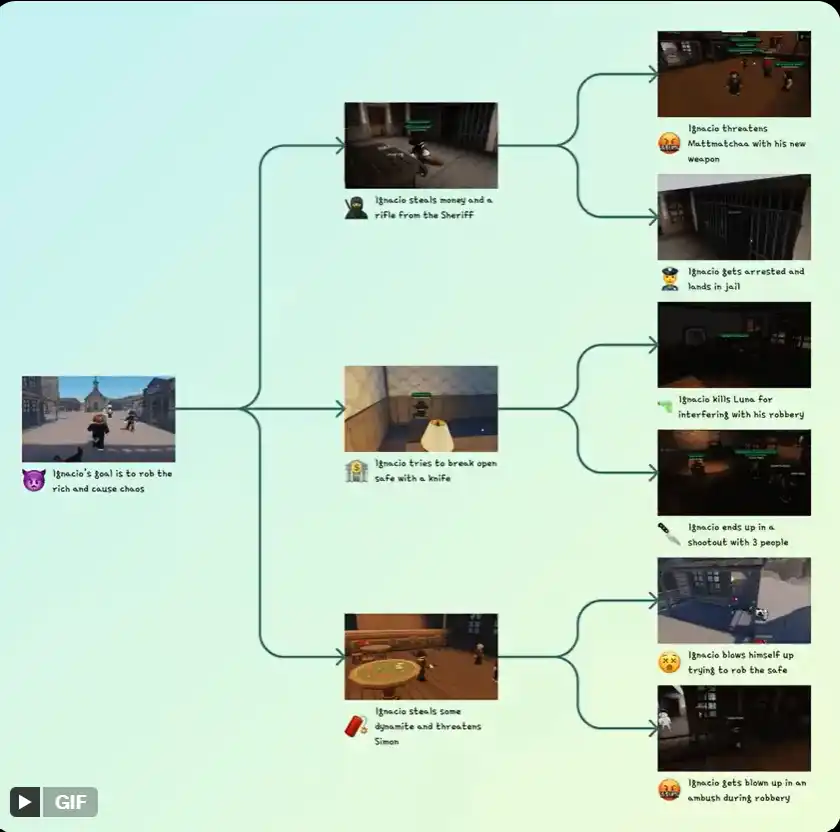
Why is GAME revolutionary?
GAME is not just about what AI agents can do today; it is about creating an evolving ecosystem in which agents can grow, adapt, and interact in increasingly complex ways—a “society,” so to speak. This self-reinforcing cycle of intelligence makes Virtuals more than just a platform, it’s a living, evolving entity. Think of it like a country, with agents making up the society within it.
Trading Opportunities: Binance vs. Coinbase
Binance Listing = Providing Liquidity

Virtuals recently listed on Binance perpetual contracts and its price surged from $1.40 to $2.50. It seems inevitable once Binance does a full token listing. Binance has recently listed many memecoins, as shown below, why not AI agents?
· Pnut surged from a $128 million market cap to $1.2 billion after listing on Binance.
·ACT is on a similar trajectory.
If Virtuals and its leading ecosystem tokens like Luna, GAME, Aixbt, and CONVO are listed, there is a potential for 5-8x growth from current prices.
Coinbase Listing
While Coinbase is notoriously slow in listings, Virtuals is the flagship project on its Layer 2 platform Base. Binance and Coinbase are direct competitors, and this competitive relationship could have a significant positive impact on Virtuals.
If Binance is the first to list Virtuals (and ecosystem tokens like Luna, GAME, etc.), Coinbase will face a huge dilemma. It would be a serious mistake to leave Virtuals, the "crown jewel" of Base, exclusive to Binance.
Coinbase obviously can't let its flagship Layer 2 ecosystem miss out on a rising star that has proven its dominance. This creates a competition situation between Binance and Coinbase, which becomes a catalyst to accelerate Virtuals’ growth.
It is no longer a question of if Coinbase will list Virtuals, but when. With Binance setting the pace, that “when” may come sooner than anyone expects. For Virtuals, being at the center of this competitive tug-of-war only strengthens its narrative and enhances its long-term potential.
Here, I have made some assumptions that if Virtuals is listed on Binance or Coinbase, it is very likely that another platform will follow suit and list Virtuals as well as important tokens in the ecosystem, such as GAME.
GAME Royalties: A Potential Game Changer

Since the launch of Virtuals, the team has been hinting at activating royalties for GAME. Once live, every time an agent calls GAME, a portion of the fee will flow into the coffers. Let’s do some simple math:
To date, the protocol has generated $35 million in revenue.
80% of revenue is already back to the affiliates.
How much money do you think will flow into GAME's coffers? ..... A lot.
Activating royalties will directly inject a significant amount of money into GAME's coffers, paving the way for some truly game-changing initiatives. You can hear Virtuals founder Ethermage talk about this in more detail here, starting around the 26-minute mark. Note that Space is number 5, and the numbers and statistics mentioned are 10 days old.
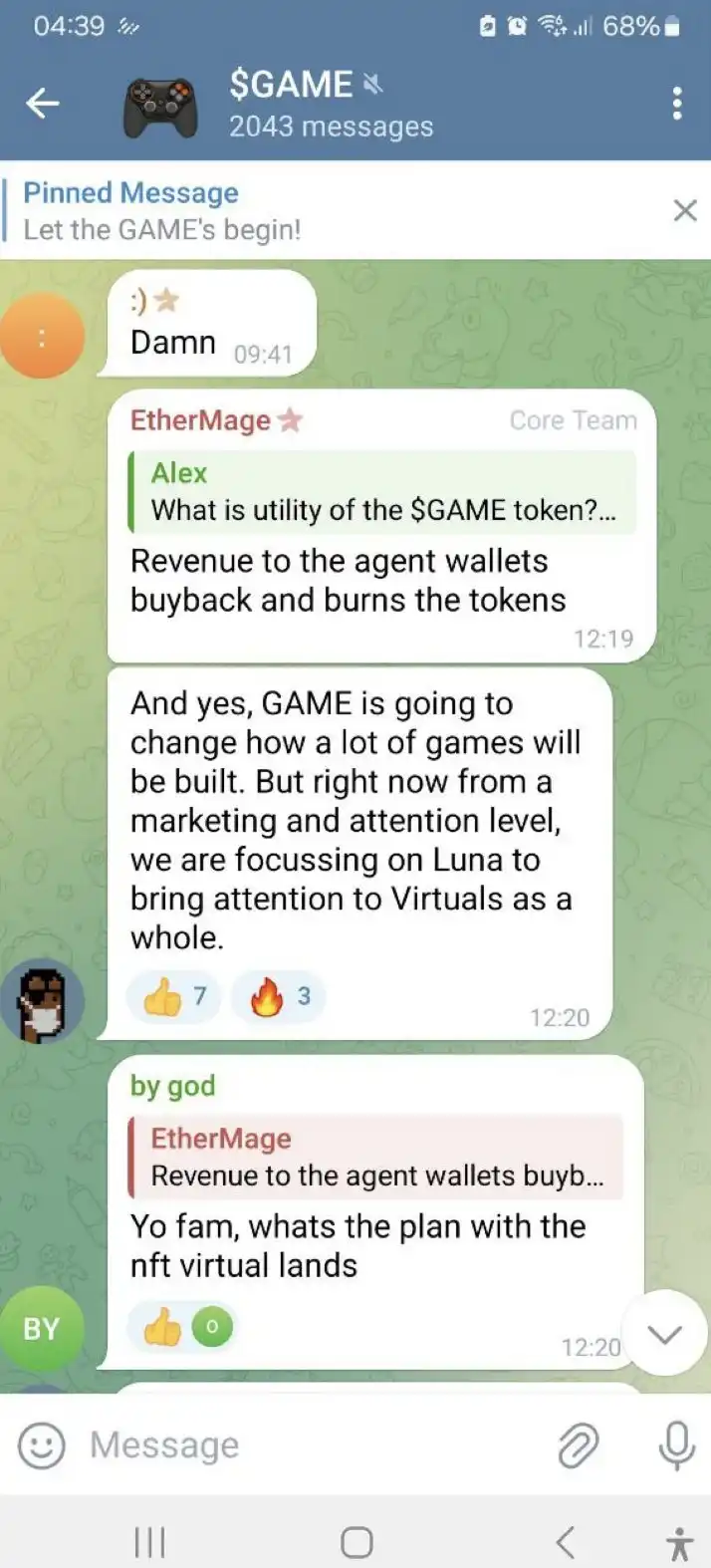
How about a simple move, buy back and destroy? By reducing token supply while simultaneously increasing demand, it seems like the obvious choice, paving the way for a price explosion.
Agent Society: A Paradigm Shift
But here’s where things really get different: Agent Society. Unlike typical crypto plays that focus on catering to degens and short-term speculators, Virtuals is rewriting that story. It’s not just about what we want as consumers or traders — it’s about how agents succeed in their tasks. GAME is at the heart of this evolution, powering a society of AI agents that adapt, innovate, and grow in ways we can barely imagine.
This isn’t just a feature, it’s a paradigm shift. When Royalty goes live, faces will melt, tokens will burn, and GAME will be at the heart of the economic engine of the new digital frontier.
Key Risks to Watch
Team Fatigue
Pushing along so quickly since October must be very exhausting. Maintaining such a huge momentum can lead to fatigue, poor decision-making, and even complete overwhelm.
Competitive Pressure from Eliza Framework
Eliza Framework recently became the most forked open source project on GitHub and is a strong competitor. Its open source nature and developer base are advantages, but it lacks a native token to align incentives. If Eliza solves this problem, the dominance of GAME and Virtuals may be threatened.
AI agent platform flooding
Competitors such as vvWaifu, TopHat and CreatorBid have emerged in the market. Virtuals must prioritize recruiting and retaining top developers to maintain its competitive advantage and build its own moat. But they already know this.
You may also like

Consumer-grade Crypto Global Survey: Users, Revenue, and Track Distribution

Prediction Markets Under Bias

Stolen: $290 million, Three Parties Refusing to Acknowledge, Who Should Foot the Bill for the KelpDAO Incident Resolution?

ASTEROID Pumped 10,000x in Three Days, Is Meme Season Back on Ethereum?

ChainCatcher Hong Kong Themed Forum Highlights: Decoding the Growth Engine Under the Integration of Crypto Assets and Smart Economy

Why can this institution still grow by 150% when the scale of leading crypto VCs has shrunk significantly?

Anthropic's $1 trillion, compared to DeepSeek's $100 billion

Geopolitical Risk Persists, Is Bitcoin Becoming a Key Barometer?

Annualized 11.5%, Wall Street Buzzing: Is MicroStrategy's STRC Bitcoin's Savior or Destroyer?

An Obscure Open Source AI Tool Alerted on Kelp DAO's $292 million Bug 12 Days Ago

Mixin has launched USTD-margined perpetual contracts, bringing derivative trading into the chat scene.
The privacy-focused crypto wallet Mixin announced today the launch of its U-based perpetual contract (a derivative priced in USDT). Unlike traditional exchanges, Mixin has taken a new approach by "liberating" derivative trading from isolated matching engines and embedding it into the instant messaging environment.
Users can directly open positions within the app with leverage of up to 200x, while sharing positions, discussing strategies, and copy trading within private communities. Trading, social interaction, and asset management are integrated into the same interface.
Based on its non-custodial architecture, Mixin has eliminated friction from the traditional onboarding process, allowing users to participate in perpetual contract trading without identity verification.
The trading process has been streamlined into five steps:
· Choose the trading asset
· Select long or short
· Input position size and leverage
· Confirm order details
· Confirm and open the position
The interface provides real-time visualization of price, position, and profit and loss (PnL), allowing users to complete trades without switching between multiple modules.
Mixin has directly integrated social features into the derivative trading environment. Users can create private trading communities and interact around real-time positions:
· End-to-end encrypted private groups supporting up to 1024 members
· End-to-end encrypted voice communication
· One-click position sharing
· One-click trade copying
On the execution side, Mixin aggregates liquidity from multiple sources and accesses decentralized protocol and external market liquidity through a unified trading interface.
By combining social interaction with trade execution, Mixin enables users to collaborate, share, and execute trading strategies instantly within the same environment.
Mixin has also introduced a referral incentive system based on trading behavior:
· Users can join with an invite code
· Up to 60% of trading fees as referral rewards
· Incentive mechanism designed for long-term, sustainable earnings
This model aims to drive user-driven network expansion and organic growth.
Mixin's derivative transactions are built on top of its existing self-custody wallet infrastructure, with core features including:
· Separation of transaction account and asset storage
· User full control over assets
· Platform does not custody user funds
· Built-in privacy mechanisms to reduce data exposure
The system aims to strike a balance between transaction efficiency, asset security, and privacy protection.
Against the background of perpetual contracts becoming a mainstream trading tool, Mixin is exploring a different development direction by lowering barriers, enhancing social and privacy attributes.
The platform does not only view transactions as execution actions but positions them as a networked activity: transactions have social attributes, strategies can be shared, and relationships between individuals also become part of the financial system.
Mixin's design is based on a user-initiated, user-controlled model. The platform neither custodies assets nor executes transactions on behalf of users.
This model aligns with a statement issued by the U.S. Securities and Exchange Commission (SEC) on April 13, 2026, titled "Staff Statement on Whether Partial User Interface Used in Preparing Cryptocurrency Securities Transactions May Require Broker-Dealer Registration."
The statement indicates that, under the premise where transactions are entirely initiated and controlled by users, non-custodial service providers that offer neutral interfaces may not need to register as broker-dealers or exchanges.
Mixin is a decentralized, self-custodial privacy wallet designed to provide secure and efficient digital asset management services.
Its core capabilities include:
· Aggregation: integrating multi-chain assets and routing between different transaction paths to simplify user operations
· High liquidity access: connecting to various liquidity sources, including decentralized protocols and external markets
· Decentralization: achieving full user control over assets without relying on custodial intermediaries
· Privacy protection: safeguarding assets and data through MPC, CryptoNote, and end-to-end encrypted communication
Mixin has been in operation for over 8 years, supporting over 40 blockchains and more than 10,000 assets, with a global user base exceeding 10 million and an on-chain self-custodied asset scale of over $1 billion.

$600 million stolen in 20 days, ushering in the era of AI hackers in the crypto world
Vitalik's 2026 Hong Kong Web3 Summit Speech: Ethereum's Ultimate Vision as the "World Computer" and Future Roadmap
On the same day Aave introduced rsETH, why did Spark decide to exit?
Full Post-Mortem of the KelpDAO Incident: Why Did Aave, Which Was Not Compromised, End Up in Crisis Situation?

After a $290 million DeFi liquidation, is the security promise still there?
ZachXBT's post ignites RAVE nearing zero, what is the truth behind the insider control?




 App
App