
 Buy Crypto
- Markets
 Futures
- Spot
- Copy Trade
- Earn
- More
The Fed's hawkish rate cut: BTC lost the 100,000 mark, and the total market value of cryptocurrencies plummeted by 7.5%

Original title: "After the Fed's hawkish rate cut, the overall cryptocurrency market has ushered in a correction"
Original author: Alvis, MarsBit
At the latest Fed interest rate meeting last night, the benchmark policy rate was lowered by 25 basis points to a range of 4.25%-4.5%. Although this result was in line with market expectations, the hawkish wording in the statement and the adjustment of economic forecasts had a profound impact on market sentiment, and the overall cryptocurrency market suffered a sharp correction. The prices of mainstream and altcoins such as Bitcoin, Ethereum, Dogecoin and Solana have all fallen significantly.
The Fed sent a hawkish signal, causing market fluctuations
Federal Reserve Chairman Jerome Powell made it clear at the press conference that although the rate cut was in line with market expectations, the frequency and magnitude of future rate cuts may be much lower than the previous market assumptions. Powell stressed that the Fed only plans to cut interest rates twice in 2025, and also raised its inflation forecast for 2025 from 2.1% to 2.5%. This adjustment reflects the Fed's deep concern about future inflationary pressures.
Powell specifically mentioned the uncertainty of future economic policies, including the protectionist policies that the incoming Trump administration may implement, such as tariffs on imported goods, large-scale deportation of undocumented workers, and the possible expansion of fiscal deficits, as important reasons for the Fed to maintain a more cautious attitude. These potential policy changes may further exacerbate inflationary pressures and have a wide impact on the market.
Bitcoin led the decline, and the crypto market was under pressure
The price of Bitcoin quickly fell 5.6% to $100,000 after the Fed announced the rate cut, and it has recovered as of press time.
Ethereum fell even more significantly, down 6.96% to $3,600. Altcoins such as Dogecoin and Solana were not immune, with Solana down more than 7% and Dogecoin, hit by high volatility, down more than 8%. The broader altcoin market has been particularly bleak, with some second- and third-tier assets falling more than 10%.
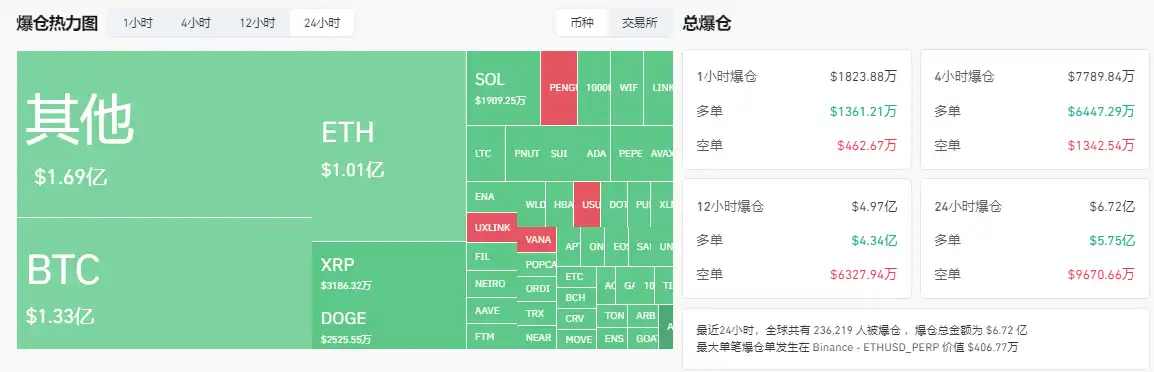
According to Coinglass data, a total of 236,199 people worldwide were liquidated in the last 24 hours, with a total liquidation amount of $672 million, and the largest single liquidation occurred on Binance - ETHUSD_PERP worth $4.0677 million.
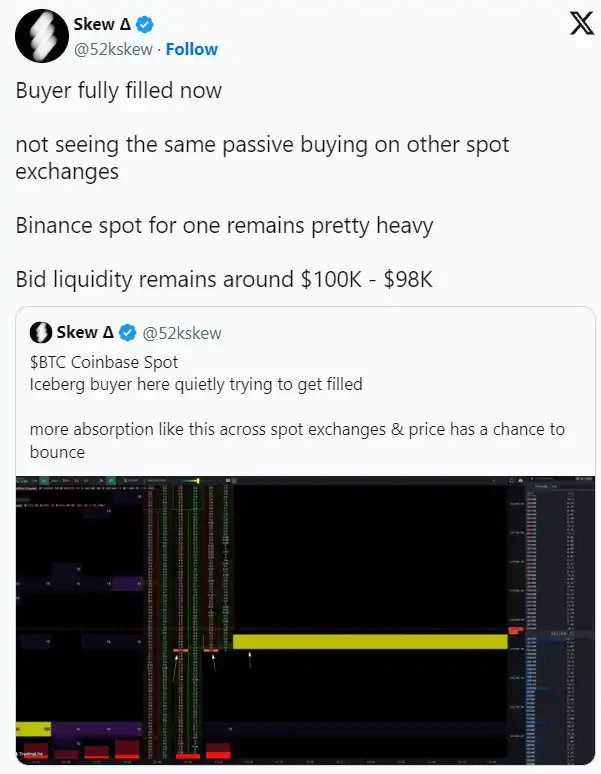
Cryptocurrency analyst Skew pointed out that the rapid decline of Bitcoin cleared the long and short positions in the market, indicating that the market has entered a deep adjustment period. The price of Bitcoin once fell to the key bidding range of $100,000 to $98,000. Analysts believe that if the support level of $100,000 to $101,400 cannot be regained before the daily close, the market may continue to look for a new bottom.
Economic forecasts highlight inflation risks, and dot plots show policy determination
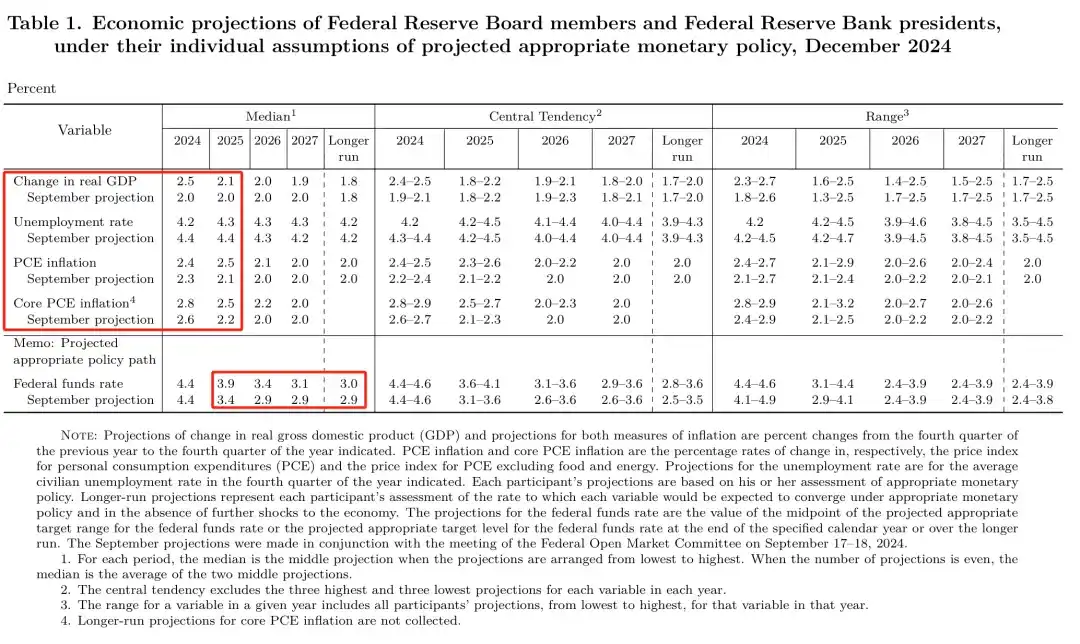
The economic forecasts in this meeting clearly show the Fed's policy considerations. The Fed raised its economic growth forecasts for 2024 and 2025, while lowering its unemployment forecasts and significantly raising its inflation forecasts. In particular, the upward adjustment of the inflation forecast for 2025 is large, showing that the Fed attaches great importance to the long-term inflation risk.
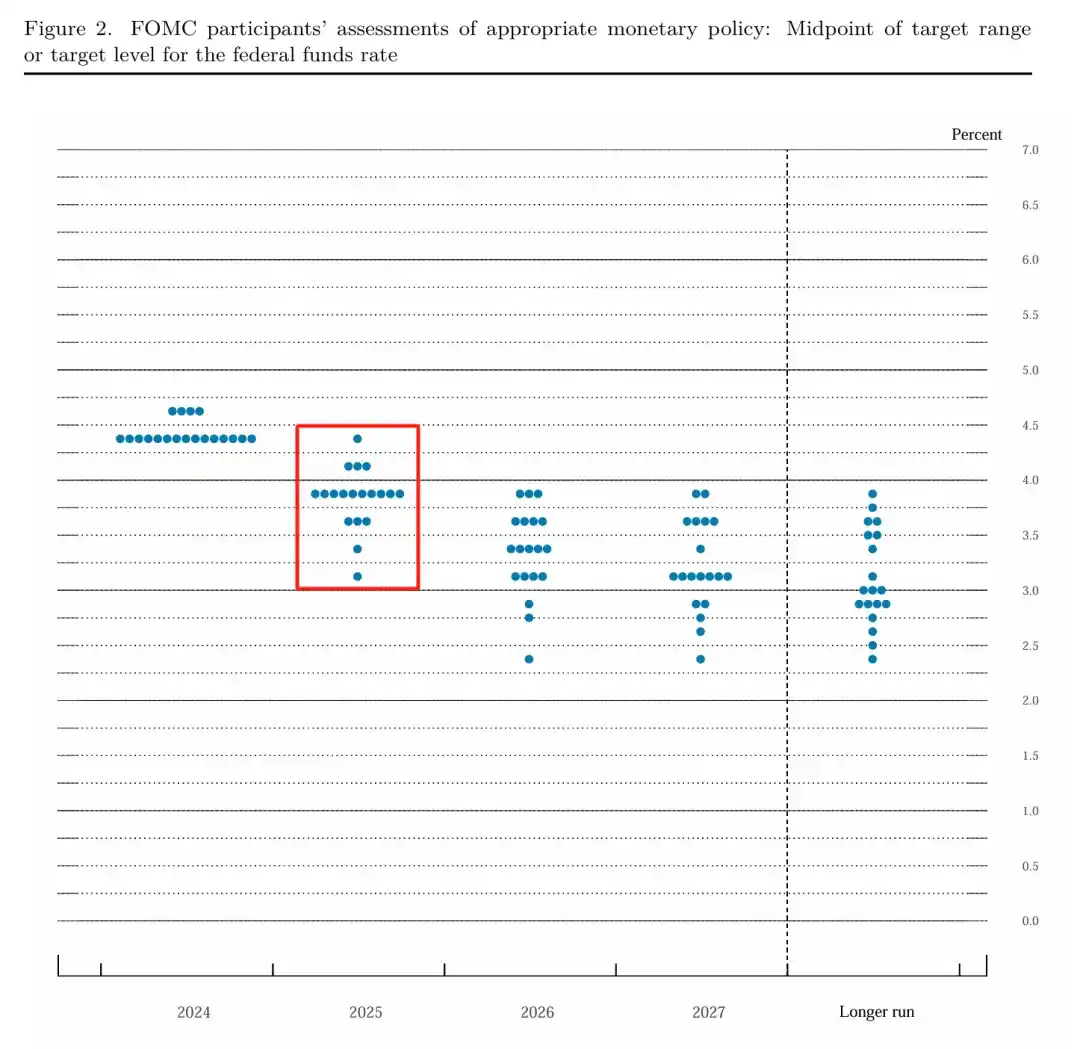
The dot plot shows that the Fed may only cut interest rates twice in 2024. This cautious policy attitude not only shows its firm determination to control inflation, but also makes the market reassess the future liquidity environment. The US dollar and the volatility index (VIX) rose sharply due to this signal, while US Treasury yields, US stocks, gold and cryptocurrency markets were generally under pressure.
Short-term outlook: The crypto market faces continued adjustments
Against this macro background, the cryptocurrency market may continue to be under pressure in the short term. Whether mainstream assets such as Bitcoin and Ethereum can hold key support levels will have an important impact on market confidence. At the same time, altcoins such as Solana and Dogecoin may perform more dramatically because these assets usually show higher sensitivity to market fluctuations.
Powell mentioned the uncertainty of the economic outlook many times in the press conference and reiterated that future policy adjustments will be based on data. Against the backdrop of a complex global macro environment, investors need to carefully evaluate the allocation strategy of crypto assets and pay close attention to the upcoming economic data to determine the medium- and long-term trends of the market.
Despite the current low market sentiment, analysts generally believe that this round of adjustments also provides patient long-term investors with opportunities for strategic layout. The price correction of mainstream crypto assets may lay the foundation for future increases, and some altcoins that have been wrongly killed may usher in a higher rebound space when the market recovers.
Attached is the original text of Powell's statement:
Recent indicators suggest that economic activity continues to expand at a solid pace. Labor market conditions have generally eased since the beginning of the year, and the unemployment rate has increased somewhat but remains low. Inflation has moved toward the Committee's 2 percent objective but remains slightly elevated.
The Committee seeks to achieve maximum employment and 2 percent inflation over the longer term. The Committee judges that risks to achieving its employment and inflation objectives are roughly balanced. The economic outlook is uncertain, and the Committee is mindful of two-way risks to its dual mandate.
To support its objectives, the Committee decided to lower the target range for the federal funds rate by 25 basis points to 4-1/2 to 4-1/2 percent. The Committee will carefully assess incoming data, the evolving outlook, and the balance of risks as it considers the size and timing of further adjustments to the target range for the federal funds rate. The Committee will continue to reduce its holdings of Treasury securities, agency debt, and agency mortgage-backed securities. The Committee is strongly committed to supporting maximum employment and returning inflation to its 2 percent objective.
In assessing the appropriate stance of monetary policy, the Committee will continue to monitor the implications of incoming information for the economic outlook. The Committee will be prepared to adjust the stance of monetary policy, as appropriate, if risks emerge that could impede the achievement of the Committee's goals. The Committee's assessment will take into account a wide range of information, including its readings on labor market conditions, inflation pressures and inflation expectations, and financial and international developments.
Voting in favor of the monetary policy action were: Chairman Jerome Powell, Vice Chairman John Williams, Thomas Barkin, Michael Barr, Raphael Bostic, Michelle Bowman, Lisa Cook, Mary Daly, Philip Jefferson, Adrienne Kugler, and Christopher Waller. Beth M. Hammack dissented in favor of maintaining the target range for the federal funds rate at 4.5 to 4.75 percent.
You may also like

Consumer-grade Crypto Global Survey: Users, Revenue, and Track Distribution

Prediction Markets Under Bias

Stolen: $290 million, Three Parties Refusing to Acknowledge, Who Should Foot the Bill for the KelpDAO Incident Resolution?

ASTEROID Pumped 10,000x in Three Days, Is Meme Season Back on Ethereum?

ChainCatcher Hong Kong Themed Forum Highlights: Decoding the Growth Engine Under the Integration of Crypto Assets and Smart Economy

Why can this institution still grow by 150% when the scale of leading crypto VCs has shrunk significantly?

Anthropic's $1 trillion, compared to DeepSeek's $100 billion

Geopolitical Risk Persists, Is Bitcoin Becoming a Key Barometer?

Annualized 11.5%, Wall Street Buzzing: Is MicroStrategy's STRC Bitcoin's Savior or Destroyer?

An Obscure Open Source AI Tool Alerted on Kelp DAO's $292 million Bug 12 Days Ago

Mixin has launched USTD-margined perpetual contracts, bringing derivative trading into the chat scene.
The privacy-focused crypto wallet Mixin announced today the launch of its U-based perpetual contract (a derivative priced in USDT). Unlike traditional exchanges, Mixin has taken a new approach by "liberating" derivative trading from isolated matching engines and embedding it into the instant messaging environment.
Users can directly open positions within the app with leverage of up to 200x, while sharing positions, discussing strategies, and copy trading within private communities. Trading, social interaction, and asset management are integrated into the same interface.
Based on its non-custodial architecture, Mixin has eliminated friction from the traditional onboarding process, allowing users to participate in perpetual contract trading without identity verification.
The trading process has been streamlined into five steps:
· Choose the trading asset
· Select long or short
· Input position size and leverage
· Confirm order details
· Confirm and open the position
The interface provides real-time visualization of price, position, and profit and loss (PnL), allowing users to complete trades without switching between multiple modules.
Mixin has directly integrated social features into the derivative trading environment. Users can create private trading communities and interact around real-time positions:
· End-to-end encrypted private groups supporting up to 1024 members
· End-to-end encrypted voice communication
· One-click position sharing
· One-click trade copying
On the execution side, Mixin aggregates liquidity from multiple sources and accesses decentralized protocol and external market liquidity through a unified trading interface.
By combining social interaction with trade execution, Mixin enables users to collaborate, share, and execute trading strategies instantly within the same environment.
Mixin has also introduced a referral incentive system based on trading behavior:
· Users can join with an invite code
· Up to 60% of trading fees as referral rewards
· Incentive mechanism designed for long-term, sustainable earnings
This model aims to drive user-driven network expansion and organic growth.
Mixin's derivative transactions are built on top of its existing self-custody wallet infrastructure, with core features including:
· Separation of transaction account and asset storage
· User full control over assets
· Platform does not custody user funds
· Built-in privacy mechanisms to reduce data exposure
The system aims to strike a balance between transaction efficiency, asset security, and privacy protection.
Against the background of perpetual contracts becoming a mainstream trading tool, Mixin is exploring a different development direction by lowering barriers, enhancing social and privacy attributes.
The platform does not only view transactions as execution actions but positions them as a networked activity: transactions have social attributes, strategies can be shared, and relationships between individuals also become part of the financial system.
Mixin's design is based on a user-initiated, user-controlled model. The platform neither custodies assets nor executes transactions on behalf of users.
This model aligns with a statement issued by the U.S. Securities and Exchange Commission (SEC) on April 13, 2026, titled "Staff Statement on Whether Partial User Interface Used in Preparing Cryptocurrency Securities Transactions May Require Broker-Dealer Registration."
The statement indicates that, under the premise where transactions are entirely initiated and controlled by users, non-custodial service providers that offer neutral interfaces may not need to register as broker-dealers or exchanges.
Mixin is a decentralized, self-custodial privacy wallet designed to provide secure and efficient digital asset management services.
Its core capabilities include:
· Aggregation: integrating multi-chain assets and routing between different transaction paths to simplify user operations
· High liquidity access: connecting to various liquidity sources, including decentralized protocols and external markets
· Decentralization: achieving full user control over assets without relying on custodial intermediaries
· Privacy protection: safeguarding assets and data through MPC, CryptoNote, and end-to-end encrypted communication
Mixin has been in operation for over 8 years, supporting over 40 blockchains and more than 10,000 assets, with a global user base exceeding 10 million and an on-chain self-custodied asset scale of over $1 billion.

$600 million stolen in 20 days, ushering in the era of AI hackers in the crypto world
Vitalik's 2026 Hong Kong Web3 Summit Speech: Ethereum's Ultimate Vision as the "World Computer" and Future Roadmap
On the same day Aave introduced rsETH, why did Spark decide to exit?
Full Post-Mortem of the KelpDAO Incident: Why Did Aave, Which Was Not Compromised, End Up in Crisis Situation?

After a $290 million DeFi liquidation, is the security promise still there?
ZachXBT's post ignites RAVE nearing zero, what is the truth behind the insider control?




 App
App