
The Demise of Decentralization and the Centralization of Power: The American Empire Nears the Handover of Cryptographic Utopia



Original Article Title: "The Decline of Decentralization and the Concentration of Power: The Rightful Delivery of the Imminent Encryption Utopia of American Capitalism"
Original Article Author: Ac-Core, YBB Capital Research
TL;DR
● In the long run, the Bitcoin ETF is not necessarily a positive development. There is a huge gap in trading volume between the Hong Kong Bitcoin ETF and the US Bitcoin ETF, undoubtedly showing that American capital is gradually engulfing the cryptocurrency market. The Bitcoin ETF divides the market into black and white parts, with the white part having a single financial attribute of speculative trading under the framework of centralized financial regulation, and the black part having more native blockchain activity and trading opportunities but facing regulatory pressure due to being "unregulated";
● MicroStrategy has achieved efficient arbitrage between stocks, bonds, and Bitcoin through its capital structure design, closely correlating the prices of its stock and Bitcoin to achieve low-risk returns in the long term. However, MicroStrategy is engaging in infinite asset borrowing and using infinite leverage to boost its own value, relying on a long-term Bitcoin bull market to sustain its value. Therefore, the odds of Citron shorting MicroStrategy are higher than directly shorting Bitcoin, but MicroStrategy is confident that the future price of Bitcoin will experience slow and steady growth with minimal volatility;
● Trump's crypto-friendly policy will not only retain the US dollar's global reserve currency status but also strengthen the dominance of the US dollar in the cryptocurrency market. With Trump holding onto the US dollar's hegemonic position in one hand without compromise and grasping the strongest weapon, Bitcoin, to counteract the lack of trust in national fiat currencies with the other hand, he is effectively hedging risks from both sides.
Chapter One: American Capital Gradually Engulfing the Cryptocurrency Market
1.1 Hong Kong-US ETF Data
According to Glassnode data from December 3, 2024, the holdings of the US Bitcoin spot ETF are only 13,000 BTC away from surpassing Satoshi Nakamoto, with holdings of 1,083,000 BTC and 1,096,000 BTC, respectively. The total net asset value of the US Bitcoin spot ETF is $103.91 billion, accounting for 5.49% of the total Bitcoin market capitalization. Meanwhile, according to an Aastocks report on December 3, Hong Kong Exchange data shows that the total trading volume of three Bitcoin spot ETFs in Hong Kong in November was approximately HK$1.2 billion.
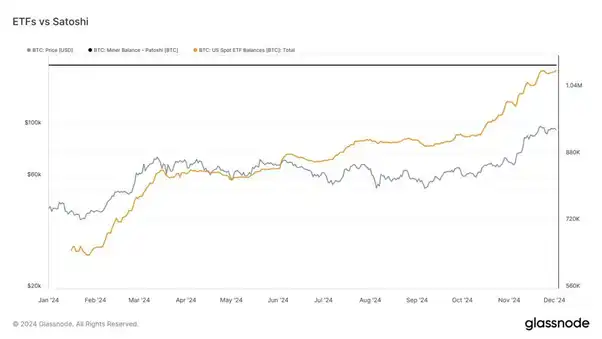
Image Source Data: Glassnode
US institutions are deeply involved in and influencing the global crypto market, even leading the development of the crypto industry. ETFs have propelled Bitcoin from an alternative asset to a mainstream asset, but they have also weakened Bitcoin's decentralized nature. ETFs have brought in a large amount of traditional capital, but they have also firmly placed Wall Street in control of Bitcoin's pricing.
1.2 The "Black-and-White Divide" of Bitcoin ETFs
Qualifying Bitcoin as a commodity means that it must follow the rules of taxation similar to other commodity classes such as stocks and bonds. However, the impact of Bitcoin ETFs is not entirely equivalent to the launch of ETFs for other commodities like gold, silver, and oil. Currently approved or registered Bitcoin ETFs differ from market acceptance of Bitcoin itself:
● The pathway to commodity ETFization is like a person holding the physical asset or commodity (trustee) on the left hand needing custody by an intermediary custodian (like a copper warehouse or a gold bank vault) and authorized institutions completing transfers and records, while the right hand, after issuing shares (e.g., fund shares), will have shareholders buying and selling shares using funds.
However, in this process, the front end (design, development, sales, and after-sales service, etc.) involves physical delivery, spot settlement, and cash settlement. But the front end of the Bitcoin ETFs approved by the U.S. SEC is cash-settled for share transactions, which is also the point of contention for Cathie Wood, who hopes to achieve physical settlement but this is practically impossible.
Because U.S. cash custodians conduct cash purchase and redemption transactions in a traditional centralized financial framework, this also means that the front half of Bitcoin ETFs is entirely centralized.
● At the end of the Bitcoin ETFs, centralized regulatory frameworks are difficult to confirm. This is because if recognizing Bitcoin, it needs to become an existing commodity within the centralized financial framework and will never acknowledge Bitcoin as a substitute for fiat currency or its decentralized properties such as being non-traceable. Therefore, Bitcoin can only be used in various financial derivative products like futures, options, and ETFs if it fully complies with regulations.
Therefore, the emergence of Bitcoin ETFs signifies a partial failure of Bitcoin ETFs to counter fiat currency, rendering the decentralization of Bitcoin ETFs meaningless, and the front end needs to rely entirely on legitimate custody like Coinbase to ensure that the entire trading chain is lawful, transparent, and traceable.
Bitcoin's Black and White Will Be Completely Split by ETF:
Current White Part: Under a centralized regulatory framework, through widespread financial products derivatives, reducing market price volatility, and with the increasing prevalence of legitimate participants, the speculative volatility of Bitcoin commodities will gradually decrease. After Bitcoin is ETF'd, the white part has lost its significant demand side (Bitcoin's decentralization, anonymity), leaving only a single financial attribute available for speculative trading. At the same time, under a legalized regulatory framework, it also means needing to pay more taxes, rendering Bitcoin's original functions of asset transfer and tax evasion no longer existent. That is, endorsement has shifted from a decentralized chain to a centralized government.
Former Black Part: The main reason for the wild fluctuations in the crypto market is its opaqueness and anonymity characteristics, making it susceptible to manipulation. At the same time, the black part of the market will be more open, with more native blockchain value vitality, and more trading opportunities. However, with the appearance of the white part, those unwilling to transition to white will forever be ostracized under a centralized regulatory framework and lose pricing power, akin to paying fines to the SEC.
II. Trump's Cryptocurrency All-Star Cabinet Picks
2.1 Cabinet Picks
In the 2024 U.S. presidential election, compared to the restrictive policies of the SEC, the Federal Reserve, FDIC, and other regulatory agencies during the Biden administration, the U.S. government may have a more favorable attitude towards cryptocurrency holdings under the Trump administration. According to Chaos Labs data, the nominees for Trump's new cabinet are as follows:

Image Source: @chaos_labs
Howard Lutnick (Transition Team Leader and Nominee for Secretary of Commerce):
Lutnick, as CEO of Cantor Fitzgerald, publicly supports cryptocurrency. His company actively explores the blockchain and digital asset space, including a strategic investment in Tether.
Scott Bessent (Nominee for Secretary of the Treasury):
Bessent, a seasoned hedge fund manager, supports cryptocurrency, believing it represents freedom and will endure long term. He is more crypto-friendly than former Treasury Secretary nominee Paulson.
Tulsi Gabbard (Nominee for Director of National Intelligence):
Gabbard's core principles revolve around privacy and decentralization. She supports Bitcoin and has previously invested in Ethereum and Litecoin in 2017.
Robert F. Kennedy Jr. (Nominee for Secretary of Health and Human Services):
Kennedy has publicly endorsed Bitcoin, seeing it as a tool to combat fiat currency devaluation. He may become an ally to the crypto industry.
Pam Bondi (Nominee for Attorney General):
Bondi has not explicitly indicated her stance on cryptocurrency, and her policy direction remains unclear.
Michael Waltz (Nominee for National Security Advisor):
Waltz strongly supports cryptocurrency, emphasizing its role in enhancing economic competitiveness and technological independence.
Brendan Carr (Nominee for FCC Chairman):
Carr is known for his anti-censorship stance and support for technological innovation, potentially providing technical infrastructure support for the crypto industry.
Hester Peirce & Mark Uyeda (Potential SEC Chairman Nominees):
Peirce is a staunch advocate for cryptocurrency, advocating for regulatory clarity. Uyeda has criticized the SEC's tough stance on cryptocurrency and calls for clear regulatory rules.
2.2 Crypto-Friendly Policies as Hedge Against Lack of Trust in the US Dollar's Global Reserve Status
Will the future White House's promotion of Bitcoin undermine people's trust in the US dollar as the global reserve currency, thereby weakening the dollar's position? American scholar Vitaliy Katsenelson suggests that at a time when market sentiment toward the dollar has been disrupted, the White House's promotion of Bitcoin could shake people's trust in the dollar as the global reserve currency, potentially weakening its status. Regarding the current fiscal challenges, "What can truly keep America great is not Bitcoin, but control over debt and deficits."
Perhaps Trump's actions could serve as a hedge by the US government against the risk of losing the dollar's dominant position in the future. In the context of economic globalization, all countries seek to achieve international circulation, reserves, and settlement of their national currencies. However, in this issue, there exists a trilemma of currency sovereignty, free capital movement, and fixed exchange rates. The significant value of Bitcoin lies in providing a new solution for national institutional contradictions and economic sanctions in the context of economic globalization.
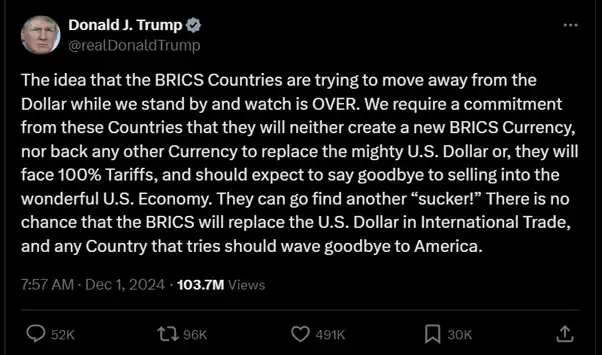
Image Source: @realDonaldTrump
On December 1, 2024, Trump stated on social platform X that the era of BRICS countries trying to move away from the US dollar has come to an end. He demanded that these countries commit to not creating new BRICS national currencies or supporting any other currency that could potentially replace the dollar. Otherwise, they would face a 100% tariff and lose the opportunity to access the US market.
Today, Trump seems to be holding onto the US dollar's dominance with one hand, refusing to compromise, while also firmly grasping the strongest weapon against national fiat currency trustlessness, Bitcoin, with the other hand, actively consolidating the dollar's international settlement power and the cryptocurrency market's pricing power.
III. MicroStrategy and Citron Capital's Long and Short Duel
During the US stock trading session on November 21, the well-known short-selling institution Citron Research announced on social platform X its plan to short "Bitcoin-heavy stock" MicroStrategy (MSTR). This announcement caused MicroStrategy's stock price to plummet, dropping more than 21% from its intraday high.
The next day, MicroStrategy's CEO, Michael Saylor, responded in a CNBC interview, stating that the company not only profits from Bitcoin's volatility trading but also leverages Bitcoin investments through the ATM mechanism. Therefore, as long as the price of Bitcoin continues to rise, the company can remain profitable.
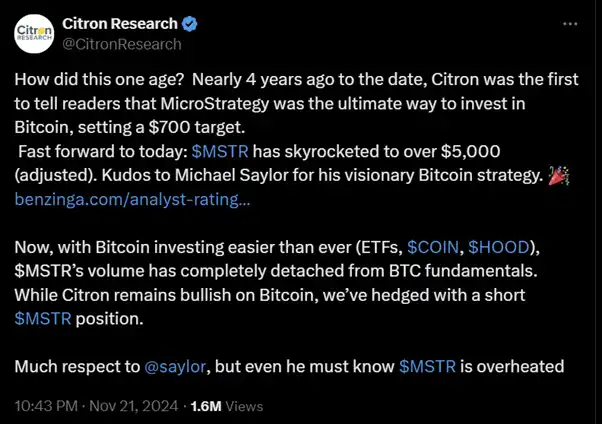
Image Source: @CitronResearch
Overall, the summary of MicroStrategy's (MSTR) stock premium, its profit strategy through the At The Market (ATM) mechanism in Bitcoin investment, leverage operations in Bitcoin investment, and the viewpoints of short-selling institutions are as follows:
1. Source of Stock Premium:
The majority of MSTR's premium comes from the ATM mechanism. Citron Research believes that MSTR's stock has become an alternative investment to Bitcoin, leading to an unreasonable premium compared to Bitcoin. Therefore, they decided to short MSTR. However, Michael Saylor countered this view, stating that the shortsightedness of the shorts overlooks MSTR's crucial profit model.
2. MicroStrategy's Leveraging Strategy:
Leverage in Bitcoin Investment: Saylor pointed out that MSTR leverages its investment in Bitcoin through debt issuance and financing, relying on Bitcoin's volatility to generate profits. The company flexibly funds itself through an ATM mechanism to avoid discount issuances in traditional financing. It also leverages high trading volume to carry out large-scale stock sales, gaining arbitrage opportunities from stock premiums.
3. Advantages of the ATM Mechanism:
The ATM model allows MSTR to flexibly raise funds and transfer debt volatility, risk, and performance to common stock. Through this operation, the company can achieve returns significantly higher than the borrowing cost and Bitcoin's price appreciation. For example, Saylor pointed out that by financing Bitcoin investment at a 6% interest rate, if Bitcoin rises by 30%, the company's actual return would be about 80%.
4. Specific Profitability Case:
By issuing $3 billion in convertible bonds, the company expects to achieve earnings per share of $125 over a period of 10 years. If Bitcoin's price continues to rise, Saylor predicts that the company's long-term profits will be substantial. For instance, two weeks ago, MSTR financed $4.6 billion through the ATM mechanism, traded at a 70% premium, and earned $3 billion worth of Bitcoin within five days, equivalent to $12.5 per share, with long-term earnings expected to reach $33.6 billion.
5. Risks of Bitcoin Price Drops:
Saylor believes that buying MSTR's stock implies that investors have accepted the risk of Bitcoin price drops. To achieve high returns, one must be willing to take on corresponding risks. He forecasts that Bitcoin will rise by 29% annually in the future, while MSTR's stock price will increase by 60% per year.
6. MSTR's Market Performance:
Year-to-date, MSTR's stock price has risen by 516%, far exceeding Bitcoin's concurrent 132% increase and even surpassing AI leader NVIDIA's 195% rise. Saylor believes that MSTR has become one of the fastest-growing and most profitable companies in the United States.
Regarding Citron's shorting, MSTR's CEO stated that Citron does not understand where MSTR's premium to Bitcoin comes from and explained:
"If we finance Bitcoin investment with funds at a 6% interest rate, when Bitcoin's price rises by 30%, we actually receive an 80% Bitcoin spread (a function of stock premium, conversion premium, and Bitcoin premium)."
「The company issued $30 billion in convertible bonds, based on an 80% Bitcoin price differential. This $30 billion investment is expected to generate $125 per share in returns over 10 years.」
This means that as long as the price of Bitcoin continues to rise, the company can continue to profit:
「Two weeks ago, we conducted a $46 billion ATM transaction, trading at a 70% differential. This means we earned $30 billion in Bitcoin in five days, approximately $12.5 per share. Looking ahead 10 years, the returns could reach $336 billion, equivalent to about $150 per share.」
In summary, MicroStrategy's operating model leverages a structured capital design to efficiently arbitrage between stocks, bonds, and cryptocurrency, closely tying its stock to Bitcoin's price movements to ensure low-risk profitability over a long period. However, MicroStrategy's essence lies in infinite asset securitization and leveraging to boost its own value, relying on a prolonged Bitcoin bull market to sustain its value. Shorting MicroStrategy carries significantly more risk than shorting Bitcoin, as MicroStrategy is betting on a slow, steady rise in Bitcoin's price without major fluctuations.
IV. Conclusion
Image Source: Tradesanta
The United States is continuously strengthening its regulatory control in the cryptocurrency industry, with market opportunities increasingly shifting towards centralization. The decentralized utopia of the crypto world is gradually compromising towards centralization, surrendering its authority. Every remedy has its poison, and the influx of ETFs is merely a palliative that cannot cure the underlying issues.
In the long run, Bitcoin ETFs may not be a positive development. There is a significant disparity in trading volume between Hong Kong Bitcoin ETFs and US Bitcoin ETFs, indicating that US capital is gradually engulfing the crypto market. Despite China's absolute dominance in the mining sector, it still lags in terms of capital markets and policy orientation. Perhaps the long-term impact of Bitcoin ETFs will accelerate the normalization of cryptocurrency trading, marking both a beginning and an end.
Reference: Fu Peng: Discussing the SEC and Bitcoin ETF - Black and White Centralization
This article is a contributed submission and does not represent the views of BlockBeats.
You may also like

It took me a year to see the painful truth about Agent payments

A Perspective on the Indian Cryptocurrency Market: Descending into Silence or Moving Towards Maturity?

Morning News | Bitmine issues preferred shares to raise $300 million; Polymarket accuses Kalshi of industrial espionage

Privacy coin trust crisis! ZEC plummets over 56% in a single day

Who is leading the price discovery in the cryptocurrency market? Measured delays on platforms like Binance and Hyperliquid

Anthropic launches IPO: Business miracle or valuation bubble?

What Is SpaceX IPO and Why Is Everyone Talking About It?
Macroeconomic Analysis of the African Payment Market Landscape

Morning Report | Coinbase Ventures makes its first investment in ENA; SpaceX plans to set the IPO price at $135 per share
Full text and analysis of the speech by the CEO of SanDisk at the 42nd Annual Strategic Decision Conference of Bernstein

Bitcoin Price Prediction 2030: Ark Invest Forecasts $710K

WEEX Review 2026: Fees, Security and Trading Features

SOL Price Today: Live Solana Price, Charts & Market Data

What Is a Bitcoin ETF: Spot vs Futures Explained

Why Is Bitcoin Dropping 15% While Nasdaq Hits Record Highs?

Morning Report | Robinhood completes acquisition of WonderFi for $180 million; Anthropic submits IPO draft application to SEC confidentially; Google plans to raise $80 billion in financing

Why do I still have confidence in ETH?

CRCL surges and plummets, COIN follows with a dive: The real battle for interests behind the CLARITY Act
It took me a year to see the painful truth about Agent payments
A Perspective on the Indian Cryptocurrency Market: Descending into Silence or Moving Towards Maturity?
Morning News | Bitmine issues preferred shares to raise $300 million; Polymarket accuses Kalshi of industrial espionage
Privacy coin trust crisis! ZEC plummets over 56% in a single day
Who is leading the price discovery in the cryptocurrency market? Measured delays on platforms like Binance and Hyperliquid
Anthropic launches IPO: Business miracle or valuation bubble?


