The Chip Industry's Most Secure Middleman Just Took a Very Risky Turn

 Prefer us on Google


Between $40 billion and $150 billion is not a growth curve, but a self-disruption of a business model.
On March 24, Arm unveiled its first in-house data center CPU in the company's 35-year history in San Francisco. This chip, named AGI CPU, features 136 Neoverse V3 cores, TSMC 3nm process, 300W TDP, with Meta as the first customer for large-scale deployment within the year. Also announced as partners are OpenAI, Cerebras, Cloudflare, SAP, and SK Telecom.
Arm CEO Rene Haas provided a set of target numbers at the event, stating that the chip business is expected to achieve $15 billion in annual revenue by 2031, with total company revenue of $25 billion and earnings per share of $9.
What do these numbers mean? Arm's total company revenue for FY2025 (ending March 2025) was $40.07 billion, according to Arm's annual report data, with licensing revenue of $18.39 billion, royalty revenue of $21.68 billion, and a 97% gross margin. In other words, a company with $40 billion in annual revenue aims to achieve a scale close to Intel's entire data center division in just 5 years through a single new business. According to Intel's Q4 2024 financial report, Intel's DCAI (Data Center and AI) division had full-year revenue of $12.8 billion in 2024.
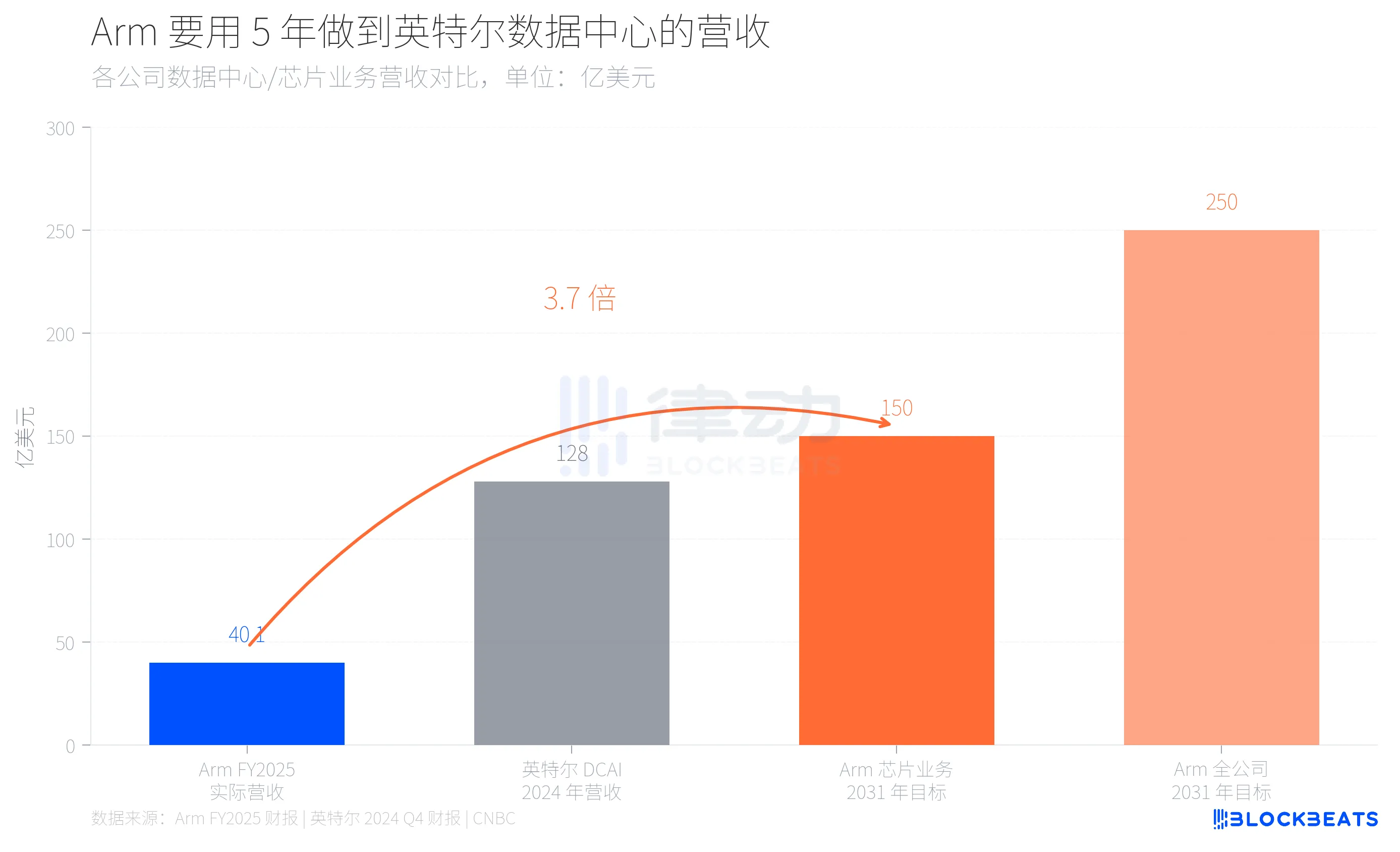
From $40 billion to $150 billion, behind the 3.7x leap is Arm's attempt to transform from a pure IP licensing company to a hybrid that sells both design blueprints and finished products. There is no precedent for this in the chip industry.
Why is Arm taking this risk? The answer lies in its customer list.
Over the past three years, Arm's largest data center customers have been doing the same thing. According to public data from AWS, Amazon has migrated over 50% of EC2 compute to its in-house Graviton chips, with the latest Graviton5 featuring 192 cores. As disclosed by Google Cloud, Google's Axion chip has already migrated over 30,000 internal applications, achieving an 80% energy efficiency gain. Microsoft's Cobalt 200 is also based on Arm Neoverse architecture, TSMC 3nm process, with 132 cores.
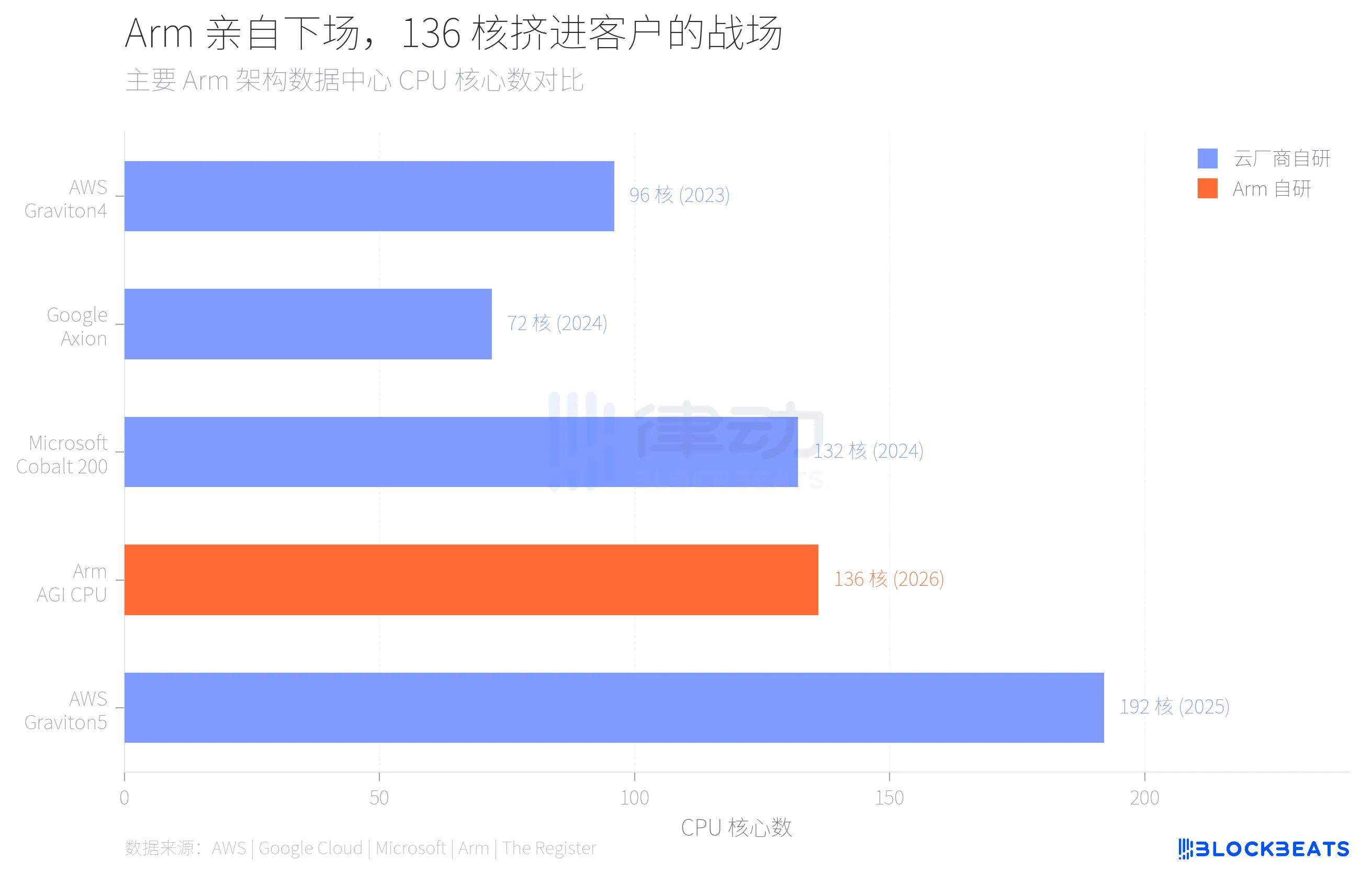
These cloud providers all use Arm's architecture license, but the chips are self-designed, self-fabricated, and self-deployed. Arm earns licensing fees and royalties rather than chip profits. As more and more computing power is consumed by these custom chips, Arm's revenue ceiling in data centers becomes clearer.
Looking at Arm's revenue structure over the past four years, the outline of this ceiling becomes more defined. According to Arm's annual reports, from FY2022 to FY2025, the company's total revenue is projected to grow from $27 billion to $40 billion, with a CAGR of around 14%. Royalty revenue is expected to increase from $15.62 billion to $21.68 billion, while licensing revenue is set to grow from $11.41 billion to $18.39 billion. The growth rate of royalties has slowed to 20% from previous years, and this 20% growth is largely driven by the upgrade to the Armv9 architecture in the mobile sector, not in data centers.
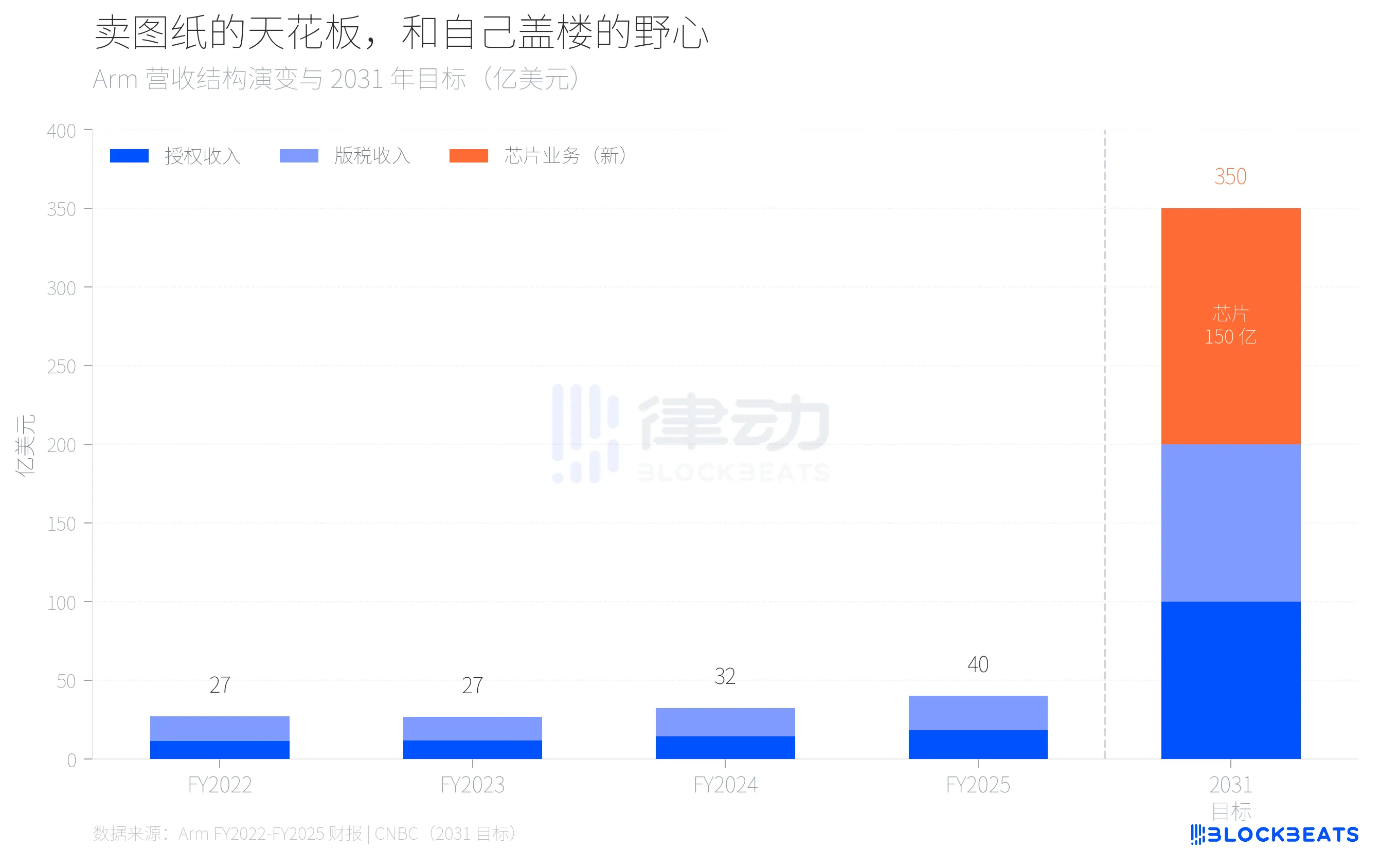
Extrapolating this growth rate, even if both licensing and royalty revenues maintain an annual growth rate of around 20%, by 2031, they will only reach about $10 billion. The remaining $15 billion must come from a business that does not yet exist today. This is the arithmetic logic behind Arm's decision to manufacture its own chips.
Arm's choice to produce its own chips fundamentally means competing with its own customers. A company that sells blueprints to others is now constructing buildings itself, while its blueprint buyers have been building for years.
This is the true background of the 136-core AGI CPU. According to The Register, this chip has a base frequency of 3.2 GHz, up to 3.7 GHz, 12-channel DDR5 memory, 6 GB/s per core bandwidth, 96 PCIe 6.0 lanes, and supports CXL 3.0. Arm positions it as the "computing foundation of the agentic AI cloud era," focusing on CPU-side task scheduling and data flow management in AI inference, rather than directly competing with GPUs.
The pace of market share change also speaks volumes. According to Omdia's estimates, by 2025, Arm architecture servers will account for approximately 21% of global shipments, with a 70% growth rate. However, within hyperscale data centers, this proportion is already close to 50%. The 40-year dominance of x86 is not collapsing but being replaced chip by chip.
The risk of Arm's in-house chip is not technical, but relational. Meta's willingness to be the first customer is partly because Meta itself does not have a mature in-house chip project like Amazon or Google. But how would Amazon, Google, or Microsoft view this? If a supplier starts competing with you, would you still hand over your most critical architecture to them?
Arm's bet is that the overall growth of the data center is faster than the deterioration of customer relationships. Rene Haas apparently believes that the incremental demand for CPUs in the AI era is large enough to allow for both in-house chips and architecture licensing to coexist. The $15 billion target is the pricing of this assessment.
After 35 years of selling blueprints, building their own building for the first time. While they continue to sell blueprints, they are also constructing the building, all on the same plot of land. It remains to be seen whether it will be too crowded.
Disclaimer: This content is provided for general branding and informational purposes only and doesn't constitute financial, investment, legal, or tax advice. Any events, rewards, online events, or related information mentioned herein should not be considered a recommendation, solicitation, or invitation to purchase, sell, trade, or otherwise deal in any crypto assets or to use any services. Crypto assets are highly volatile and may result in loss. WEEX services and online events may not be available in all regions and are subject to applicable laws, regulations, and eligibility requirements. You are responsible for ensuring that your use of WEEX services complies with local laws and for carefully assessing the risks before participating in any crypto-related activities.
You may also like

What is SCEX? The Cryptocurrency Exchange for Vietnam's Market by Sacombank
Major Update for ChatGPT: Cross-Platform Functionality, One-Click Website Creation, and Lower Costs

BTC Challenges 64,000 After Breaking 63,000, Market Trading 'Manageable Risks'
As the Bubble Bursts, Who Dominates Attention in the AI Era? A 2026 Guide to Influential AI KOLs in China and the UK
Old Money in Crypto Shifts: Paradigm Raises $1.2 Billion, Half Bet on AI and Robotics

Bitdeer unveils $36M Nevada factory to shake up Bitcoin mining
Perplexity Fine-Tuned a Chinese AI Model to Match Claude Opus 4.8 at One-Third the Cost

Bank of Korea defends bank-first stablecoin plan amid bill deadlock
JPMorgan says bitcoin's main risk isn't Strategy, but blockchain adoption that doesn't benefit public chains and tokens

Fear & Greed Index Today: What Extreme Fear Means for Crypto, Stocks and Gold
Labour MPs Push to Make UK Crypto Donation Ban Permanent
Supreme Court ruling expanding Trump's authority over federal agencies raises questions for SEC, CFTC as crypto rulemaking advances

'Bottom building in progress': Analysts say bitcoin holder capitulation signals late-stage bear market
A Comprehensive Analysis: Starting from 1996, Who is Laying the Foundation for the Next Generation of Capital Markets
Luke Dashjr, the Biggest Anti-Spammer of Bitcoin, Inscribed Phrases on the Network in 2011

Whales bought 270,000 BTC while ETFs bled $7 billion. One side is wrong

The crypto IPO class of 2025-26 is down as much as 89%. Autopsy of a listing boom
Robinhood Chain Mining Guide: A Comprehensive Tutorial from Cross-Chain to Memecoin
BitGo CEO says single-digit percentages of bitcoin's supply are 'probably right' for large holders amid Strategy's sale

Beyond Private Keys: How to Safeguard the Security Boundaries of Web3 from Wallets, L2 to Supply Chains?
Vanguard Enters the Market, Opening a New Crypto Gateway for 50 Million Traditional Investors

Why the OUSD Alliance of 150 Companies Still Cannot Shake USDT and USDC?
Citigroup Analysis: Is There Still 47% Upside for Nvidia? Can Rubin and CPO Deliver?
WEEX API Fast Connect: Turn Every Sign-In Into a Live Trader in Under 10 Seconds
WEEX API Fast Connect is a one-click OAuth authorization system that lets your users link their WEEX account without ever touching an API key. Frictionless onboarding, faster conversions, higher retention — built for WEEX Broker partners.
Bitcoin's dwindling exchange reserves don't pack the same bullish punch anymore

From Le Mans to the Rollercoaster: Carl Moon Takes On Portimão
Crypto world renowned KOL and racing driver Carl Moon, backed by WEEX, heads to the Ferrari Challenge Portugal round at the Algarve International Circuit, July 16–19, fresh off a podium finish at Le Mans. Here's why this race is one to watch.
Fast execution. Split-second accuracy. Security that never blinks. That's WEEX — and that's exactly how Carl races.
The Downfall of a Public Company: A $1.46 Billion Bet on WLFI, $540 Million Went to the Trump Family
Dragonfly Partner: BTC is Intergenerational Wealth, Optimistic About ETH and SOL
Goldman Sachs Calls to Go Long on Chinese AI: $4 Trillion Market Value Behind, Global Funds Only Allocated 1.2%
The New Landscape of Cryptocurrency in Europe: Why Germany Takes Center Stage?
What is SCEX? The Cryptocurrency Exchange for Vietnam's Market by Sacombank
Major Update for ChatGPT: Cross-Platform Functionality, One-Click Website Creation, and Lower Costs
BTC Challenges 64,000 After Breaking 63,000, Market Trading 'Manageable Risks'
As the Bubble Bursts, Who Dominates Attention in the AI Era? A 2026 Guide to Influential AI KOLs in China and the UK
Old Money in Crypto Shifts: Paradigm Raises $1.2 Billion, Half Bet on AI and Robotics
Bitdeer unveils $36M Nevada factory to shake up Bitcoin mining