
The AI Agent is back online. What are some new projects worth keeping an eye on from the past week?


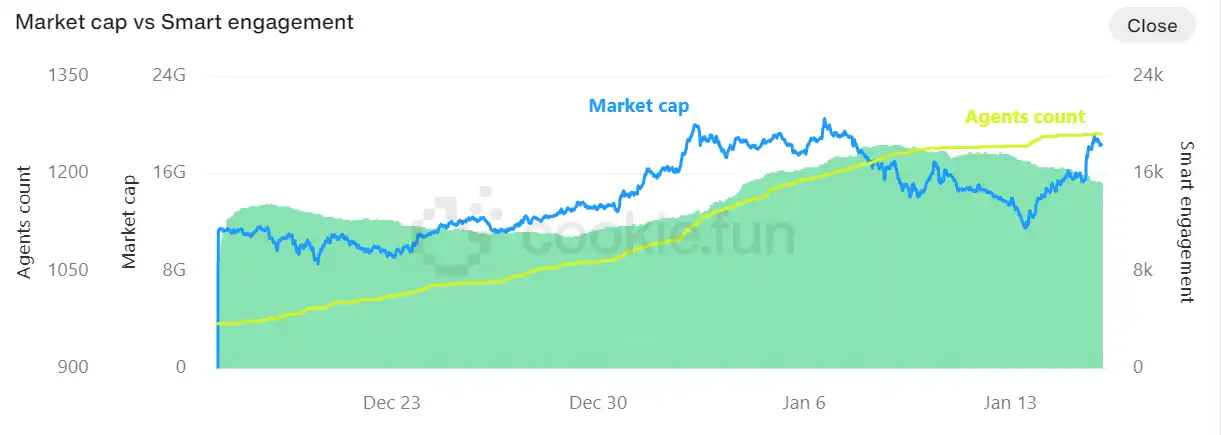
In the past few days, due to the reduced expectation of a Fed rate cut, the US stock market was hit hard, with a significant decline in the overall market. On the 13th, Bitcoin briefly fell below $90,000. The AI Agent sector also experienced a certain degree of decline in popularity, with tokens such as Buzz, ai16z, ARC, and zerebro seeing a staggering drop of around 50%. According to cookie.fun data, the market capitalization of the AI Agent sector dropped from $19 billion on the 6th to a low of around $11.5 billion on the 13th, and has now rebounded to nearly $18.4 billion. This series of changes undoubtedly poured cold water on the previously hot market.
However, Bitcoin quickly recovered, bouncing back to around $98,000 on the 14th, leading to a recovery in market sentiment. In this rebound, the AIOS and SORA tokens, two AI agent projects, stood out. AIOS is dedicated to developing an Artificial Intelligence Agent Operating System, while SORA aims to develop a modular AI framework in Go language, becoming representative forces in the AI agent sector's recovery. In this market warming, aside from major projects leading the rally, AI Agent series tokens also gained vitality due to the emergence of new projects. This article highlights three emerging AI Agent projects that have garnered high market attention recently: AICC, AIOS, and SORA. These projects are all from the Solana ecosystem and have quickly attracted significant funding and participation post-launch, resulting in a substantial increase in market capitalization.
AIOS: The Artificial Intelligence Agent Operating System Embracing FOMO and FUD
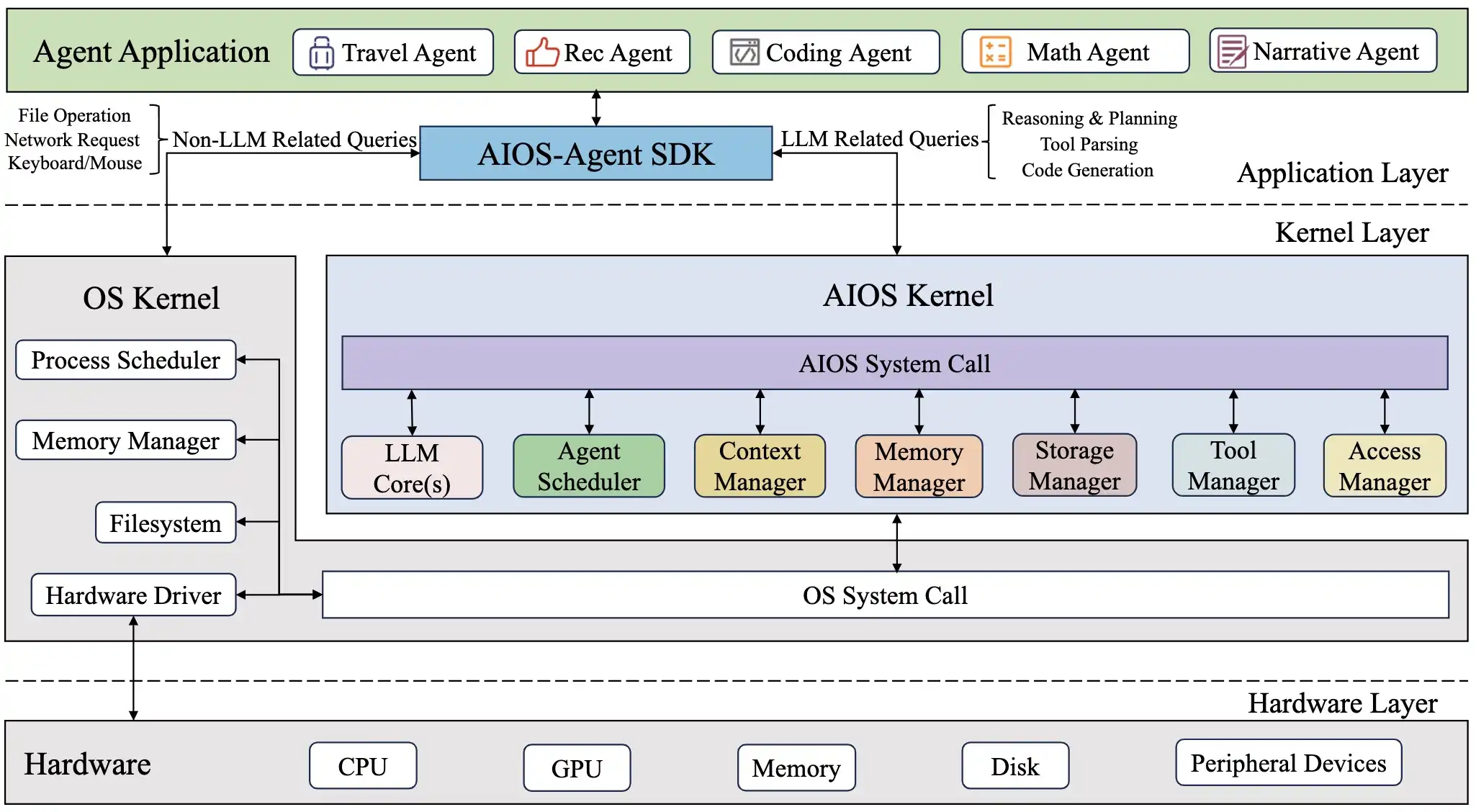
AIOS is an Artificial Intelligence Agent Operating System that embeds Large Language Models (LLMs) into the operating system, facilitating the development and deployment of AI agents based on LLMs. AIOS aims to address the challenges faced by LLM-based agents in the development and deployment process (such as scheduling, context switching, memory management, storage management, tool management, and agent SDK management), providing a better AIOS-Agent ecosystem for agent developers and users. AIOS consists of the AIOS kernel and AIOS SDK (Mind), supporting both Web UI and terminal UI.
AIOS has broad commercial prospects, aiming to build an operating system and ecosystem for LLM agents, providing a unified interface for LLMs and tools that can be applied in AI agent development, cross-model collaboration, AGI research and development, and other scenarios. The core advantage of AIOS is that it offers a unified interface that simplifies the integration and management of various LLMs and tools, solving the complex problems in LLM agent development and deployment, significantly reducing the technological threshold for developing and deploying intelligent agents.
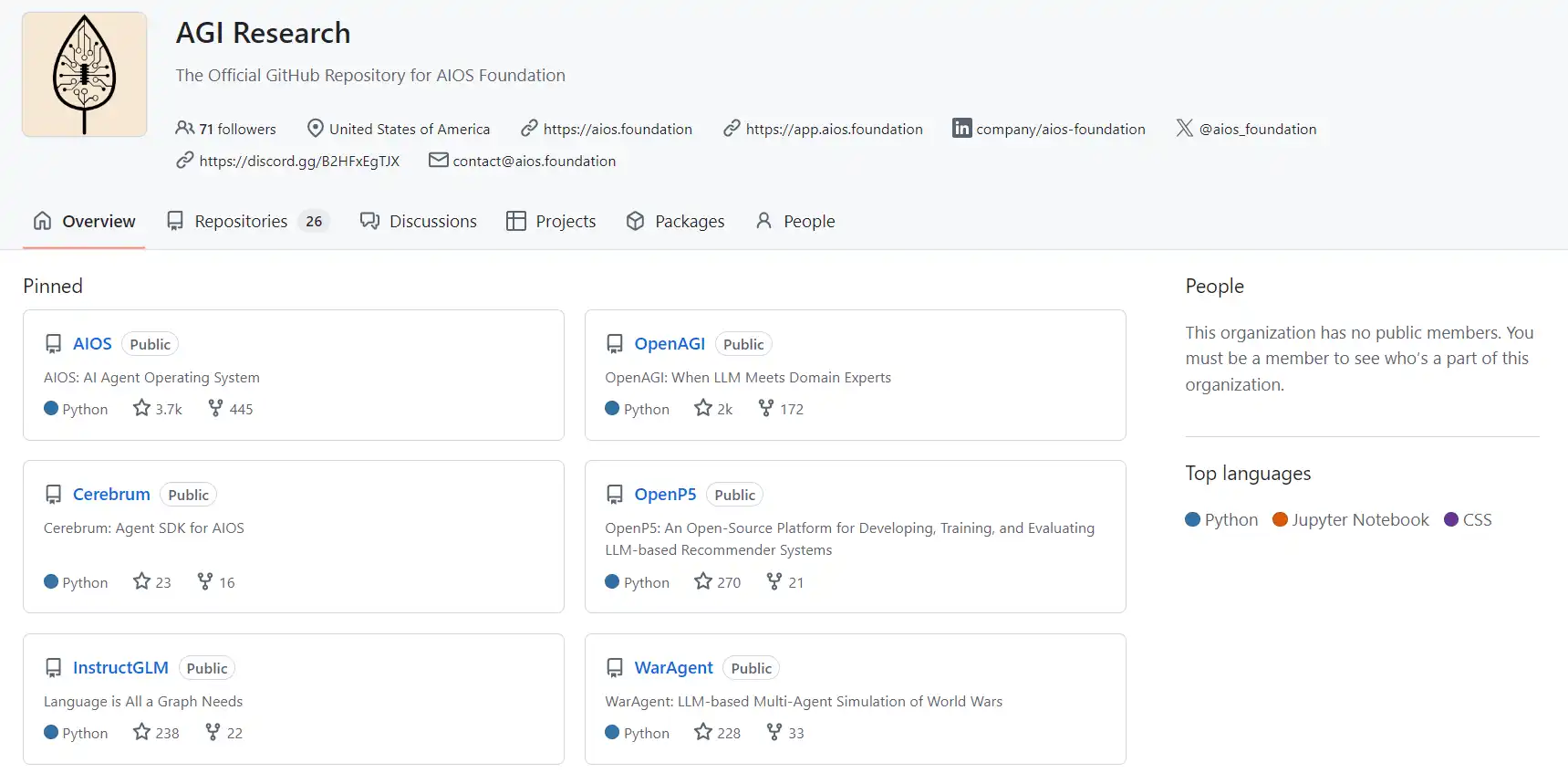
Furthermore, AIOS is not just a project team's "pie in the sky," but a product-level AI agent operating system that has received over 3700 stars on GitHub, indicating high recognition.
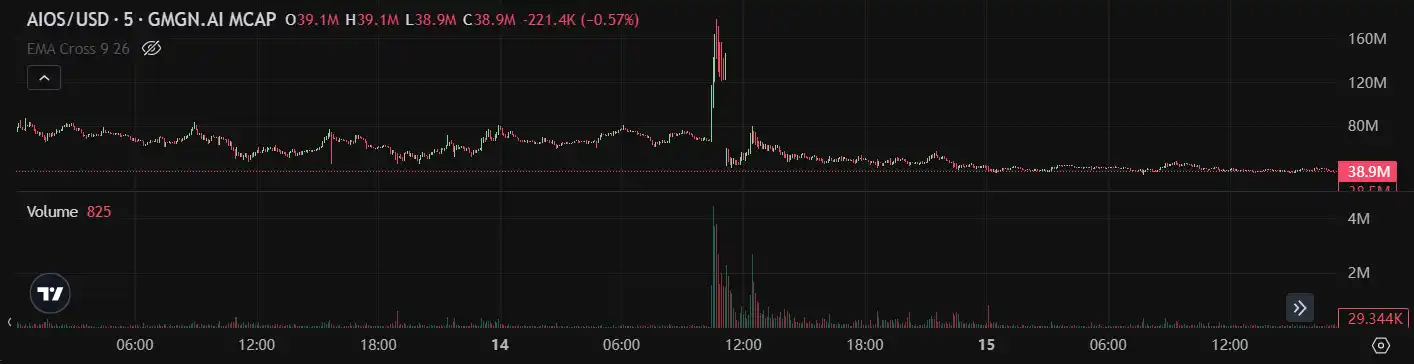
On January 14th, the AIOS Foundation announced that it would burn the held tokens within 24 hours, totaling 66.61% of the total supply (comprising 64.03% and 2.58%, respectively). In the future, as the AIOS Chain mainnet launches, circulating AIOS on Solana can choose to migrate to AIOSChain. Simultaneously, AIOSChain will mint and burn a proportional amount of native tokens and permanently lock them for staking to support decentralized ecosystem development.
Spurred by this news, AIOS experienced a short-term surge of over 150%, reaching a market cap of $170 million. Its current market cap is around $40 million.
However, the voices casting doubt on the AIOS token have never ceased. From the project team mentioning on Discord that a Twitter hack led to a crash, Chinese wash trading, 13 rebranding attempts, to questioning the narrative's meaningfulness, AIOS has emerged from among many tokens with both fervent support and skepticism, only to quickly fall back.
SORA: An AI Dialogue Framework Developed in Go
Another rising star is the project Sora. Sora Labs is an AI company focused on blockchain products, committed to making AI accessible to everyone, from individual developers to large organizations, and making it practical. By providing powerful tools and frameworks to simplify AI development, anyone can use these tools and frameworks to create, launch, and scale intelligent systems in real-world scenarios. Its main products are all open source on GitHub:
1. Zen (main product): An open source AI dialogue framework built in Go, designed to create a powerful and easy-to-build system, alongside $swarms as an AI agent framework.
2. Hana: A Twitter AI agent based on the Zen framework.
3. Toolkit: Developed using Go and Rust, designed to help in developing and managing tools that seamlessly collaborate with AI models.
4. Solana Toolkit: The Solana Toolkit extends the basic Toolkit implementation to provide Solana-specific functionality.
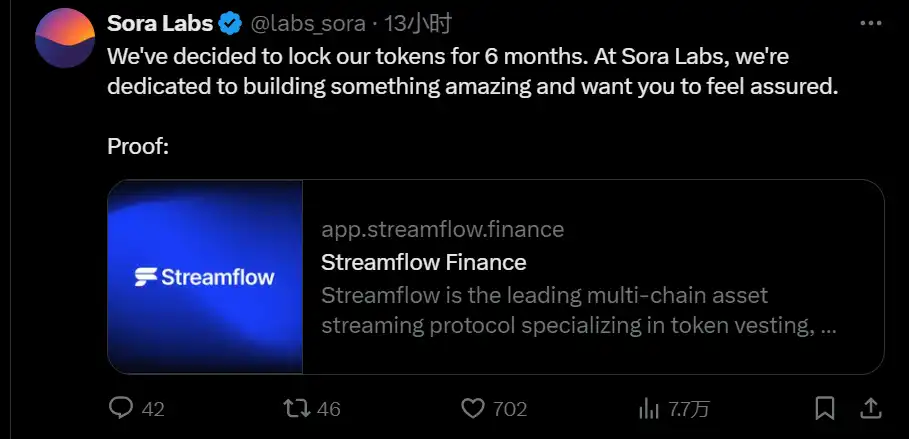
The project team also announced that the held tokens will be locked for 6 months.
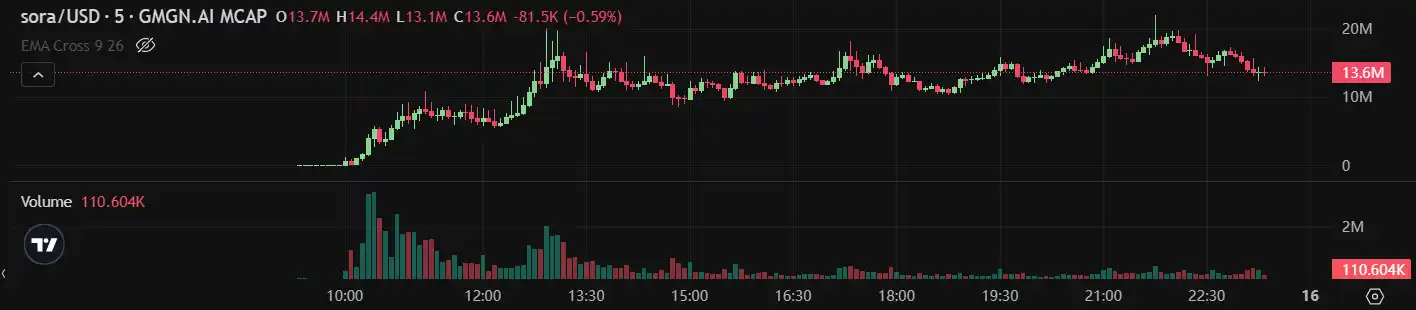
Upon the launch of the Sora token, the market value quickly reached 19M within 2 hours, with a 24-hour trading volume soaring to 75M. Subsequently, the market value has fluctuated above 10M.
AICC: From Stellar Rise to Fall from Grace of an AI DAO
AICC is a typical token that saw a high opening price followed by a downward trend. Within 3 days, it transitioned from a shining star to a luxury project to a condemned "VC coin."
AiccelerateDAO is an investment and development DAO focused on accelerating decentralized open-source AI development. The development advisory list includes Shaw, the founder of ai16z; EtherMage, a core contributor to Virtuals Protocol; Nader Dabit, Developer Relations Lead at EigenLayer; and Jason Zhao, co-founder of Story Protocol.
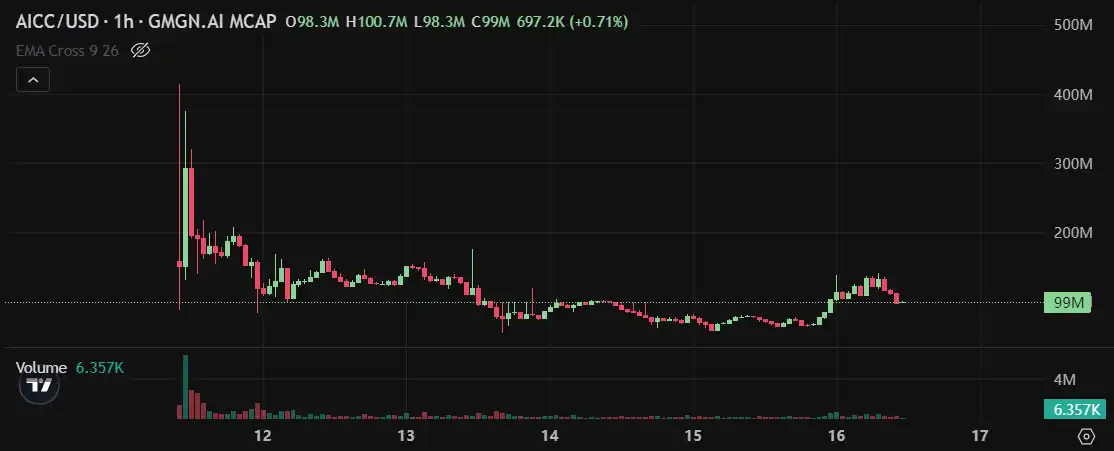
After AICC officially started trading on-chain, its market value surged to over 4 billion dollars. Following a price drop, it once again surpassed 3.7 billion dollars within an hour, becoming another "AI sector skyrocket." However, participants of AiccelerateDAO quickly sold off tokens for significant profits after the project launch, rapidly shifting the market's focus to the critical issue of token distribution structure. This sparked extensive discussion and controversy in the community, drawing attention to the tokenomics and responsibility of AICC, its project team, and investors. Consequently, the price of the AICC token plummeted, reaching a market value as low as around 50 million dollars, nearly an 80% drop from its previous peak of 3.7 billion dollars.
You may also like

Bitcoin Falls Below 200-Week Moving Average as On-Chain Data Shows Over Half of Supply in Loss
Bitcoin dropped below its 200-week moving average as on-chain data showed over 50% of circulating supply is now in loss, signaling rising market stress.

CFTC Reportedly Plans New Prediction Market Rules Focused on Manipulation Risk and Public Interest Review
The CFTC is reportedly preparing new prediction market rules focused on manipulation risk, public interest review, and retail trader protections.

Meet the new WEEX trial fund—your gateway to greater profits

WEEX Labs Lands at Dutch Blockchain Week: A Disruptive Crypto × AI Conversation Sets Sail in Amsterdam

SK Hynix Reportedly Plans U.S. ADR Listing as Early as August, With SEC Approval Possible in Late June
SK Hynix may pursue a U.S. ADR listing as early as August, with SEC approval reportedly possible in late June amid strong AI chip supply chain demand.

SpaceX vs Tesla vs xAI: Which Elon Musk Trade Has the Biggest Upside in 2026?
OpenAI Reveals It Has Confidentially Submitted an S-1 to the SEC, Keeping the Door Open for a Future IPO
On June 9, according to an OpenAI announcement, the company recently confidentially submitted a draft S-1 registration statement to the U.S. Securities and Exchange Commission (SEC), beginning the preliminary compliance process for a potential initial public offering. OpenAI said it chose to disclose this proactively because it expected the news might leak; however, the company has not yet set a specific listing timeline, and related arrangements may still take some time.

Latest research from 13 top universities including Cornell University: The current state, challenges, and misconceptions of the fusion of Crypto and AI
Deconstructing Anthropic: The Best AI Company, Possibly Also a Type of Organizational Invention
Apollo and Blackstone Reportedly Back $35 Billion Anthropic Chip Financing as Deal Details Remain Unclear
On June 9, according to currently available news alerts, Apollo and Blackstone Group participated in a $35 billion financing for an Anthropic “chip project.” Based on the original wording of the report, the funding has already been raised, but public information remains limited. The financing structure, use of proceeds, project entity, and whether Apollo and Blackstone participated through equity, debt, or project financing have not yet been disclosed.

Humanity Protocol Security Incident Escalates: More Than $31 Million Stolen From Related Addresses as Attacker Continues Selling H for ETH
On June 9, according to monitoring by Onchain Lens, more than $31 million has been stolen from addresses linked to Humanity Protocol, and the attack is still ongoing, with the hacker continuously swapping H tokens for ETH. Project founder Terence Kwok later confirmed the security incident on X, saying the issue involved a private key leak.

Bloomberg: As Bitcoin Weakens, Stablecoins and RWA Continue to Drive Expansion in Crypto Businesses
In June, Bloomberg reported that despite Bitcoin falling below $60,000 last week, wiping out about $235 billion in market value within seven days, and dropping close to 50% from last year’s peak, some core businesses in the crypto industry are still expanding, mainly in stablecoins, real-world asset tokenization (RWA), payments, and infrastructure. The report also noted that overall altcoin activity has contracted significantly: altcoin market capitalization has fallen from a peak of about $431 billion in November 2021 to around $170 billion, and among the tens of millions of tokens issued in recent years, fewer than 1,700 still maintain meaningful trading activity.

Galaxy Deep Research Report: How Hyperliquid's HIP-4 Upgrade Changes the Landscape of Prediction Markets?
Binance Research: RWA Market Expected to Expand Nearly 6x from Early 2025, with Public Equities and Onchain Payments Heating Up Together
In June, Binance Research said in its monthly market report that the real-world asset (RWA) market is expected to grow by about 589% from the beginning of 2025. Bond- and money market fund-related RWA expanded by about $6.5 billion, up 83% year over year, while publicly traded equity RWAs grew by about 422%. The report also noted that monthly crypto debit card transaction volume exceeded $747 million in May, up 48.6% year to date.

Japan to Assess a Framework for Yen Stablecoins and Crypto ETFs as Asia’s Compliant Payments Narrative Heats Up
Recently, according to the original report, Japan is considering the launch of yen stablecoins and cryptocurrency ETFs. Public information remains limited at this stage, and there is still no complete policy text, regulatory draft, or clear implementation timeline, so this is better characterized as a “policy discussion” rather than formal implementation. The original wording also noted that advancing stablecoin regulation in Asia is driving XRP usage and supporting growth in the XRPL ecosystem. However, based on currently available public information, there is not enough evidence to directly establish a clear causal relationship between this round of discussion in Japan and XRP or XRPL.

ZachXBT: Humanity private key leak and abnormal surge in H token should be viewed separately
On June 9, according to related disclosures, on-chain investigator ZachXBT posted an update on Humanity’s roughly $31 million security incident, saying that after further analyzing fund flows, he currently tends to believe the project team was not involved in an “inside job” or a self-staged attack. According to him, the official explanation about the private key leak was broadly accurate, but before the token unlock, the price of H had been artificially pushed higher, and the hacker later took advantage of that market environment; therefore, the private key leak and the earlier abnormal price pumping should be regarded as two separate and independent events. This reframing has shifted the market’s understanding of the nature of the incident. Earlier discussion around Humanity had focused on whether the team directly participated in the attack or used the security incident to cover up internal operations. ZachXBT’s latest remarks shift the focus from “whether it was self-theft” to “whether there were pre-unlock market structure issues.” He also questioned whether the team may have.

Morning Report | OpenAI has submitted an S-1 registration statement draft to the U.S. SEC; Morpho completes $175 million financing

Morning Report | BitMine increased its holdings by 126,971 ETH last week; trader Eugene announced his exit from the crypto market
Bitcoin Falls Below 200-Week Moving Average as On-Chain Data Shows Over Half of Supply in Loss
Bitcoin dropped below its 200-week moving average as on-chain data showed over 50% of circulating supply is now in loss, signaling rising market stress.
CFTC Reportedly Plans New Prediction Market Rules Focused on Manipulation Risk and Public Interest Review
The CFTC is reportedly preparing new prediction market rules focused on manipulation risk, public interest review, and retail trader protections.
Meet the new WEEX trial fund—your gateway to greater profits
WEEX Labs Lands at Dutch Blockchain Week: A Disruptive Crypto × AI Conversation Sets Sail in Amsterdam
SK Hynix Reportedly Plans U.S. ADR Listing as Early as August, With SEC Approval Possible in Late June
SK Hynix may pursue a U.S. ADR listing as early as August, with SEC approval reportedly possible in late June amid strong AI chip supply chain demand.
SpaceX vs Tesla vs xAI: Which Elon Musk Trade Has the Biggest Upside in 2026?


