
 Buy Crypto
- Markets
 Futures
- Spot
- Copy Trade
- Earn
- More
Swan Chain announces TGE to accelerate the future development of decentralized AI

Swan Chain, the leading AI blockchain infrastructure, officially announced the Token Generation Event (TGE) and public listing plan of its native token SWAN. SWAN aims to promote the development of Swan Chain's decentralized AI and Web3 ecosystem and will be listed on multiple cryptocurrency exchanges including Gate, MEXC, LBank, and Hotcoin from December 16.
Democratizing the Future: The Power of Community Governance
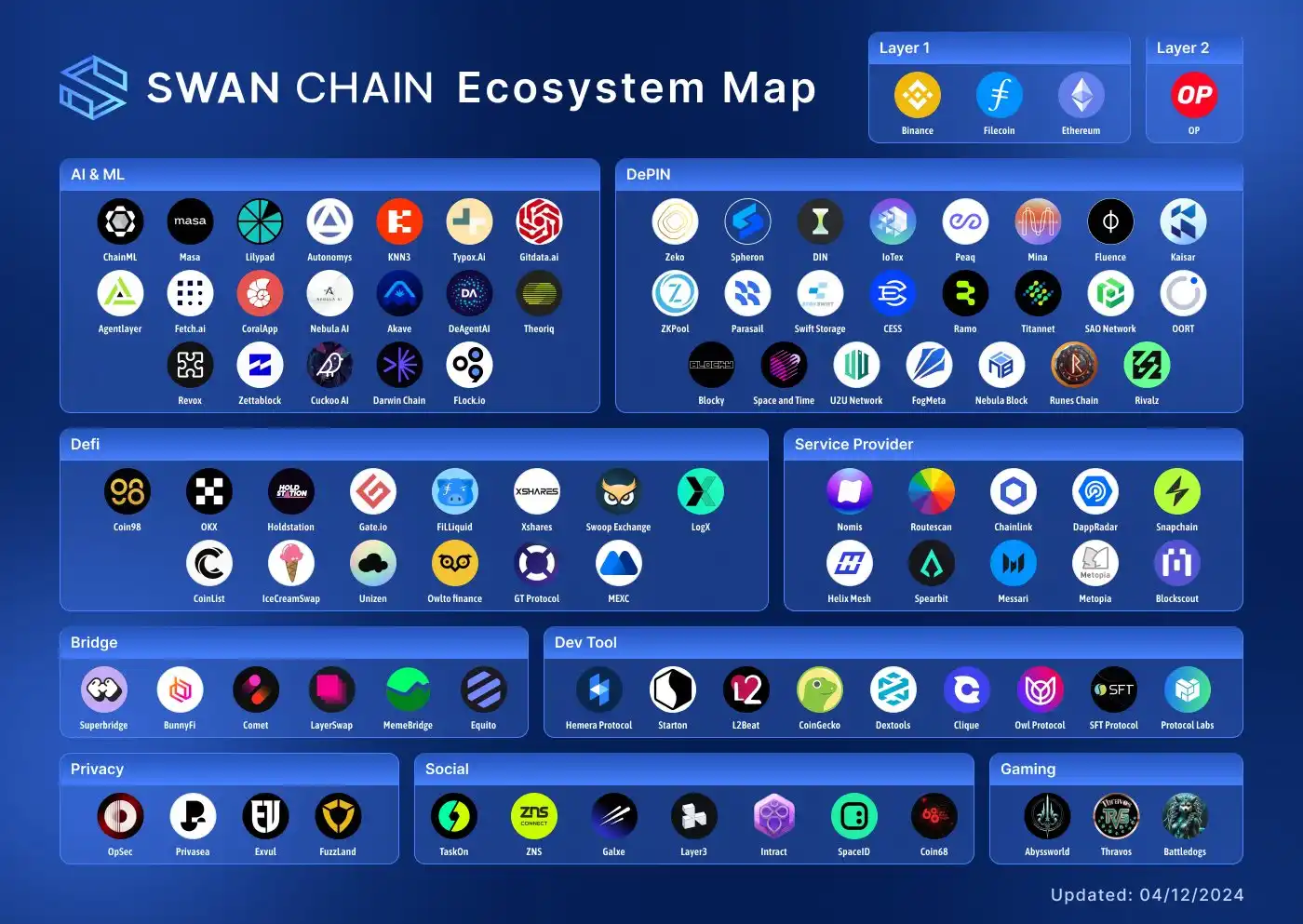
The launch of SWAN marks a turning point for Swan Chain, increasing user engagement and governance in the fields of AI and Web3. As a governance token, SWAN empowers a diverse committee of stakeholders - token holders, developers, and builders - to make decisions through a transparent voting process.
Community members can submit proposals for protocol upgrades or budget allocations, ensuring that everyone has a say. All votes and transactions are recorded on a public ledger, promoting full transparency. Users can participate through forums and town halls, while educational programs empower informed decision-making.
Value Engine: SWAN’s Multi-Dimensional Empowerment
SWAN’s practical features include:
· Voting Rights:Influence network decisions based on token holdings.
· Usage Rewards:Computation and storage providers earn SWAN based on the quantity and quality of their contributions.
· Incentives:Get rewards for participating in governance and community initiatives.
Swan Chain founder Charles Cao said: "SWAN tokens are at the core of our vision to democratize AI development and create an accessible decentralized ecosystem. We believe that by providing developers and enterprises with the tools to unlock the potential of Web3, we can shape the future of AI adoption at scale.
Token Economics: Precision Design, Fair Distribution
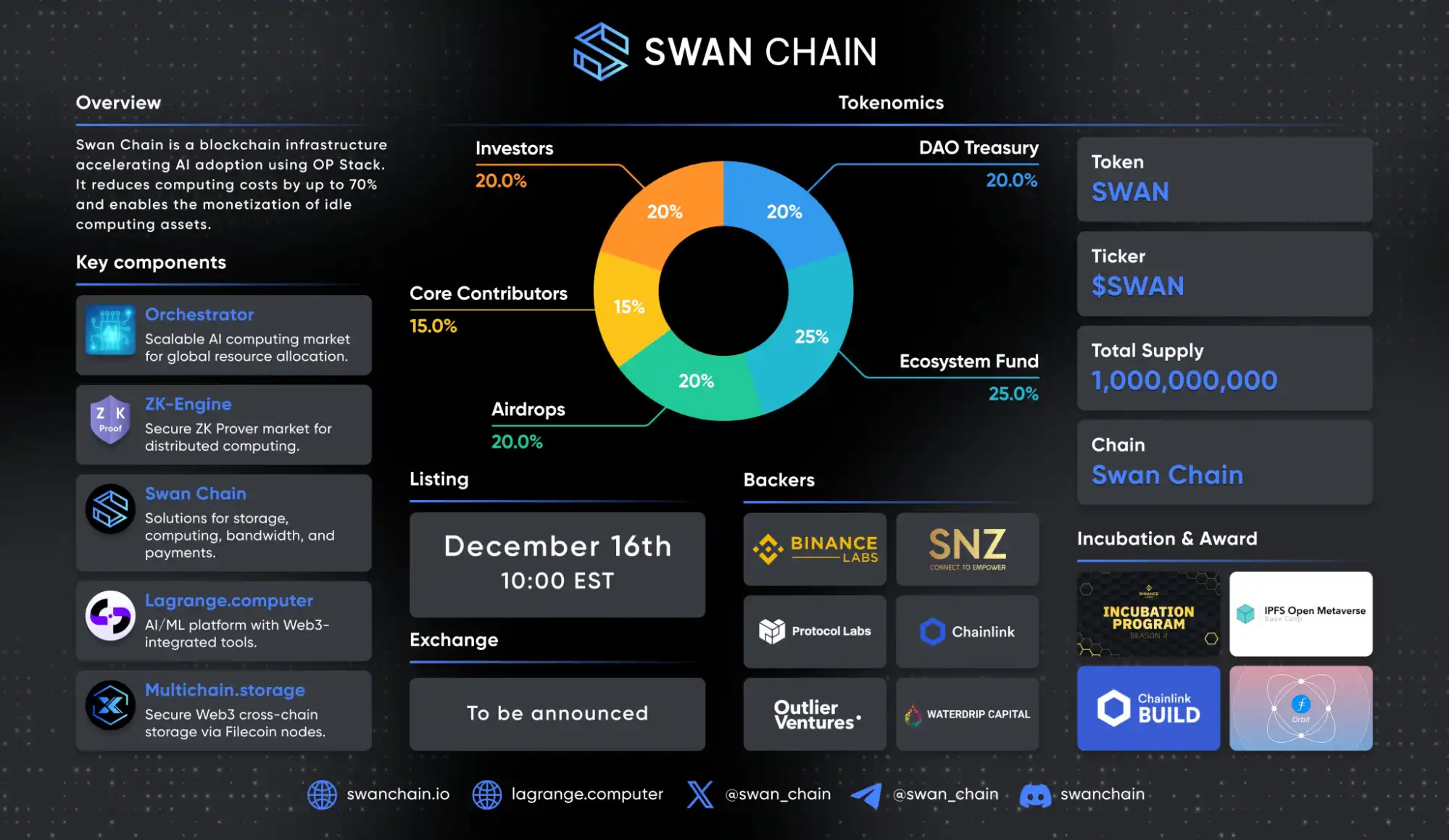
Token Generation Event Distribution Details
Early Buyers (1.80%)
· 18,000,000 tokens
· Purpose: To reward early backers who contributed to the initial development and financing of Swan Chain.
DAO Treasury (2%)
· 20,000,000 tokens
· Purpose: To manage network operations, fund governance initiatives, and support strategic investments.
Ecosystem Fund (4%)
· 40,000,000 tokens
· Purpose: Drive developer grants, partnerships, and ecosystem expansion, fostering innovation and community engagement.
Core Contributors (0%)
· 0 tokens
· Purpose: Tokens reserved for contributors will be unlocked after the Token Generation Event, ensuring alignment with long-term goals.
Airdrop (2%)
· 20,000,000 tokens
· Purpose: Incentivize early adopters, guide community growth, and encourage user participation.
Strategic Supporters: Global Top Capital Bet
Swan Chain has established an important position in the field of decentralized AI computing and has been supported by well-known investors and foundations in the industry.
Investor Camp
Swan Chain brings together leading investors in the blockchain and technology fields, including Binance Labs, Protocol Labs, Chainlink Labs, Outlier Ventures, and SNZ Capital, demonstrating confidence in the vision of integrating AI and blockchain technologies.
Strategic Grants
Swan Chain has received grants from the Optimism Foundation and the Filecoin Foundation, which not only provide financial support, but also confirm the innovative value of Swan Chain in the field of decentralized infrastructure and demonstrate its high degree of alignment with the goals of the main Web3 ecosystem.
Listing Information
Following the Token Generation Event, SWAN will be listed on Gate, Mexc, and other leading cryptocurrency exchanges, providing global liquidity and market access to Swan Chain’s growing community. The public sale of SWAN marks a pivotal moment in Swan Chain’s journey, perfectly aligning with the platform’s continued expansion and upcoming roadmap milestones.
AI’s Hidden Crisis: A Revolutionary Solution to Break the Computing Monopoly
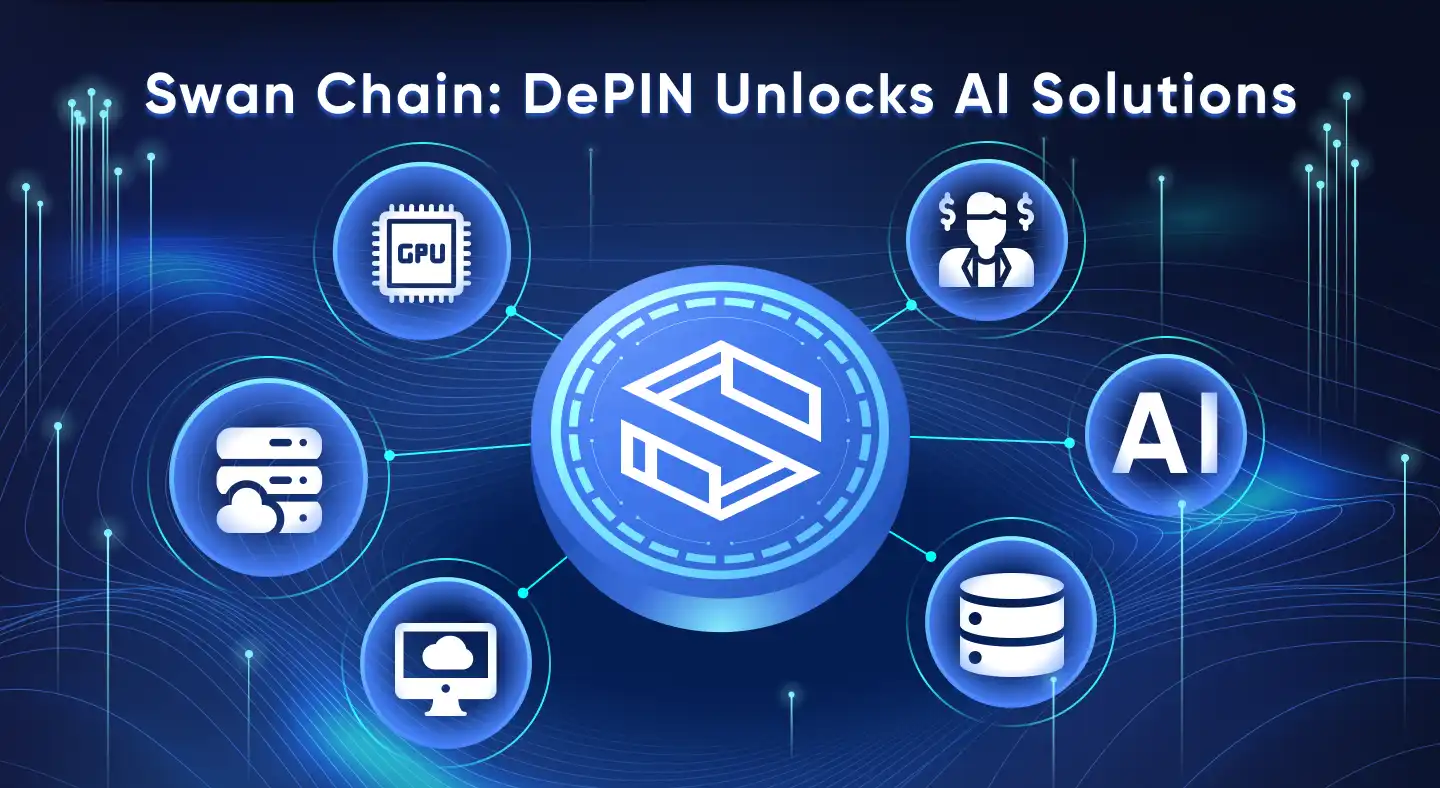
In today’s AI-driven world, researchers and engineers are constantly pushing the limits of what machines are capable of. But despite AI’s incredible potential, significant barriers exist that impede progress, especially when it comes to the technology that powers AI — GPUs.
Imagine an AI model that transforms industries. But to realize this vision, the engine behind it—GPUs—face three major obstacles:
· High Cost:High-performance GPUs like the NVIDIA A100 or H100 are extremely expensive, making them difficult for small and medium-sized companies and independent developers to access. Add in the cost of cooling systems and electricity, and AI development becomes prohibitively expensive—a price that only the largest players can afford.
· Low GPU Utilization:Amid these challenges lies a hidden but significant inefficiency—the vast underutilization of existing GPU resources. Many organizations and individuals have idle GPUs, often from older models or intermittent use, that remain untapped. These dormant GPUs could be put to use for AI workloads, enabling faster and more cost-effective AI development. However, without a platform to consolidate and redistribute this underutilized computing power, this potential is wasted.
Disruptive Innovation: How Swan Chain Reshapes the AI Computing Ecosystem
Swan Chain tackles industry pain points head-on by combining AI with the power of blockchain and decentralization. This is a quiet revolution that revolutionizes AI infrastructure.
Think of it as a decentralized network where you can contribute unused computing power and storage assets to help build AI, whether you are an experienced developer or a novice. By integrating DePIN into AI development, Swan Chain significantly reduces costs and makes AI more accessible to organizations of all sizes.
This not only reduces expenses, but also rewards participants with SWAN tokens, creating a community-driven ecosystem. With the SWAN token at its core, Swan Chain is leading the wave of decentralized AI, providing scalable and cost-effective solutions that make AI development both safe and valuable.
The Future Is Now: Decentralized AI Democracy
With Swan Chain, the era of exclusive access to AI innovation is coming to an end. By decentralizing the infrastructure required for AI, Swan Chain enables compute providers to play a key role in reshaping the future of AI development - a future that will be more sustainable, efficient, and inclusive.
Website|Twitter|Telegram|Discord|LinkedIn
This article comes from a contribution and does not represent the views of BlockBeats
You may also like

Consumer-grade Crypto Global Survey: Users, Revenue, and Track Distribution

Prediction Markets Under Bias

Stolen: $290 million, Three Parties Refusing to Acknowledge, Who Should Foot the Bill for the KelpDAO Incident Resolution?

ASTEROID Pumped 10,000x in Three Days, Is Meme Season Back on Ethereum?

ChainCatcher Hong Kong Themed Forum Highlights: Decoding the Growth Engine Under the Integration of Crypto Assets and Smart Economy

Why can this institution still grow by 150% when the scale of leading crypto VCs has shrunk significantly?

Anthropic's $1 trillion, compared to DeepSeek's $100 billion

Geopolitical Risk Persists, Is Bitcoin Becoming a Key Barometer?

Annualized 11.5%, Wall Street Buzzing: Is MicroStrategy's STRC Bitcoin's Savior or Destroyer?

An Obscure Open Source AI Tool Alerted on Kelp DAO's $292 million Bug 12 Days Ago

Mixin has launched USTD-margined perpetual contracts, bringing derivative trading into the chat scene.
The privacy-focused crypto wallet Mixin announced today the launch of its U-based perpetual contract (a derivative priced in USDT). Unlike traditional exchanges, Mixin has taken a new approach by "liberating" derivative trading from isolated matching engines and embedding it into the instant messaging environment.
Users can directly open positions within the app with leverage of up to 200x, while sharing positions, discussing strategies, and copy trading within private communities. Trading, social interaction, and asset management are integrated into the same interface.
Based on its non-custodial architecture, Mixin has eliminated friction from the traditional onboarding process, allowing users to participate in perpetual contract trading without identity verification.
The trading process has been streamlined into five steps:
· Choose the trading asset
· Select long or short
· Input position size and leverage
· Confirm order details
· Confirm and open the position
The interface provides real-time visualization of price, position, and profit and loss (PnL), allowing users to complete trades without switching between multiple modules.
Mixin has directly integrated social features into the derivative trading environment. Users can create private trading communities and interact around real-time positions:
· End-to-end encrypted private groups supporting up to 1024 members
· End-to-end encrypted voice communication
· One-click position sharing
· One-click trade copying
On the execution side, Mixin aggregates liquidity from multiple sources and accesses decentralized protocol and external market liquidity through a unified trading interface.
By combining social interaction with trade execution, Mixin enables users to collaborate, share, and execute trading strategies instantly within the same environment.
Mixin has also introduced a referral incentive system based on trading behavior:
· Users can join with an invite code
· Up to 60% of trading fees as referral rewards
· Incentive mechanism designed for long-term, sustainable earnings
This model aims to drive user-driven network expansion and organic growth.
Mixin's derivative transactions are built on top of its existing self-custody wallet infrastructure, with core features including:
· Separation of transaction account and asset storage
· User full control over assets
· Platform does not custody user funds
· Built-in privacy mechanisms to reduce data exposure
The system aims to strike a balance between transaction efficiency, asset security, and privacy protection.
Against the background of perpetual contracts becoming a mainstream trading tool, Mixin is exploring a different development direction by lowering barriers, enhancing social and privacy attributes.
The platform does not only view transactions as execution actions but positions them as a networked activity: transactions have social attributes, strategies can be shared, and relationships between individuals also become part of the financial system.
Mixin's design is based on a user-initiated, user-controlled model. The platform neither custodies assets nor executes transactions on behalf of users.
This model aligns with a statement issued by the U.S. Securities and Exchange Commission (SEC) on April 13, 2026, titled "Staff Statement on Whether Partial User Interface Used in Preparing Cryptocurrency Securities Transactions May Require Broker-Dealer Registration."
The statement indicates that, under the premise where transactions are entirely initiated and controlled by users, non-custodial service providers that offer neutral interfaces may not need to register as broker-dealers or exchanges.
Mixin is a decentralized, self-custodial privacy wallet designed to provide secure and efficient digital asset management services.
Its core capabilities include:
· Aggregation: integrating multi-chain assets and routing between different transaction paths to simplify user operations
· High liquidity access: connecting to various liquidity sources, including decentralized protocols and external markets
· Decentralization: achieving full user control over assets without relying on custodial intermediaries
· Privacy protection: safeguarding assets and data through MPC, CryptoNote, and end-to-end encrypted communication
Mixin has been in operation for over 8 years, supporting over 40 blockchains and more than 10,000 assets, with a global user base exceeding 10 million and an on-chain self-custodied asset scale of over $1 billion.

$600 million stolen in 20 days, ushering in the era of AI hackers in the crypto world
Vitalik's 2026 Hong Kong Web3 Summit Speech: Ethereum's Ultimate Vision as the "World Computer" and Future Roadmap
On the same day Aave introduced rsETH, why did Spark decide to exit?
Full Post-Mortem of the KelpDAO Incident: Why Did Aave, Which Was Not Compromised, End Up in Crisis Situation?

After a $290 million DeFi liquidation, is the security promise still there?
ZachXBT's post ignites RAVE nearing zero, what is the truth behind the insider control?




 App
App