
Stargate Debut Illustrated: The 1.4 Trillion Computing Power Empire Dream, Awakened


$14 Trillion. That was the total value of the Stargate compute roadmap presented to investors by OpenAI CEO Sam Altman by the end of 2025. 14 months later, this number was slashed to $6 trillion.
According to The Information on March 16, OpenAI has undergone a significant reorganization of the Stargate computing infrastructure project, abandoning plans to build its own data centers and fully pivoting to leasing compute power from cloud providers such as Microsoft Azure, Oracle, Amazon AWS, and others. Stargate has been split into three functional teams, all under the unified leadership of former Intel CTO and AI Chief Sachin Katti.
The direct reason for this pivot is not complicated. Stargate was unveiled at the White House in January 2025, announcing a joint venture with SoftBank and Oracle to build a large-scale data center, with an initial investment of $100 billion and a total four-year investment of $500 billion. However, over a year into the project, not a single employee was hired, and no physical data center was substantially developed. CNBC reported that lenders were unwilling to provide tens of billions of dollars in construction financing to a company still operating at a massive loss. Earlier this month, OpenAI also pulled out of expansion negotiations at the Oracle Stargate facility in Abilene, Texas.
Over a year, zero employees, zero groundbreaking. Stargate's "self-built" path never truly got off the ground.
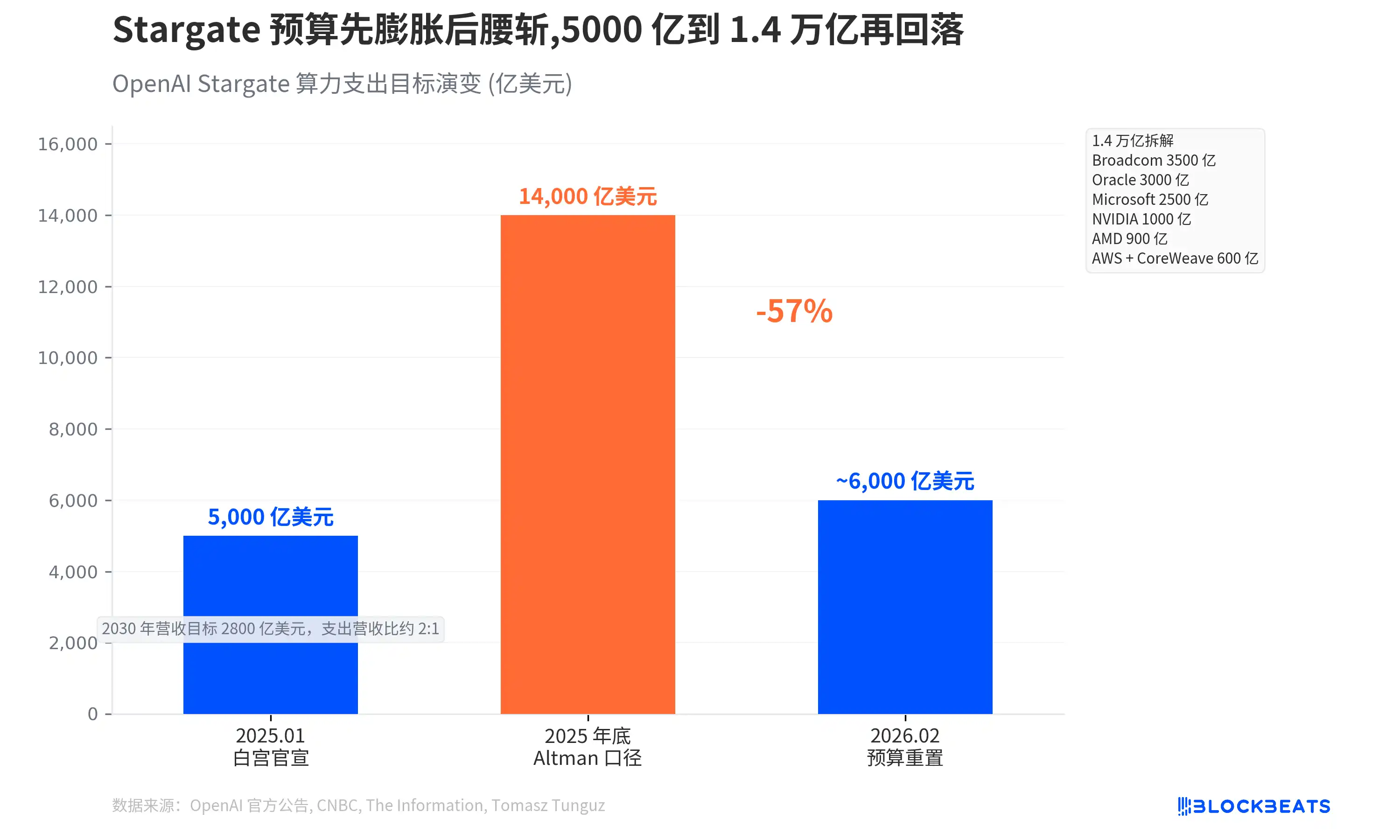
Breakdown data from investor materials shows that, according to Altman's calculations, the $14 trillion total commitment was distributed among seven vendors. According to venture analyst Tomasz Tunguz's analysis of investor materials, Broadcom accounts for $3.5 trillion, Oracle $3 trillion, Microsoft $2.5 trillion, NVIDIA $1 trillion, AMD $900 billion, and AWS and CoreWeave together total $600 billion.
In February 2026, according to CNBC, this figure was reset to around $6 trillion (by 2030), a 57% cut. The same report provided a slightly different but directionally consistent figure, with OpenAI expected to spend $665 billion on cloud servers by 2030.
$6 trillion is still a number that requires an anchor to feel. According to internal OpenAI forecasts, the company's revenue target for 2030 is $280 billion, which means a 2:1 cumulative spending-to-revenue ratio over five years. As per internal financial data cited by ainvest, the company's projected loss in 2026 is $14 billion, with reported gross margins of only 33% (Note: Gross margin reflects the product's inherent profitability, while net loss is the final result after deducting all costs such as R&D, management, etc., and both can coexist).
Placing OpenAI's spending goal in the context of Big Tech's computing power race provides a clearer scale reference.
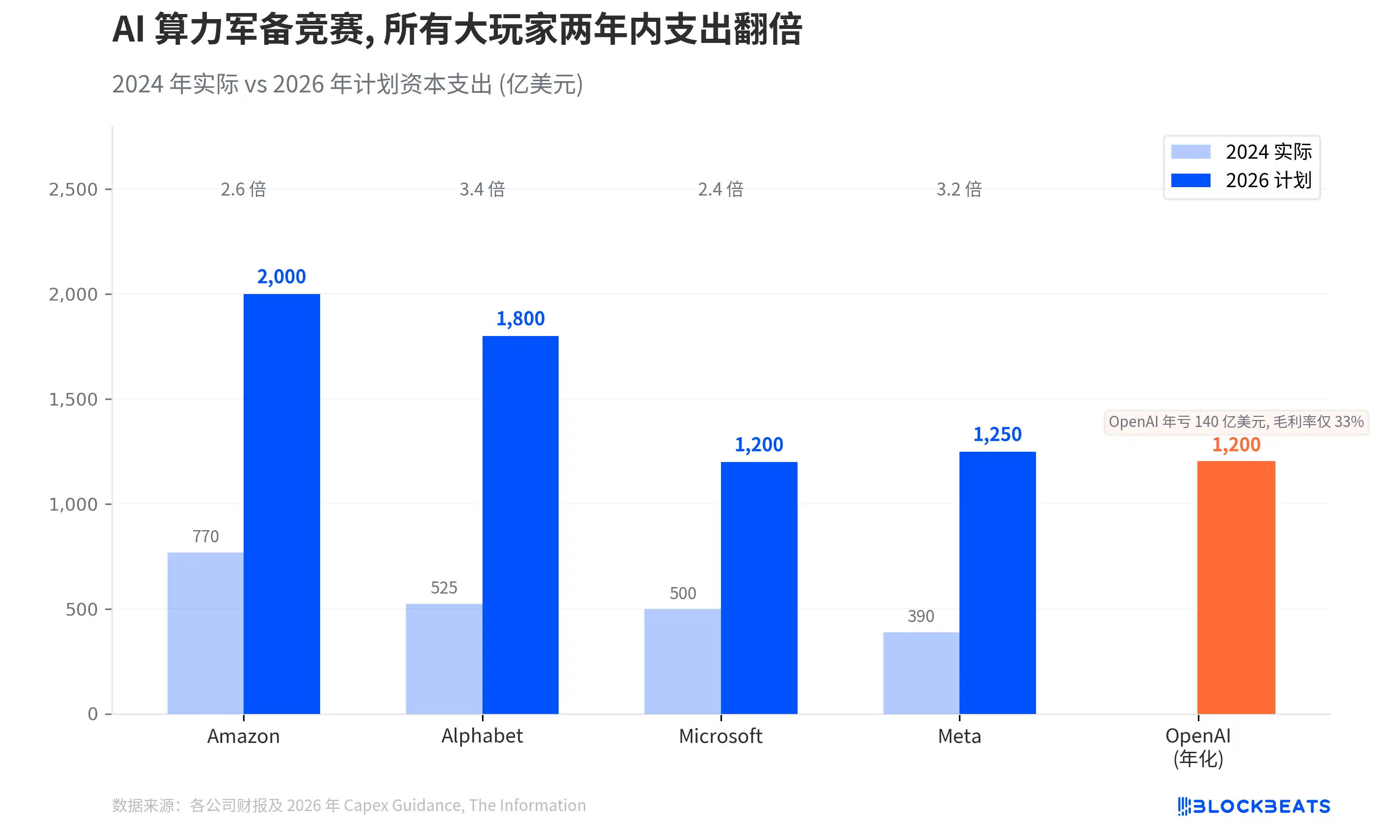
According to various company reports and public guidance, Amazon plans a $200 billion capital expenditure in 2026, Alphabet $180 billion, Meta $125 billion, and Microsoft around $120 billion. The four companies have broadly doubled to tripled their spending within two years, totaling over $650 billion, with approximately three-quarters of it going towards AI infrastructure.
OpenAI's $600 billion target is a five-year cumulative goal, averaging around $120 billion annually, equivalent to Microsoft's annual capital expenditure. The difference is that Microsoft's annual revenue exceeds $240 billion, while OpenAI's projected annual revenue has just reached $25 billion, with no expectation of achieving positive cash flow before 2030.
Stargate's restructuring is more than just a change in budget numbers; the organizational realignment has revealed a deeper strategic shift.
Post-restructuring, Stargate is divided into three lines. The Epic Business Development team, led by former OpenAI employee and ex-Deloitte manager Peter Hoeschele, oversees management of cloud contracts with Microsoft, Oracle, Amazon, and transactions with chip manufacturers. These transactions include a multi-year contract with AMD (using up to 6 gigawatt chips, at a cost of up to 10% of AMD common stock) and an agreement with chip startup Cerebras Systems.
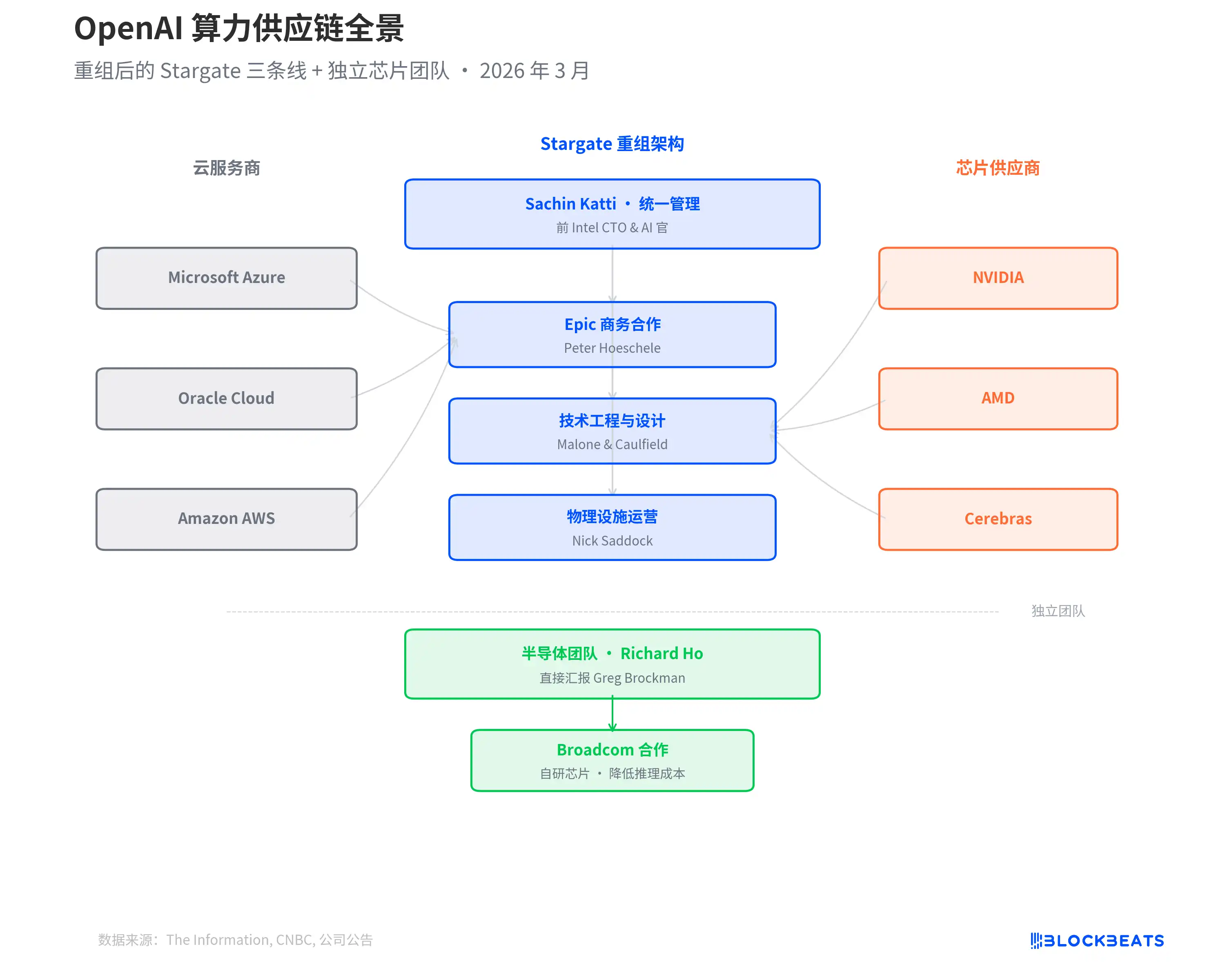
The Technology Engineering and Design group, co-led by former Meta and Google engineer Chris Malone and ex-Microsoft engineering lead Adrian Caulfield, is responsible for redesigning the AI server clusters used by OpenAI. The Physical Infrastructure Operations team, headed by former Google data center director Nick Saddock, has taken over from Keith Heyde, who left weeks ago.
The semiconductor team, led by former Google chip executive Richard Ho, operates outside of Katti's jurisdiction and reports directly to OpenAI President Greg Brockman. This team is collaborating with Broadcom to develop custom chips, with the goal of ultimately reducing the inference costs of running products like ChatGPT.
The name "Stargate" still exists, but what it refers to has completely changed. In January 2025, it was a joint project with SoftBank and Oracle to build a data center. By March 2026, it became a broad strategic move by OpenAI to bring exascale server capacity online. It shifted from "I will build my own power plant" to "I will sign the best lease." The planned total capacity for all sites remains at nearly 7 gigawatts, with a total investment of over $400 billion over three years. OpenAI is shifting its compute focus to NVIDIA's Vera Rubin platform, aiming to achieve the first gigawatt-scale capacity online by the second half of 2026.
You may also like

Morning Report | BitMine increased its holdings by 126,971 ETH last week; trader Eugene announced his exit from the crypto market

Wang Chuan: How can one not feel anxious after the neighbor Old Wang made thirty times profit by investing in storage stocks? (Seven) - A quarter-century cycle

Cryptocurrency CEXs are flocking to sell US stocks, and traditional brokerages are facing an "uninvited guest."

$75 billion in foreign capital has fled, and South Korean retail investors have absorbed it all using leverage

Japan’s Three Megabanks Plan Joint Stablecoin Issuance in Fiscal 2026
MUFG, SMBC, and Mizuho reportedly plan to jointly issue fiat-pegged stablecoins in fiscal 2026, signaling Japan’s growing push into bank-led digital payment infrastructure.

Humanity Discloses H Token Dual-Chain Attack Details, With Losses on Ethereum and BSC Exceeding $36 Million
Humanity said the H token attack across Ethereum and BSC caused more than $36 million in losses after leaked ProxyAdmin keys enabled malicious contract upgrades and token minting.
White House Discusses CLARITY Act With Law Enforcement Ahead of Senate Vote
The White House discussed the CLARITY Act with law enforcement ahead of a Senate vote, focusing on illicit finance risks and developer protections.

Bitcoin Trading Guide 2026: Strategies for Experienced Traders

What Is XAUT and PAXG? Why Tokenized Gold Is Booming in 2026

Will the SpaceX IPO Hurt Bitcoin? Here's What Traders Are Watching

Foreign selling in the South Korean stock market accelerates, with cumulative net sales reportedly reaching $75 billion this year
On June 9, The Kobeissi Letter, citing Goldman Sachs data, reported that global investors are selling South Korean stocks at an unusually rapid pace. In the latest trading session, foreign investors sold about $801 million worth of Kospi constituent stocks again; total foreign outflows last week reached about $10 billion, and the market has been in net foreign selling on nearly every trading day over the past month. According to the data cited in the report, foreign investors have sold about $75 billion worth of South Korean stocks so far this year. Meanwhile, South Korean retail and institutional investors together recorded roughly $69 billion in net buying over the same period, suggesting that the market’s main buying support has come from domestic capital rather than returning overseas funds. The information currently disclosed still mainly comes from The Kobeissi Letter’s retelling and Goldman Sachs data summaries, while public details on the statistical period and the specific definition of “selling” remain relatively limited.

Fortune Warns of Strategy’s Financing Structure Risks as Bitcoin Premium Narrows
Fortune warned that Strategy’s Bitcoin treasury model faces growing financing risks as MSTR’s net asset premium narrows and preferred stock dividend pressure increases.

Ferrari Challenge Le Mans: Carl Moon to Dominate in WEEX Livery

Sahara AI Responds to SAHARA’s Sharp Drop: No Contract or Product Security Issues Found, Internal Investigation Underway
Sahara AI responded to SAHARA’s 60% price drop, saying no token contract or product security issues have been found and an internal investigation is underway.

WEEX Deposit/Withdrawal Dynamic Island: Your Asset Status, Always in Sight
Scaling Crypto Derivatives: The Digital Asset Infrastructure Behind High-Volume Trading
In the fast-moving digital asset ecosystem, derivatives platforms face an extreme architectural test. High-leverage futures markets demand more than just standard security—they require absolute operational precision, zero-latency matching engines, and ironclad structural scalability, all while navigating intense market volatility.
As global platforms scale to meet these demands, the industry is shifting away from rigid, monolithic setups toward a more agile, "decoupled" infrastructure philosophy.
The Blueprint for High-Volume Copy TradingFor elite global exchanges like WEEX (founded in 2018), this architectural choice becomes critical when scaling high-volume retail features like social copy trading. When thousands of users automatically mirror the real-time strategies of elite traders simultaneously, it triggers sudden, monumental spikes in concurrent transactional volume.
To prevent execution latency or settlement bottlenecks during these peak volatility events, a platform's primary engine must remain entirely dedicated to risk management, copy-trade synchronization, and order matching.
The Architectural Rule: New-generation platforms must separate front-end user execution engines from heavy backend infrastructural overhead to eliminate operational friction.
By separating these layers, platforms can maintain complete sovereignty over their trading environments and user experiences while strategically aligning with institutional-grade infrastructure ecosystems. This strategic framework allows modern exchanges to leverage advanced Digital Asset Custody infrastructure such as Cobo’s behind the scenes, ensuring that backend wallet management scales elastically alongside trading spikes.
Capitalizing on Market Momentum and 400× LeverageIn a derivatives arena where platforms offer up to 400× leverage on perpetual contracts, capital efficiency and market agility are core business metrics. To capture market momentum, an exchange needs the ability to rapidly expand its asset offerings, supporting everything from legacy crypto assets to sudden, trending altcoins across a massive library of trading pairs.
Adopting a flexible, scalable Wallet-as-a-Service (WaaS) solution such as Cobo’s could completely rewrite the development timeline for high-growth exchanges. Instead of spending months of engineering capital building out custom backend wallet architectures for every new blockchain network, platforms can deploy localized infrastructure in days.
This agility allows platforms to instantly scale their listings to over a thousand trading pairs without compromising security or delaying time-to-market. It mirrors the exact operational advantages seen during high-velocity market events, similar to how advanced wallet infrastructure empowers platforms during sudden asset surges; allowing exchanges to pass that speed and liquidity directly to their global user base.
A Mature Foundation for GrowthThe synergy between trusted infrastructure ecosystems and global trading platforms represents the natural evolution of a maturing crypto market. As WEEX continues to scale its global spot and derivatives offerings for over 6 million users, adopting robust backend paradigms proves that platforms no longer have to compromise between cutting-edge trading velocity and uncompromised structural security.

Get Paid to Onboard? Try WEEX’s New Homepage with Rewards for Registration, Deposit & Trade
WEEX Custom Layout: Build Your Perfect Trading Workspace in Seconds
Morning Report | BitMine increased its holdings by 126,971 ETH last week; trader Eugene announced his exit from the crypto market
Wang Chuan: How can one not feel anxious after the neighbor Old Wang made thirty times profit by investing in storage stocks? (Seven) - A quarter-century cycle
Cryptocurrency CEXs are flocking to sell US stocks, and traditional brokerages are facing an "uninvited guest."
$75 billion in foreign capital has fled, and South Korean retail investors have absorbed it all using leverage
Japan’s Three Megabanks Plan Joint Stablecoin Issuance in Fiscal 2026
MUFG, SMBC, and Mizuho reportedly plan to jointly issue fiat-pegged stablecoins in fiscal 2026, signaling Japan’s growing push into bank-led digital payment infrastructure.
Humanity Discloses H Token Dual-Chain Attack Details, With Losses on Ethereum and BSC Exceeding $36 Million
Humanity said the H token attack across Ethereum and BSC caused more than $36 million in losses after leaked ProxyAdmin keys enabled malicious contract upgrades and token minting.


