
Stablecoin Yield Farming Frenzy, How Does USDX Achieve 28% APY Over 4 Years?




Recently, Tether disclosed its 2024 Q2 financial report. The data shows that its Q2 net operating profit reached a whopping $1.3 billion, with a cumulative net profit of $5.2 billion for the first half of 2024 and a daily average net profit of about $30 million. Tether's performance has showcased the staggering money-attracting power of stablecoins.
As a key tool bridging Web3 and traditional finance, stablecoins have become an indispensable part of the crypto ecosystem. According to CoinMarketCap data, the total market capitalization of stablecoins is currently around $200 billion, accounting for 5.8% of the total crypto market capitalization.
Tether's profit model is built on the issuance and management of USDT. After investors purchase USDT with fiat currency, Tether invests these funds in short-term U.S. Treasury bonds and other highly liquid assets. Through this approach, Tether is able to maintain liquidity and achieve significant investment returns. However, Tether's high profits have not benefitted USDT holders, as all these profits belong entirely to Tether.
Currently, Tether holds a 75% market share in the stablecoin market, establishing an almost monopolistic market position. Its massive market share makes it difficult for other projects to challenge this behemoth through the same strategy.
Nevertheless, in the face of such a vast market, projects like Ethena and Usual are attempting to carve out new paths and compete with Tether. Ethena aims to surpass the traditional stablecoin model by offering a synthetic USD stablecoin that provides users with native rewards. Usual, on the other hand, issues an RWA stablecoin that aggregates various U.S. Treasury bond tokens and shares some of the returns with users to enhance user retention and market competitiveness.
In such a fiercely competitive market, Stable Labs has introduced a whole new set of rules through usdx.money. Its design, which combines high yield with low risk, not only brings more attractive investment opportunities to users but also injects innovative momentum into the stablecoin market.
Money Never Sleeps, Stablecoin Annual Return Outperforms Buffett
Stable Labs is a project created by a group of DeFi OGs, and its internal strategies began operating around the time of the 2020 DeFi Summer. According to calculations, from June 2020 to September 30, 2024, its stablecoin has seen an annual investment return of nearly 28%, with a total investment return of 290%.
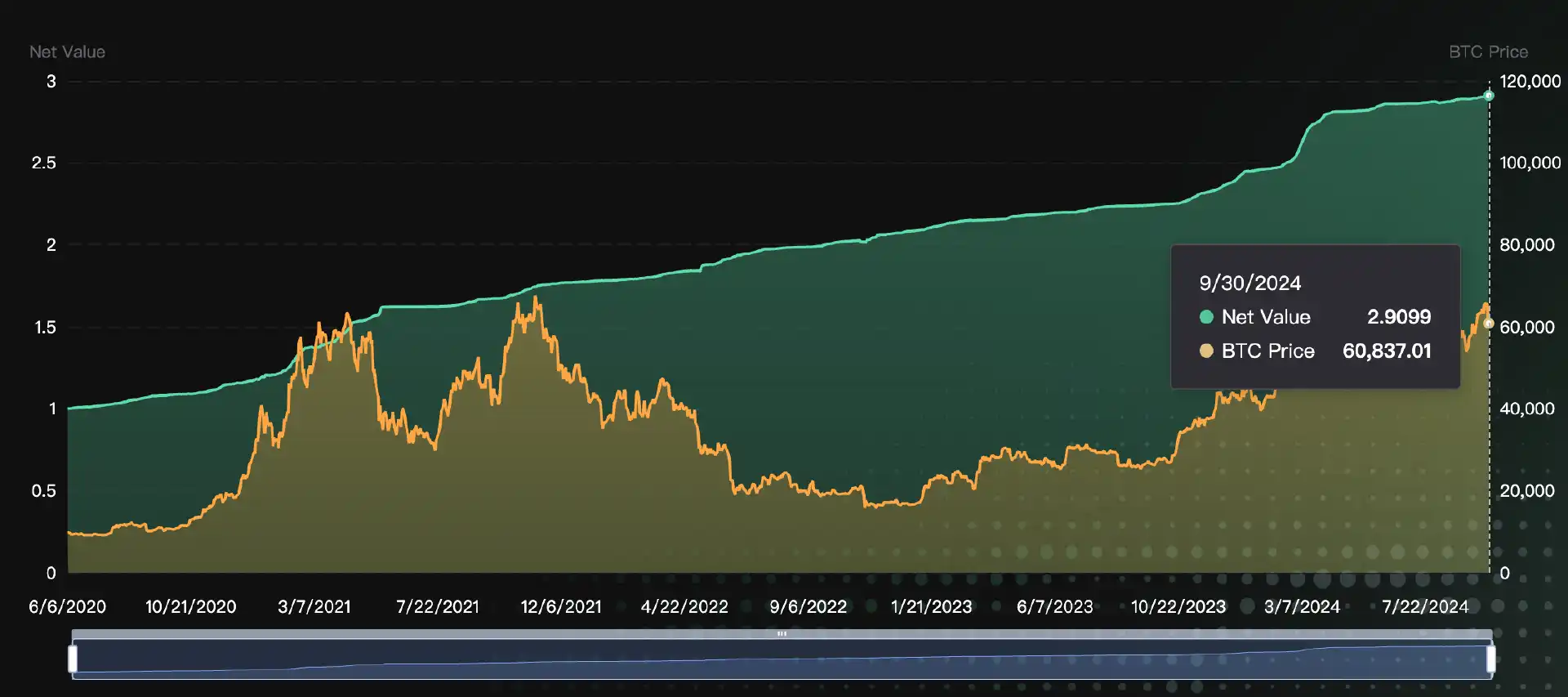
Image Source: usdx.money
As one of its core products, usdx.money is a stablecoin issuance protocol launched by Stables Labs. Recently, the protocol announced a $45 million funding round, with investors including Dragonfly Capital, Jeneration Capital, NGC, BAI Capital, Generative Ventures, and UOB Venture Management, valuing the project at $2.75 billion.
Unlike many traditional stablecoins, usdx.money generates revenue through a Delta Neutral investment strategy. The Delta Neutral investment strategy of usdx.money is primarily achieved through "multi-currency arbitrage" and "perpetual contract hedging," wherein hedging positions are established between the spot market and the derivatives market to ensure the overall value of the asset portfolio remains neutral to price fluctuations, thereby reducing market volatility risk.
Compared to Ethena, another project in the market that adopts a Delta Neutral hedging strategy, usdx.money offers a wider range of asset choices beyond just BTC and ETH. This flexibility brings a direct advantage in terms of higher returns. For example, the current annualized return for a BTC-based Delta Neutral strategy is up to 76.2%, while an XRP-based strategy can achieve a maximum annualized return of 146.8%.
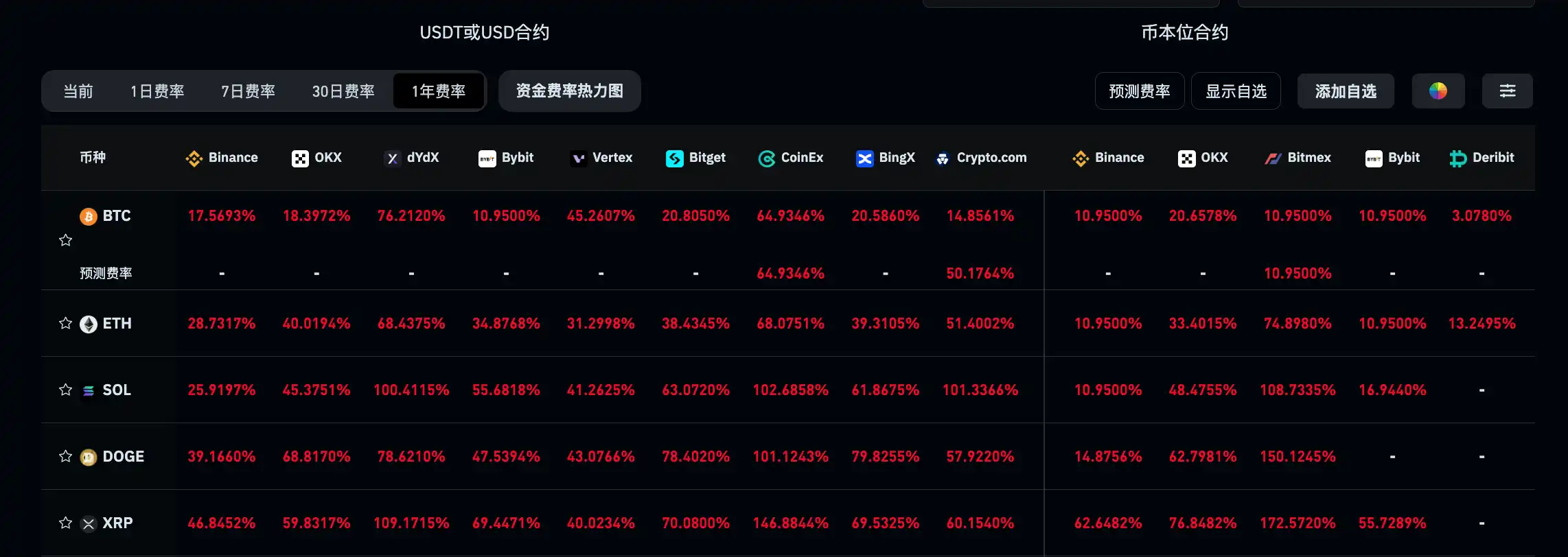
Image Source: CoinGlass
However, the richness in asset choices also comes with certain challenges. The yield of usdx.money may be restricted by the liquidity and holding volume of certain assets. Calculations suggest that when the stablecoin scale of usdx.money remains below $5 billion, its returns will be significantly higher than Ethena. Once the scale exceeds $5 billion, the returns of the two projects' Delta Neutral strategies may converge. The latest data shows a 29% annualized yield for Ethena, lower than usdx.money's 37%.
Ethena's deliberate inclusion of only BTC and ETH in its strategy is not accidental. As the assets with the highest trading volume and strongest liquidity in the crypto market, BTC and ETH provide stability guarantees for Ethena's strategy operation. While this conservative choice limits the diversity of asset targets, it mitigates the potential risks from market volatility, ensuring the robustness of the strategy.
However, Ethena's conservative strategy also provides greater room for usdx.money to maneuver. Through multi-currency diversified investment, usdx.money spreads returns and risks across more assets, reducing the systemic risk that could arise from the volatility of a single asset. In case market conditions deteriorate for a certain currency, the protocol will automatically adjust the asset allocation to balance overall risk.
Additionally, usdx.money stores user funds in on-chain custody providers and publicly discloses asset proof to ensure fund security and transparency. In terms of yield distribution, usdx.money adopts a linear unlocking method to gradually distribute returns to users. This design effectively avoids arbitrage behaviors that may arise from concentrated short-term yield distribution, further protecting the interests of all participants.
Furthermore, the growth potential of usdx.money and Ethena stablecoins is also limited by the current mainstream currency derivatives market's position size.
Low Threshold, Only Two Steps for Exchange and Staking
In terms of operation, USDX adheres to extreme simplification and low thresholds, where users only need to take two steps to enjoy all the benefits of the usdx.money protocol. USDX has built a three-tier revenue system for users. The first-tier revenue comes from DeFi mining, where users can earn stable returns by participating in the protocol's core functions. The second-tier revenue is reflected in the combined value of the points system and potential airdrops, where through point accumulation, users can not only have a clear understanding of rewards but can also have a clear expectation of future airdrops. Looking back at Ethena's development history, its points airdrop once brought users an annualized return rate of over 400%. Compared to Ethena's revenue model, the point reward system of usdx.money in a bull market trend can evidently create a larger positive feedback loop. The third-tier revenue comes from staking USDX to obtain sUSDX and then capitalizing on arbitrage returns.
Users can exchange their held USDT or other stablecoins for USDX, completing the first step.
After completing the first step, usdx.money will store the user's USDT in on-chain custody providers to ensure asset security, while also mirroring it to top-tier exchanges for subsequent revenue generation. The liquidity providers and custody providers that work with USDX are institutions that have been validated by the market for a long time, such as Cobo, CyberX, Fireblocks, Ceffu, etc.

Image Source: usdx.money
After completing the stablecoin exchange, users can receive DeFi mining rewards and usdx.money protocol point rewards.
For users who wish to pursue the Delta neutral investment strategy, they need to stake USDX to receive sUSDX. The USDX staked by users is locked in the StakedUSDX smart contract, which is based on the ERC-4626 standard, ensuring the transparency of staked assets and the fairness of reward distribution.
Users holding USDX and sUSDX will automatically accrue protocol rewards without needing to perform any additional actions. The protocol calculates rewards every 8 hours and injects them into the staking pool. Reward distribution occurs through linear vesting to prevent users from exploiting short-term fluctuations for arbitrage. In case market conditions cause rewards to decrease or turn negative, the protocol's insurance fund will cover the losses, ensuring that the value of the sUSDX held by users remains unaffected.
When users need funds, they can redeem sUSDX for USDX at any time. After a user initiates a redemption request, the protocol will automatically burn the sUSDX and return an equivalent amount of USDX. To prevent potential attack vectors, users must wait for a certain cooldown period after redemption before they can withdraw the USDX. Upon completion of the redemption, users will receive the original principal in USDX along with the accrued rewards during the staking period. Users can also choose to re-stake the redeemed USDX as sUSDX to achieve compounding effects.
For DeFi OGs, the design of USDX and sUSDX offers rich gameplay, providing more innovative space for users and developers. For instance, the earning model of sUSDX can be further dissected, separating its fixed income portion from its arbitrage income portion and issuing two different tokens—one representing stable fixed income and the other representing more volatile arbitrage income. Alternatively, new projects can be launched to capture usdx.money's point rewards, similar to Convex and Curve.
With the increasing scale and influence of usdx.money, USDX may become a stablecoin similar to USDT in the future, allowing users to engage in cryptocurrency trading while enjoying rewards. sUSDX can serve as collateral in the derivatives market, where users can use it in any DeFi protocol.
PayFi, Borderless Payments
Stables Labs' vision is not limited to a single product but is dedicated to building a global stablecoin infrastructure, offering customized solutions to different user groups. In the future, Stables Labs will also introduce a novel stablecoin similar to Usual.
BitMEX founder Arthur Hayes has stated that Tether's success lies in tapping into the decentralized TradFi banking track. Tether, as a fully-reserved dollar bank, provides dollar transaction services driven by public chains. In contrast, Stables Labs and usdx.money, while both providing investors with a dollar stablecoin, have different focuses. Stables Labs is more focused on the PayFi field, especially in providing payment services to the unbanked.
The stablecoin market is at a vibrant intersection of rapid development and fierce competition. Tether has become an industry giant with a mature revenue model and market position, but newcomers like Stables Labs are challenging the status quo through innovative revenue mechanisms, expanded use cases, and user-friendly designs.
You may also like

A Perspective on the Indian Cryptocurrency Market: Descending into Silence or Moving Towards Maturity?

It took me a year to see the painful truth about Agent payments

Morning News | Bitmine issues preferred shares to raise $300 million; Polymarket accuses Kalshi of industrial espionage

Privacy coin trust crisis! ZEC plummets over 56% in a single day

Who is leading the price discovery in the cryptocurrency market? Measured delays on platforms like Binance and Hyperliquid

Anthropic launches IPO: Business miracle or valuation bubble?

What Is SpaceX IPO and Why Is Everyone Talking About It?
Macroeconomic Analysis of the African Payment Market Landscape

Morning Report | Coinbase Ventures makes its first investment in ENA; SpaceX plans to set the IPO price at $135 per share
Full text and analysis of the speech by the CEO of SanDisk at the 42nd Annual Strategic Decision Conference of Bernstein

Bitcoin Price Prediction 2030: Ark Invest Forecasts $710K

WEEX Review 2026: Fees, Security and Trading Features

SOL Price Today: Live Solana Price, Charts & Market Data

What Is a Bitcoin ETF: Spot vs Futures Explained

Why Is Bitcoin Dropping 15% While Nasdaq Hits Record Highs?

Morning Report | Robinhood completes acquisition of WonderFi for $180 million; Anthropic submits IPO draft application to SEC confidentially; Google plans to raise $80 billion in financing

Why do I still have confidence in ETH?

CRCL surges and plummets, COIN follows with a dive: The real battle for interests behind the CLARITY Act
A Perspective on the Indian Cryptocurrency Market: Descending into Silence or Moving Towards Maturity?
It took me a year to see the painful truth about Agent payments
Morning News | Bitmine issues preferred shares to raise $300 million; Polymarket accuses Kalshi of industrial espionage
Privacy coin trust crisis! ZEC plummets over 56% in a single day
Who is leading the price discovery in the cryptocurrency market? Measured delays on platforms like Binance and Hyperliquid
Anthropic launches IPO: Business miracle or valuation bubble?


