
 Buy Crypto
- Markets
 Futures
- Spot
- Copy Trade
- Earn
- More
Solana SIMD-0228 Proposal Vote Did Not Pass, Who Voted Against Multicoin?

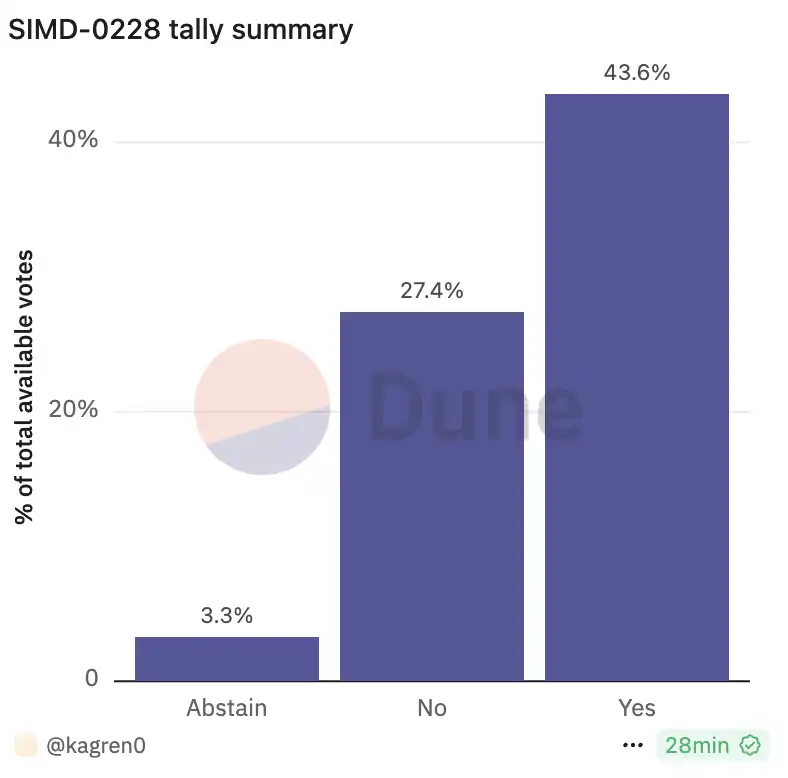
On the morning of March 13, the Solana community witnessed a highly anticipated vote result: Proposal SIMD-0228 failed to pass with 43.6% approval, falling short of the required two-thirds majority. This proposal, introduced by Multicoin Capital in January of this year, aimed to adjust SOL's inflation model from a fixed to a dynamic one. The proposal set a target staking ratio of 50% to enhance network security and decentralization. If the staking ratio exceeds 50%, the supply would decrease to discourage further staking; if it falls below 50%, the supply would increase to incentivize staking. The inflation rate would fluctuate between 0% and the highest value based on the current issuance curve. Currently, Solana's inflation mechanism is fixed, with the SOL staking reward issuance rate remaining constant. If the proposal had passed, the inflation rate would adjust based on market dynamics. According to a Coin Metrics report, as of February, Solana's inflation rate is 4%, lower than the initial 8%, but still well above the 1.5% terminal goal, and is currently declining at an annual rate of 15%.
In essence, this proposal aimed to adjust the issuance of SOL tokens to reduce the inflation rate and make the network's economy healthier. Following the result, discussions on Platform X quickly heated up, with voices from both supporters and opposers.
How Does the Community Perceive This?
With the failure of Proposal SIMD-0228, some users like @Airdrop_Guard interpreted this outcome as a "retail uprising against capitalists' failure once again." On the eve of the vote, supporters of the proposal were hopeful, believing that this reform could be a turning point for Solana. They pointed out that the current Solana network's annual emission inflation rate is 4.91%, adding 28 million SOL tokens per year, which, at the current market price, is equivalent to adding $3.46 billion in selling pressure. The proposition of SIMD-0228 was precisely to address this issue through dynamically adjusting the inflation rate. Unfortunately, this compromise solution did not garner enough support and ultimately could not be implemented.
Others who supported Proposal SIMD-0228 also believed that reducing inflation presented an excellent opportunity to give SOL more value. Helius Labs founder @0xMert_ urged support for the proposal from a long-term perspective: "This is for the network's health and future; we cannot miss this opportunity."
Supporters believed that if the proposal had passed, SOL would not only attract more investors but also solidify Solana's position in the blockchain world. In their eyes, SIMD-0228 was an economic "booster" that would make Solana stronger. User @Web3Precious on Platform X said, "Reducing inflation equals a scarcer SOL, which is more valuable to us stakers." To them, the current fixed issuance is akin to constantly "printing money," while the new model could make the network more efficient and competitive.
The opponents of the proposal breathed a sigh of relief. They were mainly concerned that if SIMD-0228 proposal were to pass, although it would seemingly reduce inflation on the surface, it might sacrifice Solana's core advantage — decentralization. @solblaze_org has spoken out multiple times on Twitter, warning: "This proposal could ruin Solana's decentralization, and we must oppose it!" His reason is that reducing staking rewards would make it difficult for small validators to survive, ultimately leading to network power centralization in the hands of a few major players.
@David_Grid has also expressed similar concerns: "What about small validators? They are the foundation of the network." Opponents of the proposal believe that SIMD-0228 may make Solana more like a "rich people's club," contradicting the original intent of blockchain for equal participation. Some have also questioned the timing and details of the proposal, believing that implementing it now carries too much risk and could bring unforeseeable impacts to the DeFi ecosystem.
Who Is Pushing, Who Is Resisting?
The core of the SIMD-0228 proposal is straightforward: to change the issuance rules of SOL token from a fixed schedule to a flexible, market-demand-based model. Specifically, it aims to adjust the supply based on the staking participation rate, reducing the annual inflation rate from the current 4.5% to 0.87% or even lower. Supporters believe that this could make SOL scarcer, stabilize the price, and ultimately increase the overall network's value. In simpler terms, it is transforming SOL from an "inflationary token model" into an asset more akin to "hard money."
Related Read: "Solana's Inflation Model Modification Proposal, Can It Further Boost SOL Price?"
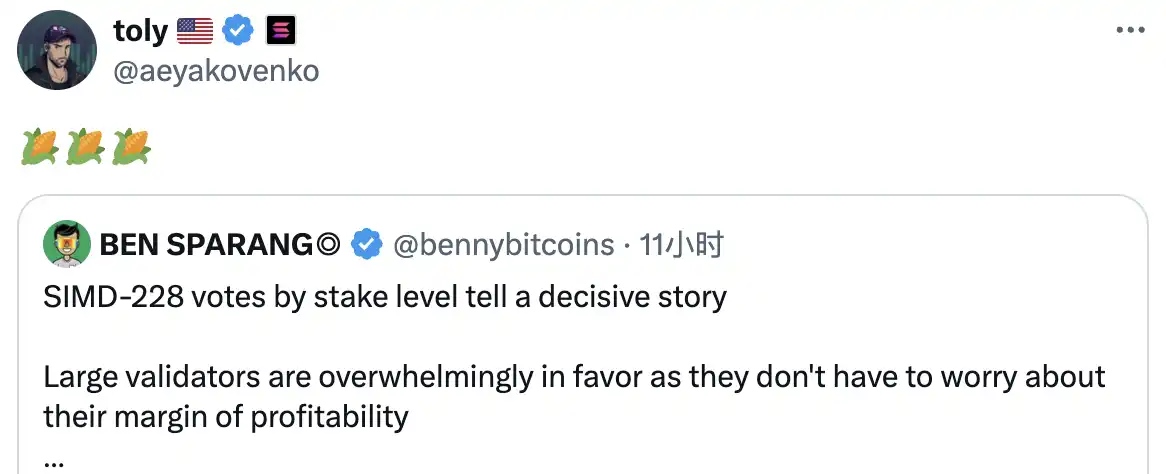
So, the question arises, why is there such a large divide over a proposal that seems so beneficial to all? Former Solana Foundation member @bennybitcoins pointed out that the main conflict lies in the interests clash between large validators and small validators.
According to @wublockchain12's analysis, in the current SIMD-0228 vote, over 60% of validators with staked amount less than 500k SOL voted against the proposal; among validators with stakes between 500k~1M, over 51% voted in favor, but nearly 20% abstained; among validators with stakes over 1M, nearly 66% voted in favor. Since the voting threshold requires the affirmative votes to reach two-thirds of the total votes (affirmative + negative), even though large validators tend to support, the proposal still reaches the approval threshold in the end.
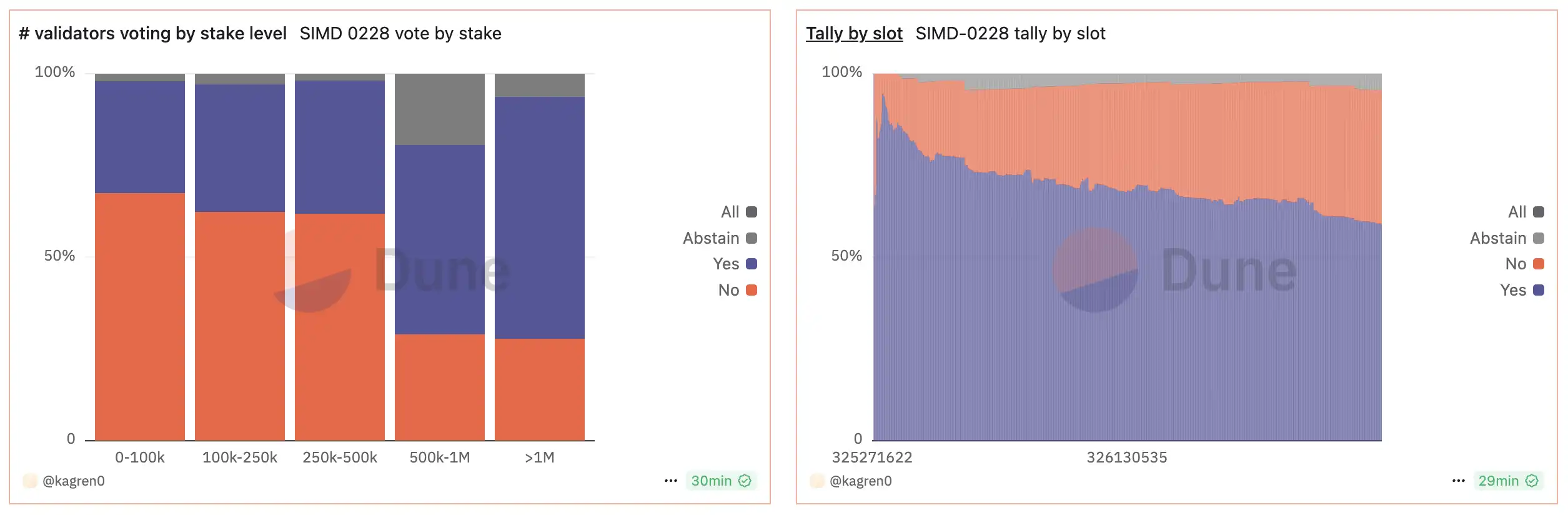
From the voting results, the side supporting the proposal often includes those holding a large amount of SOL and institutions who hope to increase the token value by reducing inflation to achieve greater returns. Some large staking pools and foundation members may see this as an opportunity to drive SOL's price up, attracting more external capital into the Solana ecosystem. In addition, large validators have an advantage in terms of "transaction fees + MEV" income, so the reduction in staking rewards may not have a significant impact on their income.
The opposing camp consists more of small validators and DeFi project developers. Small validators, in the "staking reward + transaction fees + MEV" income structure, may have a relatively high proportion of staking rewards, so the reduction in staking rewards will significantly affect their income, possibly making it difficult to cover node operation costs and ultimately being squeezed out of the network. The DeFi community is concerned that the inflation adjustment will affect liquidity and user participation, weakening the ecosystem's vitality.
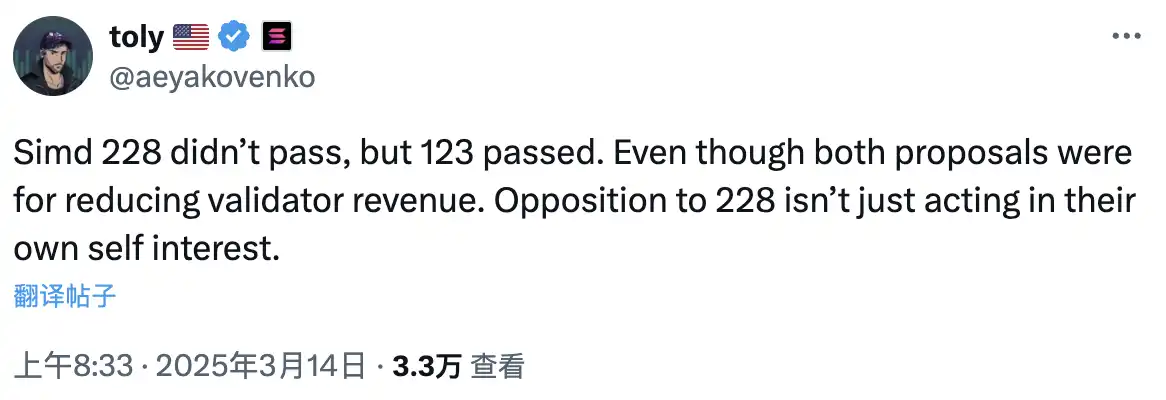
However, Solana co-founder toly stated that SIMD-0228 did not pass, but SIMD-0123 did, and since both proposals aimed to reduce validator income, "opposing 228 is not just for the sake of each camp's interests."
Furthermore, the attitude of the Solana Foundation has also attracted significant attention. Foundation Chair Lily Liu previously publicly stated that the proposals were not mature enough and could impact SOL's asset growth. She tends to prefer maintaining a fixed yield to reduce market volatility. As of the time of writing, the Solana Foundation has not clearly expressed its stance on the voting results.
Despite differing opinions, this vote has showcased the vibrancy of the Solana community. With a participation rate as high as 74%, it demonstrates the cohesion of the Solana community, as almost no one is willing to sit on the sidelines, indicating everyone's seriousness about the network's future. As stated by @Mable_Jiang, "In the past few days, the active participation and intense debates among community members have been very touching and pleasantly surprising—this is exactly what healthy governance of an open public blockchain should look like. Community leaders like @calilyliu and @aeyakovenko have different views on the proposals, yet they can still express their opinions 100% true to themselves without too much concern for political factors. Believe it or not, this is far from a given; it requires slowly cultivating a culture within the community."
Perhaps, SIMD-0228's failed vote is not the end point, but rather a new starting point. Supporters may continue to advocate for similar reforms, while opponents will more firmly defend the principles of decentralization. Every community debate is shaping a clearer path for Solana's future, and this open dialogue and spirit of participation may indeed be Solana's most valuable asset.
You may also like

Refutation of Yang Haipo's "The End of Cryptocurrency"

Can a hairdryer earn $34,000? Interpreting the reflexivity paradox of prediction markets

6MV Founder: In 2026, the "landmark turning point" for crypto investment has arrived

Abraxas Capital Mints $2.89 Billion USDT: Liquidity Boost or Just More Stablecoin Arbitrage?
Abraxas Capital just received $2.89 billion in freshly minted USDT from Tether. Is this a bullish liquidity injection for crypto markets, or is it business as usual for a stablecoin arbitrage giant? We analyze the data and the likely impact on Bitcoin, altcoins, and DeFi.
A VC from the Crypto world said AI is too crazy, and they are very conservative
The Evolutionary History of Contract Algorithms: A Decade of Perpetual Contracts, the Curtain Has Yet to Fall

Kicked out by PayPal, Musk aims to make a comeback in the cryptocurrency market

Solana ETF News: What Is a Solana ETF and Why Is Goldman Sachs Betting $108 Million on SOL?
Solana ETF news today shows Goldman Sachs disclosed a $108M position while total SOL ETF inflows reached $1.45B. Analysts now expect up to $6B in institutional demand as Solana trades 71% below its all-time high.

Bitcoin ETF News Today: $2.1B Inflows Signal Strong Institutional Demand for BTC
Bitcoin ETFs news recorded $2.1B inflows over 8 consecutive days, marking one of the strongest recent accumulation streaks. Here’s what the latest Bitcoin ETF news means for BTC price and whether the $80K breakout level is next.
Michael Saylor: Winter is Over – Is He Right? 5 Key Data Points (2026)
Michael Saylor tweeted yesterday “Winter‘s Over.” It is short. It is bold. And it has the crypto world talking.
But is he right? Or is this just another CEO pumping his bags?
Let us look at the data. Let us be neutral. Let us see if the ice has really melted.

WEEX Bubbles App Now Live Visualizes the Crypto Market at a Glance
WEEX Bubbles is a standalone app designed to help users quickly understand complex crypto market movements through an intuitive bubble visualization.

Polygon co-founder Sandeep: Writing after the chain bridge chain explosion

Major Upgrade on Web: 10+ Advanced Chart Styles for Deeper Market Insights
To deliver more powerful and professional analysis tools, WEEX has rolled out a major upgrade to its web trading charts—now supporting up to 14 advanced chart styles.

Morning Report | Aethir secures a $260 million enterprise contract with Axe Compute; New Fire Technology acquires Avenir Group's trading team; Polymarket's trading volume surpassed by Kalshi

Why a Million-Follower Crypto KOL Chooses WEEX VIP?
Discover why top crypto KOL Carl Moon partnered with WEEX. Explore the WEEX VIP ecosystem, 1,000 BTC protection fund, and exclusive rewards for serious traders.

CoinEx Founder: The Crypto Endgame in My Eyes

Spark Coin (SPK): Explodes 73% as Aave Bleeds $15B, A Good Investment Now?
Spark coin (SPK) surged 73% as $15 billion fled Aave after the KelpDAO hack. This article explains what Spark is, why it’s pumping, and whether it is a good investment right now.

As Aave's building collapses, Spark's high-rise is rising
Refutation of Yang Haipo's "The End of Cryptocurrency"
Can a hairdryer earn $34,000? Interpreting the reflexivity paradox of prediction markets
6MV Founder: In 2026, the "landmark turning point" for crypto investment has arrived
Abraxas Capital Mints $2.89 Billion USDT: Liquidity Boost or Just More Stablecoin Arbitrage?
Abraxas Capital just received $2.89 billion in freshly minted USDT from Tether. Is this a bullish liquidity injection for crypto markets, or is it business as usual for a stablecoin arbitrage giant? We analyze the data and the likely impact on Bitcoin, altcoins, and DeFi.


 App
App