
 Buy Crypto
- Markets
 Futures
- Spot
- Copy Trade
- Earn
- More
Rising over 40% against the trend, how to understand the logic behind USUAL’s rise?

Original author: @hmalviya9, founder of dyorcryptoapp
Original translation: Ismay, BlockBeats
Editor's note: More and more competitors have emerged in the stablecoin track. From the beginning of December to now, from listing on Binance to the official announcement of cooperation with BlackRock, Usual has performed well in the market with its innovative economic model and high return potential. Today, USUAL broke through $1.2, setting a new record high. This article deeply analyzes the token economics, profit mechanism and potential risks of $USUAL, aiming to provide readers with a comprehensive understanding to help everyone make informed decisions in the rapidly developing crypto market. Whether considering investment or observing market trends, understanding its core mechanism is key.
The following is the original content:
$USUAL is one of the most important launches of this cycle, and the initial performance is very promising, so should you buy it or ignore it?
I started paying attention to USUAL a few months ago when I was researching new stablecoins. What makes USUAL unique is its clear story: Tether on chain, distributing income to token holders. Tether has made more than $7.7 billion in profits so far this year, which is almost more than BlackRock.
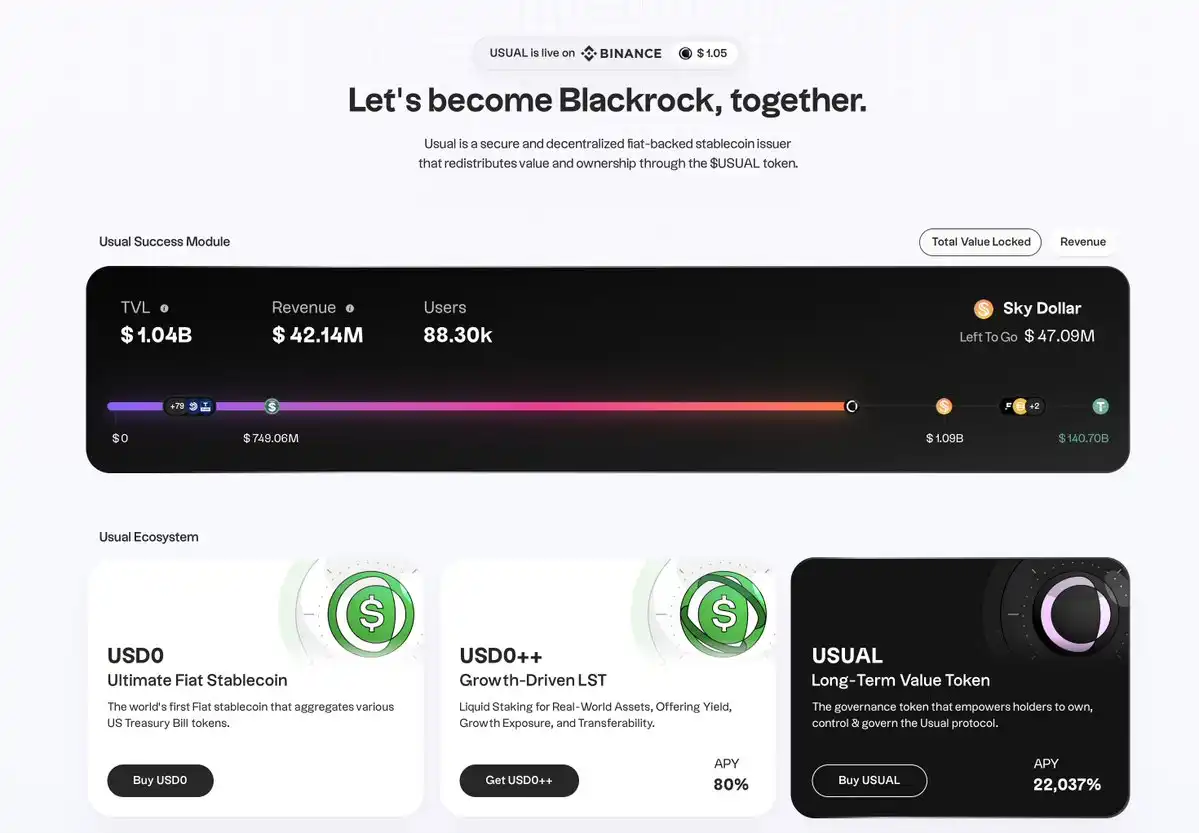
If USUAL can achieve this goal, even just 10% of it will mean $770 million in profits. And the best part is that 90% of the revenue will be distributed to token holders and stakers in the form of $USUAL.
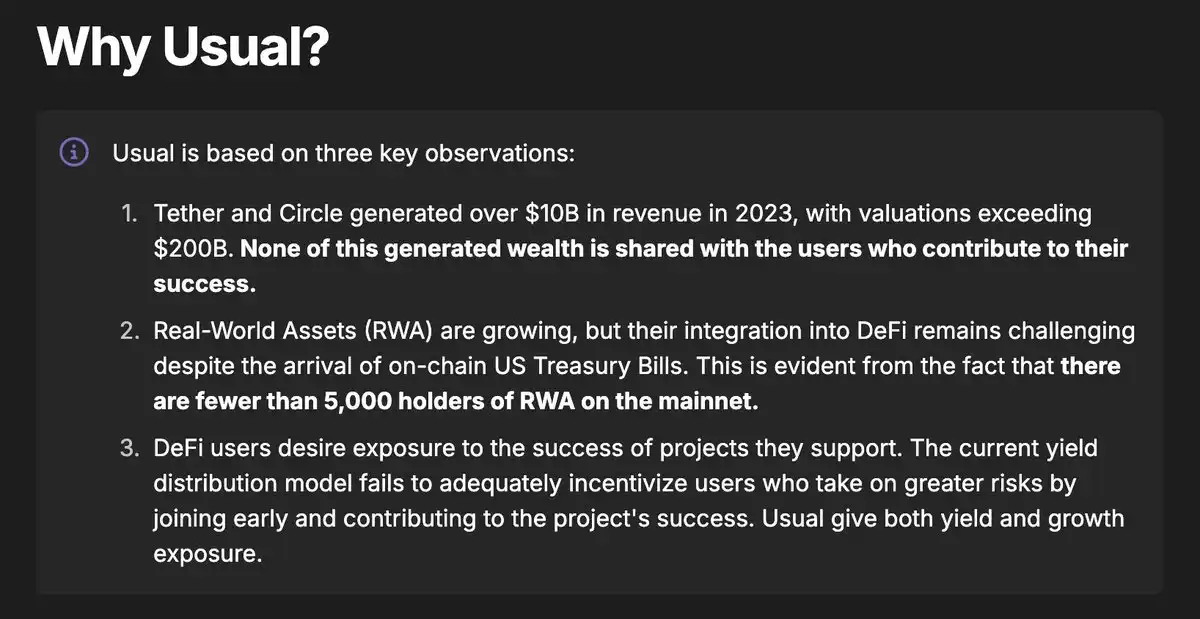
Returns are paid in $USUAL, so every time someone stakes USDO (their stablecoin), $USUAL tokens are constantly issued.
USDO is a stablecoin backed by US Treasuries that generates returns through Treasuries, and these returns are distributed in the form of $USUAL and USDO.
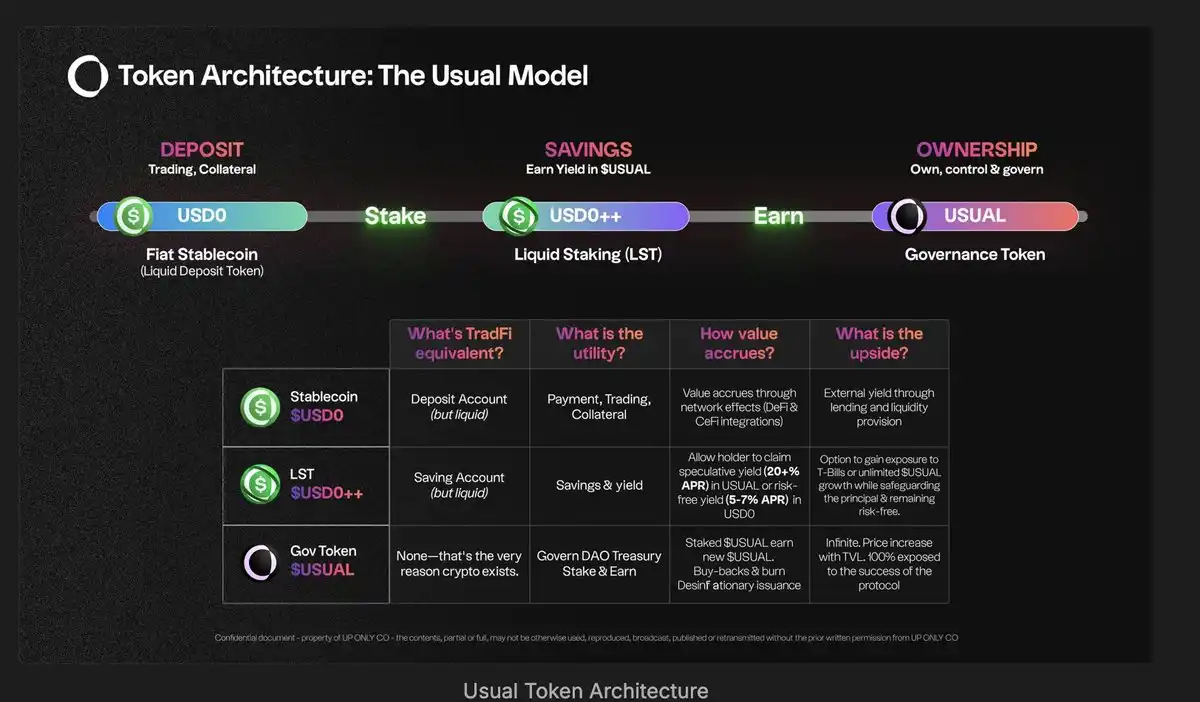
USUAL Money mentioned that when $USUAL's cash flow reaches a certain target, they plan to control the issuance of $USUAL and ensure that the continuous issuance rate is lower than the revenue growth rate. Initially, the issuance will be high, but over time, the issuance will gradually decrease.
USUAL offers two other tokens in addition to the governance and staking token $USUAL.
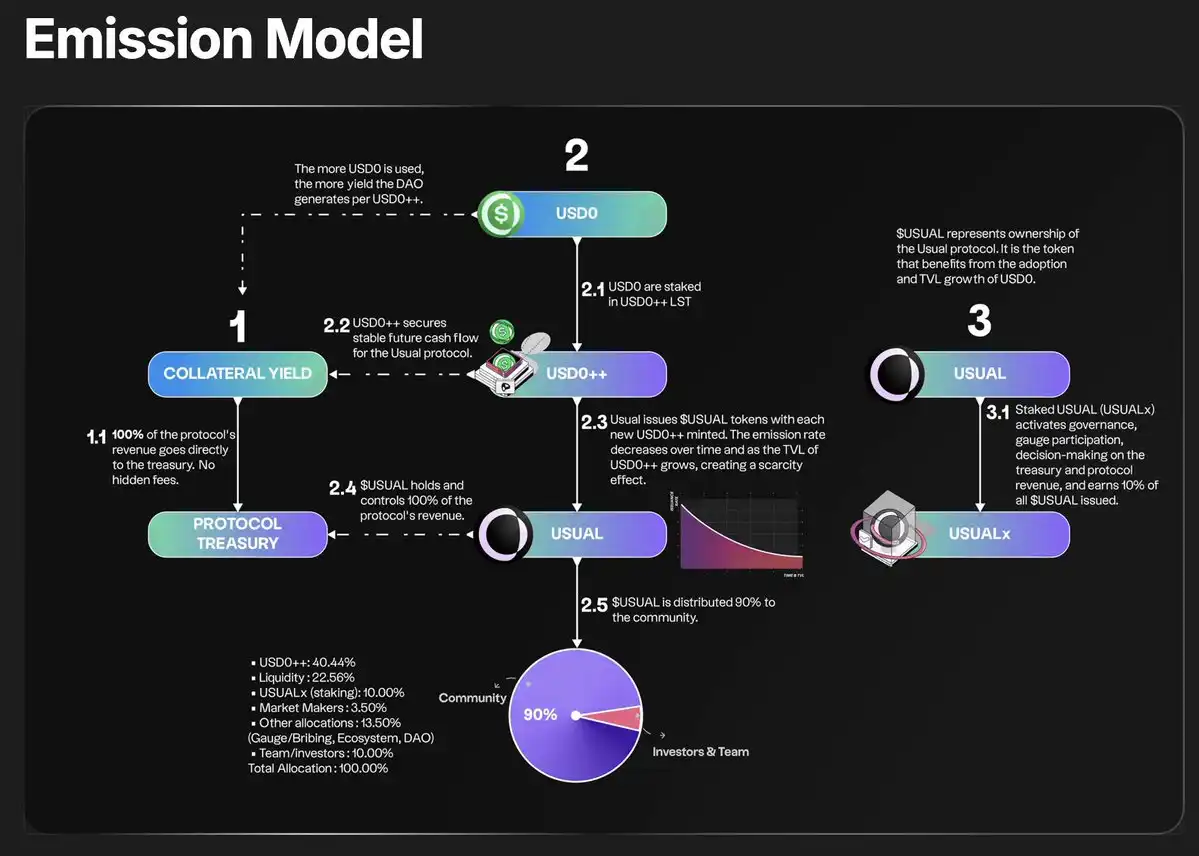
USDO++: This is the liquidity token you get after staking USDO. USDO holders need to stake USDO for 4 years to mint USDO++. USDO++ holders will receive 45% of the $USUAL issuance.
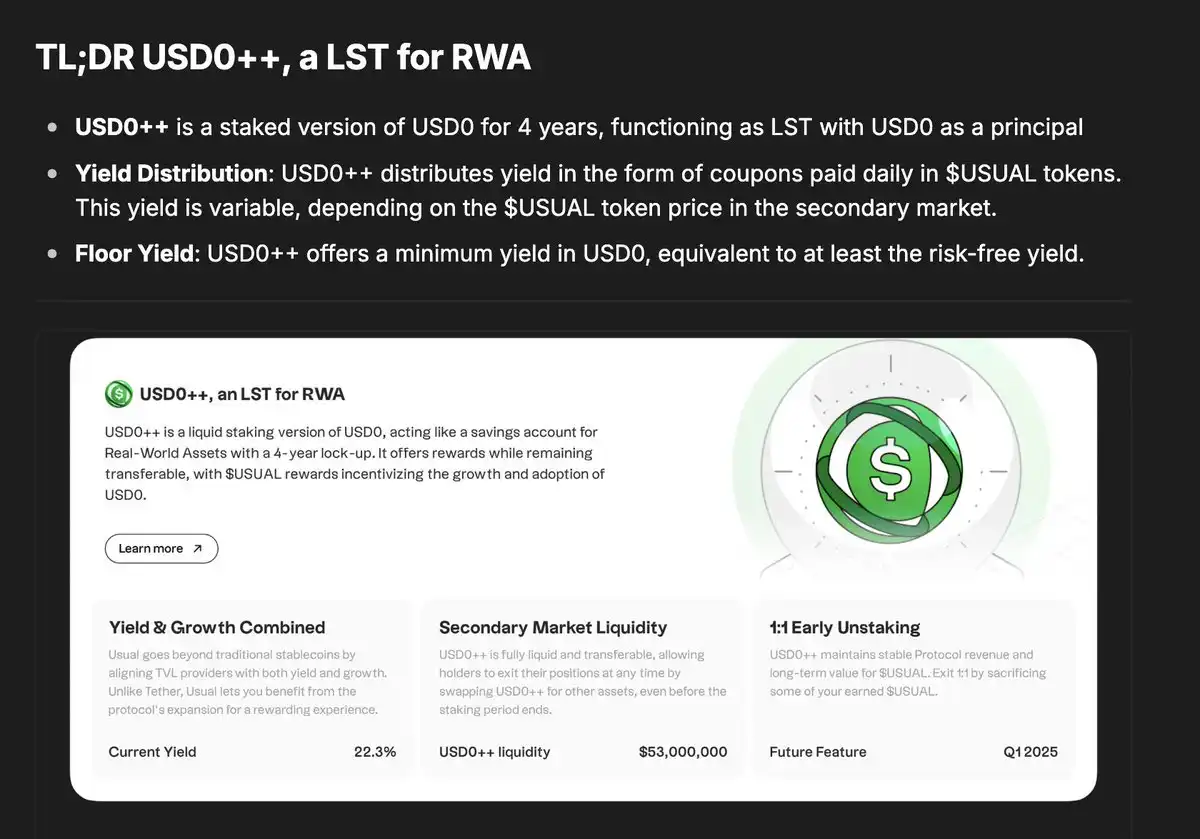
USUAL issues new $USUAL tokens whenever new USDO++ is minted. This is a core part of their flywheel mechanism. The TVL (Total Value Locked) of the protocol also tracks the value of USDO++ minted in the protocol.
The higher the TVL, the more revenue the protocol generates, which will eventually be paid to USDO++ holders in the form of $USUAL tokens.
The issuance rate of $USUAL will decrease as more users adopt it, reducing the number of tokens issued per dollar locked.
This reduction will increase the yield per token, which will naturally drive the price of $USUAL up.
The higher annualized yield (APY) on USDO++ will attract more people to stake USDO. The current APY is around 80%, so we may see TVL rise in the coming days. The current TVL is around $900 million, and 87.47% of USDO has been staked as USDO++.
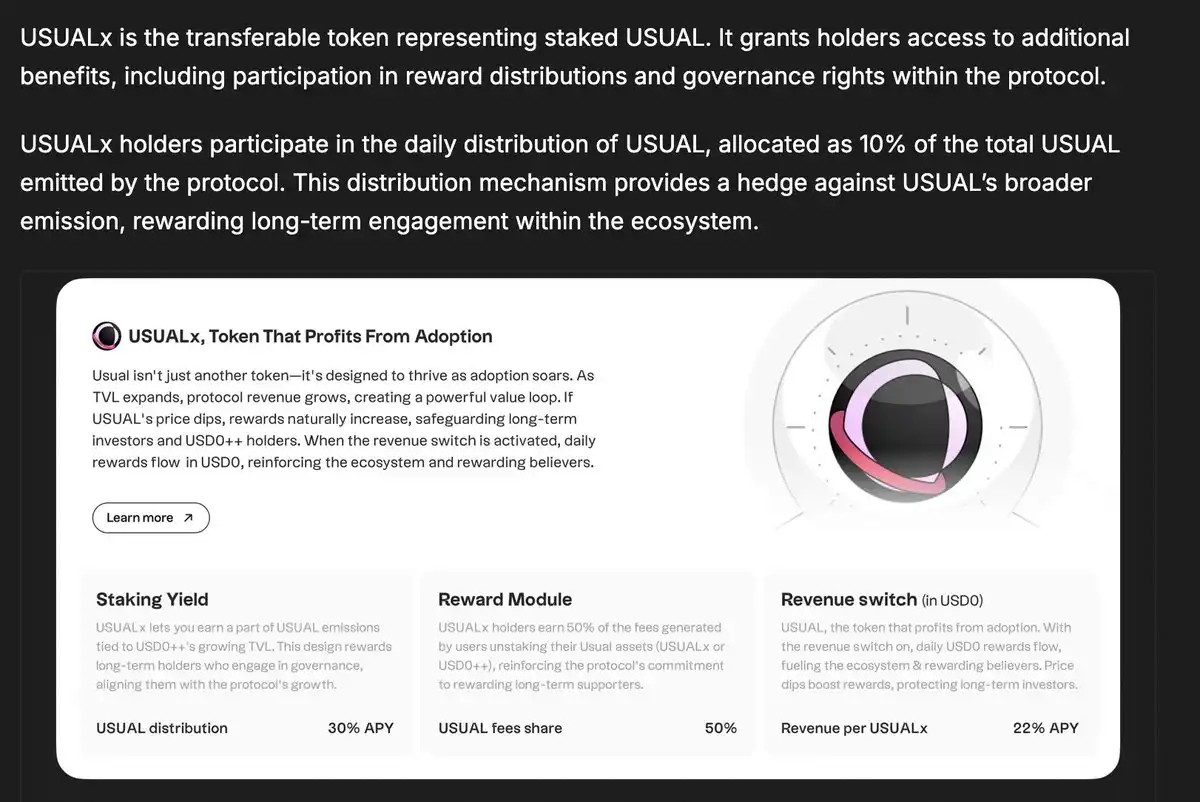
USUAL also has a staking token called USUALx, which provides three forms of yield: USDO rewards from revenue, 10% of $USUAL issuance, and 50% fee share from unlocking modules.
When USDO++ holders decide to unlock before expiration, the protocol will also initiate the destruction mechanism of $USUAL.
They need to destroy a portion of the $USUAL supply to unlock.
As mentioned in the USUAL Money whitepaper, we do face two serious product risks:
The market price of $USUAL (the main reward token) directly affects the benefits in the ecosystem, including rewards and liquidity incentives related to USDO++. If the price drops significantly, it may damage the competitiveness and user attractiveness of the ecosystem. Due to its inflationary nature, there is also a risk of hyperinflation.
To this end, the DAO can mitigate this risk by adjusting the minting rate to regulate the issuance, ensuring economic stability and sustainability.
USDO++: These locked tokens lack a costless arbitrage mechanism to maintain their anchor, which can lead to price volatility. However, this risk has been minimized through strong liquidity in the secondary market, as well as liquidity provision incentives and early redemption mechanisms. In addition, the price floor redemption mechanism limits extreme volatility, ensuring stability and market efficiency.
Overall, as long as the price of $USUAL is attractive, the protocol can attract more demand for USDO and USDO++. The greater the demand for its stablecoins, the more revenue it will ultimately generate, which will be distributed to USDO++ holders, USUALx holders, and other participants.
Currently, USUALx has an annual interest rate of about 28,000%, which may attract initial demand and create early market heat.
However, in the long run, the key lies in how the USDO anchoring mechanism is stabilized and how long $USUAL can continue to attract demand.
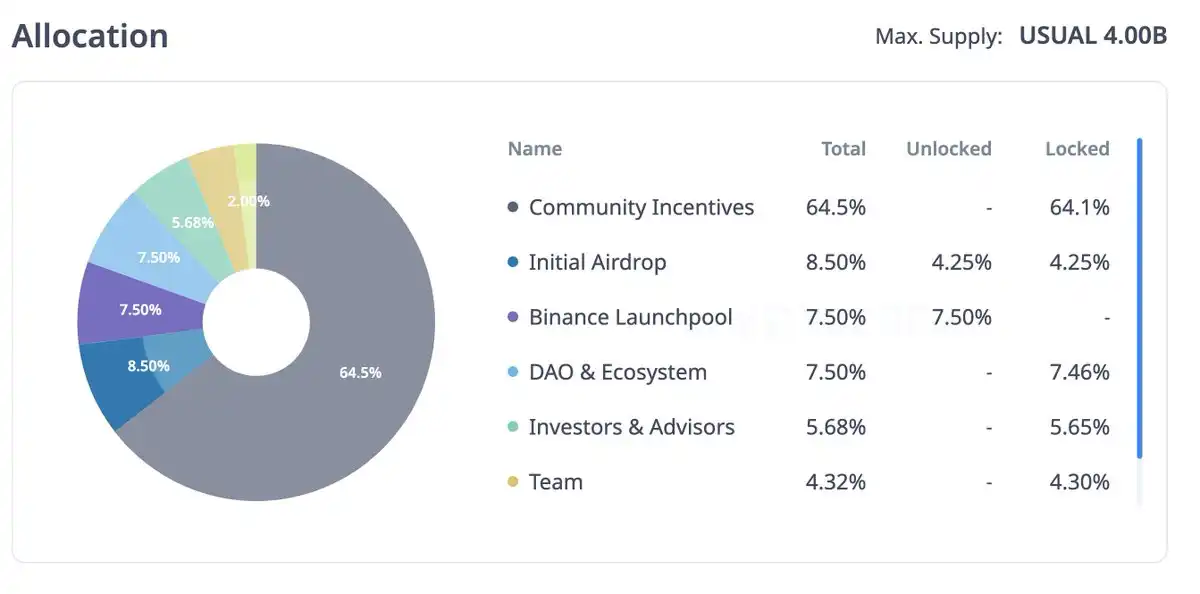
In terms of token economics: approximately 90% of the tokens are allocated to the community, of which approximately 64% are used for inflation rewards, which will adjust the issuance plan based on dynamic demand. Currently, approximately 12.4% of the tokens have entered circulation.
You may also like

Consumer-grade Crypto Global Survey: Users, Revenue, and Track Distribution

Prediction Markets Under Bias

Stolen: $290 million, Three Parties Refusing to Acknowledge, Who Should Foot the Bill for the KelpDAO Incident Resolution?

ASTEROID Pumped 10,000x in Three Days, Is Meme Season Back on Ethereum?

ChainCatcher Hong Kong Themed Forum Highlights: Decoding the Growth Engine Under the Integration of Crypto Assets and Smart Economy

Why can this institution still grow by 150% when the scale of leading crypto VCs has shrunk significantly?

Anthropic's $1 trillion, compared to DeepSeek's $100 billion

Geopolitical Risk Persists, Is Bitcoin Becoming a Key Barometer?

Annualized 11.5%, Wall Street Buzzing: Is MicroStrategy's STRC Bitcoin's Savior or Destroyer?

An Obscure Open Source AI Tool Alerted on Kelp DAO's $292 million Bug 12 Days Ago

Mixin has launched USTD-margined perpetual contracts, bringing derivative trading into the chat scene.
The privacy-focused crypto wallet Mixin announced today the launch of its U-based perpetual contract (a derivative priced in USDT). Unlike traditional exchanges, Mixin has taken a new approach by "liberating" derivative trading from isolated matching engines and embedding it into the instant messaging environment.
Users can directly open positions within the app with leverage of up to 200x, while sharing positions, discussing strategies, and copy trading within private communities. Trading, social interaction, and asset management are integrated into the same interface.
Based on its non-custodial architecture, Mixin has eliminated friction from the traditional onboarding process, allowing users to participate in perpetual contract trading without identity verification.
The trading process has been streamlined into five steps:
· Choose the trading asset
· Select long or short
· Input position size and leverage
· Confirm order details
· Confirm and open the position
The interface provides real-time visualization of price, position, and profit and loss (PnL), allowing users to complete trades without switching between multiple modules.
Mixin has directly integrated social features into the derivative trading environment. Users can create private trading communities and interact around real-time positions:
· End-to-end encrypted private groups supporting up to 1024 members
· End-to-end encrypted voice communication
· One-click position sharing
· One-click trade copying
On the execution side, Mixin aggregates liquidity from multiple sources and accesses decentralized protocol and external market liquidity through a unified trading interface.
By combining social interaction with trade execution, Mixin enables users to collaborate, share, and execute trading strategies instantly within the same environment.
Mixin has also introduced a referral incentive system based on trading behavior:
· Users can join with an invite code
· Up to 60% of trading fees as referral rewards
· Incentive mechanism designed for long-term, sustainable earnings
This model aims to drive user-driven network expansion and organic growth.
Mixin's derivative transactions are built on top of its existing self-custody wallet infrastructure, with core features including:
· Separation of transaction account and asset storage
· User full control over assets
· Platform does not custody user funds
· Built-in privacy mechanisms to reduce data exposure
The system aims to strike a balance between transaction efficiency, asset security, and privacy protection.
Against the background of perpetual contracts becoming a mainstream trading tool, Mixin is exploring a different development direction by lowering barriers, enhancing social and privacy attributes.
The platform does not only view transactions as execution actions but positions them as a networked activity: transactions have social attributes, strategies can be shared, and relationships between individuals also become part of the financial system.
Mixin's design is based on a user-initiated, user-controlled model. The platform neither custodies assets nor executes transactions on behalf of users.
This model aligns with a statement issued by the U.S. Securities and Exchange Commission (SEC) on April 13, 2026, titled "Staff Statement on Whether Partial User Interface Used in Preparing Cryptocurrency Securities Transactions May Require Broker-Dealer Registration."
The statement indicates that, under the premise where transactions are entirely initiated and controlled by users, non-custodial service providers that offer neutral interfaces may not need to register as broker-dealers or exchanges.
Mixin is a decentralized, self-custodial privacy wallet designed to provide secure and efficient digital asset management services.
Its core capabilities include:
· Aggregation: integrating multi-chain assets and routing between different transaction paths to simplify user operations
· High liquidity access: connecting to various liquidity sources, including decentralized protocols and external markets
· Decentralization: achieving full user control over assets without relying on custodial intermediaries
· Privacy protection: safeguarding assets and data through MPC, CryptoNote, and end-to-end encrypted communication
Mixin has been in operation for over 8 years, supporting over 40 blockchains and more than 10,000 assets, with a global user base exceeding 10 million and an on-chain self-custodied asset scale of over $1 billion.

$600 million stolen in 20 days, ushering in the era of AI hackers in the crypto world
Vitalik's 2026 Hong Kong Web3 Summit Speech: Ethereum's Ultimate Vision as the "World Computer" and Future Roadmap
On the same day Aave introduced rsETH, why did Spark decide to exit?
Full Post-Mortem of the KelpDAO Incident: Why Did Aave, Which Was Not Compromised, End Up in Crisis Situation?

After a $290 million DeFi liquidation, is the security promise still there?
ZachXBT's post ignites RAVE nearing zero, what is the truth behind the insider control?




 App
App