
 Buy Crypto
- Markets
 Futures
- Spot
- Copy Trade
- Earn
- More
Plume Completes $20 Million Series A Funding, with Brevan Howard Digital, Haun Ventures, Galaxy Ventures and Lightspeed Faction as Co-Investors

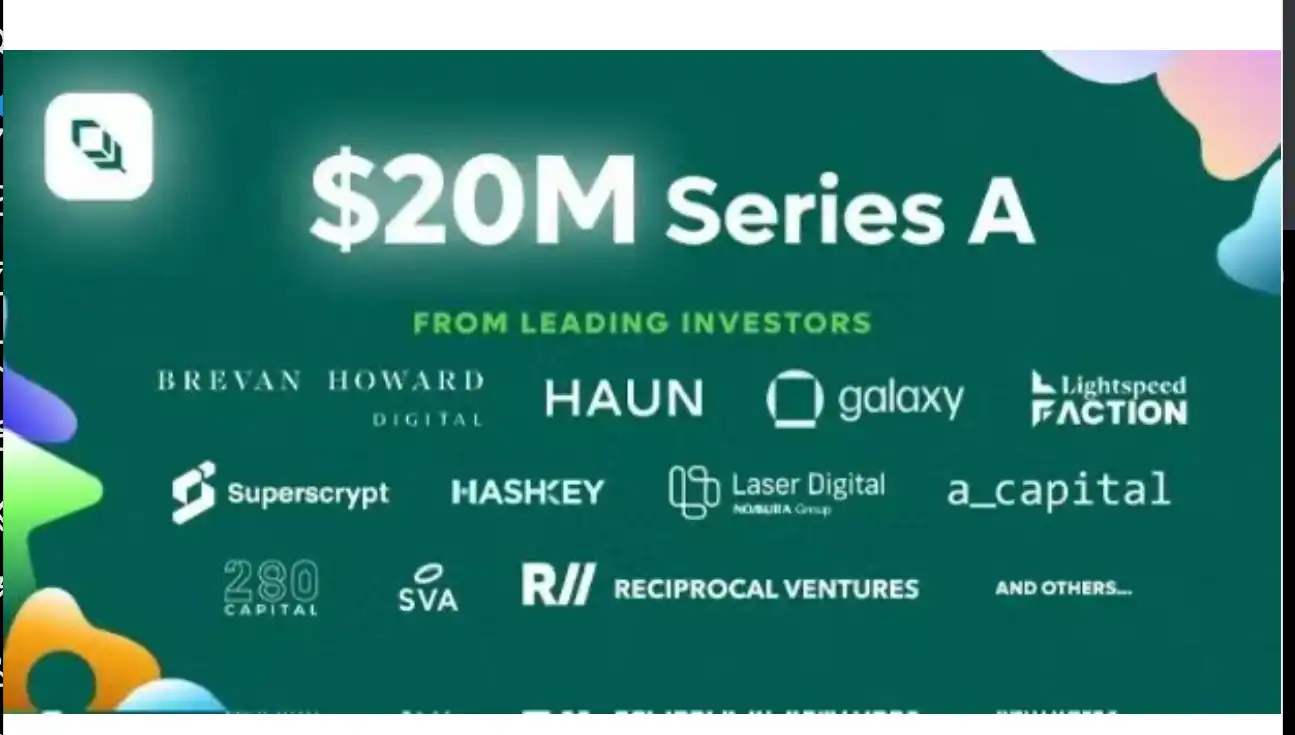
Plume, the first fully modular, integrated Layer-1 blockchain focused on real-world asset finance (RWAfi), today announced the completion of a $20 million Series A round of financing. This round of financing was led by Brevan Howard Digital, Haun Ventures, Galaxy Ventures, and Lightspeed Faction, with participation from well-known institutions such as Superscrypt, Hashkey, Laser Digital (Nomura Group), A Capital, 280 Capital, SV Angel, and Reciprocal Ventures. This financing demonstrates the high recognition of Plume's vision to build an on-chain RWAfi ecosystem by the crypto industry and traditional financial investors.
Since its seed round of financing, Plume has achieved explosive growth, with more than 180 protocols under construction in its ecosystem and assets exceeding $4 billion. Plume recently completed an 8-week testnet with impressive data, attracting more than 18 million wallets, 3.75 million active users, and more than 280 million transactions. In addition, Plume's recent pre-staking event was oversubscribed in less than 90 minutes, raising more than $30 million, laying a strong momentum for the upcoming mainnet launch.
As the leader in RWAfi, Plume has built infrastructure that facilitates on-chain interaction with the real world. Through products such as Plume Arc (modular tokenization engine) and Plume Nexus (real-world data provider), Plume has become the easiest option to bring real-world assets to the chain, while also facilitating users to interact with these assets on Plume's EVM blockchain. On Plume, users can seamlessly exchange, trade, and speculate on real-world assets just as they interact with crypto-native assets. Whether earning real income by holding oil royalties, putting them into lending markets for recycling, or putting those tokens into perpetual contract decentralized exchanges, Plume is the only on-chain platform that provides permissionless access to the real world through crypto.
“There has always been a huge demand for real-world assets (RWAs) on-chain, but the infrastructure to bring these assets on-chain has been lacking in the past,” said Chris Yin, co-founder and CEO of Plume. “Look at the original RWA - stablecoins, which are one of the best products in the crypto space and provide a great entry point for new users to enter the crypto world. But the key to adoption is the ecosystem and user experience - while stablecoins have done it, other RWAs have not yet succeeded. And now with Plume, all kinds of asset issuers can become crypto-native builders. Through our technology and ecosystem, we connect them directly to our community, ecology, and liquidity, and do it all in an open, permissionless and composable way.”
This funding round will accelerate Plume’s commitment to creating the first RWA-focused Layer-1 blockchain for crypto-native users and institutions, while supporting application and product development in emerging markets built on Plume. This will further its mission to bring real-world assets on-chain to serve crypto-native users and even the largest financial institutions.
“Plume’s innovative approach to RWA leverages the unique capabilities of DeFi-native blockchains combined with their deep understanding of traditional financial institutions and new user incentives, especially in emerging markets,” said Will Nuelle, partner at Galaxy Ventures. “It’s exciting that Plume is bringing alternative investment classes such as carbon credits, special financial products, and GPUs to the chain, which are currently not easily accessible to investors.”
Plume is committed to unlocking the untapped potential of physical assets and economic data to create new opportunities for real yield, sustainable growth, and global accessibility. Users will be able to access Plume starting with the mainnet launch early next year.
About Plume
Plume is the first fully modular, integrated Layer-1 blockchain focused on RWAfi, providing a composable, EVM-compatible environment for accessing and managing a wide range of real-world assets. With over 180 projects building on its private development network, Plume offers an end-to-end tokenization engine and a range of financial infrastructure partners to simplify the asset access process and enable seamless integration of real-world assets with DeFi. For more information, visit https://www.plumenetwork.xyz/ or contact press@plumenetwork.xyz.
You may also like

Consumer-grade Crypto Global Survey: Users, Revenue, and Track Distribution

Prediction Markets Under Bias

Stolen: $290 million, Three Parties Refusing to Acknowledge, Who Should Foot the Bill for the KelpDAO Incident Resolution?

ASTEROID Pumped 10,000x in Three Days, Is Meme Season Back on Ethereum?

ChainCatcher Hong Kong Themed Forum Highlights: Decoding the Growth Engine Under the Integration of Crypto Assets and Smart Economy

Why can this institution still grow by 150% when the scale of leading crypto VCs has shrunk significantly?

Anthropic's $1 trillion, compared to DeepSeek's $100 billion

Geopolitical Risk Persists, Is Bitcoin Becoming a Key Barometer?

Annualized 11.5%, Wall Street Buzzing: Is MicroStrategy's STRC Bitcoin's Savior or Destroyer?

An Obscure Open Source AI Tool Alerted on Kelp DAO's $292 million Bug 12 Days Ago

Mixin has launched USTD-margined perpetual contracts, bringing derivative trading into the chat scene.
The privacy-focused crypto wallet Mixin announced today the launch of its U-based perpetual contract (a derivative priced in USDT). Unlike traditional exchanges, Mixin has taken a new approach by "liberating" derivative trading from isolated matching engines and embedding it into the instant messaging environment.
Users can directly open positions within the app with leverage of up to 200x, while sharing positions, discussing strategies, and copy trading within private communities. Trading, social interaction, and asset management are integrated into the same interface.
Based on its non-custodial architecture, Mixin has eliminated friction from the traditional onboarding process, allowing users to participate in perpetual contract trading without identity verification.
The trading process has been streamlined into five steps:
· Choose the trading asset
· Select long or short
· Input position size and leverage
· Confirm order details
· Confirm and open the position
The interface provides real-time visualization of price, position, and profit and loss (PnL), allowing users to complete trades without switching between multiple modules.
Mixin has directly integrated social features into the derivative trading environment. Users can create private trading communities and interact around real-time positions:
· End-to-end encrypted private groups supporting up to 1024 members
· End-to-end encrypted voice communication
· One-click position sharing
· One-click trade copying
On the execution side, Mixin aggregates liquidity from multiple sources and accesses decentralized protocol and external market liquidity through a unified trading interface.
By combining social interaction with trade execution, Mixin enables users to collaborate, share, and execute trading strategies instantly within the same environment.
Mixin has also introduced a referral incentive system based on trading behavior:
· Users can join with an invite code
· Up to 60% of trading fees as referral rewards
· Incentive mechanism designed for long-term, sustainable earnings
This model aims to drive user-driven network expansion and organic growth.
Mixin's derivative transactions are built on top of its existing self-custody wallet infrastructure, with core features including:
· Separation of transaction account and asset storage
· User full control over assets
· Platform does not custody user funds
· Built-in privacy mechanisms to reduce data exposure
The system aims to strike a balance between transaction efficiency, asset security, and privacy protection.
Against the background of perpetual contracts becoming a mainstream trading tool, Mixin is exploring a different development direction by lowering barriers, enhancing social and privacy attributes.
The platform does not only view transactions as execution actions but positions them as a networked activity: transactions have social attributes, strategies can be shared, and relationships between individuals also become part of the financial system.
Mixin's design is based on a user-initiated, user-controlled model. The platform neither custodies assets nor executes transactions on behalf of users.
This model aligns with a statement issued by the U.S. Securities and Exchange Commission (SEC) on April 13, 2026, titled "Staff Statement on Whether Partial User Interface Used in Preparing Cryptocurrency Securities Transactions May Require Broker-Dealer Registration."
The statement indicates that, under the premise where transactions are entirely initiated and controlled by users, non-custodial service providers that offer neutral interfaces may not need to register as broker-dealers or exchanges.
Mixin is a decentralized, self-custodial privacy wallet designed to provide secure and efficient digital asset management services.
Its core capabilities include:
· Aggregation: integrating multi-chain assets and routing between different transaction paths to simplify user operations
· High liquidity access: connecting to various liquidity sources, including decentralized protocols and external markets
· Decentralization: achieving full user control over assets without relying on custodial intermediaries
· Privacy protection: safeguarding assets and data through MPC, CryptoNote, and end-to-end encrypted communication
Mixin has been in operation for over 8 years, supporting over 40 blockchains and more than 10,000 assets, with a global user base exceeding 10 million and an on-chain self-custodied asset scale of over $1 billion.

$600 million stolen in 20 days, ushering in the era of AI hackers in the crypto world
Vitalik's 2026 Hong Kong Web3 Summit Speech: Ethereum's Ultimate Vision as the "World Computer" and Future Roadmap
On the same day Aave introduced rsETH, why did Spark decide to exit?
Full Post-Mortem of the KelpDAO Incident: Why Did Aave, Which Was Not Compromised, End Up in Crisis Situation?

After a $290 million DeFi liquidation, is the security promise still there?
ZachXBT's post ignites RAVE nearing zero, what is the truth behind the insider control?




 App
App