
 Buy Crypto
- Markets
 Futures
- Spot
- Copy Trade
- Earn
- More
Pantera founder: Bitcoin will soon challenge the next order of magnitude

Original title: Escape Velocity
Original author: Dan Morehead, founder of Pantera
Original translation: 0xjs, Golden Finance
When the Pantera Bitcoin Fund returns 1,000 times, CNBC Squawk Box interviewed me on November 26, 2024.
Joe: "Our next guest has seen the cryptocurrency rally firsthand. We welcome Dan Morehead, founder and managing partner of Pantera Capital. The firm had some news this morning on the rally in Bitcoin. The Pantera Bitcoin Fund recently hit a milestone of 1,000x since its inception."
"You were kind enough to send us the original memo you wrote in 2013, where you basically said, 'Okay, now's the time - Bitcoin has corrected, time to buy.' It corrected from $130 to $65, and that's when the fund was 'launched.' You said, 'I'm personally going to buy 30,000 Bitcoins.' This was the launch of the first institutional investment vehicle for Bitcoin..."
"Now, this is a 1,000x gain and then a 1,000x gain." 30%. "
Dan: "It's early days, though. I think the median institutional ownership of blockchain is zero. Most institutions have zero investment in blockchain, and even the ones that are really progressive and really committed to blockchain only allocate 1% or 2% of their funds to blockchain. I think we still have decades to go..."
"I wouldn't bet my life savings that Bitcoin will go up, but for eleven years, the price of Bitcoin has almost doubled every year on average. What if it goes up for another year?"
Joe: "Would you bet it wouldn't go to zero?"
Dan: "To be conservative, I used to tell people it would definitely go to zero. But, I don't think that's possible now. 50 million people in the United States hold it. 3 million people worldwide hold it. 100 million people hold it. BlackRock and Fidelity are selling Bitcoin to retail investors. It really has reached escape velocity."
Joe: "But your forecast was $740,000... I heard from Michael Saylor the other day it was $13 million."
Dan: “Bitcoin has grown three orders of magnitude in market cap since we launched the Pantera Bitcoin Fund. I think it could grow another order of magnitude. That would mean a $15 trillion market cap, which is still relatively small compared to $500 trillion in financial assets. It’s doable.”
Election Results
News Flash, Crypto Holders Voted
Most Americans are under 40.
They love blockchain.
And then they vote.
For months, I’ve been writing about how politicians ignore blockchain enthusiasts at their peril. It really happened.
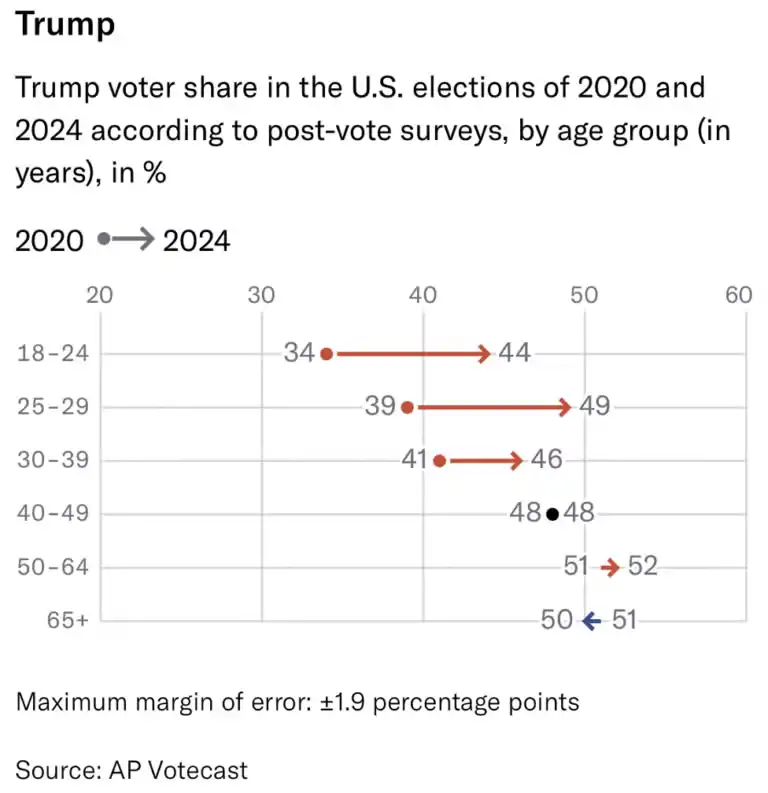
Young people who are passionate about blockchain decided this election.
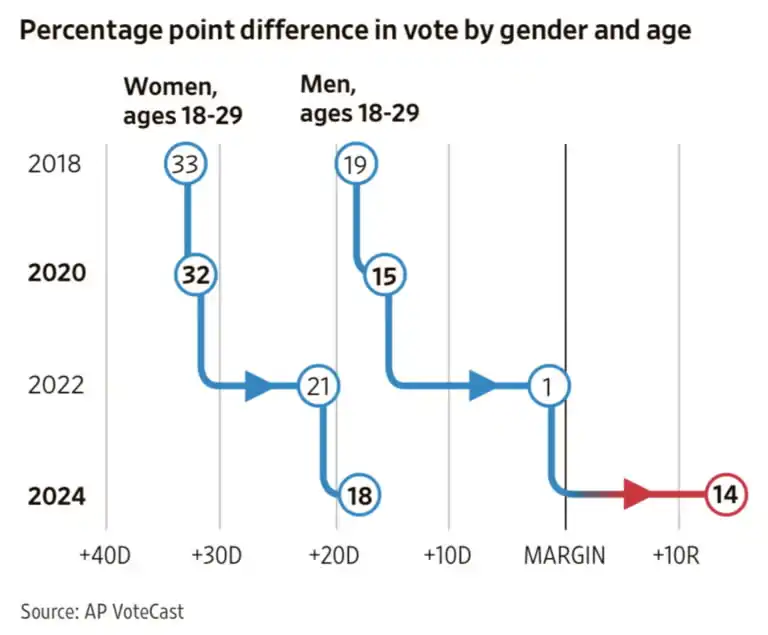
Women under 30 are up 14 points in favor of President Trump since the last election. President Trump hasn’t done much to support women or the Constitution since November 2020, so you have to conclude this is driven by his strongly pro-blockchain policy changes.
Men under 30 are up 29 points! That’s crazy.
They voted for Donald Trump for President by 14 points. I haven’t heard the term “young Republicans” since the 80s.
This graph is clear — young people changed the election. The majority of Americans are under 40. And they voted for crypto.
The End of Anti-Crypto Lawmakers
As I’ve written in the past, I’ve never understood who in Congress would oppose cryptocurrencies. Who is the imaginary anti-crypto Congressman? Who would support an anti-crypto representative in Congress? It just doesn’t make sense.
While new technology should not be partisan in the first place, if it is politicized, it should be Democrats promoting Bitcoin. That’s the progressive dream.
While the Republican sweep is widely known, less is known about the significant changes that are taking place beneath the surface. Congress will be radically altered as anti-crypto senators are successfully targeted and removed from office. Just like Senator Sherrod Brown was ousted by an unknown pro-Bitcoin car dealer — who was backed by a $40 million Bitcoin PAC.
Of the 58 general election candidates supported by crypto super PACs, the blockchain industry won 54 to 4.
The upcoming 119th Congress is:
· House: 274 pro-crypto, 122 anti-crypto
· Senate: 20 pro-crypto, 12 anti-crypto
I think the anti-crypto rhetoric of members of Congress is over. In four years, when we recount, I will be surprised to find that any of the 122 anti-crypto members of Congress are still around. They will either "switch" and support blockchain or lose the next election.
This will allow the talented people in the blockchain industry to refocus all their energy on creative progress.
You may also like

Consumer-grade Crypto Global Survey: Users, Revenue, and Track Distribution

Prediction Markets Under Bias

Stolen: $290 million, Three Parties Refusing to Acknowledge, Who Should Foot the Bill for the KelpDAO Incident Resolution?

ASTEROID Pumped 10,000x in Three Days, Is Meme Season Back on Ethereum?

ChainCatcher Hong Kong Themed Forum Highlights: Decoding the Growth Engine Under the Integration of Crypto Assets and Smart Economy

Why can this institution still grow by 150% when the scale of leading crypto VCs has shrunk significantly?

Anthropic's $1 trillion, compared to DeepSeek's $100 billion

Geopolitical Risk Persists, Is Bitcoin Becoming a Key Barometer?

Annualized 11.5%, Wall Street Buzzing: Is MicroStrategy's STRC Bitcoin's Savior or Destroyer?

An Obscure Open Source AI Tool Alerted on Kelp DAO's $292 million Bug 12 Days Ago

Mixin has launched USTD-margined perpetual contracts, bringing derivative trading into the chat scene.
The privacy-focused crypto wallet Mixin announced today the launch of its U-based perpetual contract (a derivative priced in USDT). Unlike traditional exchanges, Mixin has taken a new approach by "liberating" derivative trading from isolated matching engines and embedding it into the instant messaging environment.
Users can directly open positions within the app with leverage of up to 200x, while sharing positions, discussing strategies, and copy trading within private communities. Trading, social interaction, and asset management are integrated into the same interface.
Based on its non-custodial architecture, Mixin has eliminated friction from the traditional onboarding process, allowing users to participate in perpetual contract trading without identity verification.
The trading process has been streamlined into five steps:
· Choose the trading asset
· Select long or short
· Input position size and leverage
· Confirm order details
· Confirm and open the position
The interface provides real-time visualization of price, position, and profit and loss (PnL), allowing users to complete trades without switching between multiple modules.
Mixin has directly integrated social features into the derivative trading environment. Users can create private trading communities and interact around real-time positions:
· End-to-end encrypted private groups supporting up to 1024 members
· End-to-end encrypted voice communication
· One-click position sharing
· One-click trade copying
On the execution side, Mixin aggregates liquidity from multiple sources and accesses decentralized protocol and external market liquidity through a unified trading interface.
By combining social interaction with trade execution, Mixin enables users to collaborate, share, and execute trading strategies instantly within the same environment.
Mixin has also introduced a referral incentive system based on trading behavior:
· Users can join with an invite code
· Up to 60% of trading fees as referral rewards
· Incentive mechanism designed for long-term, sustainable earnings
This model aims to drive user-driven network expansion and organic growth.
Mixin's derivative transactions are built on top of its existing self-custody wallet infrastructure, with core features including:
· Separation of transaction account and asset storage
· User full control over assets
· Platform does not custody user funds
· Built-in privacy mechanisms to reduce data exposure
The system aims to strike a balance between transaction efficiency, asset security, and privacy protection.
Against the background of perpetual contracts becoming a mainstream trading tool, Mixin is exploring a different development direction by lowering barriers, enhancing social and privacy attributes.
The platform does not only view transactions as execution actions but positions them as a networked activity: transactions have social attributes, strategies can be shared, and relationships between individuals also become part of the financial system.
Mixin's design is based on a user-initiated, user-controlled model. The platform neither custodies assets nor executes transactions on behalf of users.
This model aligns with a statement issued by the U.S. Securities and Exchange Commission (SEC) on April 13, 2026, titled "Staff Statement on Whether Partial User Interface Used in Preparing Cryptocurrency Securities Transactions May Require Broker-Dealer Registration."
The statement indicates that, under the premise where transactions are entirely initiated and controlled by users, non-custodial service providers that offer neutral interfaces may not need to register as broker-dealers or exchanges.
Mixin is a decentralized, self-custodial privacy wallet designed to provide secure and efficient digital asset management services.
Its core capabilities include:
· Aggregation: integrating multi-chain assets and routing between different transaction paths to simplify user operations
· High liquidity access: connecting to various liquidity sources, including decentralized protocols and external markets
· Decentralization: achieving full user control over assets without relying on custodial intermediaries
· Privacy protection: safeguarding assets and data through MPC, CryptoNote, and end-to-end encrypted communication
Mixin has been in operation for over 8 years, supporting over 40 blockchains and more than 10,000 assets, with a global user base exceeding 10 million and an on-chain self-custodied asset scale of over $1 billion.

$600 million stolen in 20 days, ushering in the era of AI hackers in the crypto world
Vitalik's 2026 Hong Kong Web3 Summit Speech: Ethereum's Ultimate Vision as the "World Computer" and Future Roadmap
On the same day Aave introduced rsETH, why did Spark decide to exit?
Full Post-Mortem of the KelpDAO Incident: Why Did Aave, Which Was Not Compromised, End Up in Crisis Situation?

After a $290 million DeFi liquidation, is the security promise still there?
ZachXBT's post ignites RAVE nearing zero, what is the truth behind the insider control?




 App
App