
Out of Control dTAO Mechanism? Bittensor is Derailing from the AI Track

Original Article Title: Why dTAO is broken
Original Author: @tzedonn, crypto writer
Original Translation: zhouzhou, BlockBeats
Editor's Note: Bittensor's dTAO mechanism was originally designed to distribute TAO release more fairly, but it exposed problems within just one month of launch. The SN28 subnet exploited a mechanism vulnerability, driving TAO release into meme coin hype, ultimately being intervened by foundation centralization. As decentralization progresses, similar events may be unstoppable, turning Bittensor into a generalized incentive network rather than an AI project. The core issue lies in the lack of a unified goal.
The following is the original content (reorganized for better readability):
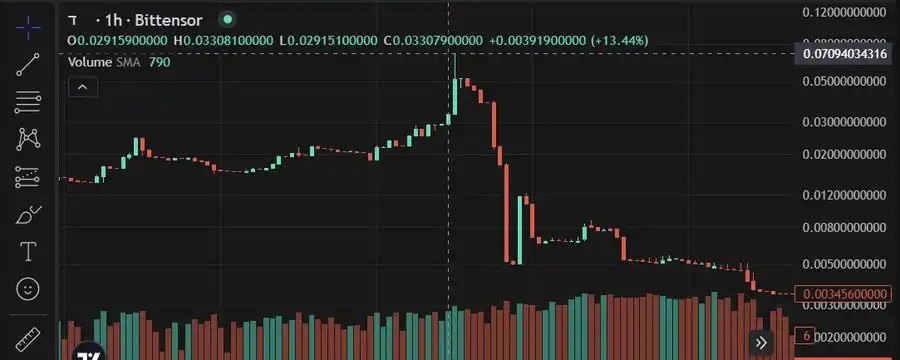
I am someone who has zero resistance to novel tokenomics. Watching crypto protocols continuously adjust their incentive mechanisms can sometimes seem smart—until they inevitably run into issues, which makes the process itself quite fascinating. So when Bittensor launched the dynamic $TAO (dTAO) system on Valentine's Day (was this @const_reborn's Valentine's gift?), I was immediately drawn in.
The idea was simple: to provide a new, more "fair" way of distributing TAO release, allowing various subnets to more reasonably receive TAO.
However, in less than a month, problems emerged. It turns out that a design that looks reasonable may not necessarily survive in a free market.
dTAO's Operating Mechanism
A quick review of dTAO's operation:
1. Each subnet has its own subnet token ($SN), which exists as a TAO-SN-based UniV2-type native liquidity pool (LP). However, the "staking" of TAO to receive SN is essentially the same as "swapping" TAO for SN. The only difference is: you cannot add additional liquidity to the pool or directly trade between different SN tokens (e.g., SN1 → SN2), but you can indirectly swap through TAO (SN1 → TAO → SN2).
2. TAO release is distributed based on each subnet's SN token price. They use a moving average price to smooth out price fluctuations and prevent price manipulation.
3. The supply of SN tokens is also very high, with a total supply cap of 21 million, similar to TAO and BTC. A portion of it goes into the TAO-SN liquidity pool, while the rest is allocated to the stakeholders of the subnet (miners, validators, subnet owners).
4. The amount of SN tokens entering the TAO-SN liquidity pool depends on how much SN is needed to 'balance' the entry of TAO into the pool, ensuring that the price of SN remains stable in terms of TAO valuation and increasing liquidity at the same time.
5. However, if the calculated amount of SN that the subnet receives exceeds its maximum release amount (based on the SN release curve), the SN release will be capped, leading to an increase in the price of SN in terms of TAO valuation.
Core Assumption of the dTAO Mechanism
Point (2) of the dTAO mechanism is based on a core assumption: a subnet with a higher market value creates more value for the Bittensor network and should therefore receive a larger TAO release.
However, the reality is that in the crypto market, the highest-priced tokens are often those that receive the most attention, hype, strongest marketing, and even have Ponzi-like characteristics. That's why the valuations of L1 chains and meme coins are always relatively high.
The intention behind the mechanism design is good because it assumes that subnets truly creating value will buy back SN tokens through generating revenue, driving up the SN price, and thus receiving more TAO release. But I find this logic a bit naive.
Meme Coin Subnet & Collapsing Tokenomics
Prior to the launch of dTAO, I had discussions with several crypto analysts about the apparent flaws in the dTAO tokenomics model – high market cap ≠ high revenue, nor does it equate to truly creating more value.
However, I didn't expect this theory to be validated by the market so quickly. The operation of a free market is always full of surprises.
Right before the dTAO upgrade, an anonymous user took over Subnet 281 and turned it directly into a meme coin subnet, naming it the 'TAO Accumulation Corporation,' abbreviated as the 'LOL-subnet.' This clearly had nothing to do with AI.
On its (now deleted) GitHub page, it once stated... No mining needed, just holding—completely turned into a Ponzi scheme.
In the LOL-subnet (Subnet 281), miners do not need to run any code, and the validator scoring mechanism is entirely based on the amount of subnet tokens held by the miner. The more SN28 tokens held, the more TAO is released.
In reality, the following occurred: Speculators buy SN28 tokens → SN28 price increases, SN28 price increase → more TAO released, if TAO release exceeds the subnet's token release limit → SN28 price continues to rise, released SN28 tokens are distributed to "miners" based on their holding proportion → the more SN28 held, the more received, in order to get more TAO, more people buy SN28 → higher price → Ponzi cycle continues.
Eventually, the TAO release officially flowed into... a meme coin! At one point, SN28 even became the 7th-ranked subnet in the Bittensor ecosystem.
Why didn't SN28 completely take over Bittensor? Centralization stepped in and saved Bittensor.
During the rapid expansion of SN28, the Opentensor Foundation directly used their root stake to run custom validator code, encouraging everyone to sell SN28. Ultimately, SN28 plummeted by 98% in a few hours and was completely liquidated.

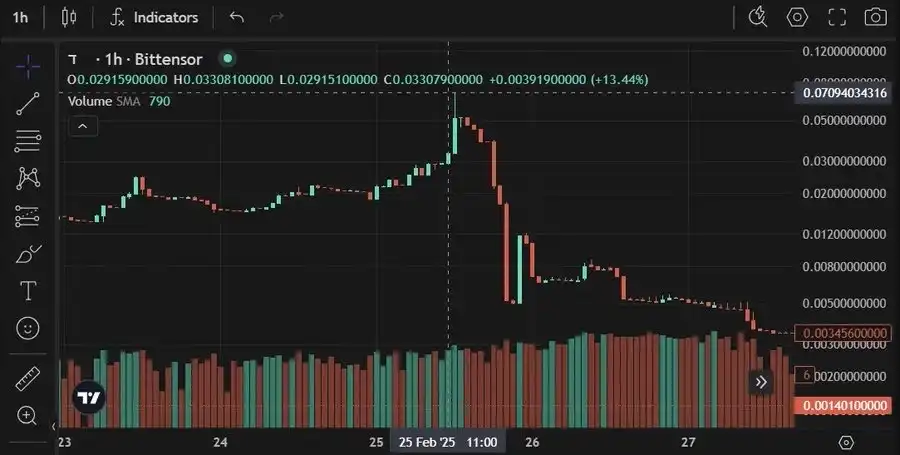
After the Opentensor Foundation took action, SN28 crashed by 98%.
Essentially, the foundation acted as a centralized entity, preventing the free market from operating under the dTAO mechanism. However, they were able to do so because we are currently in a transitional period—the TAO release mechanism is gradually transitioning from the old model to the dTAO mechanism.
Old TAO Release Mechanism & Transition to dTAO
Under the old mechanism, the top 64 validators with the most TAO staked in SN0 ("Root Subnet") could vote to determine where TAO release goes.
However, this mechanism also suffered from significant incentive issues, especially with large validators (such as Opentensor Foundation, DCG Yuma, Dao5, Polychain, etc.) holding too much power.
For example, potential conflicts of interest include:
They may prioritize allocating TAO to their own investments or incubated subnets.
They may direct TAO issuance to their own running validators and subnets eligible for TAO rewards.
These issues have long existed, and while dTAO was intended to address this centralization problem, the SN28 incident demonstrated that the new mechanism still has significant flaws.
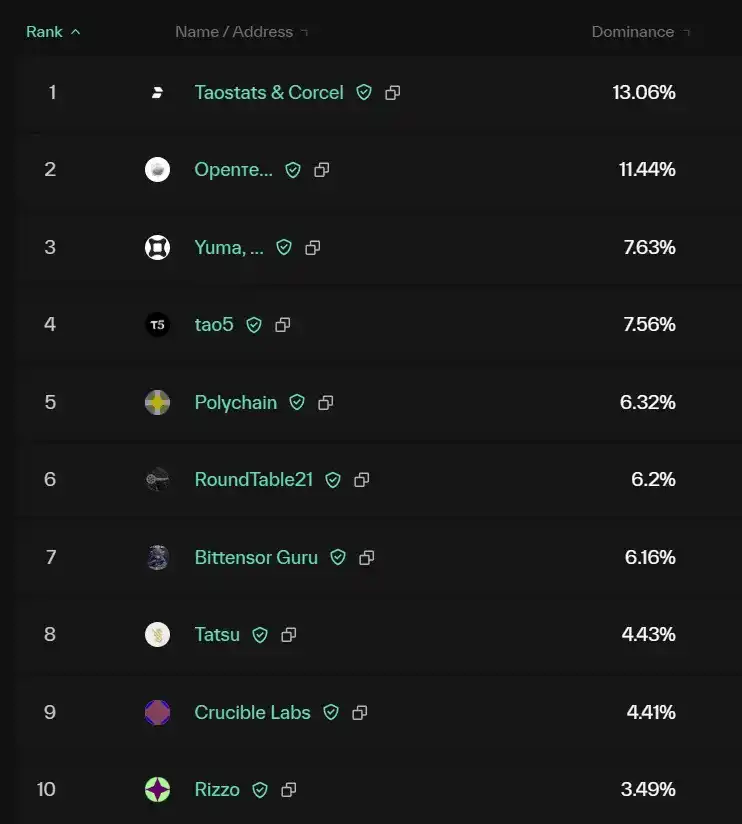
Moving towards decentralization is the right direction, but risks remain
Breaking away from the old mechanism is indeed a step in the right direction towards decentralization. Although this may mean the team will lose some control over TAO issuance, I still commend their choice of a more decentralized reward mechanism.
However, at the time of the SN28 incident, the dTAO mechanism had only just gone live for a week, and SN0 (root subnet) still controlled about 95% of the TAO issuance (as shown by the blue line in the chart below), allowing the Opentensor Foundation to intervene swiftly to prevent further fund inflation.
But the issue is:
· About a year later, SN0's power will gradually decrease to around 20%, at which point it will no longer be able to directly control most of the TAO issuance.
· If there is a future occurrence similar to SN28, it is very likely that no one will be able to intervene through SN0 anymore.
In this scenario, Bittensor may no longer be a "decentralized AI" project and could become a full-fledged meme coin incentive network.
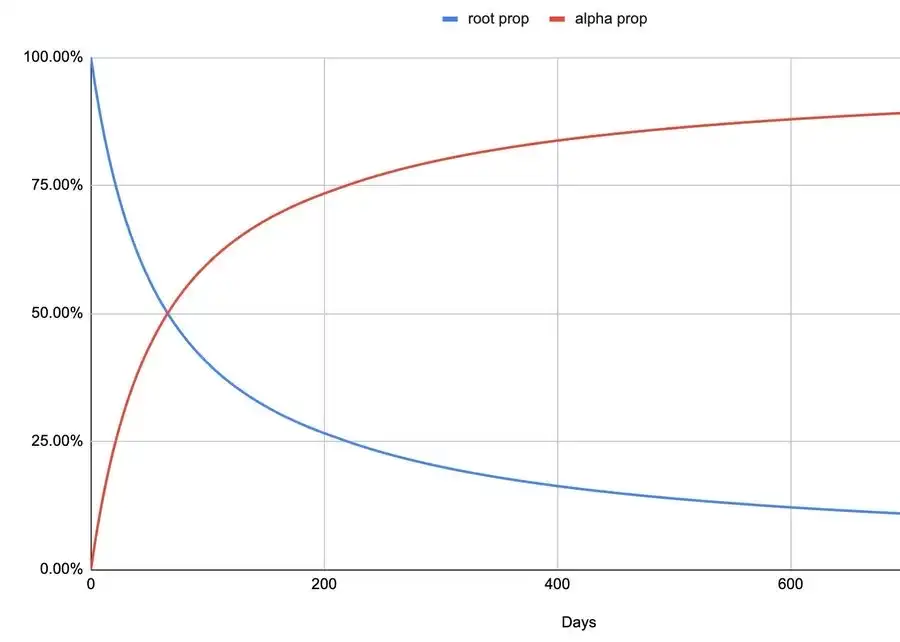
Bittensor is still in the transition period of its issuance mechanism, with control shifting from the old mechanism (SN0 or "root prop") to the new mechanism (dTAO or "alpha prop").
More than just a meme coin, Bittensor could become a generalized incentive network
Even if we assume that in a bear market environment, people will not rush into meme coins, there is still a high probability that Bittensor will become a completely AI-unrelated "generalized incentive network."
For example: If someone launches a decentralized subnet for Bitcoin mining (this concept is not new), it can incentivize a more efficient BTC mining method, then use the mined BTC to continuously repurchase SN tokens, thereby gaining TAO emission.
If this pattern holds, TAO will transition from a decentralized AI project to a broad incentive project. TAO emission will no longer be used to drive AI development but will instead become a subsidy mechanism for various operational costs (OpEx).
Technically, this is not inherently wrong because the Yuma consensus mechanism is designed to achieve consensus on "subjective" work and is not necessarily limited to AI. However, without a clear goal, the entire network may become... meaningless.
Epilogue: Cracks in the dTAO Mechanism Are Already Showing
The dTAO mechanism has only been live for 1 month, and issues have already surfaced.
According to the incentive logic of a free market, without centralizing forces intervening, Bittensor may no longer be an AI project but rather an "attention network" dominated by meme coin subnets or transform into a broad incentive network where various enterprises use TAO emission subsidies for operational costs without driving the development of the Bittensor ecosystem.
I believe Bittensor needs a true "objective function" to align all subnets in the same direction. However, the issue lies in the difficulty of defining an absolute goal in the AI field (AGI?). As we have seen, even the LLM evaluation framework is challenging to make completely fair... That is also why the Yuma consensus mechanism was initially designed to achieve consensus on "subjective" work.
"Tell me the incentive mechanism, and I can tell you the outcome." Peace!
You may also like

Perp DEX: The Next Generation Exchange "War"

10 Counterintuitive Insights on Latin American Payments

The AI gamble of mining companies: Valuations enter a phase of differentiation, and it's hard to turn the tide

A letter from Alliance to entrepreneurs: Written on the occasion of Cursor selling for 60 billion dollars

Stablecoins Finally Find Real Returns: On-Chain Reinsurance Re Explained | Interview with Re Founder Karan Saroya

The impossible triangle is simply a pseudo problem

Will MicroStrategy fall into a death spiral? What will the macro trend be in the second half of the year?

Blockchain Capital Partner: The Core Secret of Arbitrage
STRC unanchored by 11%, can the perpetual motion machine of Strategy still operate?

Bitcoin Market Analysis 2026: Can BTC Reach $150K by Year-End?
Bitcoin ETF Outflows Hit a Record $4.4 Billion: What Are Traders Doing With Their Cash?
WEEX App Just Got Smarter – New Tabs for Faster Trades & Easy Asset Management

WEEX All-New Search Features: Find, Trade & Earn Faster Than Ever

Morning Report | Illinois signs the strictest digital asset tax law in the U.S.; RWA tokenization market size surpasses $43 billion, institutions accelerate the migration of on-chain assets
Full version of the debut Q&A! Federal Reserve Chairman Waller: Sticking to the 2% inflation target, establishing five special working groups, individual did not submit the dot plot

From Disruptor to Shadow Market: The Crypto Market is Becoming a Colony of Traditional Finance
Dalio's important long article: How to position in the current market environment?
OKX Star analyzes Binance's competitive advantages: when regulation levels the playing field, competition has just begun
Perp DEX: The Next Generation Exchange "War"
10 Counterintuitive Insights on Latin American Payments
The AI gamble of mining companies: Valuations enter a phase of differentiation, and it's hard to turn the tide
A letter from Alliance to entrepreneurs: Written on the occasion of Cursor selling for 60 billion dollars
Stablecoins Finally Find Real Returns: On-Chain Reinsurance Re Explained | Interview with Re Founder Karan Saroya
The impossible triangle is simply a pseudo problem


