
 Buy Crypto
- Markets
 Futures
- Spot
- Copy Trade
- Earn
- More
On-Chain Data Analysis: When Will the Next Season of Altcoins Begin?

Original Author: Murphy, On-chain Data Analyst
On-chain Data Evaluation Model - Altseason
One day while I was in class, Xiaochi from @FC_0X0 sent me a message on WeChat saying, "There is a piece of data that shows the scissor difference between the total stablecoin inflow into exchanges and the USD value of withdrawn BTC, indicating the remaining potential buying power and the volatility of altcoins may have a direct relationship. Can we use this logic to explore the timing of altcoin seasons?"
Coincidentally, my lecture also mentioned observing data on the potential conditions of "capital outflow," which aligned with certain high-market-cap altcoins' launch timeframes. However, at that time, it was just a rough outline, vaguely hinting at some overlooked areas...
When I returned, I organized the data and, inspired by Xiaochi's idea, reconsidered a set of visual indicators that can effectively assess the "Altseason." Here, I share my train of thought:
Altseason Condition 1: Capital Outflow Evaluation
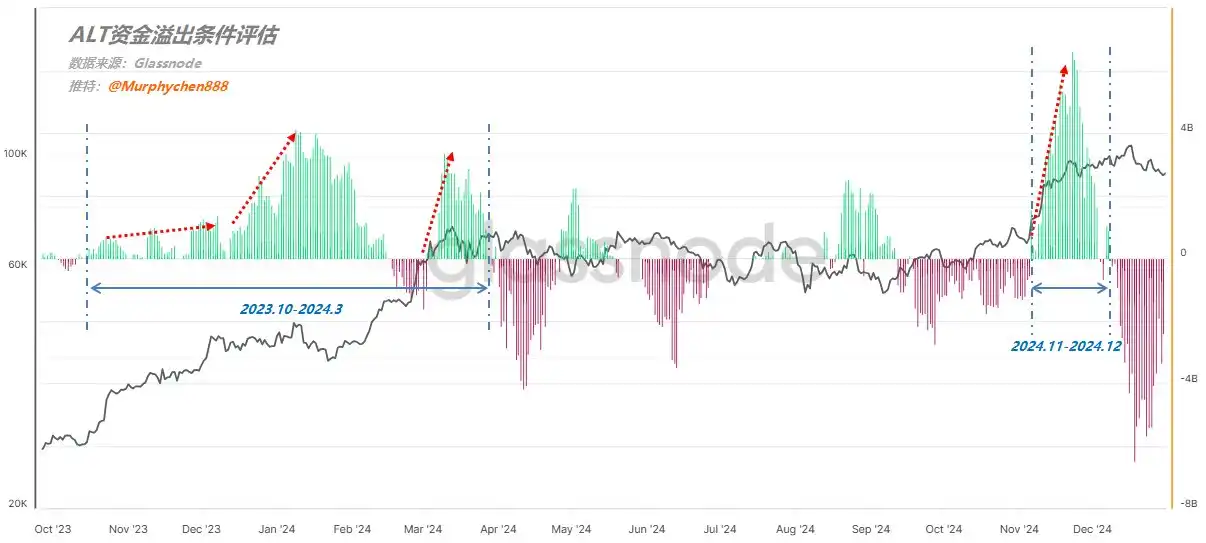
(Chart 1)
In Chart 1, the green color indicates whether the total stablecoin inflow into exchanges in the last 30 days is greater than the USD value of BTC withdrawn from exchanges. If it is, it means that, besides buying BTC, there is also a possibility of outflow into altcoins. The higher the green signal bar, the greater the theoretical outflow value, indicating a stronger prerequisite for the Altseason initiation.
From the data perspective, during the periods of 2023.10-2024.3 and 2024.11-2024.12, the theoretical outflow value was the highest, implying a higher likelihood of the Altseason occurring during these two periods. Additionally, there was a brief period between August and September, but in terms of both scale and duration, it was not as strong as the two aforementioned periods, making its influence relatively weaker.
Altseason Condition 2: Inflow of Mainstream Assets
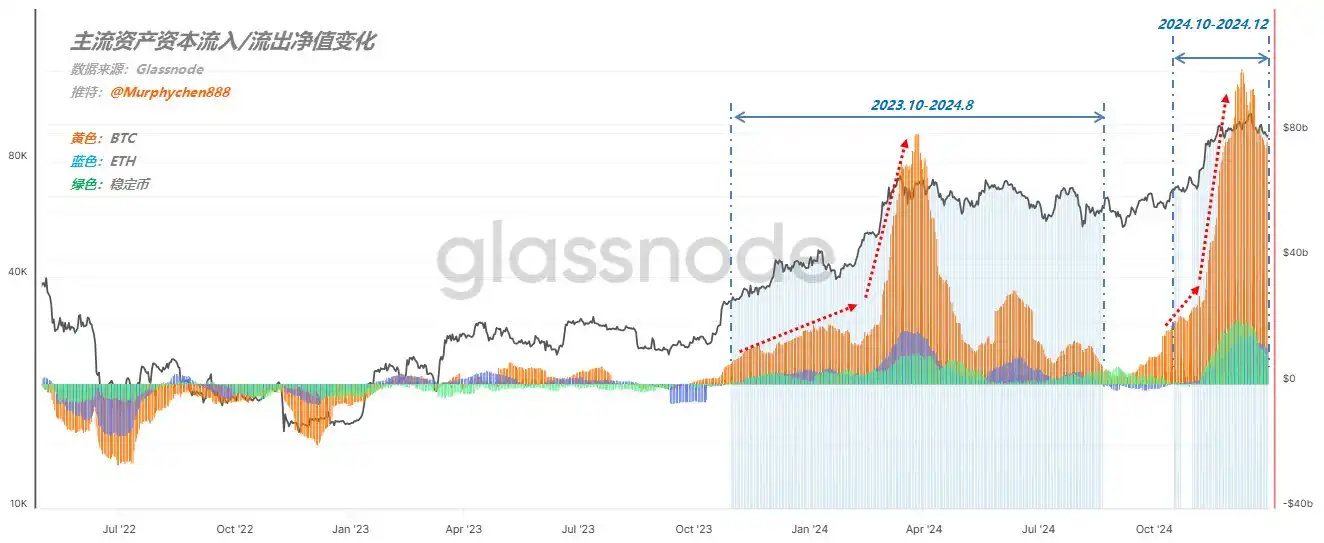
(Chart 2)
Historically, BTC often leads the overall sentiment of the crypto market, followed by market confidence flowing into other high-market-cap mainstream coins before further tilting towards alts. Visualizing this capital rotation involves using the 30-day change in realized market cap of BTC and ETH, along with the total supply of stablecoins (as shown in Chart 2). When all three major mainstream assets experience net capital inflows, it signals that the market sentiment is becoming exuberant, overall risk appetite is rising, which is also one of the macro necessary conditions to kickstart the Altseason.
From the data, it can be seen that during the periods of 2023.10-2024.8 and 2024.10-2024.12, all three major mainstream assets experienced net capital inflows, peaking in March 2024 and December 2024. This is also the most FOMO moment in market sentiment so far in this cycle.
Altcoin Season Indicator 3: Positive Momentum in Altcoin Market Cap Disparity
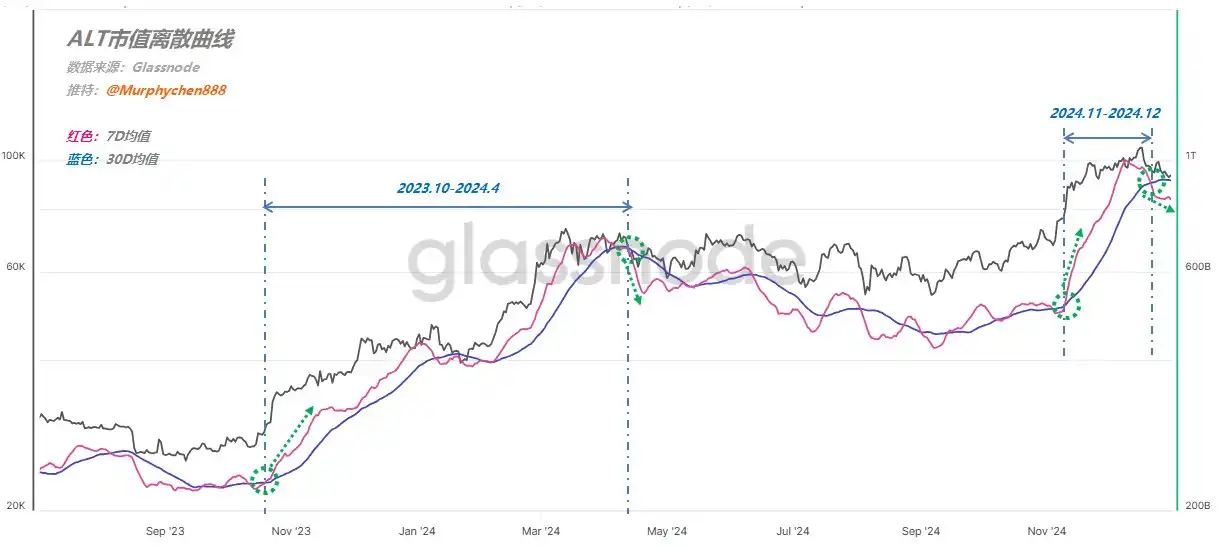
(Figure 3)
The third condition required to determine the start of the altcoin season is the isolation of positive momentum in the disparity of altcoin total market capitalization. We need to identify time periods within the altcoin space where the 7D SMA of total valuation is greater than the 30D SMA of total valuation. Because this can represent an amplification of altcoin valuation in the short term, and liquidity flowing into altcoins is rapidly increasing.
In Figure 3, the red line represents the 7D average, and the blue line represents the 30D average; from the data, during the periods of 2023.10-2024.4 and 2024.11-2024.12, the red line crossed above the blue line, indicating that liquidity in the crypto space is starting to tilt towards altcoins, and altcoin market cap is shifting towards positive momentum growth.
Summary
These three conditions are considered from different perspectives: Condition 1 represents the potential for capital overflow; Condition 2 represents overall sentiment and risk appetite; Condition 3 represents liquidity skew. When all three conditions are met simultaneously, it is highly likely that the altcoin season is approaching.
The current Condition 2 is met, but Conditions 1 and 3 are not; therefore, we can consider that the foundation for the altcoin season is there, but liquidity is still concentrated in mainstream assets (especially BTC), and on-chain funds have not overflowed significantly into altcoins.
However, we can also see that the "negative overflow" in Condition 1 is gradually diminishing, which is a positive signal. Although altcoin season anticipation may require some more patience, what is supposed to happen will happen.
The content shared in this article is for communication and research purposes only and should not be considered as investment advice.
You may also like

What Is RWA? What Is RWA in Crypto (Complete 2026 Guide)
Wondering what is RWA in crypto? We explain what RWA is, break down RWA tokenization in simple no-jargon terms, and cover why it's 2026's hottest crypto narrative.

What Is the KelpDAO Attack? What It Means for Aave Users in 2026
KelpDAO suffered a $292M rsETH exploit on April 18, 2026, triggering Aave market freezes and $13B DeFi outflows. Here’s what happened, whether Aave is safe now, and what users should do next.

Is your gold really "within reach"? The geographical blind spots of custodial services behind tokenized gold

Cook Passes the Baton, Anthropic Gears Up | Rewire News Morning Brief

Will the Fed Cut Interest Rates Again? Tonight's Data Is Key

The person taking over Apple has to do something he has never done before

Why Are You Always Losing Money on Polymarket? Because You're Betting on News, While The Rulebook Favors Insiders

Not a Price Hike, but a Supply Shortage? Oil Price Has Crossed the Threshold

a16z: 5 Ways Blockchain Helps AI Agent Infrastructure

Morning News | The Hong Kong Securities and Futures Commission announced the regulatory framework for secondary market trading of tokenized investment products; Strategy increased its holdings by 34,164 bitcoins last week; KAIO completed a strategic fi...
What Is an XRP Wallet? The Best Wallets to Store XRP (2026 Updated)
An XRP wallet lets you safely store, send, and receive XRP on the XRP Ledger. Learn what wallets support XRP and discover the best XRP wallets for beginners and long-term holders in 2026.

What are the Top AI Crypto Coins? Render vs. Akash: 5 Gems Solving the 2026 GPU Crisis
What are the best AI crypto coins for the 2026 cycle? Beyond the hype, we analyze top tokens like RNDR, AKT, and FET that provide real-world solutions to the global GPU shortage and the rise of autonomous agents.

What Is a Token in AI? What Is an AI Token + 3 Gems You Can't Miss in 2026
The era of AI hype has transitioned into an era of utility. As we move through Q2 2026, the market is no longer rewarding "narrative-only" projects. At WEEX Research, we are seeing a massive capital rotation into Decentralized Compute (DePIN) and Autonomous Agent coordination layers. This guide analyzes which AI tokens are capturing institutional liquidity and how to spot high-conviction setups in a maturing market.
Consumer-grade Crypto Global Survey: Users, Revenue, and Track Distribution

Prediction Markets Under Bias

Stolen: $290 million, Three Parties Refusing to Acknowledge, Who Should Foot the Bill for the KelpDAO Incident Resolution?

ASTEROID Pumped 10,000x in Three Days, Is Meme Season Back on Ethereum?

ChainCatcher Hong Kong Themed Forum Highlights: Decoding the Growth Engine Under the Integration of Crypto Assets and Smart Economy
What Is RWA? What Is RWA in Crypto (Complete 2026 Guide)
Wondering what is RWA in crypto? We explain what RWA is, break down RWA tokenization in simple no-jargon terms, and cover why it's 2026's hottest crypto narrative.
What Is the KelpDAO Attack? What It Means for Aave Users in 2026
KelpDAO suffered a $292M rsETH exploit on April 18, 2026, triggering Aave market freezes and $13B DeFi outflows. Here’s what happened, whether Aave is safe now, and what users should do next.


 App
App