
 Buy Crypto
- Markets
 Futures
- Spot
- Copy Trade
- Earn
- More
November Web3 Funding Recap: Total Funding Reaches $2.1 Billion, AI Sector Emerges as the Biggest Winner

Original Article Title: November 2024: Web3 Fundraising Snapshot
Original Article Author: Cheeky Rolo
Original Article Translation: Deep Tide TechFlow
Comment from @cheeky_rolo:
In last month's Web3 fundraising snapshot, I mentioned that Venture Capitalists (VCs) usually "scale back operational activities" in the last two months of the year. Looking back at that statement, I feel that I may not have accurately conveyed my meaning. "Scale back operational activities" can be interpreted in two ways:
1. It may imply that the year-end is very busy, focusing on dealing with long-pending transactions to make work clearer and more organized at the start of the new year;
2. It may also mean a reduction in workload, with a more relaxed pace.
According to Carta's data, November and December are actually the busiest months of the year in terms of transaction volume, busier than most other months. However, this trend does not seem to apply to the Web3 space. From the data we have, Web3 venture capital does not exhibit a similar end-of-year behavior of completing transactions. Specifically for November 2024, we did not see a significant increase in transaction volume. I will explore this further in future articles.
Additionally, the data for November 2024 also indicates that cryptocurrency market volatility does not have a direct impact on early-stage startup funding. As mentioned in previous months, following Bitcoin's All-Time High (ATH), there tends to be a significant lag in the inflow of venture capital funds. The performance in November 2024 has been relatively lackluster, and I do not expect much improvement by the end of the year.
Web3 Market Overview: Financing Status of Companies at Various Stages Since 2018
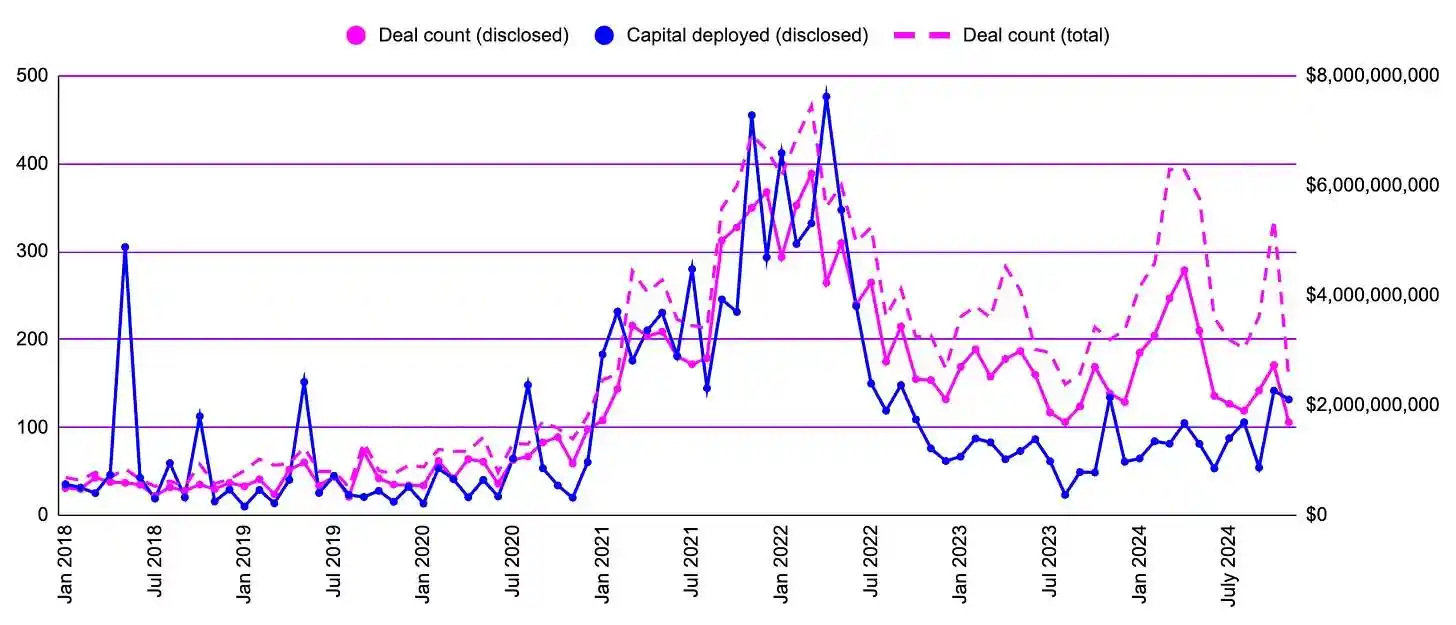
Source: Messari. The data is updated monthly, and there may be slight adjustments to previous months' data (e.g., inclusion of previously unreported funding activities, or removal of duplicate records, etc.).
Key Data for November 2024:
· The disclosed total funding amount is $2.1 billion, distributed across 106 projects, showing only a slight decrease compared to the previous month.
The total number of transactions is 156, only half of the total transactions in October 2024. Based on this, we can estimate that the total funding amount for all stages is approximately $31 billion.
· Year-to-date in 2024, the disclosed total funding amount is $15.8 billion, involving 1,927 projects.
The total number of transactions is 3,033, with an expected total annual funding amount of $25.4 billion.
Crypto Venture Capital Fund Launches Since 2022:
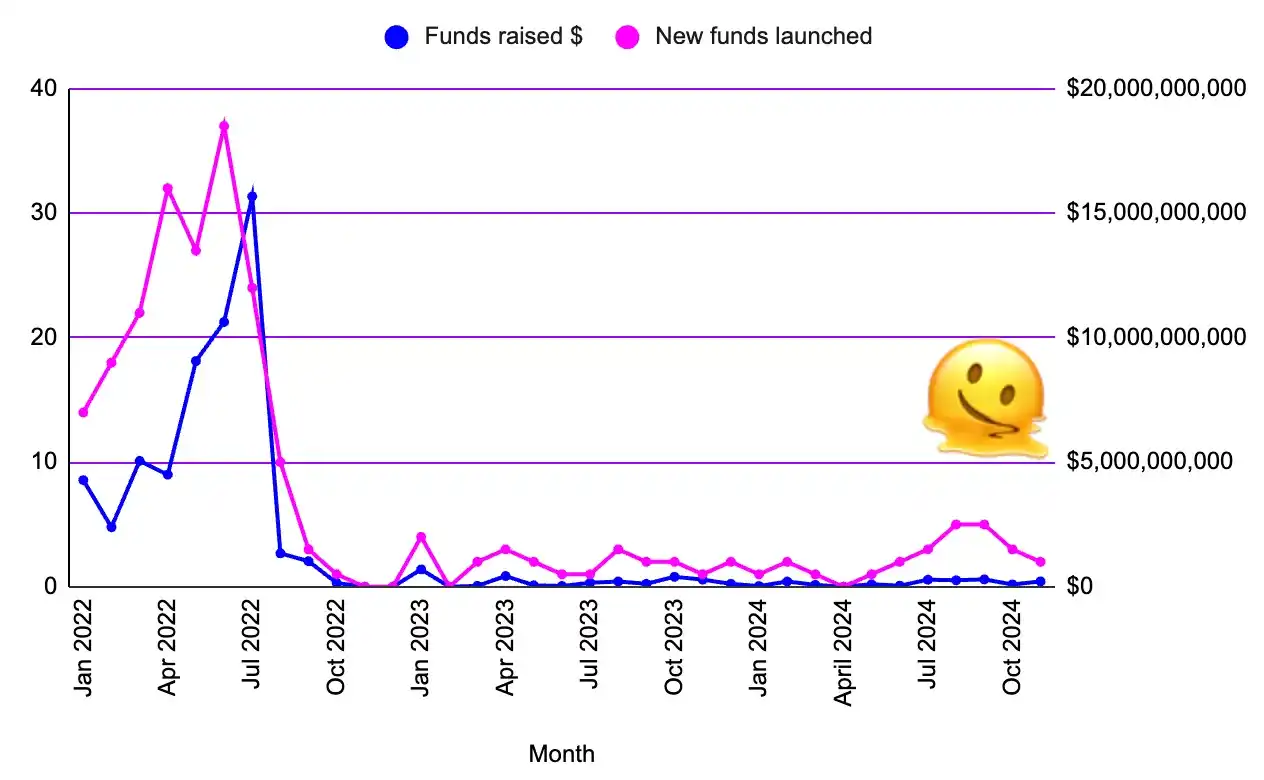
Two funds launched, raising a total of $215 million:
· Portal VC launched a $75 million fund: exclusively investing in a single founder in each category, focusing on Bitcoin programmability, decentralized physical infrastructure network (DePIN), and Maximally Extractable Value (MEV) business models.
· Accolade Partners raised $135 million through two investment vehicles.
Seed Pre-Stage Web3 Funding Data Since 2018
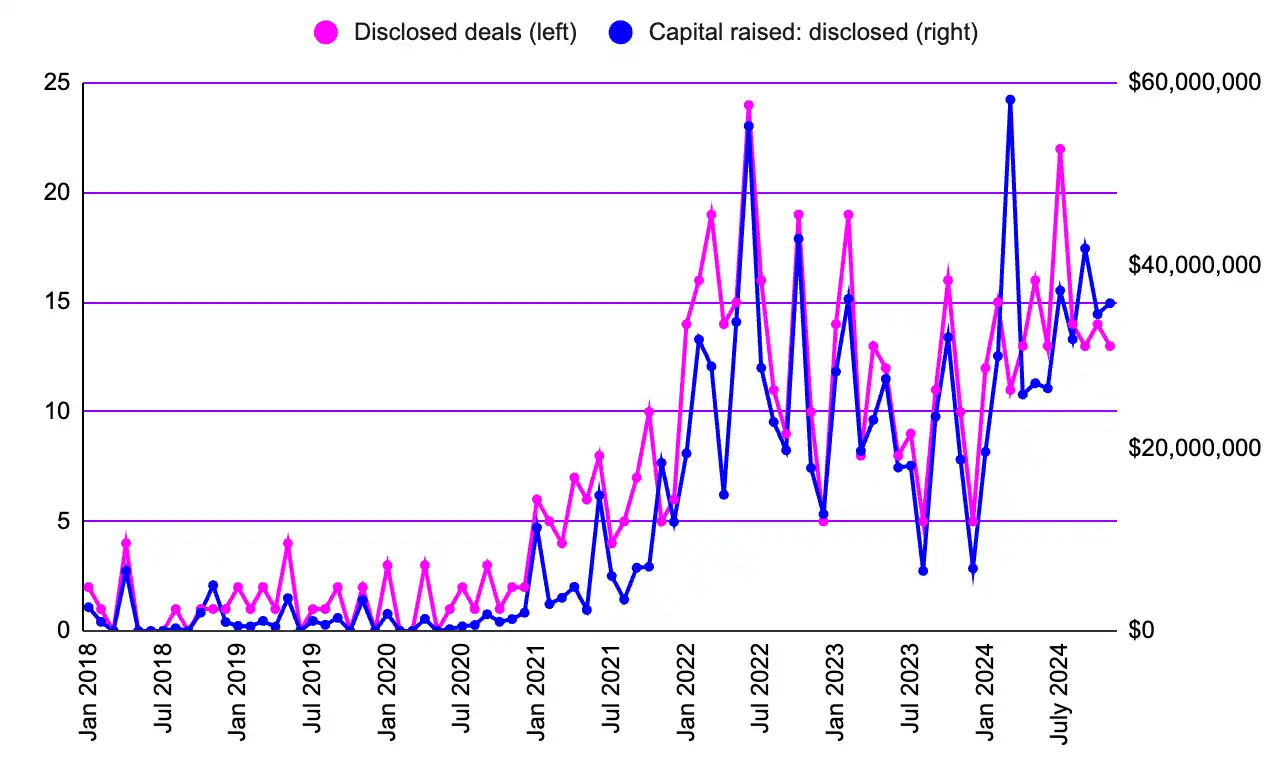
· The disclosed funding amount is $36 million, distributed across 13 seed pre-stage funding activities.
The total number of transactions is 13, lower than the 18 transactions in October 2024.
· The average funding size for this month's seed pre-stage is $2.7 million.
Since 2018, the average funding size for seed pre-stage companies has been $1.6 million.
Market Highlights for This Month:
· vlayer secured a $10 million seed pre-funding round, backed by top-tier VCs and industry builders, significant for the Web3 ecosystem as it addresses a key challenge of Web3: connecting blockchain with real-world systems through verifiable data.
· vlayer introduced four groundbreaking Solidity functions—Time Travel, Teleport, zkTLS (Web Proof), and zkEmail (Email Proof)—enhancing Ethereum's capabilities, enabling smart contracts to seamlessly interact with on-chain and off-chain data. By leveraging advanced encryption technologies like Zero Knowledge Proofs (ZKPs) and Multi-Party Computations (MPC), vlayer aims to make decentralized applications (dApps) more robust, scalable, and impactful, paving the way for broader adoption and real-world applications.
Seed Round Web3 Funding Data Since 2018
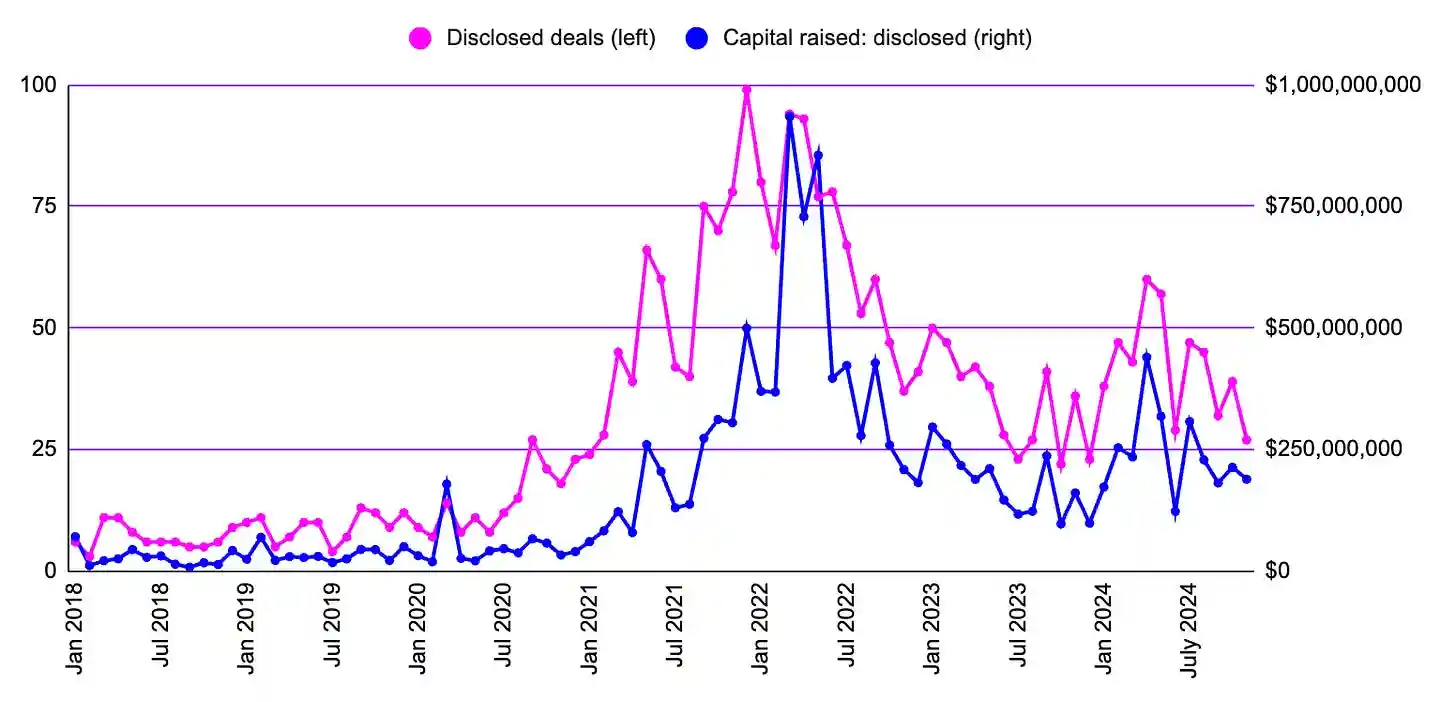
· In November 2024, the total amount raised in seed rounds was $189 million, a decrease of 11% from the previous month, involving 27 seed-stage companies (disclosed).
The total number of transactions was 33, down from 43 in October; the total seed round funding for this month is estimated to be around $231 million.
· The average funding amount for seed rounds this month was $7 million.
Since 2018, the average funding amount for seed round companies has been $4.6 million.
Key Market Highlights This Month:
· 0G Labs completed a total of $290 million in funding, including $40 million in seed round funding and a $250 million token purchase commitment. This milestone funding marks the accelerated development of the convergence of blockchain and AI, bringing a significant breakthrough to the Web3 ecosystem.
· 0G Labs is developing a decentralized AI Operating System (dAIOS), combining scalability, privacy, and verifiability, aiming to redefine AI as a public good, making it more inclusive and censorship-resistant. Its technical innovations include a data availability layer supporting data processing speeds of up to 50GB/s and a decentralized AI service marketplace that greatly enhances the efficiency of AI and blockchain integration. This funding not only addresses critical bottlenecks in current AI and blockchain integration but also demonstrates investors' high confidence in decentralized AI solutions. With this breakthrough, 0G Labs is poised to become a leader in the next wave of Web3 innovation.
Series A Round Web3 Funding Data Since 2018
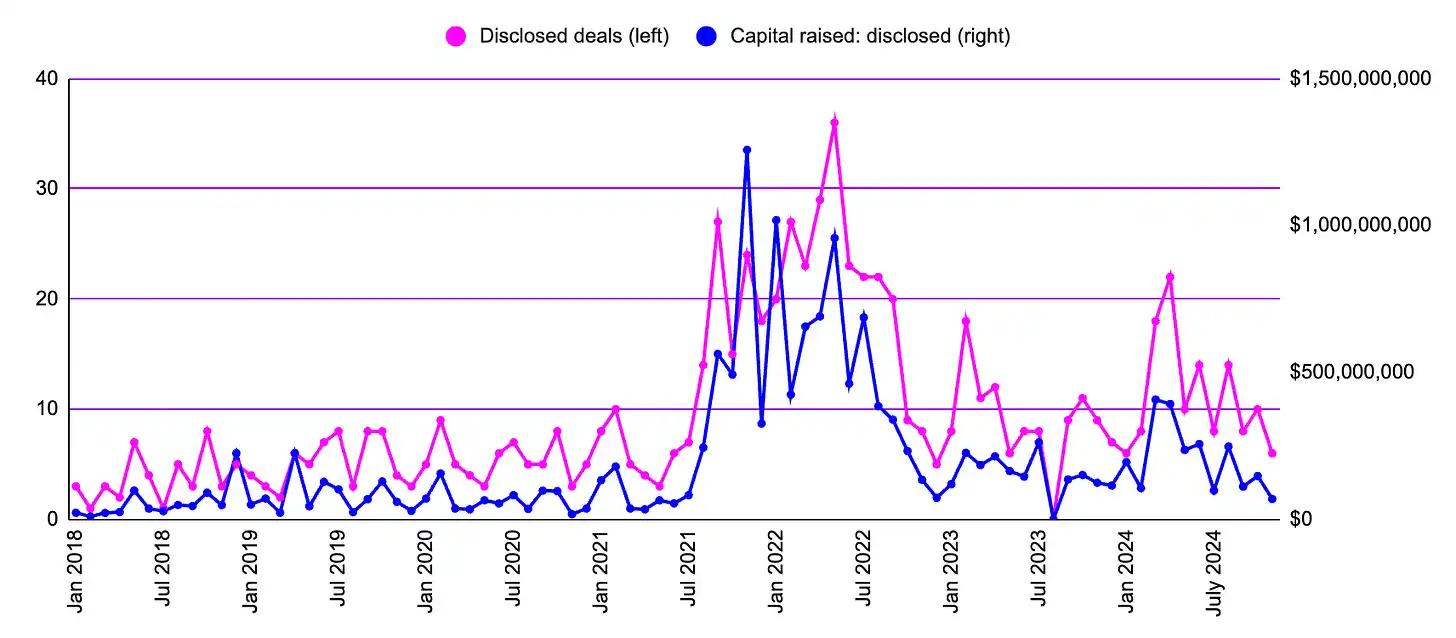
· In November 2024, the total amount raised in Series A rounds was $69.5 million, involving 6 Series A stage companies (disclosed).
· The average funding amount for Series A rounds this month was $11.5 million.
Since 2018, the average funding amount for Series A companies has been $17.5 million.
Key Market Highlights This Month:
· Monkey Tilt has completed a $30 million Series A funding round, reflecting the growing trend of the integration of entertainment, gaming, and Web3 technology, while showcasing the potential of blockchain technology platforms to reshape traditional industries.
· The Monkey Tilt platform, through integrating a multi-currency crypto payment system, immersive social features, and collaborations with culturally relevant brands and influencers, is redefining online gambling as a more interactive and community-driven experience. The platform focuses on combining traditional casino games, sports betting, and cryptocurrency technology, demonstrating how Web3 is opening up new use cases for the entertainment industry and attracting mainstream audiences. In this way, Monkey Tilt is not only advancing the adoption of decentralized technology but also injecting a fresh vitality into the entertainment industry.
You may also like

ChainCatcher Hong Kong Themed Forum Highlights: Decoding the Growth Engine Under the Integration of Crypto Assets and Smart Economy

Why can this institution still grow by 150% when the scale of leading crypto VCs has shrunk significantly?

Anthropic's $1 trillion, compared to DeepSeek's $100 billion

Geopolitical Risk Persists, Is Bitcoin Becoming a Key Barometer?

Annualized 11.5%, Wall Street Buzzing: Is MicroStrategy's STRC Bitcoin's Savior or Destroyer?

An Obscure Open Source AI Tool Alerted on Kelp DAO's $292 million Bug 12 Days Ago

Mixin has launched USTD-margined perpetual contracts, bringing derivative trading into the chat scene.
The privacy-focused crypto wallet Mixin announced today the launch of its U-based perpetual contract (a derivative priced in USDT). Unlike traditional exchanges, Mixin has taken a new approach by "liberating" derivative trading from isolated matching engines and embedding it into the instant messaging environment.
Users can directly open positions within the app with leverage of up to 200x, while sharing positions, discussing strategies, and copy trading within private communities. Trading, social interaction, and asset management are integrated into the same interface.
Based on its non-custodial architecture, Mixin has eliminated friction from the traditional onboarding process, allowing users to participate in perpetual contract trading without identity verification.
The trading process has been streamlined into five steps:
· Choose the trading asset
· Select long or short
· Input position size and leverage
· Confirm order details
· Confirm and open the position
The interface provides real-time visualization of price, position, and profit and loss (PnL), allowing users to complete trades without switching between multiple modules.
Mixin has directly integrated social features into the derivative trading environment. Users can create private trading communities and interact around real-time positions:
· End-to-end encrypted private groups supporting up to 1024 members
· End-to-end encrypted voice communication
· One-click position sharing
· One-click trade copying
On the execution side, Mixin aggregates liquidity from multiple sources and accesses decentralized protocol and external market liquidity through a unified trading interface.
By combining social interaction with trade execution, Mixin enables users to collaborate, share, and execute trading strategies instantly within the same environment.
Mixin has also introduced a referral incentive system based on trading behavior:
· Users can join with an invite code
· Up to 60% of trading fees as referral rewards
· Incentive mechanism designed for long-term, sustainable earnings
This model aims to drive user-driven network expansion and organic growth.
Mixin's derivative transactions are built on top of its existing self-custody wallet infrastructure, with core features including:
· Separation of transaction account and asset storage
· User full control over assets
· Platform does not custody user funds
· Built-in privacy mechanisms to reduce data exposure
The system aims to strike a balance between transaction efficiency, asset security, and privacy protection.
Against the background of perpetual contracts becoming a mainstream trading tool, Mixin is exploring a different development direction by lowering barriers, enhancing social and privacy attributes.
The platform does not only view transactions as execution actions but positions them as a networked activity: transactions have social attributes, strategies can be shared, and relationships between individuals also become part of the financial system.
Mixin's design is based on a user-initiated, user-controlled model. The platform neither custodies assets nor executes transactions on behalf of users.
This model aligns with a statement issued by the U.S. Securities and Exchange Commission (SEC) on April 13, 2026, titled "Staff Statement on Whether Partial User Interface Used in Preparing Cryptocurrency Securities Transactions May Require Broker-Dealer Registration."
The statement indicates that, under the premise where transactions are entirely initiated and controlled by users, non-custodial service providers that offer neutral interfaces may not need to register as broker-dealers or exchanges.
Mixin is a decentralized, self-custodial privacy wallet designed to provide secure and efficient digital asset management services.
Its core capabilities include:
· Aggregation: integrating multi-chain assets and routing between different transaction paths to simplify user operations
· High liquidity access: connecting to various liquidity sources, including decentralized protocols and external markets
· Decentralization: achieving full user control over assets without relying on custodial intermediaries
· Privacy protection: safeguarding assets and data through MPC, CryptoNote, and end-to-end encrypted communication
Mixin has been in operation for over 8 years, supporting over 40 blockchains and more than 10,000 assets, with a global user base exceeding 10 million and an on-chain self-custodied asset scale of over $1 billion.

$600 million stolen in 20 days, ushering in the era of AI hackers in the crypto world
Vitalik's 2026 Hong Kong Web3 Summit Speech: Ethereum's Ultimate Vision as the "World Computer" and Future Roadmap
On the same day Aave introduced rsETH, why did Spark decide to exit?
Full Post-Mortem of the KelpDAO Incident: Why Did Aave, Which Was Not Compromised, End Up in Crisis Situation?

After a $290 million DeFi liquidation, is the security promise still there?
ZachXBT's post ignites RAVE nearing zero, what is the truth behind the insider control?

Vitalik 2026 Hong Kong Web3 Carnival Speech Transcript: We do not compete on speed; security and decentralization are the core
In-depth Analysis of RAVE Events: Short Squeeze, Crash, and Quantitative Financial Models of Liquidity Manipulation

Eve of Ceasefire, US Military Fires on Iranian Vessel | Rewire News Morning Brief

Figma's stock price drops over 7%, will Claude Design be the terminator?




 App
App