
Market Prediction Fallacy: Is Trading Based on Fact or Rule?

 Prefer us on Google


Original Title: "Prediction Market Plunged into Another Major Controversy: Are You Trading on Fact or Rule?"
Original Author: Asher, Odaily Planet Daily
The prediction market can be said to be the most hotly debated track in the current Web3 discussion.
Prediction trading around macro events, the crypto industry, and even entertainment topics continues to heat up, with the level of discussion and participation constantly rising. However, as the market rapidly develops, some discordant voices have gradually emerged—certain events have deviated from users' expectations based on common sense or "real-world understanding" at settlement, triggering controversies regarding rule design, fairness, and platform credibility.
Recently, the prediction market has seen two consecutive high-controversy events. Below, the Odaily Planet Daily will sort out and discuss them.
Polymarket: U.S. Rescue of American Pilot in Iran Determined as U.S. Invasion of Iran
On April 3, a U.S. F-15E Strike Eagle fighter jet was shot down by the Iranian air defense system in southwestern Iran. Two crew members (one pilot, one weapon systems officer/WSO) parachuted out, with one quickly rescued and the other missing for several days, hiding in the Iranian mountains.
The U.S. military then launched a search and rescue (SAR) operation, involving armed aircraft, helicopters, etc., and successfully rescued the second severely injured crew member (Trump personally announced "WE GOT HIM"). The rescue operation involved U.S. military entering Iranian territory (mountain search and rescue, possible ground or low-altitude operations), which raised concerns against the current backdrop of sensitive geopolitical conflicts.
As the U.S. military entering Iranian territory can be considered to some extent as a U.S. invasion of Iran, it directly affected the prediction event on the Polymarket platform regarding when the U.S. military would invade Iran (US forces enter Iran by?).
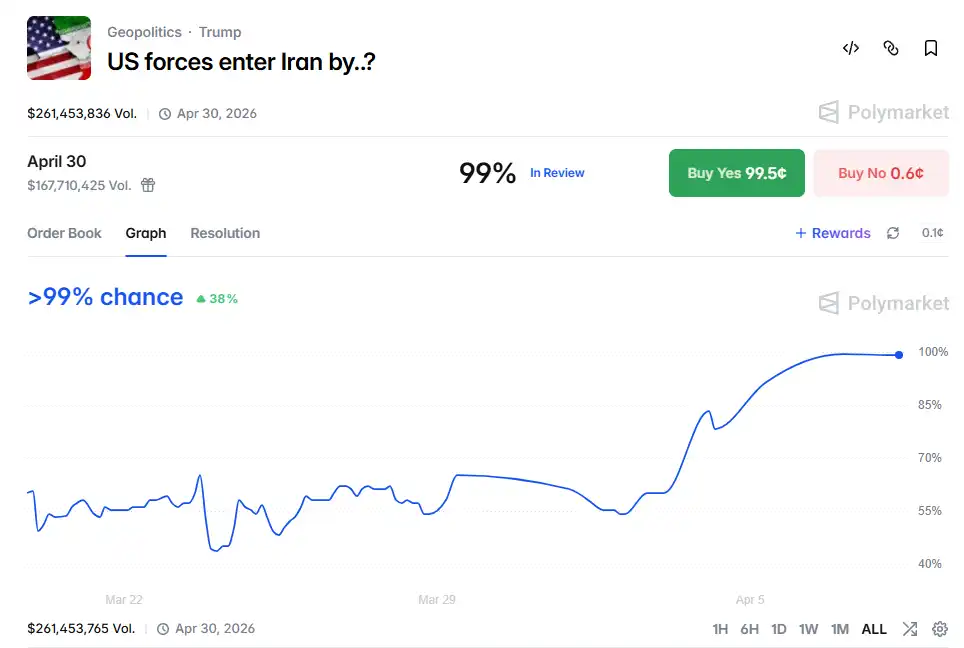
According to the settlement rules, active-duty U.S. military personnel (including special operations forces) entering Iranian land territory before a specified date would be considered an invasion, with the downed pilot not counting as an invasion, but U.S. special forces did indeed enter Iranian territory to rescue the pilot. Therefore, the special forces entering Iran to rescue the pilot met the standard for determining the U.S. invasion of Iran as Yes on Polymarket.
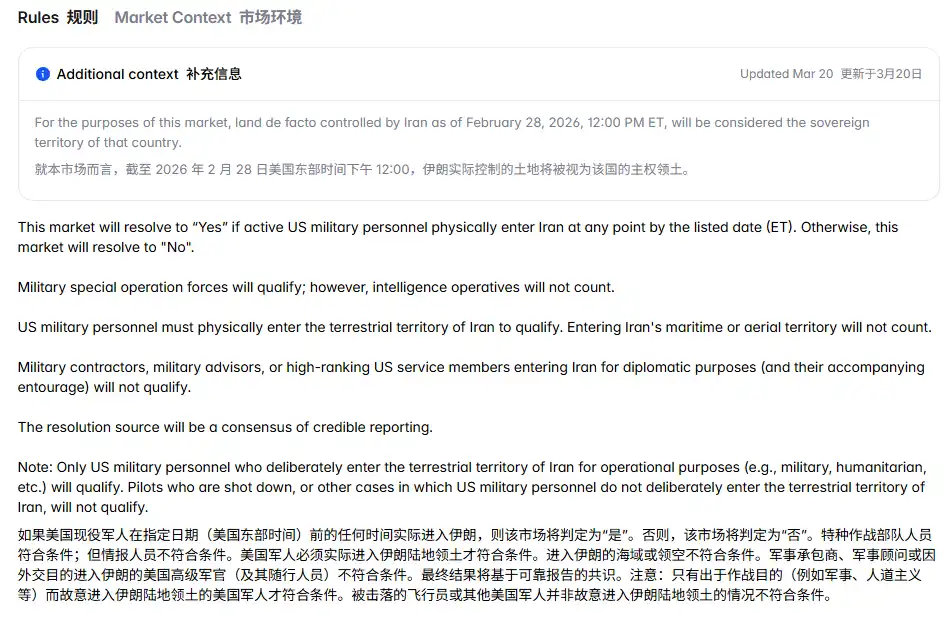
The "Pilot Rescue" event has been judged by Polymarket as the U.S. invasion of Iran, sparking strong community controversy.
Supporters of the "Count as Entry" (Yes side) believe that this action meets the definition of "entry" as per the rules. The U.S. Special Forces actively entered Iranian territory to carry out a mission, and the rules explicitly state that "special operation forces will qualify," including "for operational purposes (including humanitarian)." From an objective standpoint, this is the first confirmed U.S. ground penetration behavior in the current conflict context, with U.S. personnel indeed stepping on Iranian soil, hence should be considered an "entry."
Opponents of the "Count as Entry" (No side) argue that this definition is overly broad. They believe that this action was essentially a short-term, limited humanitarian rescue operation, not an invasion or occupation, and does not align with the general understanding of the public regarding "U.S. troops entering Iran."
Furthermore, the rules explicitly exclude that "pilots who are shot down... will not qualify," and this action revolves around the downed pilot, having the nature of "forced entry," which logically should fall into a similar exception category. Referring to past cases (such as similar regional actions not being considered invasions), rescue actions should not be equated with military entry; if judged as Yes, it may encourage marginal interpretations of the rules, weakening the seriousness and consistency of the market.
The Chinese community also generally believes that "entering Iran" should more specifically refer to large-scale ground or amphibious operations, rather than short-term actions of "rescue and leave."
Predict.fun: Polymarket Issuing Stablecoin Deemed as Token Launch
On the evening of April 6, Polymarket officially announced on X that it would undergo a comprehensive platform upgrade:
Rebuilding the trading engine, upgrading smart contracts; introducing a new native collateral token, Polymarket USD (1:1 pegged to USDC, to replace USDC.e, reducing bridging risks).
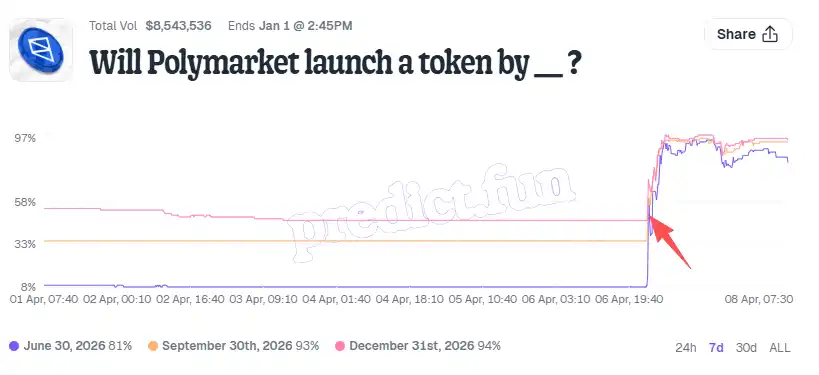
Notably, the second point mentioned the launch of the native collateral token Polymarket USD, directly impacting the probabilities of two related prediction events on Predict.fun.
One is token launch; the other is post-launch market cap:
1. When will Polymarket launch a token (Will Polymarket launch a token by ___ ?).
2. One day after opening, what was the FDV of Polymarket (Polymarket FDV above ___ one day after launch?)?
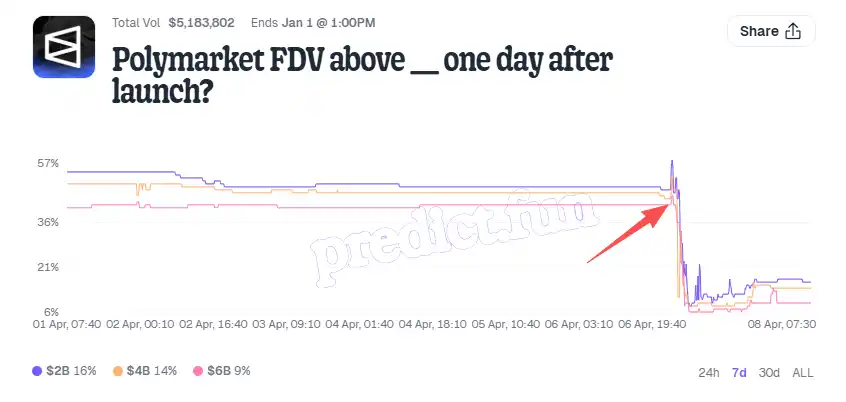
According to the settlement rules document, it is clearly stated that "any fungible token issued by Polymarket counts as 'issuance' for this event," and stablecoins are no exception. Therefore, Polymarket's stablecoin meets the criteria to be judged as Yes.
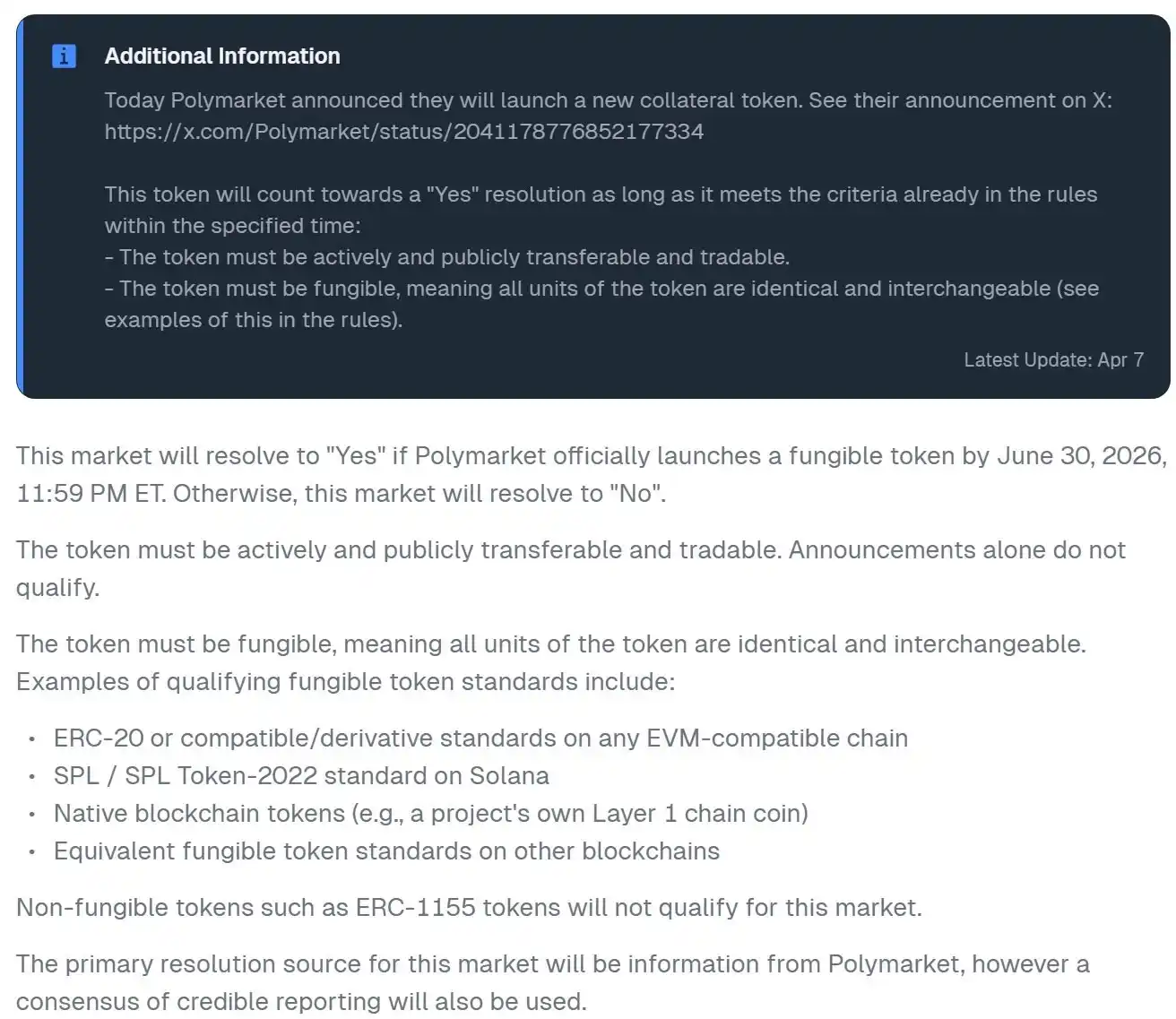
Settlement Rules Explanation
The community has engaged in a debate on this matter.
Supporters argue that based on the literal interpretation of the rules, "token issuance" is not limited to being a "governance token," but is a general reference to all tokens. Under this premise, Polymarket USD, as an ERC20/SPL fungible token issued by Polymarket, fundamentally meets the definition of "issuance." Furthermore, subsequent official clarifications are more of a reiteration of the original rules rather than a temporary rule change, making them somewhat reasonable in terms of compliance.
However, skeptics do not accept this explanation. On the one hand, they believe that including stablecoins in the category of "issuance" is an overinterpretation of the rules and a typical play on words. On the other hand, even if stablecoins are considered "issuance," the core of this prediction market is still the "Polymarket FDV," not the "Polymarket USD FDV." Stablecoins serve more as collateral or settlement tools, and their market value structure differs fundamentally from that of the project's native token (such as the POLY governance token), so they should not be directly equated or substituted for the overall project valuation logic.
Whose Side Are You On?
Overall, the controversial event in the prediction market actually revolves around a central question: are you betting on "reality" or on "rules"? Many times, these two do not completely overlap.
For those of us involved in prediction markets, understanding the rules themselves may be more important than predicting the outcome. How the information source is defined, whether there are any exceptions, whether there is room for interpretation—these details can directly determine the outcome at critical moments.
It is also for this reason that some high-probability events that appear to be a "financial management trap" may not be without risk, but may instead be a potential "loss trap." Many reversals occur precisely in these overlooked details. Instead of blind betting, take a closer look at the rules. It is more useful to do so than to complain after losing money.
Disclaimer: This content is provided for general branding and informational purposes only and doesn't constitute financial, investment, legal, or tax advice. Any events, rewards, online events, or related information mentioned herein should not be considered a recommendation, solicitation, or invitation to purchase, sell, trade, or otherwise deal in any crypto assets or to use any services. Crypto assets are highly volatile and may result in loss. WEEX services and online events may not be available in all regions and are subject to applicable laws, regulations, and eligibility requirements. You are responsible for ensuring that your use of WEEX services complies with local laws and for carefully assessing the risks before participating in any crypto-related activities.
You may also like
HSBC Sells Insurance in Singapore for $2.1 Billion: What Changes

Dellepiane Highway to Close for 24 Hours for New Pedestrian Bridge Construction
Uniswap Token Jar: Unlocking Protocol Revenue Through Destruction, 11 Chains Have Launched This New Mechanism

Experts: "Banks are already preparing for a new era, and XRP may benefit the most"
$30,000 Investment Yields Only One User? The Decline of Influencer Marketing in Crypto

Multi-Chain Market: The Crypto Revolution That Surpasses Bitcoin Maximalism

Bitfinex completes El Salvador licence set across three markets
Brazil tokenizes cows as collateral in first B3 credit deal
Where Are the Arbitrage Opportunities in On-Chain Stock Perpetual Contracts?

Oil Alert: The Risk of a Major Spike Grows Due to the Crisis in the Middle East
Two weeks until SPiCE Southeast Asia 2026: Speakers share what’s to come

ETF: AI Attracts Billions from Wall Street as Crypto Changes Tracks

Ledger Hedging and New Stablecoin Path: In-Depth Analysis of Stripe's $53 Billion Acquisition of PayPal
Philippines’ BPI tests stablecoin rail for overseas remittances

South Korea's Central Bank Expands CBDC Trials in September! Collaborates with 9 Banks to Open Up to 500,000 Users for 'Deposit Tokens'
Stop Believing in the 4-Year Cycle! Grayscale Research: Bitcoin May Have Hit Bottom, All Eyes on the Fed

HashKey Cloud and BitGo launch institutional staking partnership
Lviv Increases Water Rates: What We Know About the New Tariff

From HBM to Cold Storage: Storage Giants at a Crossroads, What Will Drive the Next Market Cycle?
EU bars Belarusians from owning MiCA regulated crypto firms

Hack of X profile of the CEO of a well-known exchange. Chaos and millions in losses in just a few minutes
Construction costs for housing have surpassed $2.25 million per m2, reaching a record high

Alert on Economic Activity: June Estimated to Remain Under Pressure Following Worse-Than-Expected May

Elvis Arrives on HBO Max: When the Movie About the King of Rock Premieres
AI: Which Companies Are Already Turning the Boom into Profits and Which Still Need to Pass the Market Test
Polymarket Account in Farage Backer's Name Took $9M in Crypto From Unknown Sources: FT

Asian Markets Plunge: What the Tech Crash Signals
Odos shuts down July 30 as DeFi aggregator ends all services

BitMEX shuts down without an FTX style crisis, revealing where crypto’s real danger has moved
Three Major Korean Exchanges Invested by TradFi: Is the Korean Crypto Market Being 'Reined In'?
HSBC Sells Insurance in Singapore for $2.1 Billion: What Changes
Dellepiane Highway to Close for 24 Hours for New Pedestrian Bridge Construction
Uniswap Token Jar: Unlocking Protocol Revenue Through Destruction, 11 Chains Have Launched This New Mechanism
Experts: "Banks are already preparing for a new era, and XRP may benefit the most"
$30,000 Investment Yields Only One User? The Decline of Influencer Marketing in Crypto
Multi-Chain Market: The Crypto Revolution That Surpasses Bitcoin Maximalism

Contents
Latest articles




Latest coin listings on WEEX


