
Lumoz Launches SVM as a Service, Supporting SVM L2 with Integrated ZK and TEE Hybrid Proof

Source: Lumoz
Background
In recent years, the rapid development of blockchain technology has driven innovation in multiple areas such as DeFi, NFTs, and AI. Solana, as a high-speed, low-cost blockchain, has gained widespread attention due to its unique consensus mechanism and high throughput. In large-scale application scenarios, an L2 chain or application chain based on SVM has vast market potential.
Against this backdrop, Lumoz has proposed an innovative SVM chain solution (Lumoz SVM Stack) based on the SVM execution layer, combined with unique ZK and TEE technologies, bringing a fresh perspective to the industry. Through its efficient scaling architecture and optimized algorithms, Lumoz SVM Stack not only provides high transaction throughput and processing speed for the SVM chain but also ensures security and decentralization.
Architecture
Lumoz SVM Stack is a general L2 solution based on the SVM transaction execution layer, adopting a modular architecture that separates various functions into different modules to ensure flexibility and scalability. The architecture consists of multiple core layers: supporting Ethereum and Solana as settlement layers, Celestia, Avail, among others, as data availability layers, and supporting various types of proofs such as SP1 and SGX. These designs, combined with the SVM execution environment, form an efficient and customizable modular Layer 2 solution. Ultimately, the vision of Lumoz SVM Stack is to become the world's fastest and most versatile SVM-driven Layer 2 solution.
Solana lacks a global state tree, which is crucial for ensuring that off-chain execution results can be securely settled back to Layer 1. To address this issue, Lumoz combines the fundamental function of a global state tree with a Sparse Merkle Tree (LSMT), using cryptographic techniques to verify off-chain execution results on the network extension to ensure the security and consistency of on-chain and off-chain operations. This innovative solution not only enhances Lumoz's advantages in scalability and security but also provides a more reliable cross-chain execution mechanism for the blockchain ecosystem.
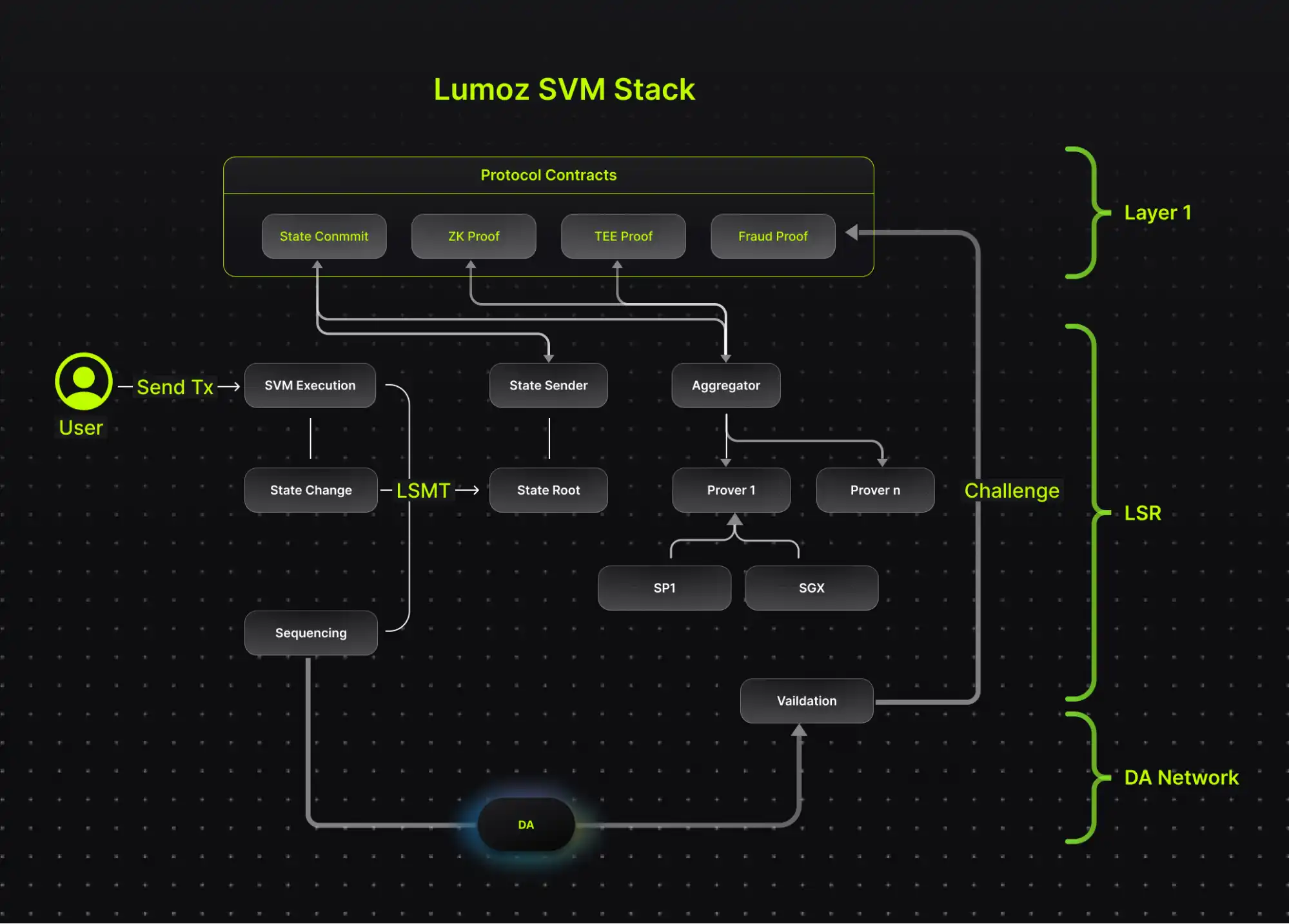
Lumoz SVM Stack is built on the Solana Agave client's code, ensuring compatibility with the Solana mainnet while leveraging Solana's parallel execution capabilities and unique transaction data structure. Through optimization of storage logic and performance parameters, Lumoz SVM Stack maximizes Solana's native performance advantages, further enhancing the system's efficiency and scalability.
The current architecture design allows existing dApps in the Solana ecosystem to seamlessly migrate to the Lumoz SVM Stack network without any modification to the program code. This solution not only reduces the required resources and costs but also maintains consistency with Solana's tools and developer stack, providing developers with lower migration costs and higher development efficiency.
Key Components of the Architecture
· Shared Sorter: The Lumoz SVM Stack adopts a decentralized and transparent transaction sorting approach, ensuring the efficiency and trustworthiness of network scalability. In terms of security, speed, and decentralization, Lumoz SVM Stack exhibits significant advantages. The shared sorter processes multiple transactions in batches, reducing the number of individual transactions the base layer needs to handle, thereby greatly increasing the system's throughput and capacity. Additionally, the Lumoz SVM Stack also provides robust support for transaction sorting, enhancing overall performance.
· Stateless Validator: The stateless validator contract of the Lumoz SVM Stack decomposes the full validation task into small chunks and distributes these tasks to the validator network. Through this design, the Lumoz SVM Stack significantly reduces the hardware requirements of participants, making it easier for nodes to join or exit the network without needing access to the full blockchain state. This not only enhances the system's flexibility but also lowers the entry barriers, promoting more participation of nodes.
· Data Availability: While Solana has strict limits on transaction size, which may pose a challenge for aggregation-based Data Availability (DA) solutions, the Lumoz SVM Stack overcomes the limitations of Solana's native DA solution by extending the DA solution. This design ensures the security and decentralization of data management while retaining the ability to conduct data audits on Solana, ensuring the blockchain's auditability and transparency.
Key Technologies
SVM Compatibility and Parallel Efficient Execution
Solana's SVM (Solana Virtual Machine) is an efficient smart contract execution environment that, with its parallel transaction processing and state-independent design, can execute multiple transactions simultaneously, significantly increasing throughput and reducing latency. SVM supports programming languages like Rust and C, allowing developers to easily build high-performance decentralized applications, driving the rapid development of the Solana ecosystem.
It is worth emphasizing that SVM's parallel execution relies on Solana's unique transaction data structure. In the Solana network, the initiator of each transaction pre-declares the account information to be read from and written to. This design allows SVM to process transactions efficiently in a parallel order based on this account information, ensuring that different transactions do not simultaneously perform read or write operations on the same account. Therefore, simply grafting SVM onto another execution framework does not bring the advantage of parallel processing.
Based on this principle, we have chosen to use the Solana Client as the underlying execution framework to fully leverage SVM's parallel execution advantage, ensuring efficient transaction processing and low-latency performance throughout the system.
Support for Multiple Proofs
Lumoz supports a powerful multi-proof pipeline that can transform assembly-level instructions from different execution clients into arithmetic of algebraic proof systems. This pipeline design enables Lumoz to not only use various backends such as SuperNova, Halo2, and eSTARK to encode arithmetic but also break free from reliance on a single protocol, providing greater flexibility and scalability.
In addition to ZK proofs, Lumoz innovatively leverages SGX to achieve a Trusted Execution Environment (TEE) that generates different types of proofs. The code executed by SGX is the same as the code executed on zkVM, acting similarly to a lightweight execution client. This ensures that all proof systems can verify the same underlying lightweight client execution, enabling potential data reuse. In the SGX environment, necessary data is signed using standard ECDSA signatures, and the signing process is completed using SGX's dedicated private key. The Trusted Execution Environment (TEE) guarantees the confidentiality and integrity of the computation and verifies it through remote attestation.
TEE: Using an Intel SGX CPU, Intel® Software Guard Extensions (SGX) are a set of security-related instructions built into certain Intel CPUs to enable TEE. By using an SGX chip, the chip owner, system operator, and observer gain strong cryptographic assurances, ensuring that no party can view what happens within the Secret memory space.
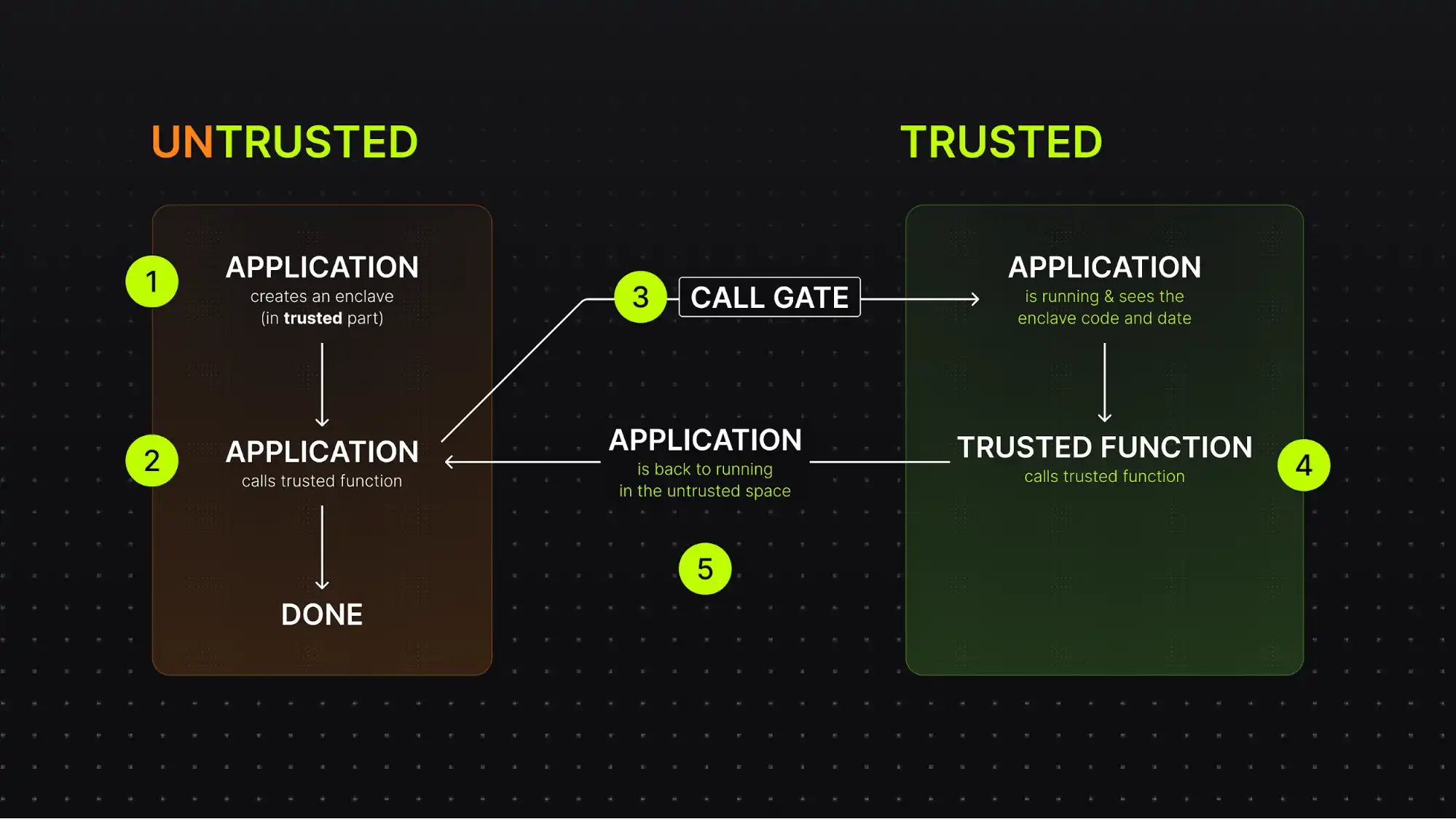
Through this multi-proof pipeline design, Lumoz provides a more efficient, secure, and flexible solution that enhances performance, improves cross-platform and cross-protocol compatibility, and drives innovation in decentralized validation and data security in blockchain technology.
Settlement Protocol Based on Sparse Merkle Tree (LSMT)
Lumoz's Sparse Merkle Tree (LSMT) is an innovative cryptographic data structure that combines the advantages of traditional Merkle trees and Patricia trees, enabling efficient storage of a large number of key-value pairs. Compared to traditional Merkle trees, LSMT only stores necessary nodes through its unique node organization, which are usually nodes containing non-null values or nodes along the path of leaf nodes with values. This design makes LSMT a "sparse" data structure, significantly reducing the storage space requirement.
A significant advantage of LSMT is its ability to provide succinct proofs (Merkle proofs) to verify whether a specific key-value pair is included in the tree without revealing its exact value. This design optimizes storage and computation efficiency, particularly suitable for scenarios requiring efficient data consistency verification.
In Layer 2 solutions, a key application of LSMT is state commitment and state verification. State commitment refers to submitting off-chain transactions (Layer 1 state) to Layer 2 solutions. By submitting this state on Layer 1, participants in Layer 2 can validate the validity of their off-chain transactions without disclosing the entire state or requiring the Layer 1 blockchain to process every off-chain transaction. In this way, LSMT provides an efficient and secure way to achieve cross-chain validation and data commitment, reducing reliance on the base layer and enhancing system scalability and privacy protection.
Conclusion
By innovatively combining various advanced blockchain solutions such as SVM, ZK, and TEE, Lumoz offers an efficient, secure, and flexible SVM general L2/application chain solution. By leveraging the parallel processing advantage of the SVM execution layer and using the Sparse Merkle Tree (LSMT) for data validation, Lumoz is able to significantly increase transaction throughput and processing speed while ensuring security and decentralization. Furthermore, Lumoz's zk and SGX multi-proof pipeline technology provides robust support for secure transaction execution, further improving the efficiency of cross-chain interaction and data processing.
With the continuous development of decentralized applications and blockchain technology, Lumoz's architecture not only provides developers with a more flexible development environment but also effectively reduces transaction costs, driving the application and popularization of blockchain technology in various fields. In the future, Lumoz is poised to become one of the most versatile and scalable Layer 2 solutions, advancing the further development of public chains like Solana and laying a solid foundation for the sustainability and innovation of the blockchain ecosystem.
This article is a submitted contribution and does not represent the views of BlockBeats
You may also like

Pantera Capital Partner: How Tokenization is Restructuring the Private Equity and Early Investment Ecosystem?

New York Proposes Stricter Stablecoin Issuer Rules Aligned With Federal GENIUS Act
NYDFS proposed stricter stablecoin issuer rules aligned with the GENIUS Act, covering reserves, custody, redemption timelines, audits, and capital buffers.
Every exchange is a "Universal Exchange."

The counterattack of traditional finance: Alliance chains are quietly reviving

CryptoQuant Says Bitcoin Profitable Supply Is Near 45% Pressure Zone as On-Chain Data Points to Market Repricing
CryptoQuant said Bitcoin’s profitable supply is nearing the 45% pressure zone, signaling rising market stress, unrealized losses, and a possible on-chain repricing phase.

Bitcoin Falls Below 200-Week Moving Average as On-Chain Data Shows Over Half of Supply in Loss
Bitcoin dropped below its 200-week moving average as on-chain data showed over 50% of circulating supply is now in loss, signaling rising market stress.

CFTC Reportedly Plans New Prediction Market Rules Focused on Manipulation Risk and Public Interest Review
The CFTC is reportedly preparing new prediction market rules focused on manipulation risk, public interest review, and retail trader protections.

Meet the new WEEX trial fund—your gateway to greater profits

WEEX Labs Lands at Dutch Blockchain Week: A Disruptive Crypto × AI Conversation Sets Sail in Amsterdam

SK Hynix Reportedly Plans U.S. ADR Listing as Early as August, With SEC Approval Possible in Late June
SK Hynix may pursue a U.S. ADR listing as early as August, with SEC approval reportedly possible in late June amid strong AI chip supply chain demand.

SpaceX vs Tesla vs xAI: Which Elon Musk Trade Has the Biggest Upside in 2026?
OpenAI Reveals It Has Confidentially Submitted an S-1 to the SEC, Keeping the Door Open for a Future IPO
On June 9, according to an OpenAI announcement, the company recently confidentially submitted a draft S-1 registration statement to the U.S. Securities and Exchange Commission (SEC), beginning the preliminary compliance process for a potential initial public offering. OpenAI said it chose to disclose this proactively because it expected the news might leak; however, the company has not yet set a specific listing timeline, and related arrangements may still take some time.

Latest research from 13 top universities including Cornell University: The current state, challenges, and misconceptions of the fusion of Crypto and AI
Deconstructing Anthropic: The Best AI Company, Possibly Also a Type of Organizational Invention
Apollo and Blackstone Reportedly Back $35 Billion Anthropic Chip Financing as Deal Details Remain Unclear
On June 9, according to currently available news alerts, Apollo and Blackstone Group participated in a $35 billion financing for an Anthropic “chip project.” Based on the original wording of the report, the funding has already been raised, but public information remains limited. The financing structure, use of proceeds, project entity, and whether Apollo and Blackstone participated through equity, debt, or project financing have not yet been disclosed.

Humanity Protocol Security Incident Escalates: More Than $31 Million Stolen From Related Addresses as Attacker Continues Selling H for ETH
On June 9, according to monitoring by Onchain Lens, more than $31 million has been stolen from addresses linked to Humanity Protocol, and the attack is still ongoing, with the hacker continuously swapping H tokens for ETH. Project founder Terence Kwok later confirmed the security incident on X, saying the issue involved a private key leak.

Bloomberg: As Bitcoin Weakens, Stablecoins and RWA Continue to Drive Expansion in Crypto Businesses
In June, Bloomberg reported that despite Bitcoin falling below $60,000 last week, wiping out about $235 billion in market value within seven days, and dropping close to 50% from last year’s peak, some core businesses in the crypto industry are still expanding, mainly in stablecoins, real-world asset tokenization (RWA), payments, and infrastructure. The report also noted that overall altcoin activity has contracted significantly: altcoin market capitalization has fallen from a peak of about $431 billion in November 2021 to around $170 billion, and among the tens of millions of tokens issued in recent years, fewer than 1,700 still maintain meaningful trading activity.

Galaxy Deep Research Report: How Hyperliquid's HIP-4 Upgrade Changes the Landscape of Prediction Markets?
Pantera Capital Partner: How Tokenization is Restructuring the Private Equity and Early Investment Ecosystem?
New York Proposes Stricter Stablecoin Issuer Rules Aligned With Federal GENIUS Act
NYDFS proposed stricter stablecoin issuer rules aligned with the GENIUS Act, covering reserves, custody, redemption timelines, audits, and capital buffers.
Every exchange is a "Universal Exchange."
The counterattack of traditional finance: Alliance chains are quietly reviving
CryptoQuant Says Bitcoin Profitable Supply Is Near 45% Pressure Zone as On-Chain Data Points to Market Repricing
CryptoQuant said Bitcoin’s profitable supply is nearing the 45% pressure zone, signaling rising market stress, unrealized losses, and a possible on-chain repricing phase.
Bitcoin Falls Below 200-Week Moving Average as On-Chain Data Shows Over Half of Supply in Loss
Bitcoin dropped below its 200-week moving average as on-chain data showed over 50% of circulating supply is now in loss, signaling rising market stress.


