
Kyle Samani Returns to Crypto? Post Discusses How to Efficiently Weed Out CEX


Original Author: Kyle Samani, Co-founder of Multicoin
Original Translator: Azuma, Odaily Planet Daily
Editor's Note: The man known for his shilling of Solana, Multicoin Capital's former co-founder Kyle Samani, who recently made a high-profile return after stepping back, is back at it again!
Yesterday evening, Kyle Samani posted a lengthy thread on his personal X account. In the post, Kyle Samani once again employed his continued shilling (not meant negatively) rhetoric, using "efficiency" as a breakthrough point in the decentralized narrative, elaborating on how the current Solana ecosystem's flagship PropAMM will match or even outperform traditional centralized models in terms of efficiency. He argued that PropAMM is one of the most important innovations in market microstructure in recent years or even decades.
· Related articles: "Kyle Samani's Exit from the Scene, Is There Another Story?", "Kyle Samani's Turnaround, The Person Who Believed Most in Web3 Also Exits the Scene"
Below is the original content by Kyle Samani, translated by Odaily Planet Daily.
Original Content:
PropAMM is one of the most important innovations in market microstructure in recent years, and may even be one of the most important innovations in decades.
To help everyone understand this conclusion, let's first take a look at how Market Makers (MM) quote on traditional centralized exchanges (CEX).
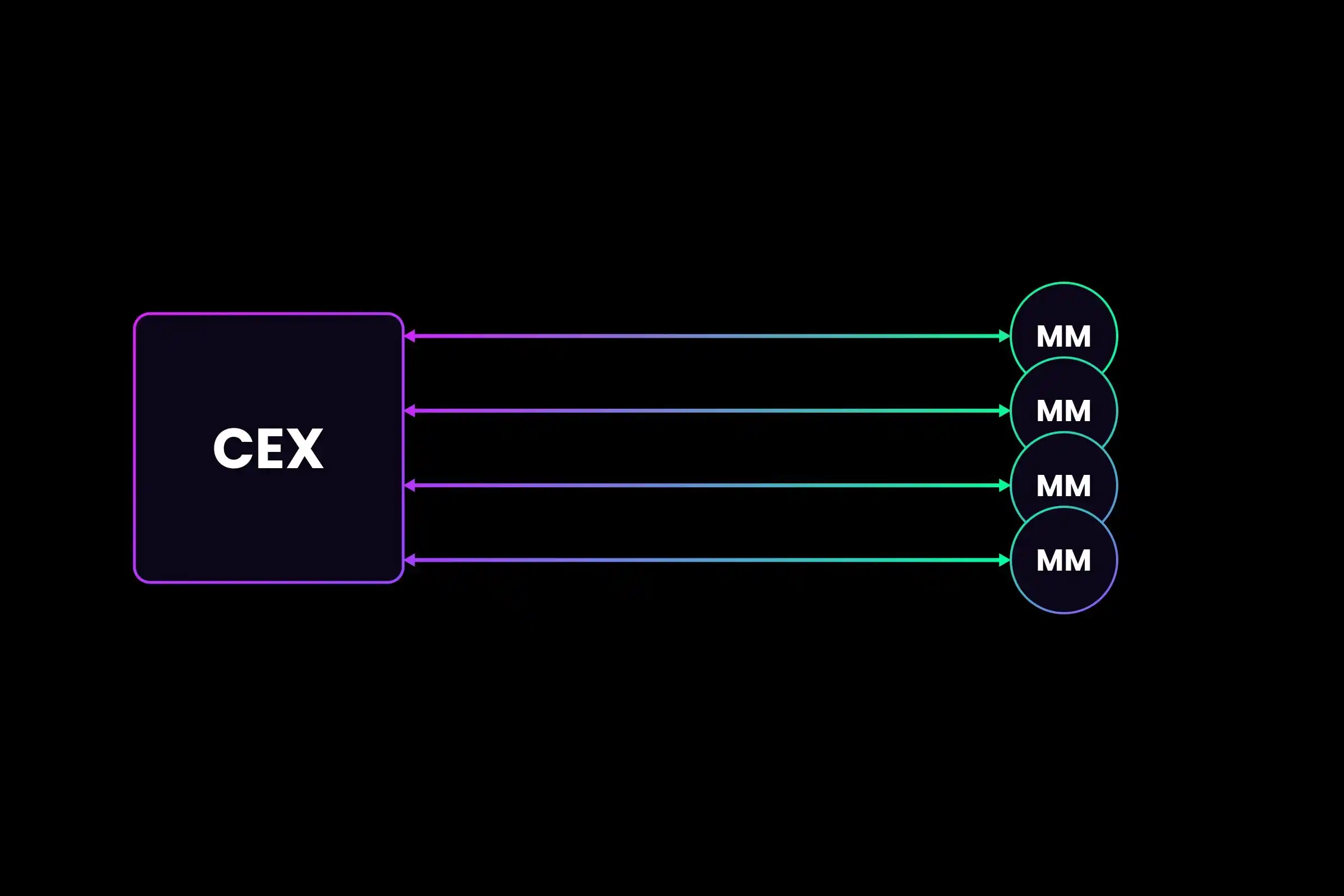
Market Makers typically engage in physical co-location with the exchange. Each Market Maker runs algorithms on a server and is connected to another server through a standardized length of network cable (e.g., 50 meters), where the exchange's system is running.
There is a constant back-and-forth data flow between market makers and trading platforms. Every time a market maker sends an order to the trading platform—whether it's a limit order, cancel order, or market order—the trading platform needs to broadcast this information to all other market makers; then, other market makers will resend their orders based on the new information; and so the cycle repeats, indefinitely.
Below is a simple schematic.
Now let's take a look at how PropAMM works on the Solana mainnet.
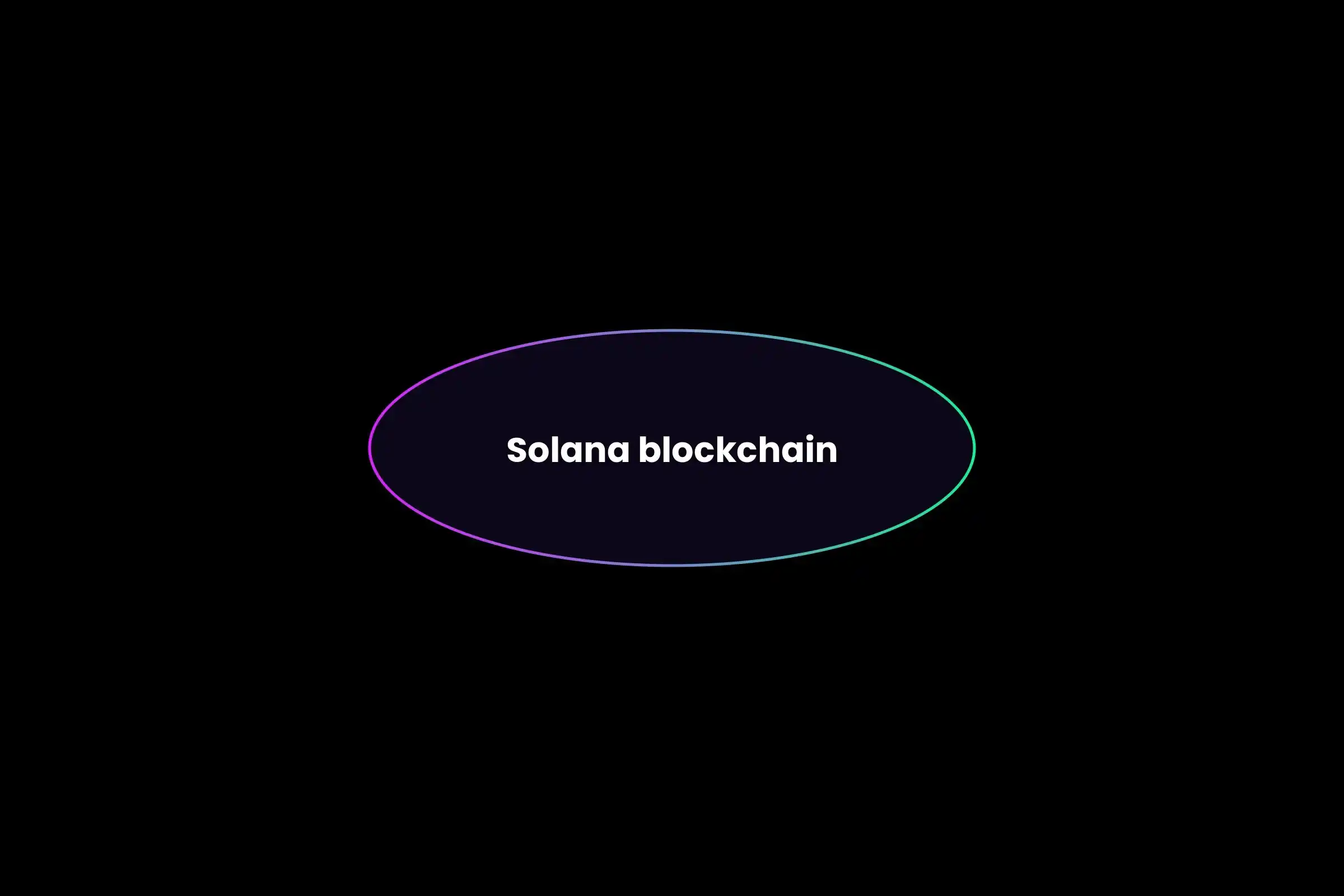
The beauty of PropAMM on Solana is that the blockchain itself directly "hosts" the market maker algorithm. This means the system no longer needs to shuttle billions of messages back and forth between market makers and trading platforms; the market maker algorithm will run directly on the same physical machine as the trading platform.
The new schematic is as follows. (Yes, only the Solana blockchain is needed!)
In the cryptocurrency industry, there has always been a perennial view that, because decentralized systems need to communicate between global nodes, they will surely be slower (have higher latency) than centralized systems.
But if you look at this problem in a different way, on-chain hosted algorithms may actually have lower latency than traditional centralized trading platforms in finance.
Why is this so? The reason is the latency required for PropAMM to update prices only involves electrons moving within the same block of physical silicon. For example, if a previous market order caused a price change for SOL-USD, this information is immediately visible to all PropAMM and used for pricing the next market order. Everything happens within the same block of silicon, eliminating the need for bidirectional communication between servers.
It is worth noting that PropAMM does require frequent oracle updates, but this is not a problem and does not change the overall fact as I described above.
The most critical point remains that when a trading platform—in the case above, the Solana blockchain—directly hosts the PropAMM algorithm, market maker pricing changes in real-time within the same block of physical silicon.
PropAMM has become the dominant mechanism for the SOL-USDC spot price on Solana, with a spread tighter than all major CEXs. I expect this market structure to become the dominant mode of on-chain trading this year, including spot, perpetuals, and even prediction markets.
The biggest challenge for PropAMM is that there is currently no way to guarantee that a taker will always receive the best execution, due to:
· All PropAMM algorithms are not public (which is actually reasonable, as traditional market-making algorithms are also private);
· The outcome of trading routing across multiple PropAMMs is non-deterministic.
However, this issue is solvable. I expect all relevant aggregator teams to introduce solutions this year, such as Jupiter and dFlow on the spot side, and Phoenix on the derivatives side.
Current PropAMMs are still not fully optimized and are subject to various limitations of the Solana blockchain itself. This year, Solana will roll out a series of major upgrades that will significantly improve PropAMM performance, including:
1. Higher CU (Computational Unit) limits per trade and larger trade sizes;
2. Higher CU limits per block;
3. Alpenglow: reducing slot time from 400ms to 100–150ms;
4. DoubleZero: reducing global network latency;
5. Application-controlled execution;
6. Multiple concurrent leaders.
If on the Solana mainnet, PropAMMs are already able to provide quotes tighter than all CEXs without these upgrades, it is conceivable that as these upgrades are gradually rolled out, their performance will become even more powerful.
You may also like

Morning Report | OpenAI has submitted an S-1 registration statement draft to the U.S. SEC; Morpho completes $175 million financing

Galaxy Deep Research Report: How Hyperliquid's HIP-4 Upgrade Changes the Landscape of Prediction Markets?

Latest research from 13 top universities including Cornell University: The current state, challenges, and misconceptions of the fusion of Crypto and AI

Deconstructing Anthropic: The Best AI Company, Possibly Also a Type of Organizational Invention

Every exchange is a "Universal Exchange."

The counterattack of traditional finance: Alliance chains are quietly reviving
Pantera Capital Partner: How Tokenization is Restructuring the Private Equity and Early Investment Ecosystem?

Mastercard Launches Agent Pay for AI, Plans to Record AI Agent Payment Authorizations on Polygon
Mastercard launched Agent Pay for AI, a new payment protocol designed to help AI agents make small payments such as pay-per-use access to data and APIs. The system plans to record human-granted AI agent permissions on Polygon, focusing on verifiable authorization, identity, and payment controls.

Curve Deploys Llamalend v2 on Optimism With 250,000 OP Incentives
Curve launched Llamalend v2 on Optimism with 250,000 OP incentives from the Optimism Foundation. The upgrade expands Llamalend beyond its earlier crvUSD-focused model, adding broader collateral support, LlamaRisk market reviews, and the ability to use Curve LP tokens as collateral.

Raydium Old Liquidity Pool Reportedly Exploited, With $1.34 Million Moved to Ethereum and Tornado Cash
An old Raydium liquidity pool was reportedly exploited for around $1.34 million in USDC, RAY, and wSOL, with the stolen funds bridged to Ethereum and deposited into Tornado Cash. The incident highlights the tail risks of legacy DeFi pools, old contracts, and cross-chain fund laundering paths.
Kalshi Executive Challenges “SBF Backed AI Unicorns” Narrative, Says Leopold Aschenbrenner Was Key Figure
Kalshi executive John Wang questioned the “SBF backed AI unicorns” narrative, saying Leopold Aschenbrenner was the key figure behind major AI investment decisions.

New York Proposes Stricter Stablecoin Issuer Rules Aligned With Federal GENIUS Act
NYDFS proposed stricter stablecoin issuer rules aligned with the GENIUS Act, covering reserves, custody, redemption timelines, audits, and capital buffers.

CryptoQuant Says Bitcoin Profitable Supply Is Near 45% Pressure Zone as On-Chain Data Points to Market Repricing
CryptoQuant said Bitcoin’s profitable supply is nearing the 45% pressure zone, signaling rising market stress, unrealized losses, and a possible on-chain repricing phase.

Bitcoin Falls Below 200-Week Moving Average as On-Chain Data Shows Over Half of Supply in Loss
Bitcoin dropped below its 200-week moving average as on-chain data showed over 50% of circulating supply is now in loss, signaling rising market stress.

CFTC Reportedly Plans New Prediction Market Rules Focused on Manipulation Risk and Public Interest Review
The CFTC is reportedly preparing new prediction market rules focused on manipulation risk, public interest review, and retail trader protections.

Meet the new WEEX trial fund—your gateway to greater profits

WEEX Labs Lands at Dutch Blockchain Week: A Disruptive Crypto × AI Conversation Sets Sail in Amsterdam
SK Hynix Reportedly Plans U.S. ADR Listing as Early as August, With SEC Approval Possible in Late June
SK Hynix may pursue a U.S. ADR listing as early as August, with SEC approval reportedly possible in late June amid strong AI chip supply chain demand.
Morning Report | OpenAI has submitted an S-1 registration statement draft to the U.S. SEC; Morpho completes $175 million financing
Galaxy Deep Research Report: How Hyperliquid's HIP-4 Upgrade Changes the Landscape of Prediction Markets?
Latest research from 13 top universities including Cornell University: The current state, challenges, and misconceptions of the fusion of Crypto and AI
Deconstructing Anthropic: The Best AI Company, Possibly Also a Type of Organizational Invention
Every exchange is a "Universal Exchange."
The counterattack of traditional finance: Alliance chains are quietly reviving


