
Is Whale Watching a Reliable Trading Signal?



Original Article Title: Whale Alerts: Are They Tradable?
Original Article Source: Presto Research
Original Article Translation: Golem, Odaily Daily Planet
Key Points:
· Whale alerts are popular because large on-chain transactions are often seen as a precursor to an imminent token sell-off and a sell signal. To assess these claims, Presto Research analyzed the price movements of BTC, ETH, and SOL after large deposits to Binance.
· According to the regression analysis, the R-squared values between large transaction deposits and subsequent price movements are low (ranging from 0.0017 to 0.0537). Narrowing the data to deposits from VCs and MM (Market Makers) slightly increased the R-squared values, but their practical utility as trading signals remains limited. The research results strongly suggest that whale deposits to exchanges lack predictive power as a reliable trading signal.
· On-chain metrics are effective in other areas, such as analyzing blockchain fundamentals, tracking illicit fund flows, or explaining price fluctuations. Only when investors have a more realistic expectation of the capabilities and limitations of these metrics can they better serve the industry.
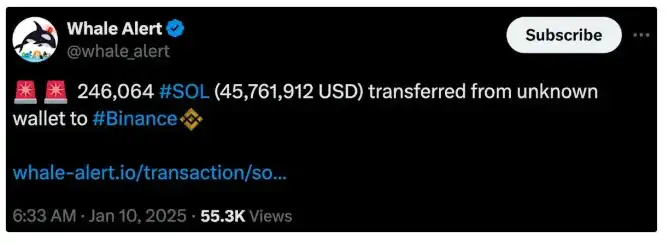
One of the key differences between crypto assets and other assets is the public availability of their transaction records, which are stored on a distributed ledger. This transparency of the blockchain has led to the emergence of various tools that leverage this unique feature, categorized as "on-chain data." One such tool is "Whale Alerts," which is a service that automatically notifies large on-chain crypto transactions. They are popular because large transactions are often seen as a precursor to imminent sell-off activity, hence traders consider them a "sell signal."
This report evaluates the effectiveness of this widely accepted assumption. After briefly outlining the popular whale alert services in the market, we will analyze the relationship between large transaction deposits and the prices of BTC, ETH, and SOL. We will then present the analysis results and provide key conclusions and recommendations.
Whale Alerts Overview
Whale Alerts refer to services that track and report large crypto transactions. These services have emerged with the development of the crypto ecosystem, reflecting market participants' high regard for the transparency features of blockchain.
History
As early Bitcoin adopters, miners, and investors (such as Satoshi Nakamoto, the Winklevoss Twins, F2Pool, Mt. Gox) accumulated a significant amount of Bitcoin, the term "whale" began to circulate. Initially, blockchain enthusiasts monitored large transactions through a blockchain explorer (such as Blockchain.info) and shared this information on forums like Bitcointalk or Reddit. This data was often used to explain significant fluctuations in the Bitcoin price.
During the bull market of 2017, with the increase in whale transactions and large transactions, the market saw a pressing need for automated monitoring solutions. In 2018, a European development team introduced a tool called "Whale Alert," which could track large cryptocurrency transactions in real-time across multiple blockchains and send alerts via Twitter, Telegram, and a web interface. The tool quickly gained popularity among market participants, becoming the preferred service for those seeking actionable trade signals.
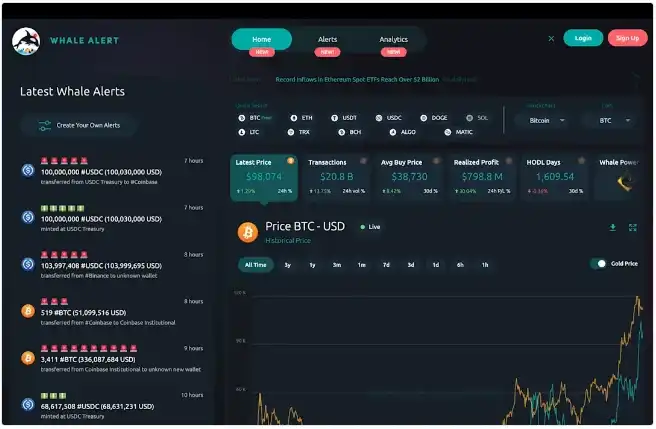
Source: Whale Alert (@whale_alert)
Key Assumption
Following the success of Whale Alert, many platforms offering similar services have emerged over the years, as shown in the image below. While many new platforms have added more features to provide background information for alerts, the original Whale Alert still focuses on simple, real-time notifications and remains the most popular service, as evidenced by its large following on Twitter. A common feature of all these services is their reliance on the assumption that large on-chain transactions, especially exchange deposits, signal imminent sell-offs.
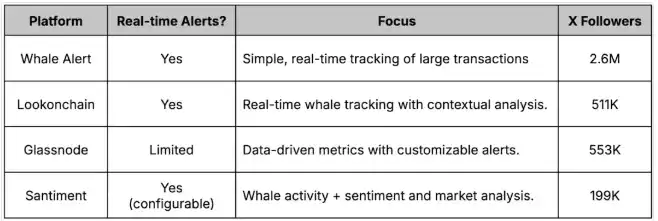
Mainstream Whale Alert Services, Data Source: Whale Alert, LookIntoBitcoin, Glassnode, Santiment, Twitter, Presto Research
Signal Validity Assessment
Supporters of the Whale Alert service believe that on-chain asset transfers to exchanges often precede liquidations, making them effective sell signals. To validate this assumption, we analyzed the price change of digital assets after large deposits entered exchanges, with the key parameters of the analysis shown in the chart below. The assumption is that if large deposit transactions can serve as reliable trading signals, a clear relationship should be observed between deposits and the corresponding asset's price.

Key Analysis Parameters, Source: Presto Research
Assets, Exchanges, Analysis Period, and Deposit Threshold
Our analysis focuses on three major cryptocurrencies—BTC, ETH, and SOL—between January 1, 2021, and December 27, 2024, along with their USDT prices on Binance. This time range was chosen to align with the operational duration of the wallet addresses currently used by Binance for deposit aggregation.
The deposit threshold was set based on data analysis from an exchange. Specifically, benchmarking against the Whale Alert thresholds of $50 million, $50 million, and $20 million for BTC, ETH, and SOL whales, respectively, we adjusted the deposit thresholds to $20 million, $20 million, and $8 million to match Binance's 40% share of global spot trading volume.
Entity Types
We also conducted a specific analysis of known entity deposits and performed the same analysis on a narrower data sample to examine if deposits from specific entity types showed a stronger relationship with price movements. These entities were identified by Arkham Intelligence and supplemented by our own investigations, as shown in the figure below.
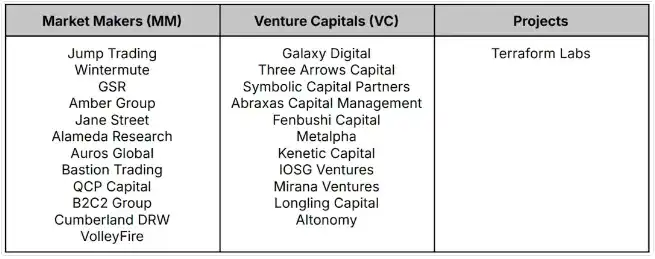
Entities with Known Addresses, Source: Arkham Intelligence, Presto Research
Measuring Market Impact
To assess the potential selling pressure from whale deposits, we made the following assumptions:
· Selling pressure would manifest within a specific time window after on-chain confirmation of deposits exceeding the threshold. We analyzed two time periods: one hour and six hours.
· The Maximum Drawdown (MDD) within the specified interval was used as a metric to gauge the price impact of deposits (if any), effectively filtering out noise during that period.
Results
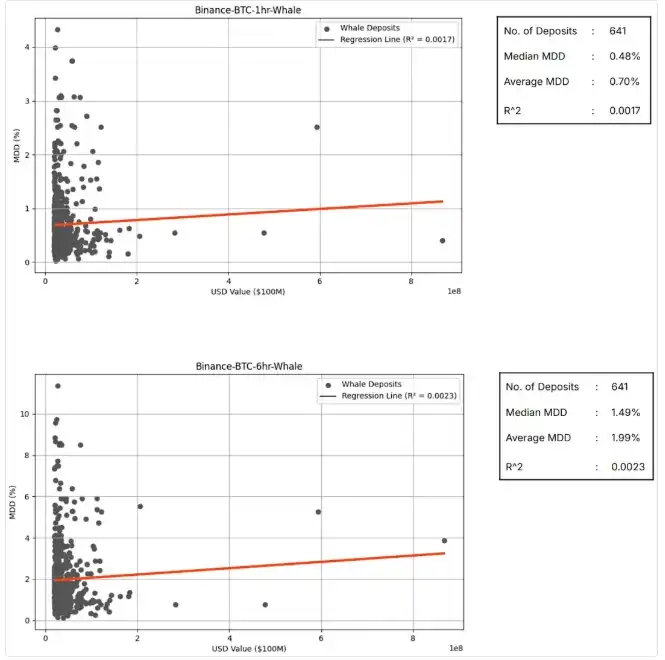
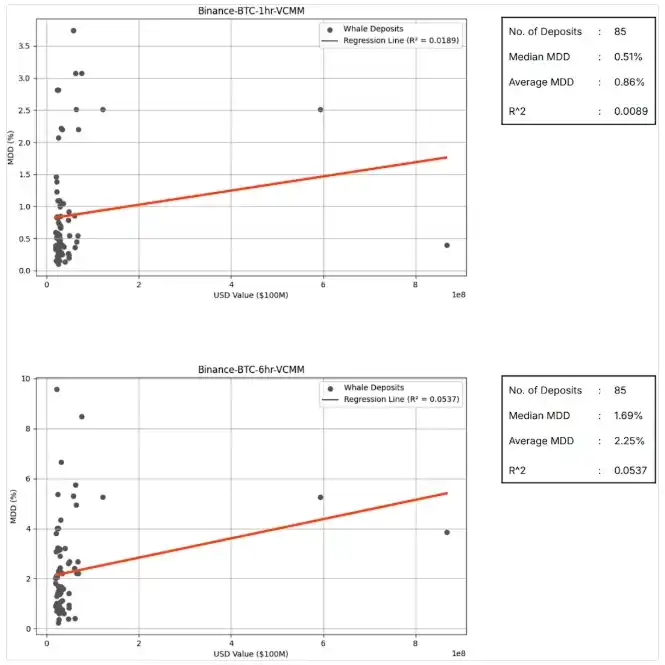
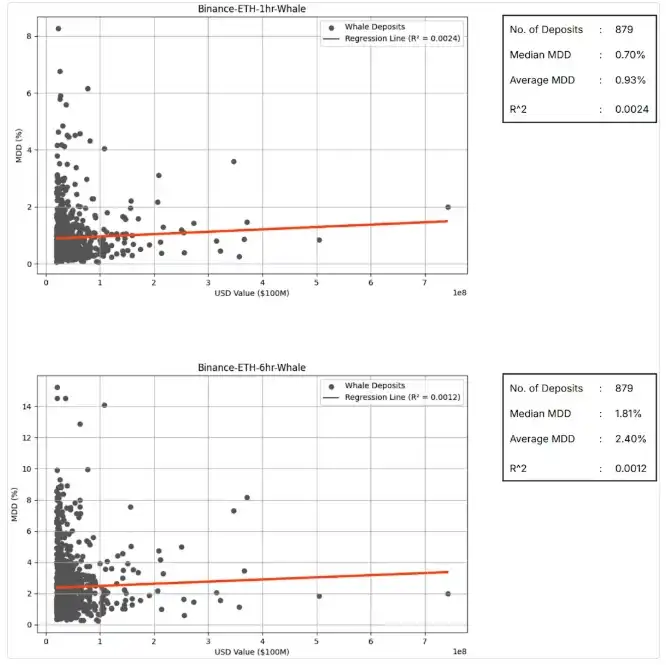
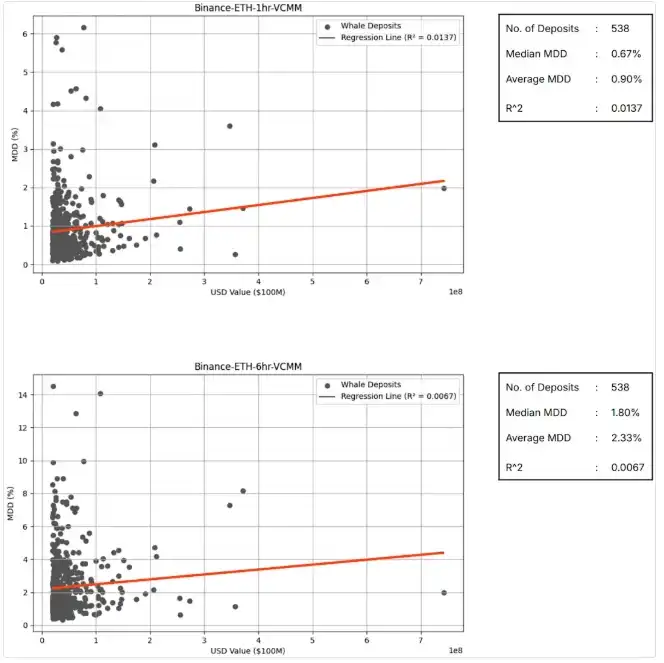
The analysis results are depicted in the following charts
· BTC Whale Deposit Impact (Overall):
Source: Binance, Dune Analytics, Presto Research
· BTC Whale Deposit Impact (VC and MM only):
Source: Binance, Dune Analytics, Presto Research
· ETH Whale Deposit Impact (Overall):
Source: Binance, Dune Analytics, Presto Research
· ETH Whale Deposit Impact (VC and MM only):
Source: Binance, Dune Analytics, Presto Research
· SOL Whale Deposit Impact (Overall):
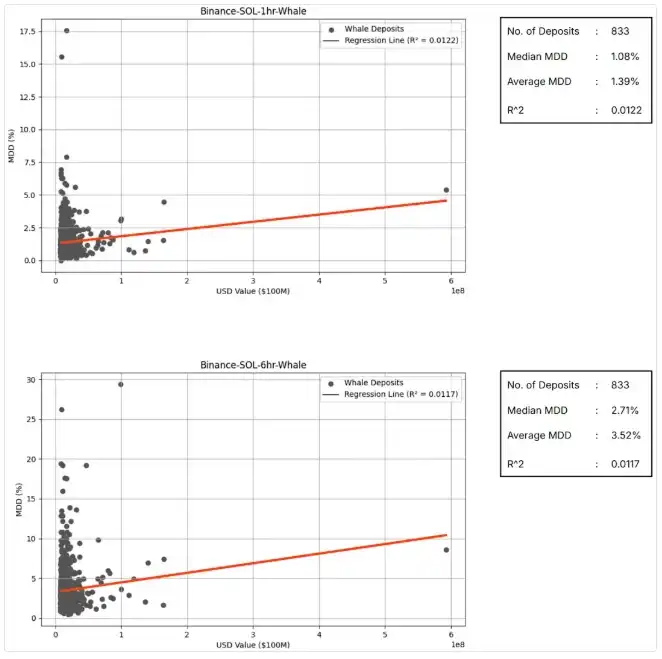
Source: Binance, Dune Analytics, Presto Research
· SOL Whale Deposit Impact (VC and MM only):
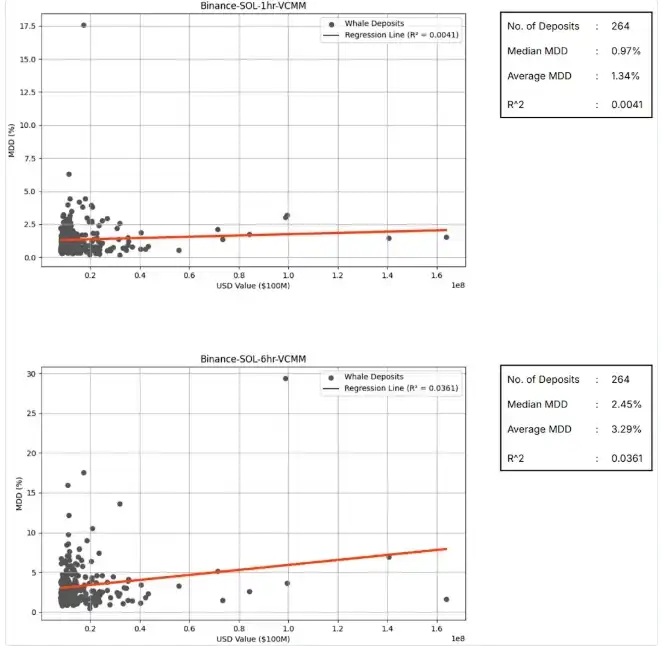
Source: Binance, Dune Analytics, Presto Research
Key Points
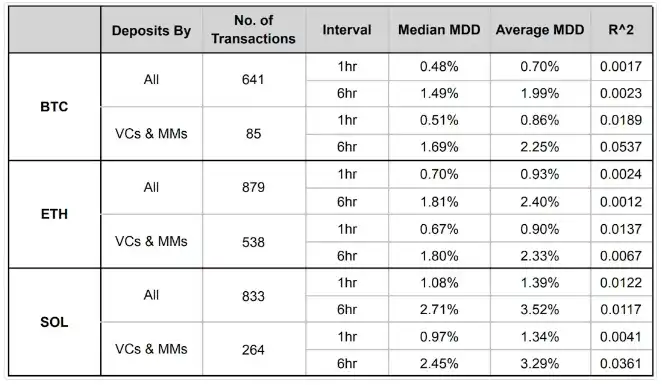
Data Source: Binance, Dune Analytics, Presto Research
The chart above summarizes the results of the above statistics and draws the following 3 conclusions:
1. Large Exchange Deposits and Price Drop Prediction: The R-squared values for all 12 scenarios indicate a very weak predictive power, ranging from 0.0017 to 0.0537.
2. VC and MM Deposits May Be Slightly Better Predictive Signals: In this data set, the R-squared values show some improvement, but this improvement may only be the result of reduced sample noise rather than a true stronger correlation. Furthermore, the absolute values are still low, indicating limited actual effectiveness as a trading signal.
3. ETH Whale Deposits Mainly Come from VC and MM: They represent 61% of ETH whale deposits (i.e., 538 out of 879 transactions), while BTC accounts for only 13%, and SOL for 32%. This reflects the characteristics of different assets: ETH, with its diverse Web3 uses (such as gas fees, staking, DeFi lending, and swap intermediation), has higher turnover, while BTC, as a store of value asset, is more stable.
Conclusion
Undoubtedly, our analysis method has certain limitations, and regression analysis has its inherent constraints, so drawing conclusions solely based on R-squared values can sometimes be misleading.
Nevertheless, this analysis, combined with background and individual observation results, strongly suggests that whale deposits to exchanges lack sufficient predictive power to be a reliable trading signal. This also provides us with profound insights into the broader use of on-chain metrics.
On-chain metrics are undoubtedly valuable tools, especially for analyzing blockchain fundamentals or tracking illicit fund flows, and they may be useful in retrospectively explaining price movements. However, using them to predict short-term price changes is an entirely different matter. Price is a function of both supply and demand, and exchange deposits are just one of many factors influencing the supply side, even if they are indeed useful. Price discovery is a complex process influenced by fundamentals, market structure, behavioral factors (such as emotions, expectations), and random noise.
In the highly volatile cryptocurrency market, participants are constantly seeking a "foolproof" trading strategy, and there will always be an audience drawn to the "magic" of on-chain metrics. As some "overzealous" data providers are eager to exaggerate the promises of their platforms, investors can only better serve the industry when they have a realistic expectation of the capabilities and limitations of these tools.

You may also like

Galaxy Deep Research Report: How Hyperliquid's HIP-4 Upgrade Changes the Landscape of Prediction Markets?

ZachXBT: Humanity private key leak and abnormal surge in H token should be viewed separately
On June 9, according to related disclosures, on-chain investigator ZachXBT posted an update on Humanity’s roughly $31 million security incident, saying that after further analyzing fund flows, he currently tends to believe the project team was not involved in an “inside job” or a self-staged attack. According to him, the official explanation about the private key leak was broadly accurate, but before the token unlock, the price of H had been artificially pushed higher, and the hacker later took advantage of that market environment; therefore, the private key leak and the earlier abnormal price pumping should be regarded as two separate and independent events. This reframing has shifted the market’s understanding of the nature of the incident. Earlier discussion around Humanity had focused on whether the team directly participated in the attack or used the security incident to cover up internal operations. ZachXBT’s latest remarks shift the focus from “whether it was self-theft” to “whether there were pre-unlock market structure issues.” He also questioned whether the team may have.

Morning Report | OpenAI has submitted an S-1 registration statement draft to the U.S. SEC; Morpho completes $175 million financing

Morning Report | BitMine increased its holdings by 126,971 ETH last week; trader Eugene announced his exit from the crypto market

Wang Chuan: How can one not feel anxious after the neighbor Old Wang made thirty times profit by investing in storage stocks? (Seven) - A quarter-century cycle

Cryptocurrency CEXs are flocking to sell US stocks, and traditional brokerages are facing an "uninvited guest."
$75 billion in foreign capital has fled, and South Korean retail investors have absorbed it all using leverage

Japan’s Three Megabanks Plan Joint Stablecoin Issuance in Fiscal 2026
MUFG, SMBC, and Mizuho reportedly plan to jointly issue fiat-pegged stablecoins in fiscal 2026, signaling Japan’s growing push into bank-led digital payment infrastructure.

Humanity Discloses H Token Dual-Chain Attack Details, With Losses on Ethereum and BSC Exceeding $36 Million
Humanity said the H token attack across Ethereum and BSC caused more than $36 million in losses after leaked ProxyAdmin keys enabled malicious contract upgrades and token minting.
White House Discusses CLARITY Act With Law Enforcement Ahead of Senate Vote
The White House discussed the CLARITY Act with law enforcement ahead of a Senate vote, focusing on illicit finance risks and developer protections.

Bitcoin Trading Guide 2026: Strategies for Experienced Traders

What Is XAUT and PAXG? Why Tokenized Gold Is Booming in 2026

Will the SpaceX IPO Hurt Bitcoin? Here's What Traders Are Watching

Foreign selling in the South Korean stock market accelerates, with cumulative net sales reportedly reaching $75 billion this year
On June 9, The Kobeissi Letter, citing Goldman Sachs data, reported that global investors are selling South Korean stocks at an unusually rapid pace. In the latest trading session, foreign investors sold about $801 million worth of Kospi constituent stocks again; total foreign outflows last week reached about $10 billion, and the market has been in net foreign selling on nearly every trading day over the past month. According to the data cited in the report, foreign investors have sold about $75 billion worth of South Korean stocks so far this year. Meanwhile, South Korean retail and institutional investors together recorded roughly $69 billion in net buying over the same period, suggesting that the market’s main buying support has come from domestic capital rather than returning overseas funds. The information currently disclosed still mainly comes from The Kobeissi Letter’s retelling and Goldman Sachs data summaries, while public details on the statistical period and the specific definition of “selling” remain relatively limited.

Fortune Warns of Strategy’s Financing Structure Risks as Bitcoin Premium Narrows
Fortune warned that Strategy’s Bitcoin treasury model faces growing financing risks as MSTR’s net asset premium narrows and preferred stock dividend pressure increases.

Ferrari Challenge Le Mans: Carl Moon to Dominate in WEEX Livery

Sahara AI Responds to SAHARA’s Sharp Drop: No Contract or Product Security Issues Found, Internal Investigation Underway
Sahara AI responded to SAHARA’s 60% price drop, saying no token contract or product security issues have been found and an internal investigation is underway.

WEEX Deposit/Withdrawal Dynamic Island: Your Asset Status, Always in Sight
Galaxy Deep Research Report: How Hyperliquid's HIP-4 Upgrade Changes the Landscape of Prediction Markets?
ZachXBT: Humanity private key leak and abnormal surge in H token should be viewed separately
On June 9, according to related disclosures, on-chain investigator ZachXBT posted an update on Humanity’s roughly $31 million security incident, saying that after further analyzing fund flows, he currently tends to believe the project team was not involved in an “inside job” or a self-staged attack. According to him, the official explanation about the private key leak was broadly accurate, but before the token unlock, the price of H had been artificially pushed higher, and the hacker later took advantage of that market environment; therefore, the private key leak and the earlier abnormal price pumping should be regarded as two separate and independent events. This reframing has shifted the market’s understanding of the nature of the incident. Earlier discussion around Humanity had focused on whether the team directly participated in the attack or used the security incident to cover up internal operations. ZachXBT’s latest remarks shift the focus from “whether it was self-theft” to “whether there were pre-unlock market structure issues.” He also questioned whether the team may have.
Morning Report | OpenAI has submitted an S-1 registration statement draft to the U.S. SEC; Morpho completes $175 million financing
Morning Report | BitMine increased its holdings by 126,971 ETH last week; trader Eugene announced his exit from the crypto market
Wang Chuan: How can one not feel anxious after the neighbor Old Wang made thirty times profit by investing in storage stocks? (Seven) - A quarter-century cycle
Cryptocurrency CEXs are flocking to sell US stocks, and traditional brokerages are facing an "uninvited guest."


