

Have Institutions Finally 'Entered Crypto,' but Just to Vampire?

Original Title: From "Adoption" to Annexation: The End State of Institutional Adoption
Original Author: Meltem Demirors, Crucible Capital
Original Translation: Ding Dang, Odaily Planet Daily
Institutions have finally "entered crypto"—but they are not here to join you on the moon. They are here to turn the crypto economy into a fee stream for their AUM (Asset Under Management) accumulation machine. This is not a judgment or criticism, just an observation of the reality.
The following thoughts mainly focus on crypto as a digital currency/token economy, rather than just as a blockchain for financial infrastructure (the latter mostly does not require a native token, as evidenced by the architecture of most current DeFi governance tokens).
This is a perspective I have held since last year's Digital Assets Summit, where my keynote was titled "Believe in Something." Everything that has happened in the past twelve months has not changed my view, only made the picture clearer.
Recently, my friend Evgeny from Wintermute and Dean from Markets Inc each wrote two great articles discussing what "institutional adoption of crypto" really means and its impact on market cycles. This inspired me to write a third piece, building on their work with a new angle—the shifting capital landscape and the erupting AUM war.
If you're short on time, start with this summary:
"Institutional adoption" is not a mission, it is an extraction strategy. The real question now is: Can crypto move fast enough to build and fund its own institutions, keeping economic value on-chain rather than seeing it continuously siphoned off to TradFi?
Traditional Finance has already extracted most of the value from the crypto economy
Just by following the money flow, it's clear who the true winners in the current crypto world are: not DeFi protocols, but the financial companies that Satoshi Nakamoto sought to replace in the Bitcoin Whitepaper.
· With just USDT and USDC, the two major stablecoins generate around $10 billion in net interest margin revenue annually, owned by Tether (a private company), Coinbase, and Circle (public companies). These companies are certainly key participants in the crypto economy, but their primary beneficiaries are their own shareholders.
· Cantor Fitzgerald—led by current US Secretary of Commerce Howard Lutnick—earns hundreds of millions of dollars annually by holding US Treasury bonds for Tether and orchestrating trades around digital asset companies and investment product organizations.
· Former US President Trump, his family, and associates have collectively earned billions of dollars through expanding cryptocurrency projects and token tools.
· BlackRock's Bitcoin ETF IBIT, grew rapidly to around $100 billion in AUM in about 18 months, becoming the fastest-growing ETF in history and one of the most profitable products for the company (more details later).
· Apollo Global Management and its peers quietly diverted crypto collateral and corporate treasury balances into their credit and multi-asset funds.
Each year, traditional financial institutions siphon off billions of dollars in assets and profits from the crypto economy—and in many cases, the economic rent they capture surpasses the value created by the original protocols themselves.
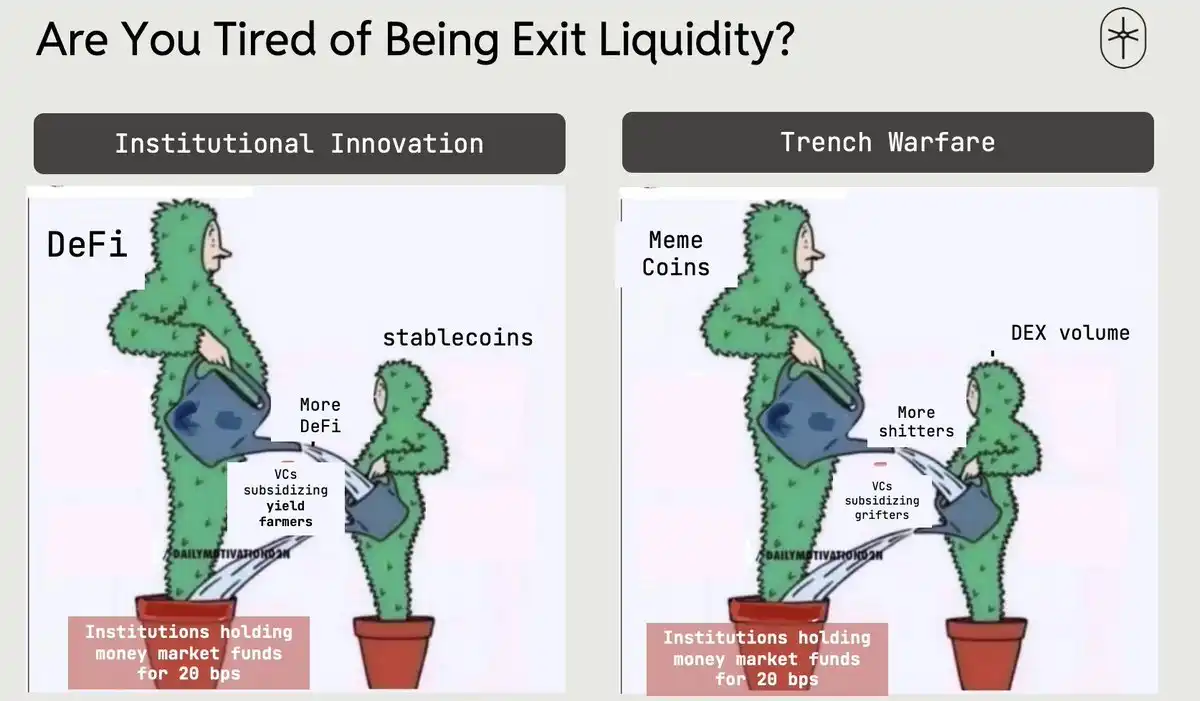
Those "institutional innovators" cheering for "adoption" in countless meetings and the trench warriors on Twitter hyping Memecoins are actually more alike than you think. It's time to stop licking and start thinking.
How Exactly Do Institutions Think?
Businesses have only one core function: to maximize profit. Cryptocurrency can achieve this goal in two ways:
· Cost side: Distributed ledger, on-chain collateral, instant settlement can significantly reduce back- and mid-office operating costs, increase collateral liquidity and utilization (see my previous notes on fungible liquidity).
· Revenue side: Packaging crypto into ETFs, tokenized funds, structured products, custody services, futures trading bundles, lending, treasury management solutions…all throw off hefty fee streams, plus mindless Twitter hype from the crypto community.
Over the past decade, institutions have primarily focused on the first way.
When we started DCG in 2015, it took me a full three years to pitch the advantages of Bitcoin's global ledger and final settlement mechanism to almost every financial institution. At that time, financial services firms did not view crypto as a new revenue stream. It was seen as too risky; and the potential profits from peddling shitcoins were not enough to convince the board to take on reputation and compliance risks.
After leaving DCG, I joined CoinShares in early 2018. At that time, the company's assets under management (AUM) grew from millions to billions. A few independent investment managers who dared to embrace Bitcoin—such as Cathie Wood, Murray Stahl, Ross Stevens—eventually reaped substantial rewards for their courage.
Early 2024 marked a turning point. Institutions started viewing crypto as a tool for their second act: a new revenue stream.
While sporadic institutional participation existed before, the launch of the BlackRock IBIT Bitcoin ETF blew the dam wide open. IBIT became the most successful ETF in history, significantly boosting BlackRock's financials. Here are a few key figures:
· IBIT reached $700 billion in AUM within its first year, becoming the fastest ETF to reach this scale in history, roughly five times faster than the previous record holder, SPDR Gold Shares (GLD).
· By the end of 2024, after the listing of IBIT options, it attracted over $300 billion in additional inflows, while competitor funds saw a near standstill in flows, giving it a market share of over half of all Bitcoin ETF AUM.
· Currently, IBIT has around $1 trillion in AUM, generating hundreds of millions of dollars in fee income annually for BlackRock, surpassing even the profitability of the company's nearly trillion-dollar S&P 500 index funds.
The conclusion is clear: IBIT showed all major asset management firms and financial institutions the standard playbook—take Bitcoin or other digital assets → package them into a traditional fund structure → list them → turn them into a steady stream of hefty fees. Everything else that follows—Distributed Autonomous Technologies (DATs), tokenized government debt, on-chain money market funds—is simply following this playbook repeatedly.
The AI Capex Supercycle: A Capital-Eating Black Hole
Shifting gears slightly, let's talk about another major trend—this is also the reason why Crucible was founded immediately after the 2024 launch of IBIT. The Energy-Compute value chain is actively reshaping the global capital stack in real-time.
Building the AI economy—chips, data centers, power, factories, and so on—will require trillions of dollars in capital expenditure over the next decade, and this money has to come from somewhere. All the liquidity assets not directly tied to AI—crypto, non-AI stocks, even credit assets—are being sold off to chase those deemed "must-haves" in AI.
Meanwhile, many LPs are overallocated in the private markets, exits and dividends are slowing down, and new private credit and PE commitments are quietly being cut or delayed. This has led to longer, more uneven, and harder-to-predict fundraising cycles, intensifying the competition between asset management firms and PEs for high-quality AUM channels. The result is that anything that looks like a pool of capital will be drained.
On-chain Capital: The Next Frontier of AUM
In this AUM battle, crypto is no longer a quirky toy but a potential management scale of trillions of dollars, blatantly on display.
Crypto has already proven to be both a money printer and a "honey pot" attracting institutional allocators. The Trump administration has also explicitly stated that it will create an extremely favorable environment for various crypto innovations.
Currently, on-chain asset management and treasury scale has reached several hundred billion dollars:
· Approximately $300 billion in stablecoin supply, with around 60% being USDT and 25% being USDC;
· DeFi Total Value Locked (TVL) of approximately $900–$1000 billion, distributed across Ethereum, Solana, BSC, Hyperliquid, and other chains;
· Real-world asset (RWA) products through tokenized money market funds (such as BlackRock's BUIDL), tokenized gold (such as Tether Gold, PAXG), and consumer credit products (such as Figure's tokenized HELOC), further adding several billion dollars in scale.
But the average yield of this on-chain capital is only 2–4%, while traditional money market funds can provide 4.1%, and even Lido's $18 billion stETH pool offers only ~2.3%.
For a hungry asset accumulation machine, this is not "DeFi TVL"; this is under-monetized cash flow—packaged, staked, re-lent, and fee-charged. For institutions, this is as natural as breathing.
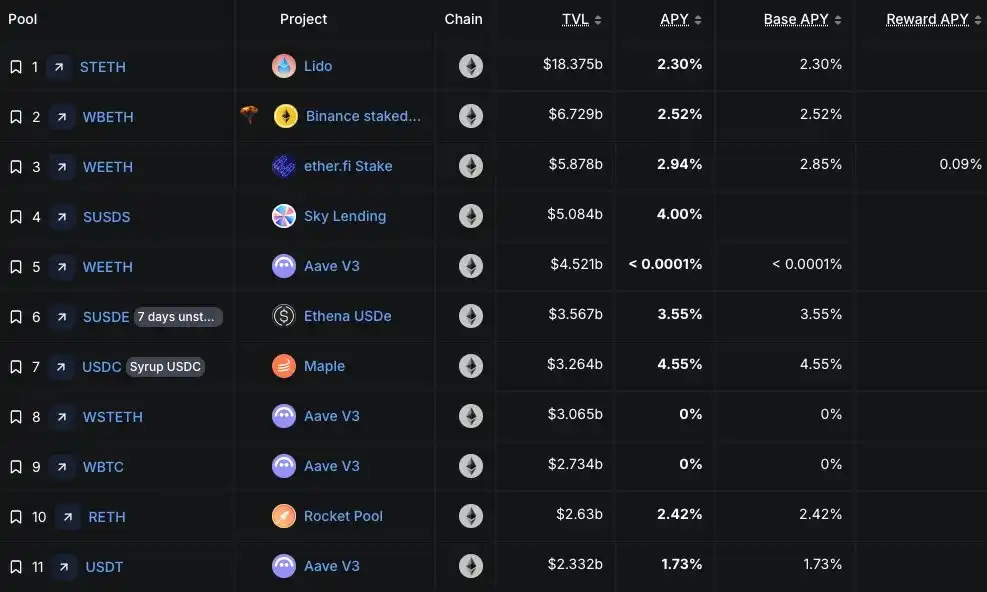
Image Source: DefiLlama
Tokenization and regulated structured products have turned previously untouchable crypto capital into fee-charging AUM that complies with existing custody and risk management frameworks. When companies, DAOs, and protocols accumulate significant crypto debt and seek safer external yields, asset management firms can repackage these assets into tokenized funds, money market funds, structured products. For companies facing fundraising pressure and saturated traditional channels, a "raid" on the crypto asset balance sheet is one of the cleanest paths to growing fee-charging AUM.
A Wake-up Call
Just as Western economies have introduced groups that do not share their culture and values, they are now facing the same social and economic consequences, crypto is standing at a similar existential crisis. The crypto economy and its visionary leaders are introducing financial institutions that do not share our values, these institutions are not here to co-build native economic growth, and our industry will soon taste the same social and economic bitterness.
If left unchecked, the crypto economy will devolve into another liquidity silo of the traditional financial AUM machine. The only way out is to accelerate the building and amplification of our own native institutions—on-chain asset management, risk management, underwriters, financial products, crypto-native allocators—to compete for sovereign AUM, design products that truly serve the long-term interests of crypto, keep more economic value within the crypto ecosystem, rather than flowing out to corporate balance sheets.
If we do not prioritize working with crypto-native institutions now, "institutional adoption" will not be a win, but an assimilation.
Believe in something. Or we will be left with nothing.
You may also like

The arrival of the Web 3.0 era: A review of Hong Kong court rulings on digital assets

Track Markets At a Glance: New WEEX Price Widgets for iOS & Android
To streamline your market data access, WEEX has officially launched "Market Watchlist" desktop widgets

The billion-dollar lesson: The focus of DeFi security is shifting from code to operational governance

A Brief Analysis of Stablecoin Licenses and On-Chain Funding
BVNK Founder: Three Stages of Stablecoin Development

The truth about Trump's son's Bitcoin game: he made a staggering $100 million while retail investors lost $500 million

What Is Futures Trading? Hours, Platforms, and How to Start Trade Futures(2026 Guide)
Learn how to start futures trading, understand trading hours, and choose the best futures trading platform. Includes real data, strategies, and ways to maximize returns with rebates.

The Rise of Composable RWA

MAGA Up 350% in 24 Hours, PEPE Up 46% in One Day: Which Memecoins Are Next in 2026?
MAGA +350% in 24hrs. PEPE +46% in one day. RAVE +4,500% then -90%. In 2026's memecoin market, the gains are real. So are the traps? Here's how to tell the difference before you buy.

RCD Espanyol vs Real Madrid: Can the Pericos Delay the Inevitable?
RCD Espanyol vs Real Madrid lineups, standings, and stats for May 3, 2026. Real Madrid visits RCDE Stadium as Barcelona closes in on the LALIGA title. Full preview inside.
MegaETH goes live with an FDV exceeding 2 billion USD. Which ecological projects are worth paying attention to?

Dialogue with "Wood Sister" Cathie Wood: The next bull market is about to arrive
Can prediction markets win the competition for perpetual contracts?

Who is trading on Trade.xyz?

Binance quietly placed a bet on a leading large model company

Best Crypto Discord Server 2026: Why Jacob’s Crypto Clan Is Gaining Massive Attention
Jacob’s Crypto Clan has grown into one of the most active crypto Discord communities, with over 45K members and continuing to expand. This rapid growth reflects strong demand for structured trading insights and real-time collaboration.

Tom Lee Buying ETH: Why Wall Street’s Loudest Ethereum Bull Keeps Doubling Down
Tom Lee keeps buying ETH through every dip, every drawdown, and every moment of market doubt. Inside the strategy that's turning Ethereum into a treasury asset — and what it signals for the rest of the market.

Stripe Sessions 2026: AI Agent, Global Payments, and Invisible Crypto Infrastructure
The arrival of the Web 3.0 era: A review of Hong Kong court rulings on digital assets
Track Markets At a Glance: New WEEX Price Widgets for iOS & Android
To streamline your market data access, WEEX has officially launched "Market Watchlist" desktop widgets
The billion-dollar lesson: The focus of DeFi security is shifting from code to operational governance
A Brief Analysis of Stablecoin Licenses and On-Chain Funding
BVNK Founder: Three Stages of Stablecoin Development
The truth about Trump's son's Bitcoin game: he made a staggering $100 million while retail investors lost $500 million


