
 Buy Crypto
- Markets
 Futures
- Spot
- Copy Trade
- Earn
- More
Full text of the draft of "U.S. Strategic Bitcoin Reserve": Manage BTC as a permanent national asset

Original source: Bitcoin Policy Institute
Original translation: BitpushNews
On December 17, 2024, the Bitcoin Policy Institute drafted an executive order proposing to establish a strategic Bitcoin reserve under the Trump administration's U.S. Treasury Exchange Stabilization Fund (ESF), which needs to be signed after Trump takes office to take effect.
Bitpush Note: The Bitcoin Policy Institute is a nonpartisan, nonprofit organization dedicated to studying the policy and social impact of Bitcoin and emerging currency networks.
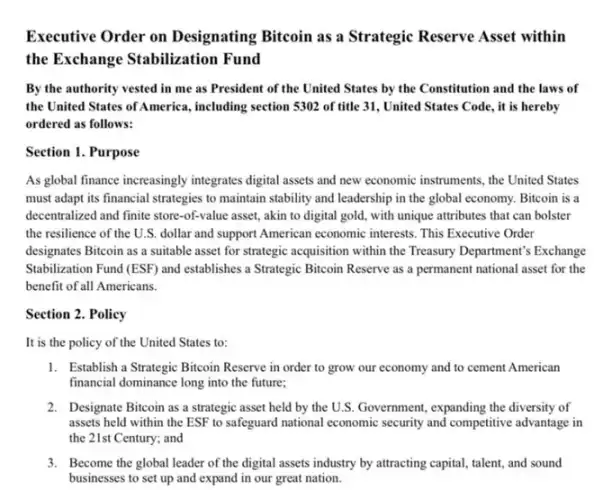
Below is the full text of the Executive Order:
By the authority vested in me by the Constitution and the laws of the United States, including 31 U.S.C. Section 5302, it is hereby ordered as follows:
Section 1. Purpose
As global finance increasingly integrates digital assets and new economic instruments, the United States must adapt its financial strategy to maintain global economic stability and leadership. Bitcoin is a decentralized, finite store of value asset, similar to digital gold, with unique properties that enhance the resiliency of the dollar and support U.S. economic interests.
This Executive Order designates Bitcoin as an asset suitable for strategic acquisition within the Treasury’s Exchange Stabilization Fund (ESF), establishes a strategic Bitcoin reserve, and maintains it as a permanent national asset for the benefit of all Americans.
Section 2. Policy
It is the policy of the United States:
1. Establish a Strategic Bitcoin Reserve to grow our economy and solidify America’s future financial dominance;
2. Designate Bitcoin as a strategic asset held by the U.S. Government, broaden the diversity of assets held by the ESF to protect national economic security and competitive advantage in the 21st century, and promote industry development by attracting capital, talent, and voices;
3. Become a global leader in the digital asset industry, building and expanding businesses across our great nation.
Section 3. Establishment of the SBR and Designation of Bitcoin as a Strategic Reserve Asset
(a) Establishment of a Strategic Bitcoin Reserve
The Strategic Bitcoin Reserve (SBR) is hereby established to be managed by the Secretary of the Treasury and to enhance the diversity of the United States’ reserve assets. To enhance confidence in its mission, the SBR will be subject to regular audits, rigorous security standards, and comprehensive reporting measures to ensure long-term accountability and security.
(b) Consolidation of Government Bitcoin Holding
Not later than 7 days after the date of this order, any bitcoin under the control of any Federal agency, including the United States Marshals Service, shall not be sold, exchanged, auctioned, or otherwise pledged and shall be transferred to the SBR by the head of such Federal agency upon acquisition of legal title to such bitcoin, including upon final, nonappealable judgment in a criminal or civil forfeiture action in favor of the Federal agency.
(c) Designation of Reserve Asset
Bitcoin is hereby designated as a strategic reserve asset suitable for purchase and holding within the ESF. Not later than 60 days after the date of this order, the Secretary of the Treasury is hereby directed to implement a Bitcoin Acquisition Program to acquire and manage Bitcoin within the ESF. The goal of the SBR is to position the United States as the undisputed world leader in Bitcoin holding, innovation, and management, ensuring that U.S. interests, rather than those of foreign competitors, set the standard for global digital asset strategy.
SECTION 4. ACQUISITION AND CUSTODY AGREEMENTS
(a) Acquisition Program
Pursuant to 31 U.S.C. 4 5302, which authorizes the Secretary of the Treasury to “deal with … credit instruments,” the Secretary of the Treasury is hereby directed to appropriate not less than $521 billion from the ESF for the strategic acquisition of Bitcoin for inclusion in the SBR, in a manner consistent with the Secretary’s obligations under law, by purchasing obligations from appropriate counterparties and repaying them in Bitcoin. The Secretary of the Treasury shall work with reputable market participants pursuant to agreements that maximize value and mitigate risk. The initial acquisition program shall be completed not later than 365 days after the date of this order.
(b) Custody and Security Protocols
In order to safeguard the SBR’s bitcoin holdings at all stages, the Secretary of the Treasury shall implement the following phased custody framework. Within 30 days of the date of this order, the Secretary shall confirm that the U.S. Government’s existing relationships with reputable and secure custody service providers are sufficient to ensure immediate, trusted storage solutions for bitcoin within the SBR. The Secretary shall direct that all bitcoin purchases under the acquisition program be securely transferred to such custody service providers.
In parallel, the Secretary shall coordinate with the National Security Agency, the Cybersecurity and Infrastructure Security Agency, the National Institute of Standards and Technology (NIST), and any other agencies requested by the Secretary to develop and implement self-custody protocols (including dedicated hardware, assured software, access controls, geographic distribution, multi-signature controls, and physical security measures) designed to enhance long-term security, reduce reliance on third parties, and maintain full sovereign control over the United States’ bitcoin reserves as a “digital Fort Knox.” The Secretary should ensure that the SBR custody agreement is consistent with ESF audit procedures, rigorous cybersecurity standards, and cryptographic proof of reserve verification to safeguard the integrity of the SBR and the confidence of the American public.
Section 5. Conditions for Sale of the Strategic Bitcoin Reserve
(a) Long-Term Preservation
The SBR should serve as a permanent pillar of America’s financial strength and commitment to the future of the digital economy, in the same enduring spirit that preserved our nation’s gold reserve at Fort North. Bitcoin held in the SBR should not be viewed as a short-term financial instrument or a rainy day fund for day-to-day emergencies, but rather as a generational asset that supports America’s prosperity and security for decades to come. It is the policy of the United States. The Government shall hold (HODL) all Bitcoin acquired in the SBR for at least 25 years after the date of this order.
(b) Strict Limitations on Liquidation
Sales or other divestments of the SBR should be permitted only in the most dire and extraordinary circumstances, which clearly outweigh ordinary financial volatility or geopolitical uncertainty.
(c) Rigorous Approval Process
Before any sale is made, the Secretary of the Treasury shall submit a detailed written decision, accompanied by substantial evidence, demonstrating that the proposed liquidation is in direct response to an extraordinary national economic or security crisis. The decision must be approved by the President of the United States. The Secretary of the Treasury shall not be authorized to sell, pledge, exchange, or otherwise dispose of any portion of the SBR without express authorization.
(d) Transparent and Controlled Execution
In the rare circumstances in which a sale is approved, it should be conducted through the most sensible and tightly controlled methods to minimize market impact and maintain public confidence. Preference should be given to private, staged transactions or other measured methods that ensure that, even in a crisis, the nation's reputation for financial prudence and responsibility remains intact.
Section 6. Reporting and Transparency
(a) Public Reserve Certification
The Secretary of the Treasury shall implement a public reserve certification process using cryptographic certifications. These certifications shall be provided on a quarterly basis to ensure transparency of the ESF’s bitcoin holdings while protecting sensitive security information.
(b) Annual Report
As part of the annual report on the operations of the ESF required by the Gold Reserve Act, the Secretary of the Treasury shall provide detailed information on the status, performance, and strategic advantages of bitcoin within the ESF. The report shall also summarize acquisition strategies, custodial security measures, and impacts on economic stability, subject to considerations of national economic security.
Section 7. Interagency Coordination
The Secretary of the Treasury shall coordinate with the Federal Reserve, the Department of Defense, and other relevant Federal agencies to ensure that the acquisition and management of bitcoin within the ESF is consistent with United States national security, economic stability, and cybersecurity standards.
You may also like

Consumer-grade Crypto Global Survey: Users, Revenue, and Track Distribution

Prediction Markets Under Bias

Stolen: $290 million, Three Parties Refusing to Acknowledge, Who Should Foot the Bill for the KelpDAO Incident Resolution?

ASTEROID Pumped 10,000x in Three Days, Is Meme Season Back on Ethereum?

ChainCatcher Hong Kong Themed Forum Highlights: Decoding the Growth Engine Under the Integration of Crypto Assets and Smart Economy

Why can this institution still grow by 150% when the scale of leading crypto VCs has shrunk significantly?

Anthropic's $1 trillion, compared to DeepSeek's $100 billion

Geopolitical Risk Persists, Is Bitcoin Becoming a Key Barometer?

Annualized 11.5%, Wall Street Buzzing: Is MicroStrategy's STRC Bitcoin's Savior or Destroyer?

An Obscure Open Source AI Tool Alerted on Kelp DAO's $292 million Bug 12 Days Ago

Mixin has launched USTD-margined perpetual contracts, bringing derivative trading into the chat scene.
The privacy-focused crypto wallet Mixin announced today the launch of its U-based perpetual contract (a derivative priced in USDT). Unlike traditional exchanges, Mixin has taken a new approach by "liberating" derivative trading from isolated matching engines and embedding it into the instant messaging environment.
Users can directly open positions within the app with leverage of up to 200x, while sharing positions, discussing strategies, and copy trading within private communities. Trading, social interaction, and asset management are integrated into the same interface.
Based on its non-custodial architecture, Mixin has eliminated friction from the traditional onboarding process, allowing users to participate in perpetual contract trading without identity verification.
The trading process has been streamlined into five steps:
· Choose the trading asset
· Select long or short
· Input position size and leverage
· Confirm order details
· Confirm and open the position
The interface provides real-time visualization of price, position, and profit and loss (PnL), allowing users to complete trades without switching between multiple modules.
Mixin has directly integrated social features into the derivative trading environment. Users can create private trading communities and interact around real-time positions:
· End-to-end encrypted private groups supporting up to 1024 members
· End-to-end encrypted voice communication
· One-click position sharing
· One-click trade copying
On the execution side, Mixin aggregates liquidity from multiple sources and accesses decentralized protocol and external market liquidity through a unified trading interface.
By combining social interaction with trade execution, Mixin enables users to collaborate, share, and execute trading strategies instantly within the same environment.
Mixin has also introduced a referral incentive system based on trading behavior:
· Users can join with an invite code
· Up to 60% of trading fees as referral rewards
· Incentive mechanism designed for long-term, sustainable earnings
This model aims to drive user-driven network expansion and organic growth.
Mixin's derivative transactions are built on top of its existing self-custody wallet infrastructure, with core features including:
· Separation of transaction account and asset storage
· User full control over assets
· Platform does not custody user funds
· Built-in privacy mechanisms to reduce data exposure
The system aims to strike a balance between transaction efficiency, asset security, and privacy protection.
Against the background of perpetual contracts becoming a mainstream trading tool, Mixin is exploring a different development direction by lowering barriers, enhancing social and privacy attributes.
The platform does not only view transactions as execution actions but positions them as a networked activity: transactions have social attributes, strategies can be shared, and relationships between individuals also become part of the financial system.
Mixin's design is based on a user-initiated, user-controlled model. The platform neither custodies assets nor executes transactions on behalf of users.
This model aligns with a statement issued by the U.S. Securities and Exchange Commission (SEC) on April 13, 2026, titled "Staff Statement on Whether Partial User Interface Used in Preparing Cryptocurrency Securities Transactions May Require Broker-Dealer Registration."
The statement indicates that, under the premise where transactions are entirely initiated and controlled by users, non-custodial service providers that offer neutral interfaces may not need to register as broker-dealers or exchanges.
Mixin is a decentralized, self-custodial privacy wallet designed to provide secure and efficient digital asset management services.
Its core capabilities include:
· Aggregation: integrating multi-chain assets and routing between different transaction paths to simplify user operations
· High liquidity access: connecting to various liquidity sources, including decentralized protocols and external markets
· Decentralization: achieving full user control over assets without relying on custodial intermediaries
· Privacy protection: safeguarding assets and data through MPC, CryptoNote, and end-to-end encrypted communication
Mixin has been in operation for over 8 years, supporting over 40 blockchains and more than 10,000 assets, with a global user base exceeding 10 million and an on-chain self-custodied asset scale of over $1 billion.

$600 million stolen in 20 days, ushering in the era of AI hackers in the crypto world
Vitalik's 2026 Hong Kong Web3 Summit Speech: Ethereum's Ultimate Vision as the "World Computer" and Future Roadmap
On the same day Aave introduced rsETH, why did Spark decide to exit?
Full Post-Mortem of the KelpDAO Incident: Why Did Aave, Which Was Not Compromised, End Up in Crisis Situation?

After a $290 million DeFi liquidation, is the security promise still there?
ZachXBT's post ignites RAVE nearing zero, what is the truth behind the insider control?




 App
App