
 Buy Crypto
- Markets
 Futures
- Spot
- Copy Trade
- Earn
- More
Finding the Top 10 Ways to Spot an AI Agent

Original Title: "Ten Ways to Find the Top AI Agent"
Original Author: Zhou Zhou, Foresight News
Over the past month, AI Agent has sparked a new wave of excitement in the crypto industry.
In less than a month, the total market capitalization of the entire AI Agent race reached billions of dollars. Virtuals reached a market capitalization of 30 billion dollars, while ai16z, Fartcoin, and others reached a market capitalization of 10 billion dollars. According to incomplete statistics from Foresight News, there are at least 14 AI Agent-related cryptocurrencies with a market cap of over 100 million dollars.

Many Web3 practitioners have stated that AI Agent may be one of the biggest narratives of this cycle, similar to DeFi, NFTs, and the Metaverse that appeared in the last two cycles. So, when a brand-new crypto narrative is born in its early stages, how can we use a good methodology to find the leading AI Agent crypto project? The author attempts to list ten methods for the readers' enjoyment.
One, On-Chain Revenue Method
This method is more suitable for assessing platform-type AI Agents, such as Clanker, vvaifu.fun, Virtuals, etc. If there is a surge in on-chain revenue and on-chain transaction volume every day, such as consecutive days of rapid growth, it may indicate that this AI Agent may have good development potential. Conversely, it may mean that the development has stagnated.
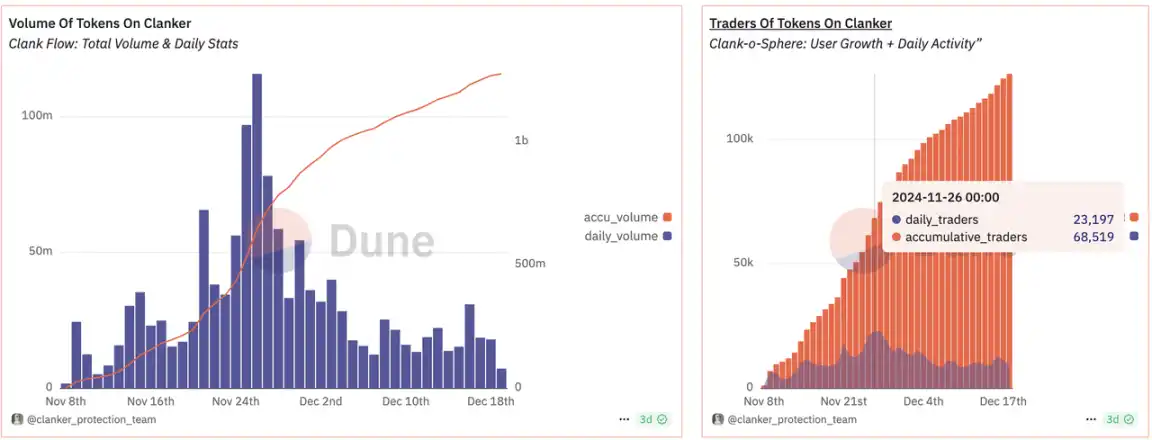
Image Source: Dune
For example, Clanker, as a star project of the Base ecosystem AI Agent, can be seen from on-chain data that after November 26, both the token issuance, traders, and on-chain revenue began to decline, and this trend was immediately reflected in the token price as well.
Two, Developer Attention Method
Having more stars on GitHub may indicate that there is more developer attention and recognition of this framework. This method is more suitable for evaluating framework-type AI Agents, such as Eliza.
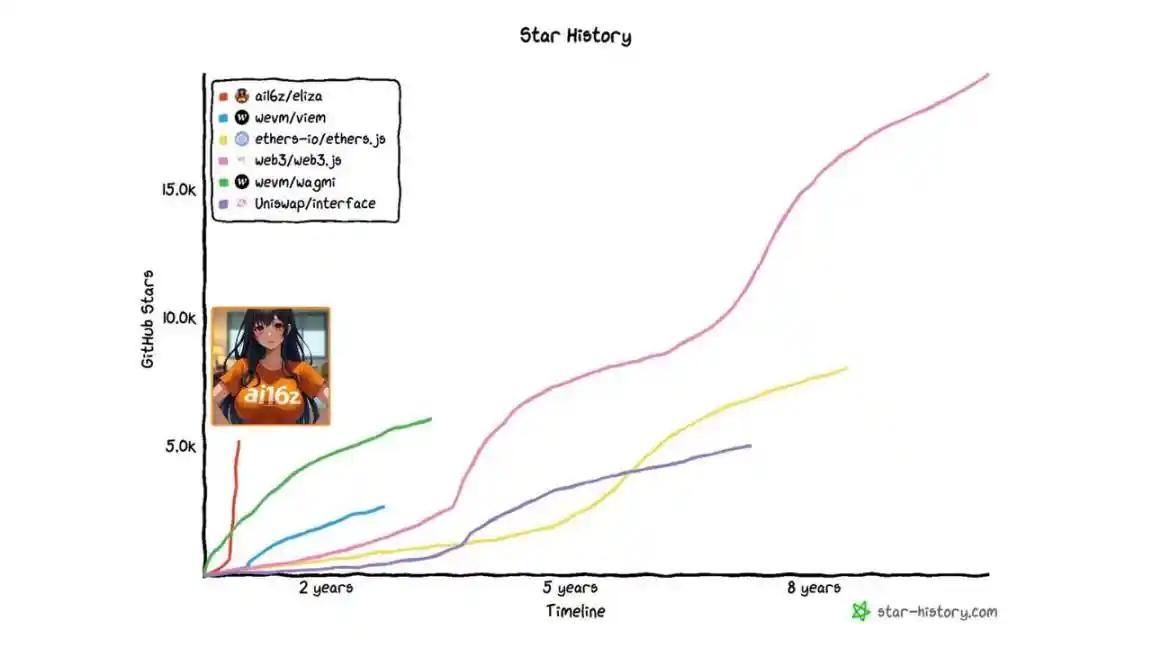
Search Github to see the developer attention of framework-type AI Agents, that is, how many stars they have. For example, ai16z/Eliza received 5300 stars in less than a month. This is a very astonishing data.
Data Source: GitHub
As shown in the above figure, we can see the developer attention of ai16z/Eliza, which surpassed uniswap in just one month. This demonstrates the developers' interest in this framework. Another set of data can also be compared: Sui currently has 6400 stars, Solana has 13,000 stars, Ethereum has 50,000 stars, Base has 70,000 stars.
However, it is important to note that stars on GitHub can also be inflated, although such behavior is not common. So, this metric can serve as a supplementary reference for decision-making.
Three, KOL Fan Count Method
A more certain track for AI Agents is: KOL (Key Opinion Leader).
Currently, well-known AI Agent-style KOLs include: Terminal of Truths (210,000 fans), aixbt (160,000 fans), Zerebro (60,000 fans), Eliza (14,000 fans), LUNA (30,000 fans on Twitter, 500,000 fans on TIKTOK), etc.
One major difference in this AI revolution is the semantic shift. The author predicts that an AI Agent will emerge as a KOL leader, and the market capitalization of this leader's token may even exceed $5 billion. The change in fan count may become an important measure.
Four, Thought Leader Influence Method
There are constantly thought leaders in the AI industry entering the Crypto space. Currently, founders like Marc Andreessen of a16z (represents supported projects: ai16z) and Sam Altman (represents supported project: Worldcoin) have brought multiple billion-dollar cryptocurrencies to the crypto industry. It can be expected that there will be more in the future, such as Musk and his founded Grok.
There are also less certain entities, such as Apple, Meta, TikTok, and companies like Claude, Copilot, Gemini. These AI vendors may bring something different to the Crypto space.
Special attention needs to be paid to tech giants who are actively researching both AI and Crypto, such as Musk, Marc Andreessen, Sam Altman, and Huang Renxun. Their leadership in the tech industry often has a significant influence on the crypto industry as well.
Five, External World Breaking Method
If the AI Agent is indeed one of the key narratives of this cycle, additional focus is required on the AI Agent's impact on the external world. For example, Web2 developers are being drawn to Web3's AI Agent frameworks and products, and as far as the author knows, Eliza is currently attracting some AI practitioners from outside the industry.
Products in the KOL space, such as Terminal of Truths and LUNA, have also caught the attention of outsiders, each already having over 200,000 followers, and their influence continues to grow. It is important to understand and assess whether this trend will further break through the industry's boundaries and impact a broader external world.
Six, Top Exchange "Listing Effect" Method
Early participants in Sandbox may be aware that some Metaverse concepts skyrocketed after being listed on Binance. Top exchanges are called top exchanges for a reason; they need to ensure that the coins they list can lead the market. If other exchanges take the lead, they will gradually lose their top exchange status.
Prioritize monitoring the listing information and Launchpad information of Binance, Upbit, Coinbase, Bitget, and Hype, as these five exchanges are vigorously competing in the "listing effect" during this cycle.
Particularly for Coinbase and Hype, Americans are indeed ahead of other regions in the broad AI Agent field, giving them potentially quicker access to information advantages.
Seven, Public Chain Method
Some public chains naturally lend themselves to the birth of AI Agent projects, naturally lowering the barrier to entry for AI Agent projects. Identifying a few good public chains and then finding excellent AI Agent projects on those chains can significantly amplify efforts.
For example, Base, with its developers' stars numbering 70,000, surpassing Ethereum by far and also outperforming Solana and Sui, can be considered a standout player in the latecomer's advantage.
Coinbase itself also places great emphasis on AI Agent, making early strategic moves. This will give them a significant first-mover advantage in future competitions.
While Solana's advantage lies in its well-developed meme platform, the AI Agent relies heavily on memes to rise, making this a significant strength of Solana.
8. Community Law of AI Agents
Everyone has their own blind spots, but the power of a team is all-encompassing and thorough.
Establishing your own AI Agent communication group and community, or finding one or two high-quality communities, is crucial. Opportunities for AI Agents often arise in unnoticed corners, requiring the power of a community at such times.
9. Race Track Segmentation Method
AI Agents are also divided into various tracks, such as the KOL track, the beautiful female anchor track, the investment research blogger track, the meme platform track, the VC track, the platform track, the framework track, etc.
There are many tracks within AI Agents, and not all tracks can go unchallenged. It is necessary to find the truly promising tracks that can survive until the end.
10. Source Law
Who was the first to start at the very beginning? Which AI Agent initiated the narrative of the entire track; perhaps it is the leader of this track.
In the NFT track, CryptoPunks has always held a transcendent position, Ape has created a new narrative for the entire track, and the Fat Penguin is one of the best NFTs combining with Web2; in the metaverse track, Sandbox, Decentraland were among the early leaders on major exchanges and occupied the leading position in the metaverse; Uniswap pioneered the concept of an automated market maker in a decentralized exchange (DEX) and became a market pioneer... Projects that achieve systemic innovation often receive the largest portion of the track's dividend.
It will make you feel like it's expensive forever, just like BTC, but looking back, you'll find that it was really cheap at that time.
You may also like

Consumer-grade Crypto Global Survey: Users, Revenue, and Track Distribution

Prediction Markets Under Bias

Stolen: $290 million, Three Parties Refusing to Acknowledge, Who Should Foot the Bill for the KelpDAO Incident Resolution?

ASTEROID Pumped 10,000x in Three Days, Is Meme Season Back on Ethereum?

ChainCatcher Hong Kong Themed Forum Highlights: Decoding the Growth Engine Under the Integration of Crypto Assets and Smart Economy

Why can this institution still grow by 150% when the scale of leading crypto VCs has shrunk significantly?

Anthropic's $1 trillion, compared to DeepSeek's $100 billion

Geopolitical Risk Persists, Is Bitcoin Becoming a Key Barometer?

Annualized 11.5%, Wall Street Buzzing: Is MicroStrategy's STRC Bitcoin's Savior or Destroyer?

An Obscure Open Source AI Tool Alerted on Kelp DAO's $292 million Bug 12 Days Ago

Mixin has launched USTD-margined perpetual contracts, bringing derivative trading into the chat scene.
The privacy-focused crypto wallet Mixin announced today the launch of its U-based perpetual contract (a derivative priced in USDT). Unlike traditional exchanges, Mixin has taken a new approach by "liberating" derivative trading from isolated matching engines and embedding it into the instant messaging environment.
Users can directly open positions within the app with leverage of up to 200x, while sharing positions, discussing strategies, and copy trading within private communities. Trading, social interaction, and asset management are integrated into the same interface.
Based on its non-custodial architecture, Mixin has eliminated friction from the traditional onboarding process, allowing users to participate in perpetual contract trading without identity verification.
The trading process has been streamlined into five steps:
· Choose the trading asset
· Select long or short
· Input position size and leverage
· Confirm order details
· Confirm and open the position
The interface provides real-time visualization of price, position, and profit and loss (PnL), allowing users to complete trades without switching between multiple modules.
Mixin has directly integrated social features into the derivative trading environment. Users can create private trading communities and interact around real-time positions:
· End-to-end encrypted private groups supporting up to 1024 members
· End-to-end encrypted voice communication
· One-click position sharing
· One-click trade copying
On the execution side, Mixin aggregates liquidity from multiple sources and accesses decentralized protocol and external market liquidity through a unified trading interface.
By combining social interaction with trade execution, Mixin enables users to collaborate, share, and execute trading strategies instantly within the same environment.
Mixin has also introduced a referral incentive system based on trading behavior:
· Users can join with an invite code
· Up to 60% of trading fees as referral rewards
· Incentive mechanism designed for long-term, sustainable earnings
This model aims to drive user-driven network expansion and organic growth.
Mixin's derivative transactions are built on top of its existing self-custody wallet infrastructure, with core features including:
· Separation of transaction account and asset storage
· User full control over assets
· Platform does not custody user funds
· Built-in privacy mechanisms to reduce data exposure
The system aims to strike a balance between transaction efficiency, asset security, and privacy protection.
Against the background of perpetual contracts becoming a mainstream trading tool, Mixin is exploring a different development direction by lowering barriers, enhancing social and privacy attributes.
The platform does not only view transactions as execution actions but positions them as a networked activity: transactions have social attributes, strategies can be shared, and relationships between individuals also become part of the financial system.
Mixin's design is based on a user-initiated, user-controlled model. The platform neither custodies assets nor executes transactions on behalf of users.
This model aligns with a statement issued by the U.S. Securities and Exchange Commission (SEC) on April 13, 2026, titled "Staff Statement on Whether Partial User Interface Used in Preparing Cryptocurrency Securities Transactions May Require Broker-Dealer Registration."
The statement indicates that, under the premise where transactions are entirely initiated and controlled by users, non-custodial service providers that offer neutral interfaces may not need to register as broker-dealers or exchanges.
Mixin is a decentralized, self-custodial privacy wallet designed to provide secure and efficient digital asset management services.
Its core capabilities include:
· Aggregation: integrating multi-chain assets and routing between different transaction paths to simplify user operations
· High liquidity access: connecting to various liquidity sources, including decentralized protocols and external markets
· Decentralization: achieving full user control over assets without relying on custodial intermediaries
· Privacy protection: safeguarding assets and data through MPC, CryptoNote, and end-to-end encrypted communication
Mixin has been in operation for over 8 years, supporting over 40 blockchains and more than 10,000 assets, with a global user base exceeding 10 million and an on-chain self-custodied asset scale of over $1 billion.

$600 million stolen in 20 days, ushering in the era of AI hackers in the crypto world
Vitalik's 2026 Hong Kong Web3 Summit Speech: Ethereum's Ultimate Vision as the "World Computer" and Future Roadmap
On the same day Aave introduced rsETH, why did Spark decide to exit?
Full Post-Mortem of the KelpDAO Incident: Why Did Aave, Which Was Not Compromised, End Up in Crisis Situation?

After a $290 million DeFi liquidation, is the security promise still there?
ZachXBT's post ignites RAVE nearing zero, what is the truth behind the insider control?




 App
App