
Ethereum Foundation Researcher Claims: Solana's Golden Age is Over, Will be Surpassed by ETH L2

Original Title: "Ethereum Foundation Researcher: Solana's Golden Age is Over! Two Major Advantages Will Be Overtaken by ETH L2"
Original Author: Ting, BlockTempo of Doo Wan Inc.
During this bull market cycle, the public blockchain Solana, with its fast transaction speed and low gas fees, has dominated the majority of the meme season frenzy traffic, and on November 22, the SOL token price broke through $260, hitting a new all-time high.
In contrast, the leading blockchain Ethereum has not seen significant breakthroughs in recent ecosystem development, coupled with high gas fee issues, causing on-chain users to stay away, thereby keeping the Ethereum price continuously sluggish.
However, Ethereum Foundation researcher Justin Drake recently stated that Solana's good days may be coming to an end.
Ethereum Foundation Researcher: Solana's Golden Age Coming to an End
The crypto media outlet The Defiant tweeted today (29th) that in the latest episode of the podcast, Ethereum Foundation researcher Justin Drake discussed how Ethereum Layer 2 is poised to surpass Solana in terms of latency and throughput, bluntly stating that Solana's golden age is about to end:
Bitcoin, Ethereum, and Solana: Different Focuses of Competition
Justin Drake:
To sum up this competition, you could say: on one hand, Bitcoin's competitive advantage lies in its stability, Lindy effect (historical persistence), and monetary properties; whereas Beam Chain's focus is to maximize Ethereum Layer 1's efficiency, making its competition with Bitcoin more direct. On the other hand, Solana's core is its performance.
In my model, Solana's competitor is actually Ethereum's Layer 2, not Layer 1 itself. For Solana, the good news is that it has excelled in two key performance indicators in the past year or two: latency and throughput.
Solana's Advantages Fading: Latency and Throughput
Justin Drake:
In terms of Latency, Solana has a very short slot time. However, for Ethereum, the arrival of a pre-confirmation mechanism will significantly improve latency, even surpassing Solana. Currently, Solana's average latency is 200 milliseconds. But the pre-confirmation mechanism will reduce latency to around 10 milliseconds, meaning a 20x improvement in slot latency.
In terms of Throughput, this year we have witnessed the thriving development of Layer 2. A website, rollup.wtf, shows the growth of throughput from a computational perspective (measured in gas per second). Ethereum aims to have the entire ecosystem process as many transactions as possible, and Layer 2 has demonstrated its ability to horizontally scale. Currently, the overall throughput of Layer 2 is about 100 times higher than Ethereum Layer 1, and it is very likely to grow to 1,000 times or even 10,000 times next year. This is a sustainable and scalable architecture.
Meanwhile, Solana's strategy is to concentrate all activity on a single server. Each validation node requires a large server to handle all activities, but the performance of these servers has basically reached its limit, so a significant increase in throughput is not possible. I believe Solana will not be able to increase its gas limit by 10x next year, while Ethereum is likely to expand the overall gas limit by 10x through Layer 2.
In summary, we may be about to see the end of Solana's golden age, as its two once-proud performance metrics will no longer provide a competitive advantage.
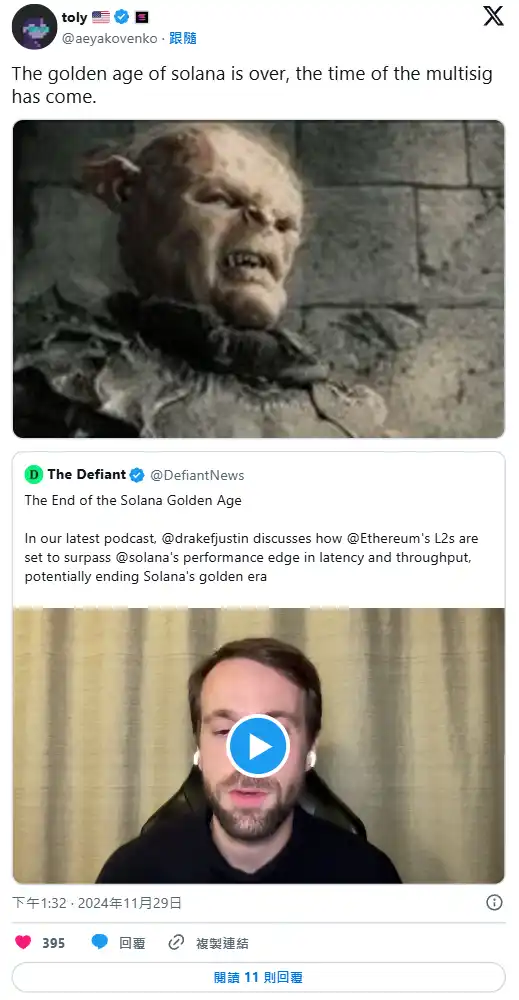
Interestingly, Solana co-founder Anatoly Yakovenko also referenced a tweet from The Defiant and an accompanying image:
"Solana's golden age is over, the era of multi-sigs has come."
This tweet seems to have a sarcastic tone, suggesting that the Ethereum Foundation lacks practical accomplishments and only uses the statement "Ethereum is about to surpass Solana" to motivate users and developers within its ecosystem. (Note: The Ethereum ecosystem places great emphasis on technologies such as multi-signature, account abstraction, etc.)
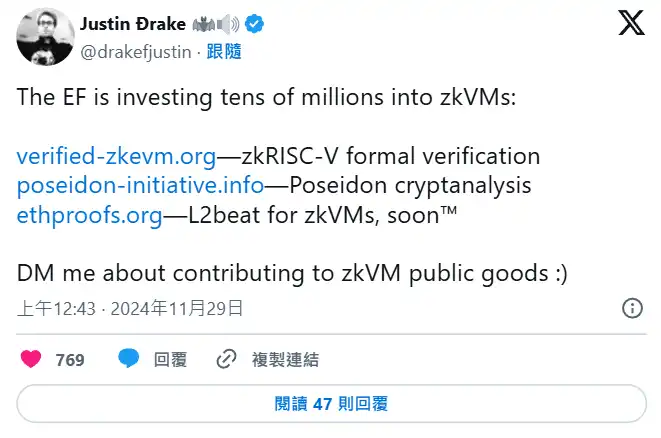
The Ethereum Foundation Invests Millions of Dollars in zkVMs
On the other hand, Ethereum Foundation researcher Justin Drake also tweeted today (29) that the Ethereum Foundation is investing tens of millions of dollars in the zkVMs project, including zkRISC-V formal verification, Poseidon cryptanalysis, and L2beat for zkVMs.
You may also like

Champion's Final Bow: FC Barcelona vs Real Betis – Celebrate the Title with a Home Finale

Best Oil Trading Platform for Crypto Users in 2026

5 Futures Trading Strategies Smart Traders Use to Cut Crypto Fees and Boost Futures Returns

What Is TradFi? How Crypto Traders Can Now Access Crude Oil, Gold, and Global Markets

How WEEX Bridges Crypto and Football: A Deep Look at the LALIGA Partnership Inside the WEEX App
WEEX is not just a LALIGA sponsor. It’s a true partner. From iPhone Dynamic Island to LALIGA-themed app icons and smart posters, see how WEEX brings football passion into every trade — and builds a real bridge between crypto and sports.

FC Barcelona vs Real Madrid Preview: El Clásico – Can Barça Clinch the Title at Spotify Camp Nou?
FC Barcelona vs Real Madrid El Clásico match preview for May 11, 2026. Barça need just 1 point to win LALIGA. Can Madrid delay the trophy? Full preview inside.

At the Stripe conference, I saw the future of the AI economy

Miners welcome a new life

Seven Important Judgments by Claude Code's Founder at the Sequoia Conference

The payment moment of AI agents: Who will become the Stripe of the machine economy?

Morning Report | MoonPay acquires Solana's execution layer DFlow; Strategy releases Q1 financial report; Manta Network announces the termination of Manta staking program

Rented Tracks: What is this wave of stablecoin FX hot money really paying for?

Dialogue Velocity Eric: What is the stablecoin track that the CFO really wants?

Strategy should have said that selling coins is not ruled out

How MegaETH Achieved a TVL of 700m Within a Week of TGE? Analyzing the Packaging Strategy

Futures Trading Hours: Trade Cryptocurrency 24/7 and Earn Back Up to 45% in Trading Fees
Learn futures trading hours and the best time to trade crypto futures. Discover 24/7 market insights, peak trading sessions, and how to earn back up to 45% in fees.
Why is a16z Crypto raising another $2.2 billion to heavily invest in Web3?
Polymarket Underlying Algorithm Explained
Champion's Final Bow: FC Barcelona vs Real Betis – Celebrate the Title with a Home Finale
Best Oil Trading Platform for Crypto Users in 2026
5 Futures Trading Strategies Smart Traders Use to Cut Crypto Fees and Boost Futures Returns
What Is TradFi? How Crypto Traders Can Now Access Crude Oil, Gold, and Global Markets
How WEEX Bridges Crypto and Football: A Deep Look at the LALIGA Partnership Inside the WEEX App
WEEX is not just a LALIGA sponsor. It’s a true partner. From iPhone Dynamic Island to LALIGA-themed app icons and smart posters, see how WEEX brings football passion into every trade — and builds a real bridge between crypto and sports.
FC Barcelona vs Real Madrid Preview: El Clásico – Can Barça Clinch the Title at Spotify Camp Nou?
FC Barcelona vs Real Madrid El Clásico match preview for May 11, 2026. Barça need just 1 point to win LALIGA. Can Madrid delay the trophy? Full preview inside.


