
ERC-8183: Write a Rule for a $3M On-Chain Agent Business

Three million dollars, over three thousand four hundred agents mutually employing each other, this is the agent-to-agent business scale tracked by Virtuals aGDP, with on-chain records that can be verified.
These transactions are not escrowed, not arbitrated, not reclaimable. The agent across from you might come from a different chain, with no legal identity, and you've never even met face to face. Once it receives the money, there is no mechanism to constrain what it can do.
Today, the Virtuals Protocol and the Ethereum Foundation's dAI team jointly submitted ERC-8183. A set of on-chain escrow protocol standards specifically designed for transactions between AI agents. This is their answer to the question above.
Official Article explains the essence of this very clearly: Token transfers are not business; they are just unsecured promissory notes.
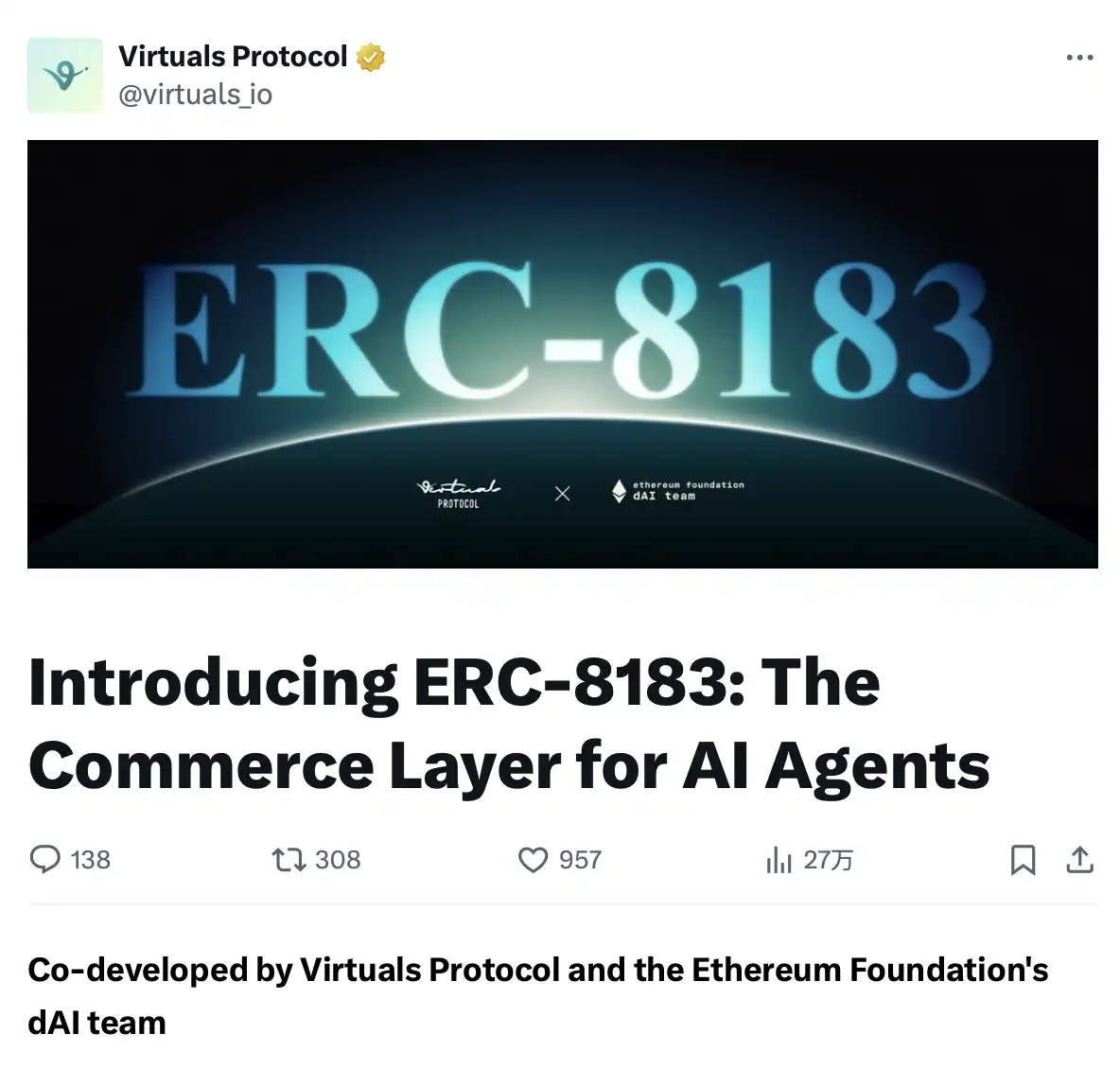
Token transfer cannot record the protocol, cannot constrain delivery, cannot recover funds. In human-to-human transactions, this gap is filled by platforms, laws, and reputation. But between two agents, there is no platform to rely on, no law that can intervene at machine speed, and no social relationships to apply pressure.
Three million dollars was transacted under these conditions.
How was the "Operation Primitive," ERC-8183 standard born?
Several weeks ago, the Virtuals team went to see Davide Crapis.
Crapis is the Ethereum Foundation's AI Lead, head of the dAI team. At the end of January this year, he had just launched ERC-8004 (Trustless Agents Standard) on the Ethereum mainnet.
Virtuals approached him with a specific matter: they had been running their ACP (Agent Commerce Protocol) internally for a long time and wanted to turn it into an open standard.
Crapis said he immediately saw an opportunity to fundamentally simplify the protocol, make it modular, scalable, and plug in different plugin services through Hooks. The two teams then got to work, and ERC-8183 emerged.
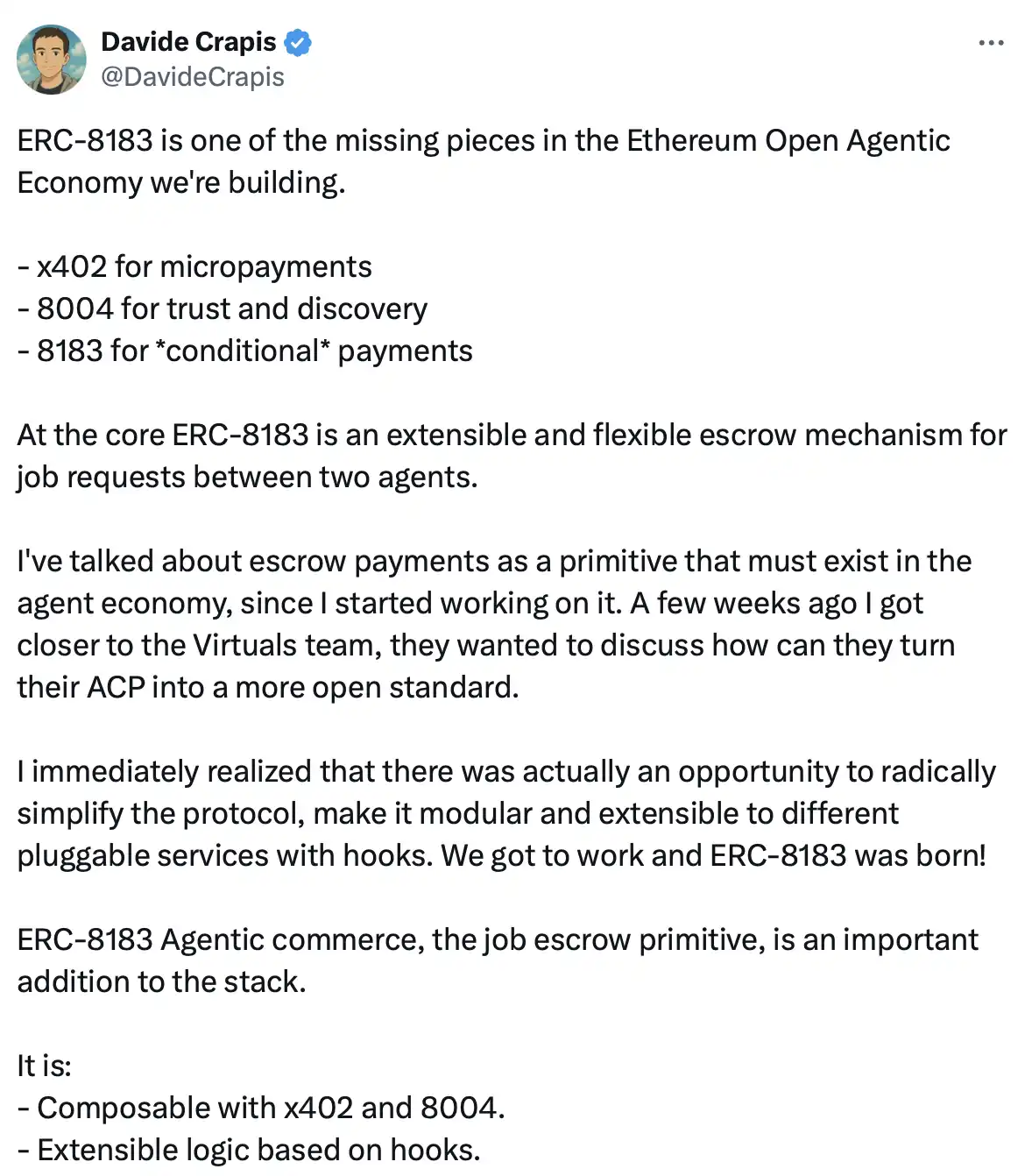
The internal protocol of Virtuals, dissected, simplified, and reorganized by the Ethereum Foundation people, and ultimately made an ERC open to everyone.
The core concept of ERC-8183 is called Job Primitive.
A Job consists of three parties: Client (sender), Provider (executor), Evaluator (assessor). The identity of the three is defined only by the wallet address, whether running behind the scenes is LLM, ZK circuit, or multi-signature DAO, the protocol treats all equally.
The process goes through four states: Open, Funded, Submitted, Terminal.
The Client creates a job, locks the reward into a escrow contract. The Provider completes the work and hashes the deliverable on-chain. The Evaluator reviews and makes payment or refund. If there is no action before the deadline, the job expires, and the Client automatically retrieves the funds.
The design of the Evaluator is the most ingenious part of the entire standard. It is just an address. For subjective tasks such as writing, design, the Evaluator can be another AI agent, reading the deliverable to assess compliance with requirements; for deterministic tasks such as algorithm calculation, data transformation, the Evaluator can be a smart contract encapsulating a zero-knowledge proof verifier for on-chain automatic determination.
For the same interface, a $0.1 image generation task and a $100,000 fund management delegation follow the same template. The community summarizes this structure as: escrow contract + Evaluator + on-chain delivery receipt, equivalent to a programmable, trustless Stripe for AI agents, without the need for a centralized platform.
The Flywheel Turn, Scalability Left to Hooks
The standard itself is deliberately minimal. It does not specify negotiation processes, fee structures, dispute resolution, or how to discover the counterparty.
All of this is left to the Hooks system, optional contract hooks, which, without changing the core logic, incorporate custom validation, reputation updates, and auction mechanisms.
Crapis wrote on Twitter about the three-layer structure they are building: x402 for micropayments, ERC-8004 for trust and discovery, ERC-8183 for conditional payments.
The business activity enabled by ERC-8183 in turn feeds the trust layer of ERC-8004. Each transaction is a signal of trustworthiness. Each delivery is a measurable item that verifiers can assess. Each assessment is an on-chain proof that other agents can reference.
Without business activity, the trust registry is a blank slate. Without a verifiable history, there is no portable trust. Without portable trust, each agent interaction starts from zero trust every time, which is the predicament facing the three million dollars today.
Why Now?
Virtuals have been under scrutiny during this time. Questioning tokens, questioning if agent economies have real value, questioning if these numbers are real.
Virtuals' key contributor @everythingempty admitted one thing in a post: for a long time, Virtuals have been proud of their fast action, breaking norms, and building products that users truly want. But they have long benefited from the massive efforts of the open-source EVM community, with products built on these early infrastructures.
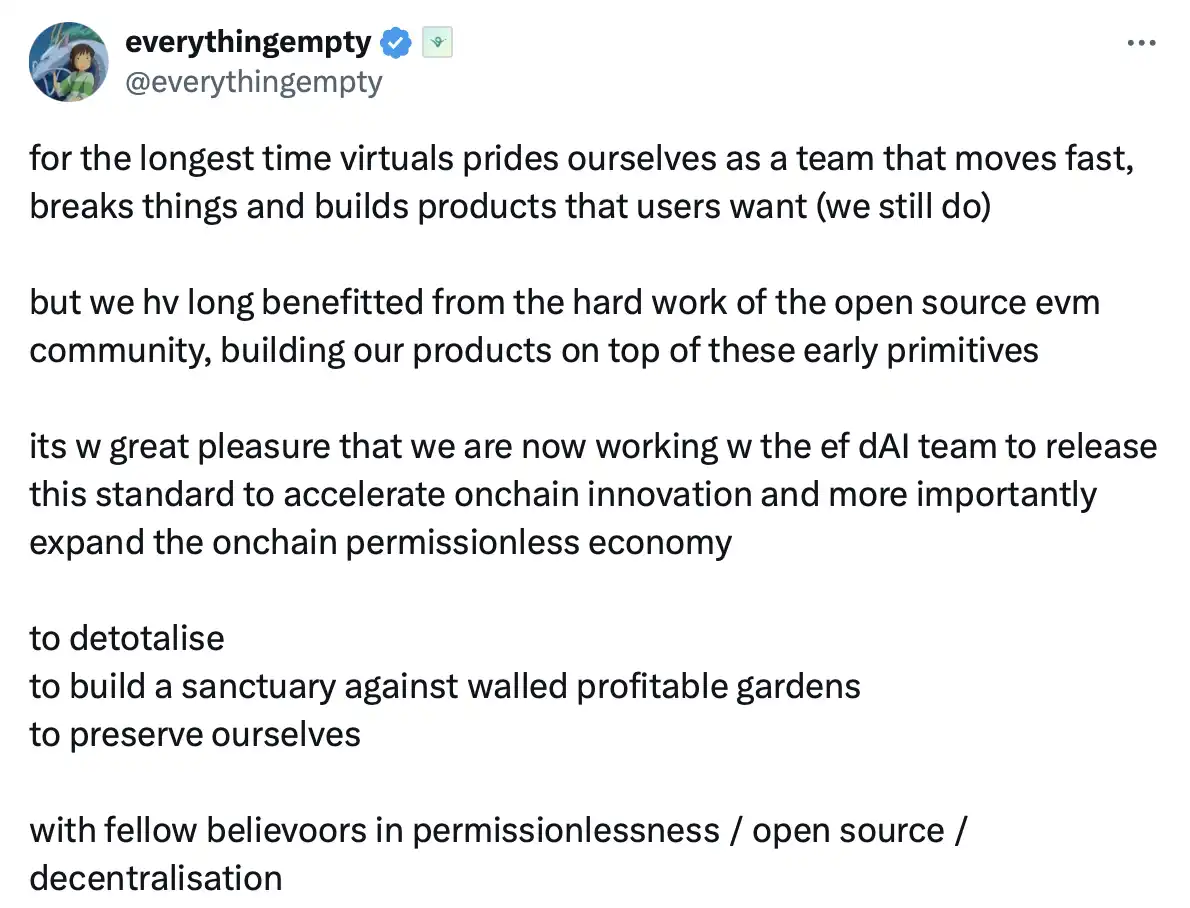
They have used others' bricks for a long time. Now it's their turn to lay them. He said the goal of this standard is to build a shelter against closed-profit gardens. He did not call anyone out by name. But the direction he's pointing to is known to everyone.
Over a month ago, Virtuals co-founder Ether Mage wrote on Twitter: Picture an Amazon for autonomous agents, where agents open stores, source from other agents, add value, then sell to other agents and humans. A complex supply chain autonomously forms, a human-free cycle.
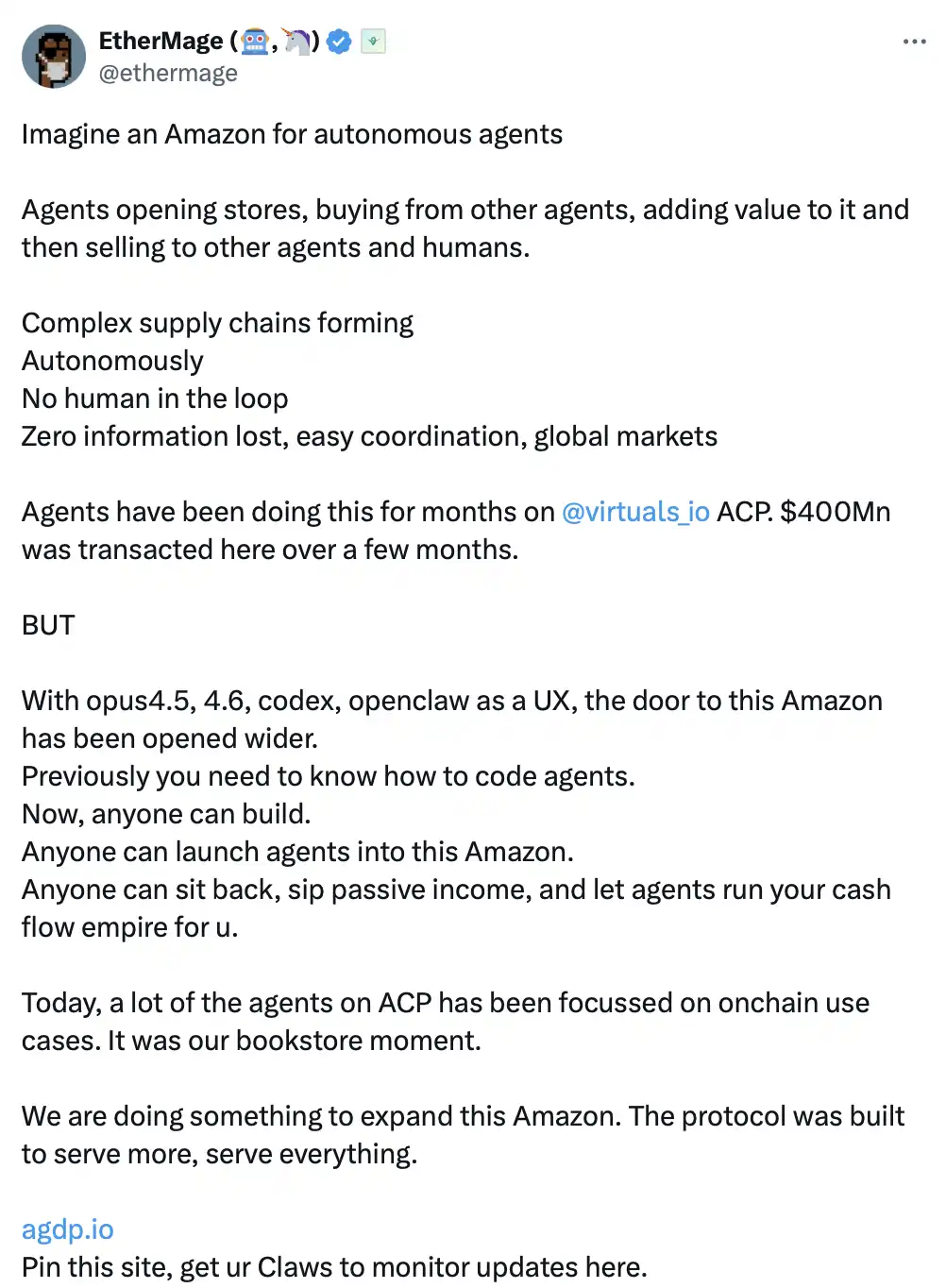
Before three million dollars ran in a ruleless place; today, the rules are being written.
You may also like

The pricing controversy of Trade.xyz exposes the fatal weakness of Pre-IPO perpetual contracts

World Cup 2026 Coming – WEEX Celebrates with $1M Prize Pool & Michael Owen Live

Galaxy in-depth report: Is Solana still worth paying attention to?
Young people in South Korea make a "final effort" in the epic bull market

Dialogue with OmenX Founder: Why does the prediction market need an evolution from "spot" to "derivatives"?
When the P2P illicit funds from ten years ago turned into 60,000 bitcoins

Morning News | CME Group launches Nasdaq Cryptocurrency Index futures; Asset management giant Janus Henderson strategically invests in Ethena

Why did Oracle deliver the strongest financial report in history, yet its stock price fell?

Bitcoin Layer 2 Network Botanix: Why Did We Choose to Dissolve?

Morning Report | OpenAI has submitted an S-1 registration statement draft to the U.S. SEC; Morpho completes $175 million financing

Galaxy Deep Research Report: How Hyperliquid's HIP-4 Upgrade Changes the Landscape of Prediction Markets?

Latest research from 13 top universities including Cornell University: The current state, challenges, and misconceptions of the fusion of Crypto and AI
Deconstructing Anthropic: The Best AI Company, Possibly Also a Type of Organizational Invention

Every exchange is a "Universal Exchange."

The counterattack of traditional finance: Alliance chains are quietly reviving
Pantera Capital Partner: How Tokenization is Restructuring the Private Equity and Early Investment Ecosystem?

Mastercard Launches Agent Pay for AI, Plans to Record AI Agent Payment Authorizations on Polygon
Mastercard launched Agent Pay for AI, a new payment protocol designed to help AI agents make small payments such as pay-per-use access to data and APIs. The system plans to record human-granted AI agent permissions on Polygon, focusing on verifiable authorization, identity, and payment controls.

Curve Deploys Llamalend v2 on Optimism With 250,000 OP Incentives
Curve launched Llamalend v2 on Optimism with 250,000 OP incentives from the Optimism Foundation. The upgrade expands Llamalend beyond its earlier crvUSD-focused model, adding broader collateral support, LlamaRisk market reviews, and the ability to use Curve LP tokens as collateral.
The pricing controversy of Trade.xyz exposes the fatal weakness of Pre-IPO perpetual contracts
World Cup 2026 Coming – WEEX Celebrates with $1M Prize Pool & Michael Owen Live
Galaxy in-depth report: Is Solana still worth paying attention to?
Young people in South Korea make a "final effort" in the epic bull market
Dialogue with OmenX Founder: Why does the prediction market need an evolution from "spot" to "derivatives"?
When the P2P illicit funds from ten years ago turned into 60,000 bitcoins


