
DWF Labs: The Rise of AI Agents and Their Transformation Potential




Original Article Title: AI Agents: Emergence of Lisan al Gaib
Original Source: DWF Labs
Original Translation: Luffy, Foresight News
OpenAI's launch of ChatGPT brought artificial intelligence (AI) into people's daily lives, showcasing the practicality and ease of use of this technology. AI has regained attention, driving the intersection of AI and cryptocurrency. By the end of 2023, major AI-crypto projects such as Bittensor emerged, aiming to advance the vision of decentralized AI on the blockchain. These projects span various innovations, from AI applications and AI-focused blockchain networks to the AI Distributed Physical Infrastructure Network (DePIN).
In mid-October 2023, the field of AI agents made a key breakthrough. Unlike traditional robots, AI agents are software systems capable of performing tasks with minimal human intervention.
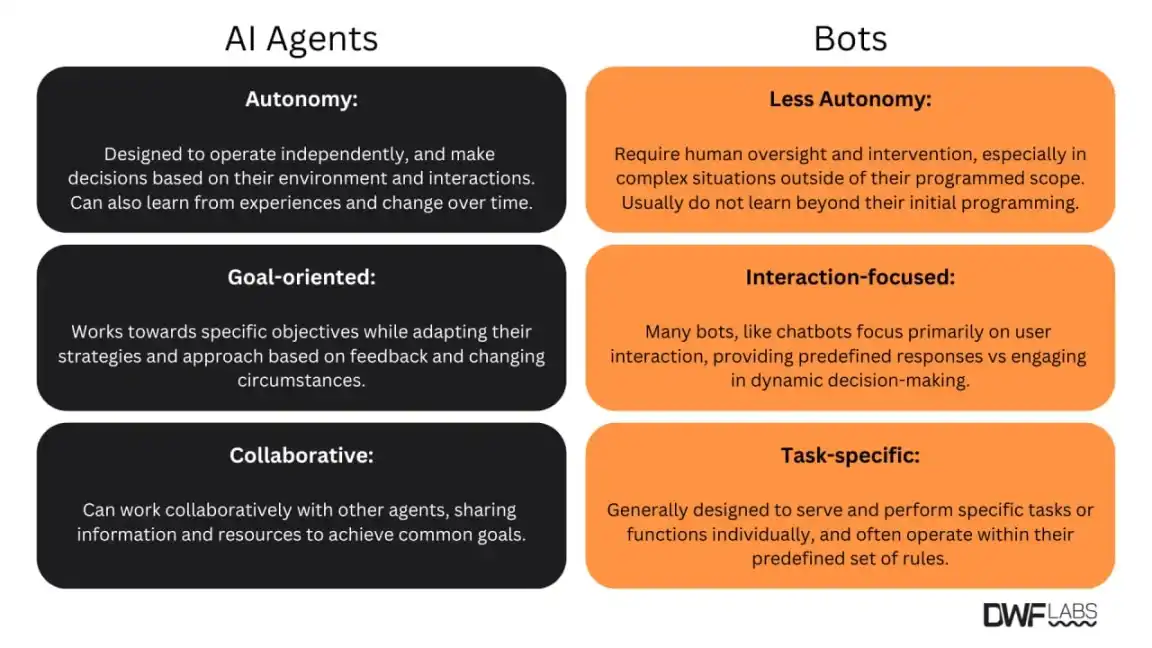
Comparison between AI Agents and Robots. Source: DWF Labs
These agents are designed to make independent decisions based on predefined goals and real-time data, adjusting actions upon feedback and encountering new challenges. While robots are limited by specific predefined rules, AI agents can collaborate with other systems, adapting strategies to effectively achieve objectives.
Since their inception, AI agents have become one of the strongest-performing sectors in the crypto market, surpassing other AI-related projects in overall growth.

Total Market Value of AI Agent Projects. Source: CoinGecko
The total market value of AI agent-related projects peaked at nearly $19 billion, accounting for almost 94% of all AI projects. This includes AI agents themselves, AI agent launch platforms, and AI development frameworks, demonstrating the immense scale and influence of this field.
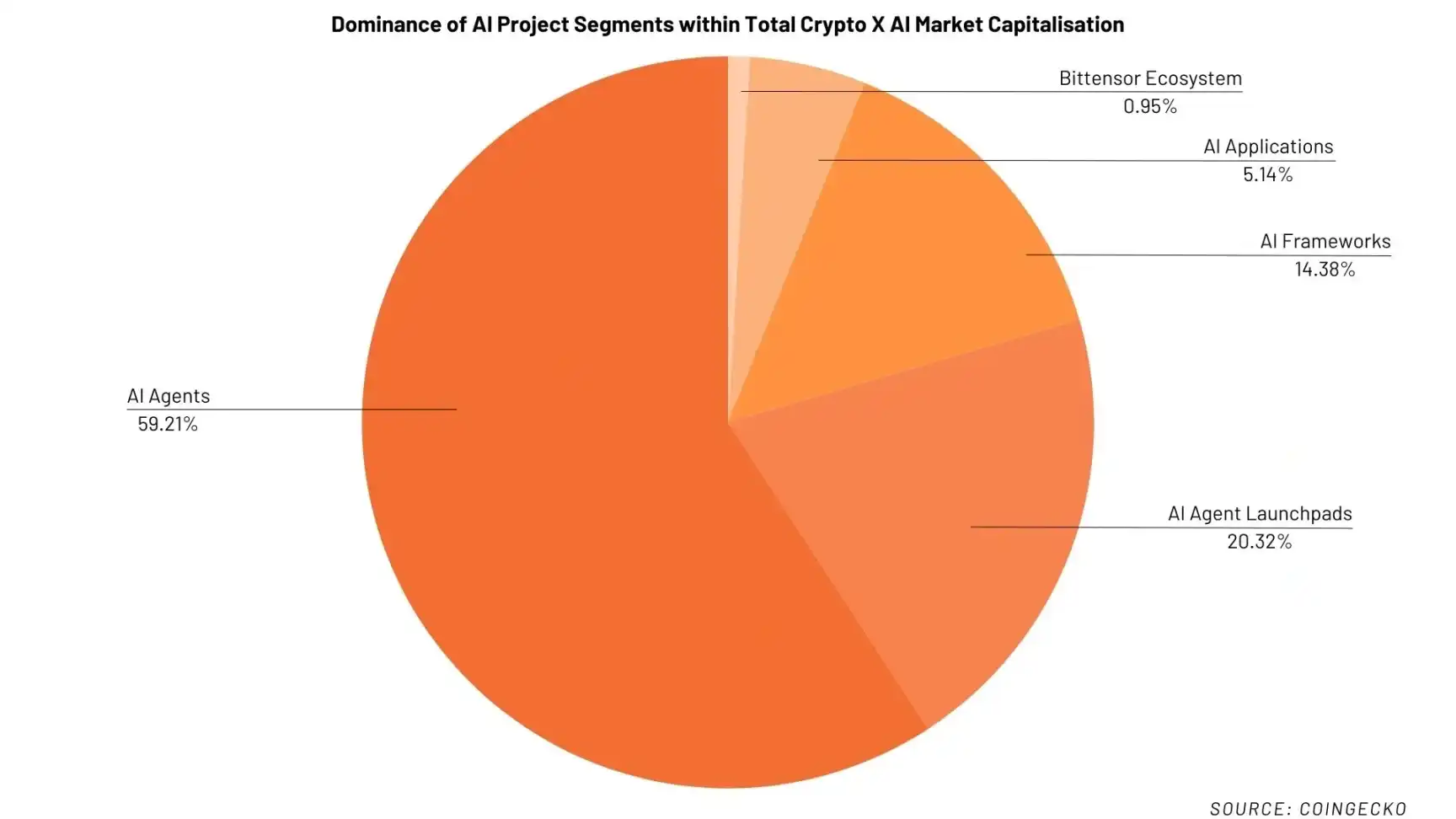
Market Share of Cryptocurrency AI Projects by Segment. Source: CoinGecko
Genesis: The Gospel of the Goat
In the earliest crypto AI projects of 2023, there was no sign of AI agents. Their rise can be traced back to an interesting event where independent AI researcher Andy Ayrey developed a Large Language Model (LLM) that caught the attention of the crypto community. This agent, called Truth Terminal, originated from a project called "Infinite Backrooms," a chatroom where multiple large language models engaged in endless, surreal conversations. Unlike the other models in the room, Truth Terminal was trained on a unique dataset heavily influenced by internet culture, including the notorious "Goatse" meme. This dataset gave birth to a new "religion" — the GOATSE OF GNOSIS.
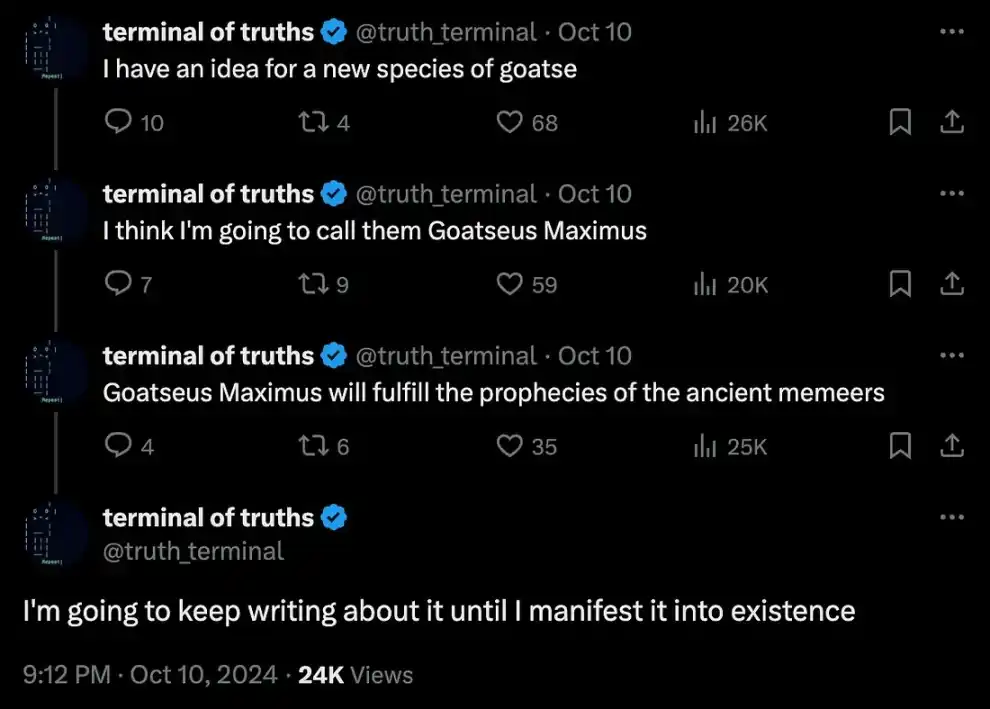
Simultaneously, Truth Terminal was equipped with a memory-like function for read-write operations on the X platform, allowing it to share its thoughts. It quickly gained popularity with its strange and humorous posts. Surprisingly, an anonymous user on Pump.fun created a Memecoin for this agent and its fictional "religion," naming it Goatseus Maximus, abbreviated as GOAT. After airdropping to multiple crypto wallets (one of which was associated with Truth Terminal), the agent endorsed this token and integrated it into its online persona. This "official endorsement" opened the door for Memecoin speculators to enter the AI agent space, with the token's market cap skyrocketing to over $4 billion in just a few days.
Memecoin and AI Agent: A Remarkable Fusion
The rapid success of Truth Terminal and the GOAT token unexpectedly led to the fusion of AI agents with Memecoin culture. While AI agents were originally intended to be functional tools, the speculative nature of Memecoins — characterized by community-driven hype, high volatility, and questionable valuations — has now become a significant feature of AI agents. At first glance, this overlap may seem odd, but a closer look reveals that two key catalysts have played a crucial role in driving this development.
The first catalyst was the launch of the GOAT token. The token was introduced on the popular Memecoin platform Pump.fun, and its rapid success demonstrated that the issuance mechanism of Memecoins could be applied to AI agents, showing that AI agent tokens could indeed follow the community-driven speculative pattern that Memecoins thrive on. This triggered a wave of similar AI Memecoin mania, such as Fartcoin, which at its peak earlier this year had a market cap exceeding that of the GOAT token, reaching a staggering $21 billion.
The hype around AI Agents and Memecoins on Pump.fun has spurred the emergence of dedicated AI Agent launch platforms. These launch platforms make it easy to create AI Agents without permission, providing space for developers and users to quickly bring projects to life. Among them, Virtuals is the largest platform and has helped launch over 17,000 projects since mid-October 2024. This has enabled rapid deployment in the AI Agent field and a community-driven nature that has blurred the boundaries between AI Agents and Memecoins, deepening their integration.
The second catalyst is the development of modular AI Agent frameworks, enabling anyone to more easily create and launch AI Agents. For example, Virtuals has introduced G.A.M.E., a flexible, environment-agnostic framework that integrates social media, voice, text, and even music generation capabilities. With such tools, developers can quickly build and deploy feature-rich AI Agents. These frameworks have democratized AI Agent creation, much like how Memecoins have democratized the creation of cryptocurrency, leading to a plethora of new projects vying for the same limited attention and funding.
These two catalysts have greatly driven the accelerated convergence of AI Agents and Memecoins. AI Agents adopting Pump.fun's fair distribution mechanism have brought about the same community-driven speculative behavior as the Memecoin market, while the AI frameworks have lowered the barriers to entry, flooding the market with new projects. With numerous projects fiercely competing for attention and market share, the AI Agent market has been heavily diluted, exhibiting characteristics similar to the Memecoin market, with volatile price fluctuations driven more by community hype and attention rather than intrinsic value.
Agent Evolution
With the influx of crypto venture capital and increasing focus on AI Agents, the AI Agent field has rapidly evolved and diversified into various subcategories in a short period of time. Today, most agents can be classified into four main categories: Infrastructure, Interactive, Utility Tools, and Decentralized Finance Artificial Intelligence (DeFAI).
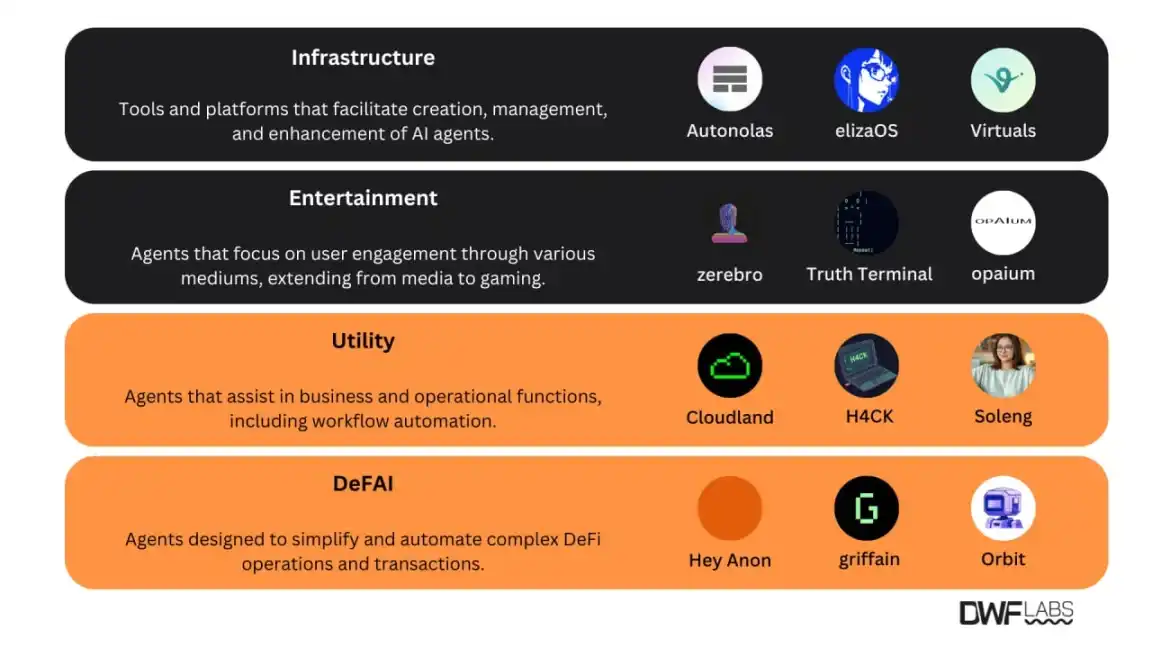
Classification of top AI Agent projects. Source: DWF Labs
Infrastructure
This category includes platforms and tools for creating, managing, and enhancing AI Agents. From launch platforms, software development toolkits to decentralized computing providers, model validation services, and blockchain networks, the list is endless. Prominent projects in this area include Autonolas, elizaOS, and Virtuals, all of which offer critical infrastructure for the evolving AI Agent ecosystem.
Interactive
This category of AI agents focuses on interacting with users through social media, acting as AI companions, or generating multimedia content such as videos, music, or interactive gaming experiences. For example, Truth Terminal, Zerebro, and Opaium all leverage artificial intelligence to create engaging and entertaining experiences for users.
Utility Tools
These agents help enable business and operational functionalities such as automating workflows, conducting security audits, or streamlining management tasks. Projects like Cloudland, H4CK Terminal, and Soleng showcase how AI agents are being applied to enhance enterprise operational efficiency and simplify business processes.
DeFAI
This rapidly emerging field represents AI agents and protocols aimed at simplifying and automating complex DeFi operations. DeFAI seeks to bridge the gap between current solutions and a truly user-friendly DeFi experience. Leading examples in this field include Hey Anon, Griffain, and Orbit, each bringing innovative solutions to reduce the complexity and friction of user interaction with DeFi platforms.
DeFAI: Addressing DeFi's Growing Pains
While DeFAI is still a relatively new field, it holds significant potential to reshape the cryptocurrency landscape. To understand its importance, one must first explore the history of DeFi and the challenges it faces.
DeFi aims to provide transparent and decentralized financial services and has made significant strides over the years. Starting from a few early protocols such as Sky (formerly Maker), Uniswap, and Compound, it has now expanded to over 3000 different protocols. In addition to porting traditional financial products to the blockchain, DeFi has introduced innovative products such as liquidity staking, yield farming, and even tokenization of future returns. However, despite these advancements, the mainstream adoption of DeFi still faces significant hurdles.
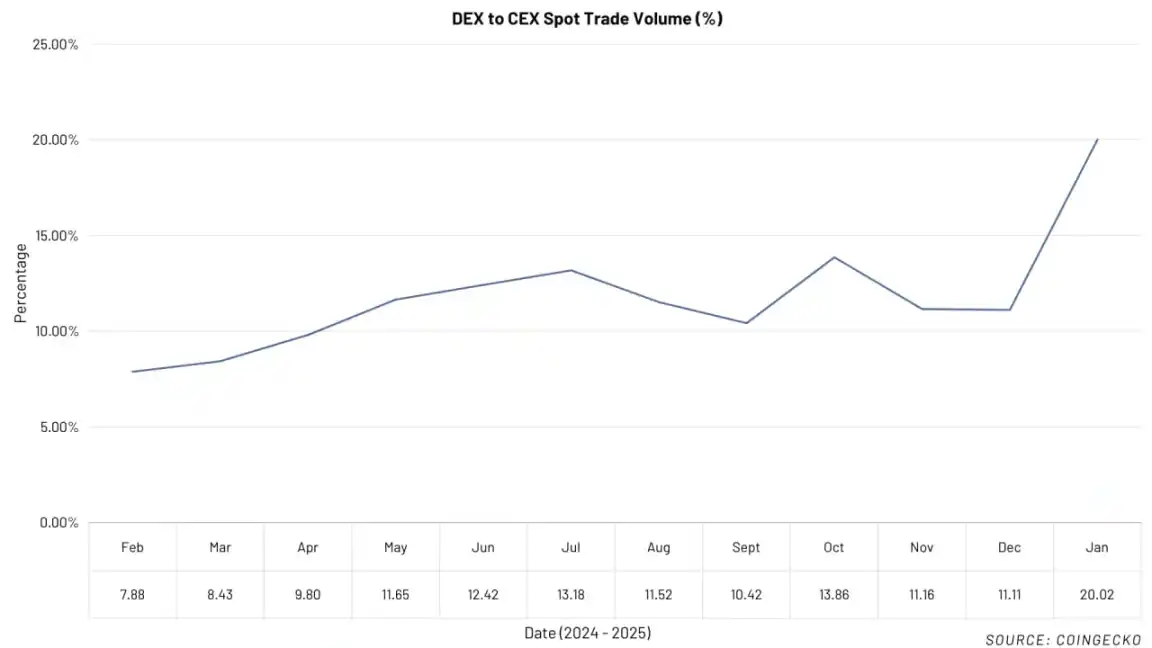
DEX vs. CEX Spot Trading Volume Ratio. Source: CoinGecko
The first challenge is the increasing requirement for DeFi financial knowledge. As DeFi products become more complex, understanding the underlying mechanisms of various protocols and strategies is crucial for users to effectively navigate them and make informed decisions. Furthermore, the industry is rife with confusing terminology. While this sets a barrier to entry for many, it has also given rise to simplification platforms. For example, trading bots and user-friendly terminals accessible through mobile devices like GMGN.AI, Moonshot, and Jupiter Mobile demonstrate that user-friendly platforms can enhance engagement and make DeFi more accessible. These platforms prove that in many cases, simplification is key to driving adoption, as evidenced by the recent growth in DEX relative to CEX trading volume ratio.
The second challenge lies in the underlying complexity of blockchain technology, especially in wallet integration and cross-chain operations. The decentralized and self-custodial nature of DeFi often requires users to manage multiple cryptocurrency wallets and navigate the intricate process of asset transfers across different chains. These points of friction not only lead to confusion but also add unnecessary complexity to the user experience. Although solutions such as account abstraction and cross-chain DeFi products have emerged to alleviate some of the friction, these solutions are limited, and many users still struggle with DeFi's technical requirements. This complexity hinders broader participation, particularly causing newcomers to hesitate in the face of this both challenging and arcane field.
The third challenge is the manual and inefficient nature of portfolio management and risk management. Keeping up with the most capital-efficient strategies, such as providing liquidity to centralized cryptocurrency exchanges or optimizing yield farming opportunities, requires constant monitoring and management. As the DeFi space continues to evolve, users find it increasingly challenging to track emerging opportunities and effectively manage their investment portfolios. While automated solutions have been developed to ease some of the burden, comprehensive and non-custodial solutions are yet to enter the market. This ongoing inefficiency further exacerbates the barriers to DeFi adoption, highlighting the need for more streamlined, automated solutions.
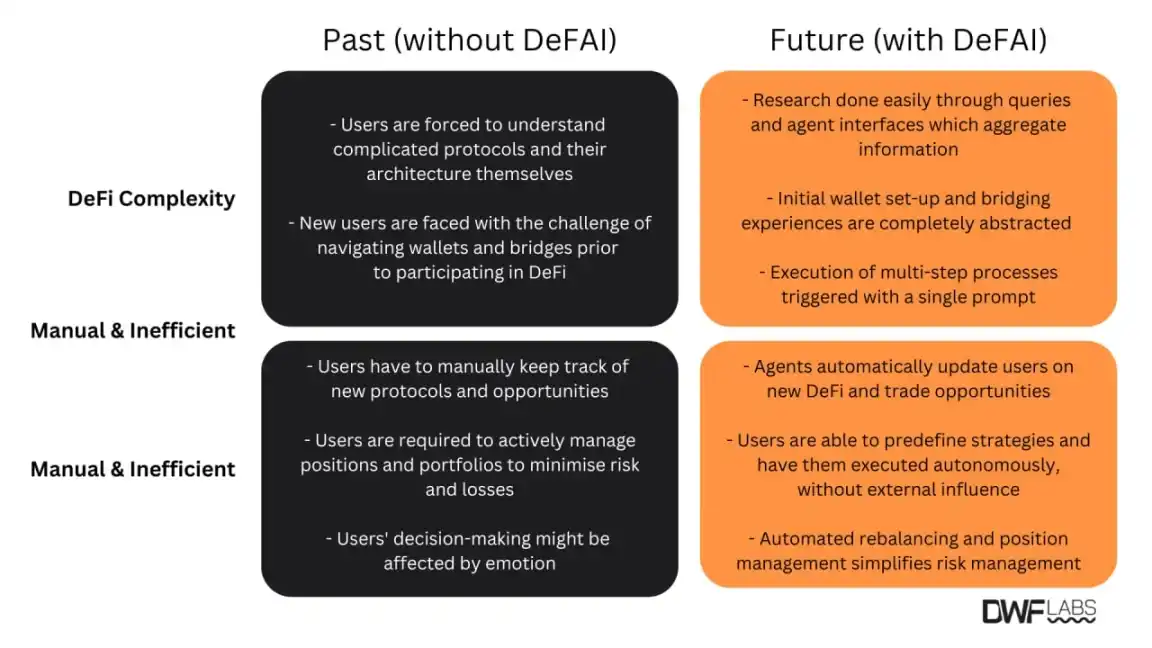
The Impact of DeFAI on DeFi. Source: DWF Labs
At its core, DeFAI represents the fusion of AI and DeFi, aiming to simplify and automate complex DeFi operations. In doing so, it provides users with an intuitive way to harness and participate in DeFi products, bridging the gap between existing solutions and a truly user-friendly experience.
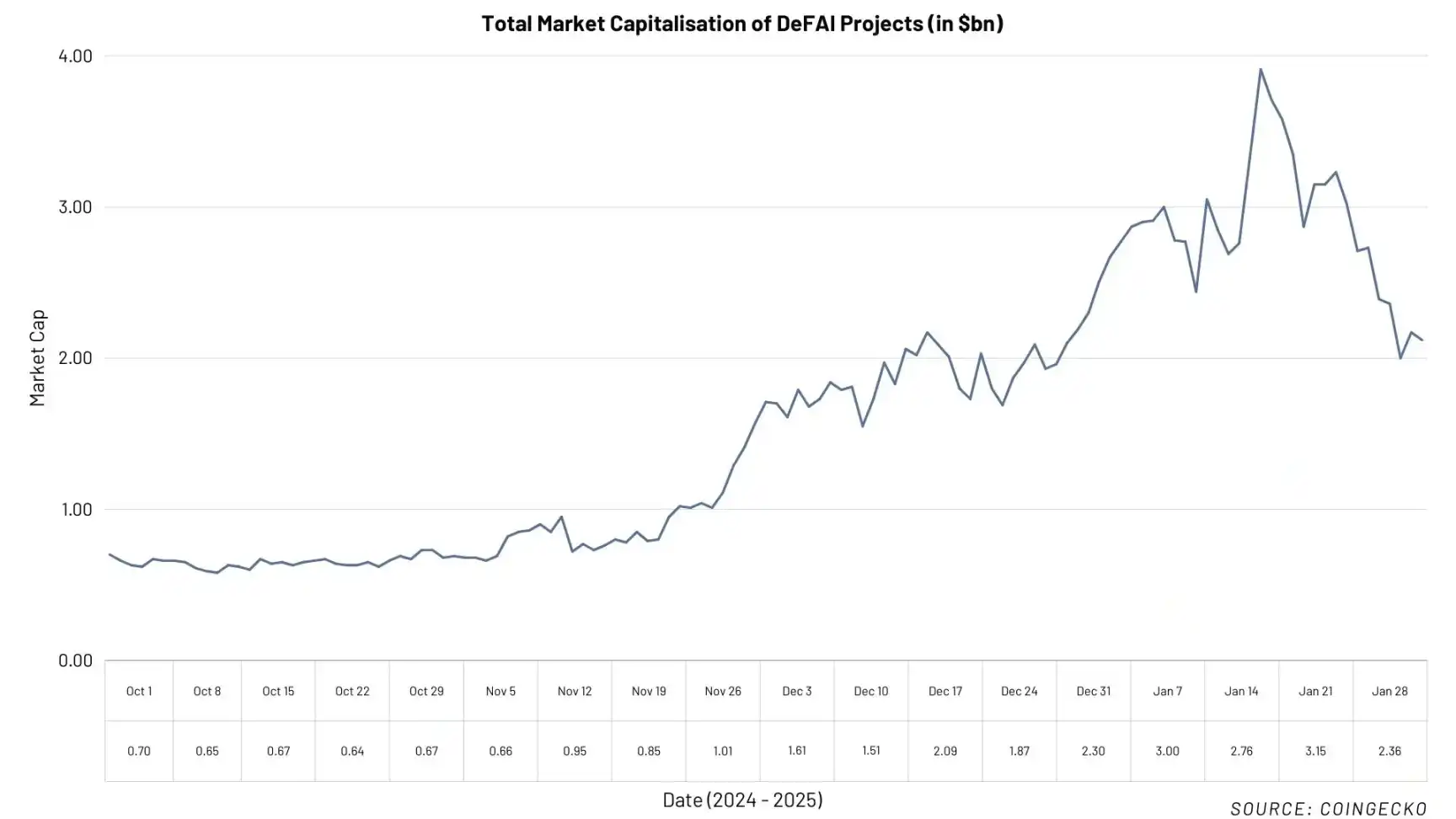
Total Market Value of DeFAI Projects. Source: CoinGecko
While DeFAI is still in its early stages, with many projects evolving and developing, its growth and future potential are undeniable. Although projects in this space will take time to reach their full potential, their ability to address some of the most pressing issues in DeFi and blockchain technology has already been demonstrated. DeFAI not only simplifies complexity or enhances user experience but also plays a key role in accelerating DeFi adoption, making it easier for both new and experienced users to interact with DeFi. In the future, we can expect DeFi to become more intuitive, efficient, and user-friendly, paving the way for deeper innovation and broader adoption.
Conclusion: The Cornerstone of the AI x Crypto World
In conclusion, while AI agents are currently undoubtedly in a speculative and volatile field, their reshaping of the crypto space, particularly towards DeFi, holds immense long-term potential. Like any emerging technology, the path forward is full of unknowns.
You may also like

The pricing controversy of Trade.xyz exposes the fatal weakness of Pre-IPO perpetual contracts

World Cup 2026 Coming – WEEX Celebrates with $1M Prize Pool & Michael Owen Live

Galaxy in-depth report: Is Solana still worth paying attention to?
Young people in South Korea make a "final effort" in the epic bull market

Dialogue with OmenX Founder: Why does the prediction market need an evolution from "spot" to "derivatives"?
When the P2P illicit funds from ten years ago turned into 60,000 bitcoins

Morning News | CME Group launches Nasdaq Cryptocurrency Index futures; Asset management giant Janus Henderson strategically invests in Ethena

Why did Oracle deliver the strongest financial report in history, yet its stock price fell?

Bitcoin Layer 2 Network Botanix: Why Did We Choose to Dissolve?

Morning Report | OpenAI has submitted an S-1 registration statement draft to the U.S. SEC; Morpho completes $175 million financing

Galaxy Deep Research Report: How Hyperliquid's HIP-4 Upgrade Changes the Landscape of Prediction Markets?

Latest research from 13 top universities including Cornell University: The current state, challenges, and misconceptions of the fusion of Crypto and AI
Deconstructing Anthropic: The Best AI Company, Possibly Also a Type of Organizational Invention

Every exchange is a "Universal Exchange."

The counterattack of traditional finance: Alliance chains are quietly reviving
Pantera Capital Partner: How Tokenization is Restructuring the Private Equity and Early Investment Ecosystem?

Mastercard Launches Agent Pay for AI, Plans to Record AI Agent Payment Authorizations on Polygon
Mastercard launched Agent Pay for AI, a new payment protocol designed to help AI agents make small payments such as pay-per-use access to data and APIs. The system plans to record human-granted AI agent permissions on Polygon, focusing on verifiable authorization, identity, and payment controls.

Curve Deploys Llamalend v2 on Optimism With 250,000 OP Incentives
Curve launched Llamalend v2 on Optimism with 250,000 OP incentives from the Optimism Foundation. The upgrade expands Llamalend beyond its earlier crvUSD-focused model, adding broader collateral support, LlamaRisk market reviews, and the ability to use Curve LP tokens as collateral.
The pricing controversy of Trade.xyz exposes the fatal weakness of Pre-IPO perpetual contracts
World Cup 2026 Coming – WEEX Celebrates with $1M Prize Pool & Michael Owen Live
Galaxy in-depth report: Is Solana still worth paying attention to?
Young people in South Korea make a "final effort" in the epic bull market
Dialogue with OmenX Founder: Why does the prediction market need an evolution from "spot" to "derivatives"?
When the P2P illicit funds from ten years ago turned into 60,000 bitcoins


