
 Buy Crypto
- Markets
 Futures
- Spot
- Copy Trade
- Earn
- More
Does the US Intentionally "Want" a Recession?

Original Author: The Kobeissi Letter
Original Translation: Deep Tide TechFlow
Is the U.S. Government Expecting an Economic Recession?
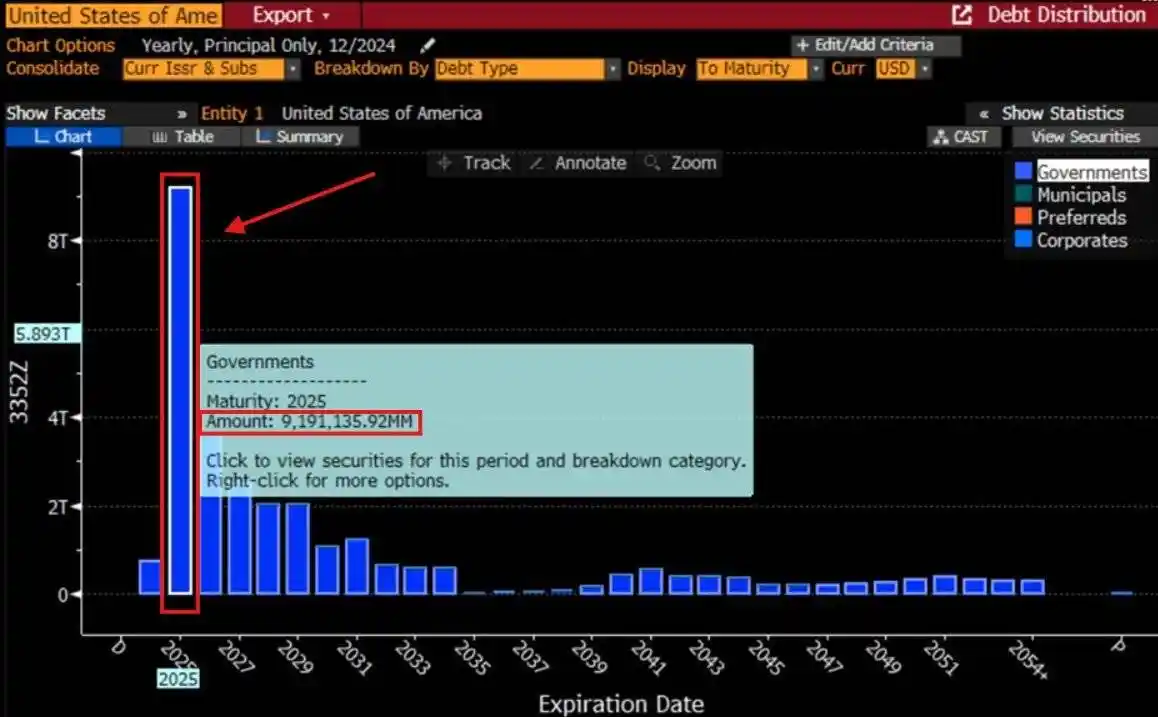
By 2025, the U.S. will have $92 trillion in debt maturing or needing to be refinanced. Faced with this massive refinancing, the quickest way to lower rates may be to induce an economic recession.
But can the U.S. benefit from a market crash?
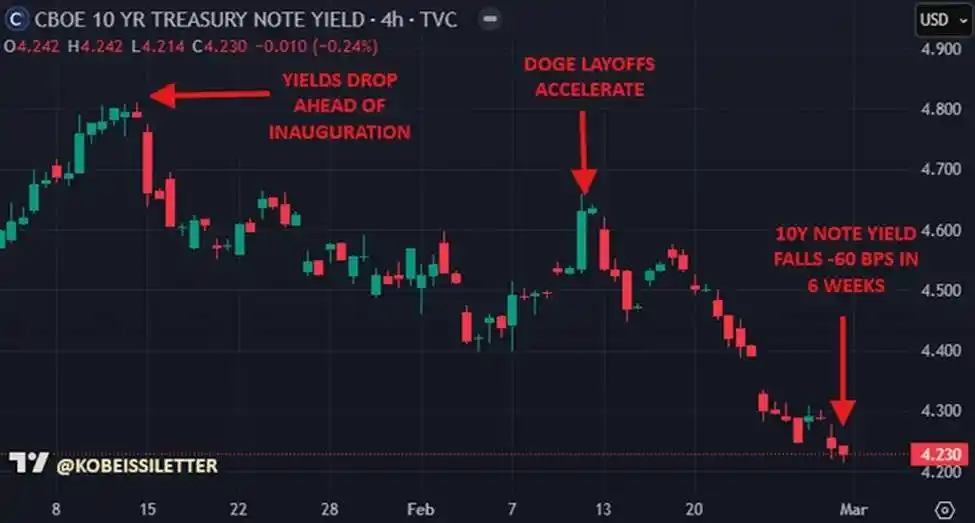
Over the past two months, the 10-year treasury yield has dropped by around 60 basis points. This is partly due to market expectations of cuts to the government's discretionary sector spending. However, it is also tied to increased uncertainty and the rising possibility of a U.S. economic recession.
An economic recession almost guarantees a rate cut.
But why does an economic recession signify a rate cut?
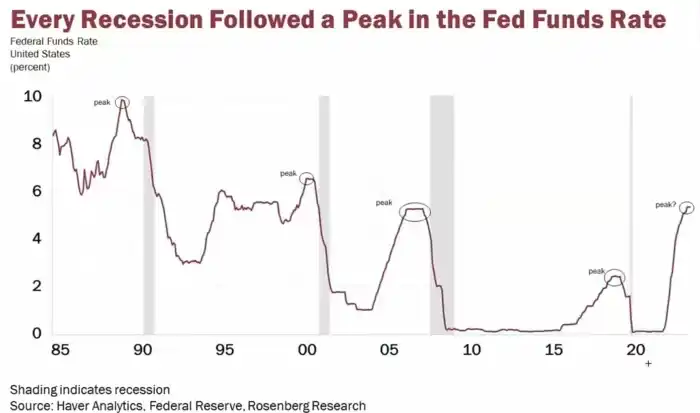
Since the 1980s, every U.S. economic recession has occurred after the federal funds rate has peaked. When economic growth stalls, the Fed acts to "stimulate" the economy. This means lowering rates to reduce the cost of capital and encourage spending.
Since the start of the trade war, U.S. economic growth expectations have plummeted significantly. Meanwhile, oil prices have hit a new 6-month low. Interestingly, President Trump has repeatedly expressed his desire to lower oil prices to alleviate inflationary pressures.
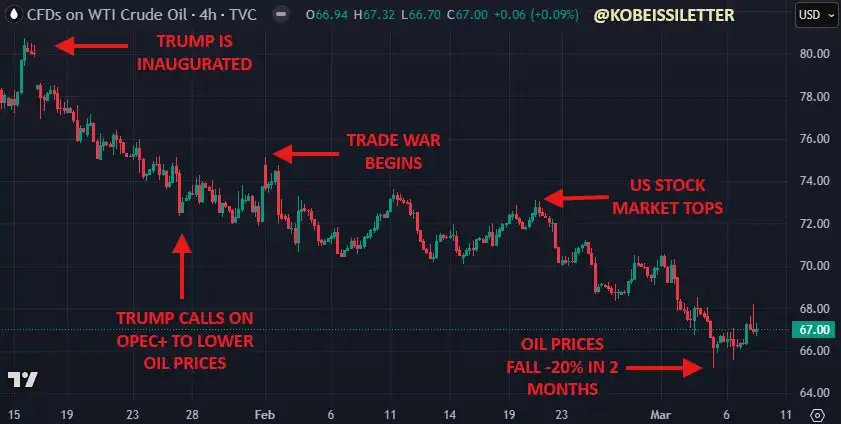
On January 25, President Trump claimed he has a solution to the Fed's more than 3-year fight against inflation. He called on the Organization of the Petroleum Exporting Countries (OPEC) to lower oil prices and urged a global rate cut.
However, the quickest way to lower oil prices is most likely through a demand-reducing economic recession.
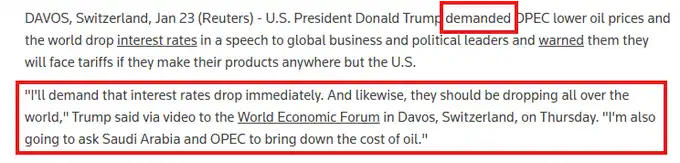
In a recent interview with Fox News, President Trump mentioned that he would prioritize lowering rates.
He said, "Rates are coming down... and I hope they do because I love the country and I'd like to see the country thrive." This quote is from @amitisinvesting's report.
Next, let's take a look at the inflation data.
American consumers believe that the inflation rate for the next 12 months will rise to +6.0%, the highest level since May 2023. This marks the third consecutive month of rising inflation expectations.
Inflation is on the rise, rate cuts are postponed, yet interest rates are declining.
The market is pricing in an economic recession.
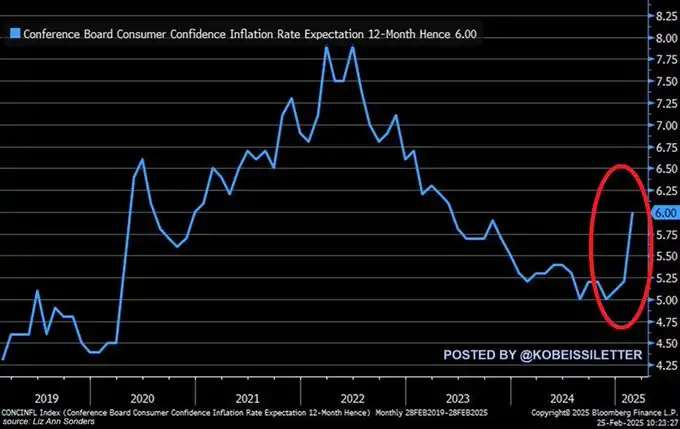
In the escalating trade war of soaring inflation, a sharp rate cut is almost inevitably a precursor to an economic recession. Furthermore, on March 6, President Trump stated that he doesn't even pay attention to the stock market. The reality, however, is that, just as we saw in his first term, Trump has always been watching the market.
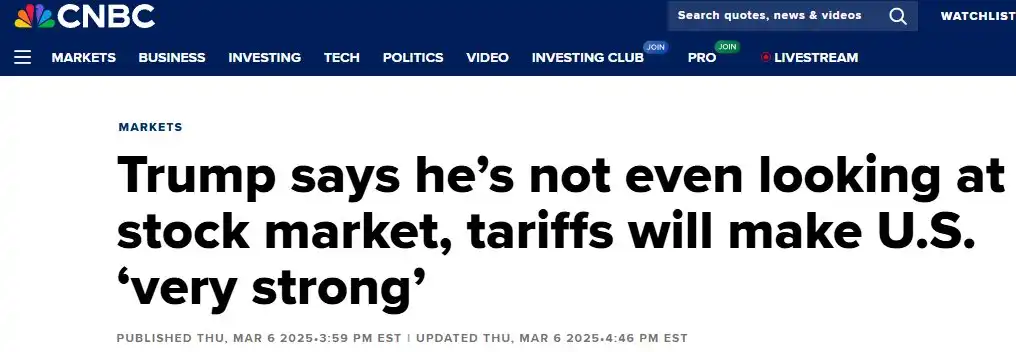
President Trump's statement of "not paying attention to the market" is significant.
In a scenario where he clearly does pay attention to the market, this is actually a signal he is sending to Wall Street, indicating his willingness to lower interest rates and reduce the trade deficit at all costs, even if it means potentially triggering an economic recession.
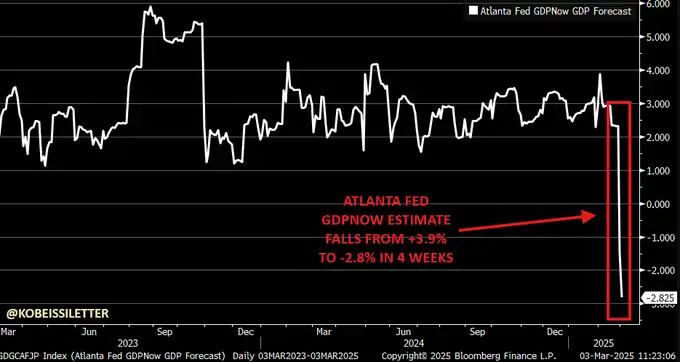
In the chaos of the trade war, we see a significant downward revision in economic growth expectations. The Atlanta Fed last week lowered its GDP growth forecast for the first quarter of 2025 to as low as -2.8%. Therefore, we see a sharp increase in market expectations for rate cuts last week.
Is this intentional?
High-interest rates are the biggest challenge facing the U.S. government.
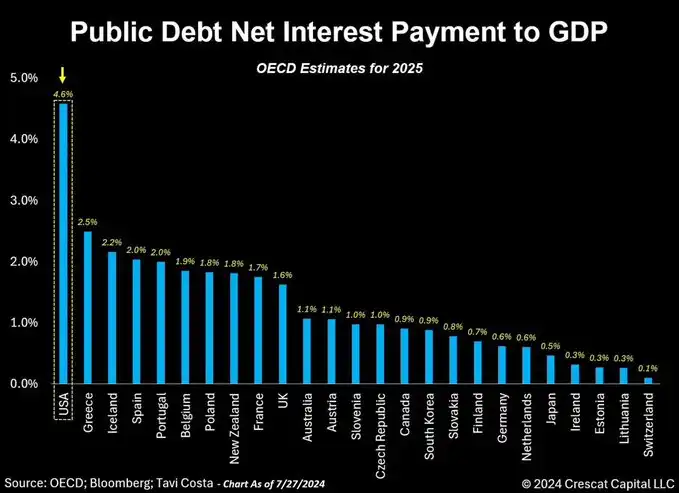
As interest rates soar, the cost of debt interest payments increases significantly. Currently, the average interest rate on the U.S.'s $36.2 trillion national debt is 3.2%, hitting the highest level since 2010. The U.S. government needs a rate cut more than anyone.
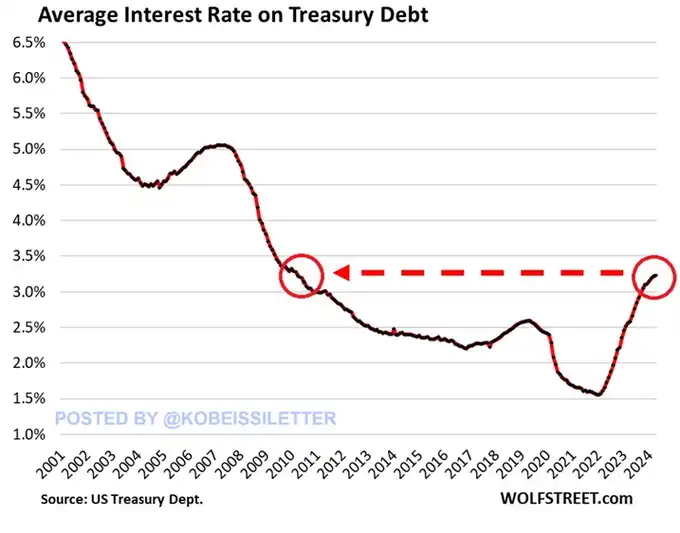
Furthermore, a rate cut is imminent:
The U.S.'s $9.2 trillion debt maturity is heavily concentrated in the first half of 2025, with 70% of the debt needing refinancing from January to June 2025.
The average interest rate on this debt is expected to rise by about 1 percentage point.
Moreover, efforts to reduce deficit spending in the U.S. will not happen overnight.
In the 2024 fiscal year, the United States had expenditures of up to $7.8 trillion, while income was only about $5.0 trillion. This means that for every $1 of income generated, there was $1.56 in costs. The shadow of a debt crisis will loom over the United States for a long time to come.
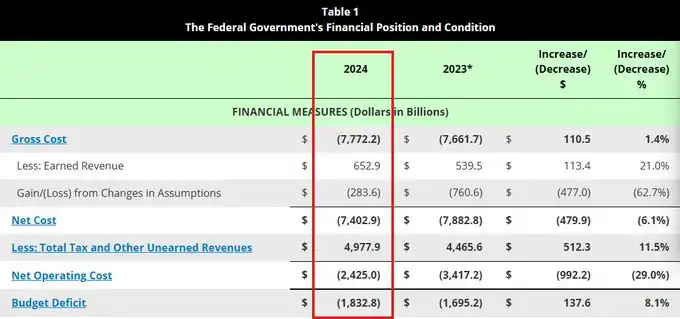
These significant changes in the macroeconomic landscape will have a broad impact on the entire market, and we are currently and will continue to seize opportunities from them.
Interested in how we trade the market? Click the link below to subscribe to our premium analysis and alert service: https://www.thekobeissiletter.com/pricing
Finally, let's go back to 2023 when the Federal Reserve was on the verge of calling for an economic recession to curb inflation.
In February 2023, many studies indicated that an economic recession might be the only solution. Subsequently, the Fed shifted to the narrative of a "soft landing," but this strategy has so far failed to lower interest rates.
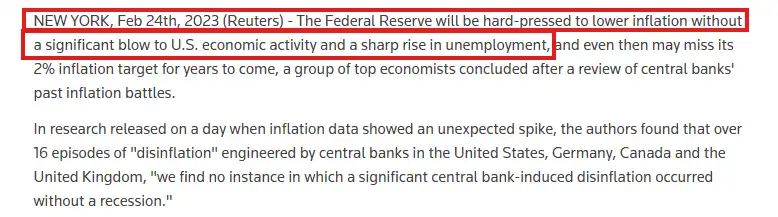
The reality is that the U.S. debt crisis is currently the most severe yet most neglected crisis. While President Trump has acknowledged this, it may be too late. An economic recession may be the only solution to lower interest rates.
Follow us @KobeissiLetter for real-time analysis updates.
You may also like

6MV Founder: In 2026, the "landmark turning point" for crypto investment has arrived

Abraxas Capital Mints $2.89 Billion USDT: Liquidity Boost or Just More Stablecoin Arbitrage?
Abraxas Capital just received $2.89 billion in freshly minted USDT from Tether. Is this a bullish liquidity injection for crypto markets, or is it business as usual for a stablecoin arbitrage giant? We analyze the data and the likely impact on Bitcoin, altcoins, and DeFi.
A VC from the Crypto world said AI is too crazy, and they are very conservative
The Evolutionary History of Contract Algorithms: A Decade of Perpetual Contracts, the Curtain Has Yet to Fall

Kicked out by PayPal, Musk aims to make a comeback in the cryptocurrency market

Solana ETF News: What Is a Solana ETF and Why Is Goldman Sachs Betting $108 Million on SOL?
Solana ETF news today shows Goldman Sachs disclosed a $108M position while total SOL ETF inflows reached $1.45B. Analysts now expect up to $6B in institutional demand as Solana trades 71% below its all-time high.

Bitcoin ETF News Today: $2.1B Inflows Signal Strong Institutional Demand for BTC
Bitcoin ETFs news recorded $2.1B inflows over 8 consecutive days, marking one of the strongest recent accumulation streaks. Here’s what the latest Bitcoin ETF news means for BTC price and whether the $80K breakout level is next.
Michael Saylor: Winter is Over – Is He Right? 5 Key Data Points (2026)
Michael Saylor tweeted yesterday “Winter‘s Over.” It is short. It is bold. And it has the crypto world talking.
But is he right? Or is this just another CEO pumping his bags?
Let us look at the data. Let us be neutral. Let us see if the ice has really melted.

WEEX Bubbles App Now Live Visualizes the Crypto Market at a Glance
WEEX Bubbles is a standalone app designed to help users quickly understand complex crypto market movements through an intuitive bubble visualization.

Polygon co-founder Sandeep: Writing after the chain bridge chain explosion

Major Upgrade on Web: 10+ Advanced Chart Styles for Deeper Market Insights
To deliver more powerful and professional analysis tools, WEEX has rolled out a major upgrade to its web trading charts—now supporting up to 14 advanced chart styles.

Morning Report | Aethir secures a $260 million enterprise contract with Axe Compute; New Fire Technology acquires Avenir Group's trading team; Polymarket's trading volume surpassed by Kalshi

Why a Million-Follower Crypto KOL Chooses WEEX VIP?
Discover why top crypto KOL Carl Moon partnered with WEEX. Explore the WEEX VIP ecosystem, 1,000 BTC protection fund, and exclusive rewards for serious traders.

CoinEx Founder: The Crypto Endgame in My Eyes

Spark Coin (SPK): Explodes 73% as Aave Bleeds $15B, A Good Investment Now?
Spark coin (SPK) surged 73% as $15 billion fled Aave after the KelpDAO hack. This article explains what Spark is, why it’s pumping, and whether it is a good investment right now.

As Aave's building collapses, Spark's high-rise is rising

RootData: Q1 2026 Cryptocurrency Exchange Transparency Research Report

What Is Memecoin Trading? A Beginner's Guide to How It Works, the Risks, and 2026's Hottest Tokens
Memecoins surged 30%+ at the start of 2026 while Bitcoin was flat. RAVE spiked 4,500% then crashed 90% in days. MAGA jumped 350% overnight. This guide explains exactly how memecoin trading works — and how to not blow up your account doing it.
6MV Founder: In 2026, the "landmark turning point" for crypto investment has arrived
Abraxas Capital Mints $2.89 Billion USDT: Liquidity Boost or Just More Stablecoin Arbitrage?
Abraxas Capital just received $2.89 billion in freshly minted USDT from Tether. Is this a bullish liquidity injection for crypto markets, or is it business as usual for a stablecoin arbitrage giant? We analyze the data and the likely impact on Bitcoin, altcoins, and DeFi.
A VC from the Crypto world said AI is too crazy, and they are very conservative
The Evolutionary History of Contract Algorithms: A Decade of Perpetual Contracts, the Curtain Has Yet to Fall
Kicked out by PayPal, Musk aims to make a comeback in the cryptocurrency market
Solana ETF News: What Is a Solana ETF and Why Is Goldman Sachs Betting $108 Million on SOL?
Solana ETF news today shows Goldman Sachs disclosed a $108M position while total SOL ETF inflows reached $1.45B. Analysts now expect up to $6B in institutional demand as Solana trades 71% below its all-time high.


 App
App