
 Buy Crypto
- Markets
 Futures
- Spot
- Copy Trade
- Earn
- More
Contra Market Fast-track + Rug Pull, will $SWARMS be the next $ARC?

Original Title: "Counter-market Express Lane + Violent Wash Trading, Will $swarms Be the Next $arc?"
Original Source: DeepTech TechFlow
While Bitcoin was dropping and altcoins were seeing a sea of red, first-tier meme coins have temporarily become the market's "safe haven." Although some high-market-cap meme coins that have already been listed are inevitably experiencing continued declines due to the overall market, for new hot assets (or more appropriately called express lane coins), the panic market sentiment can at most only cause some superficial wounds.
Last Friday, the enterprise-grade multi-agent collaboration framework Swarms announced on Twitter the "claiming" of the token $swarms issued through Pump.Fun. The reason it's a "claiming" is that $swarms was not officially issued on the day of the announcement but had existed two days prior. At that time, the unofficially endorsed $swarms might have been perceived by the market as a typical "rug pull" and its market value briefly languished at a low of $6,000 with little attention.
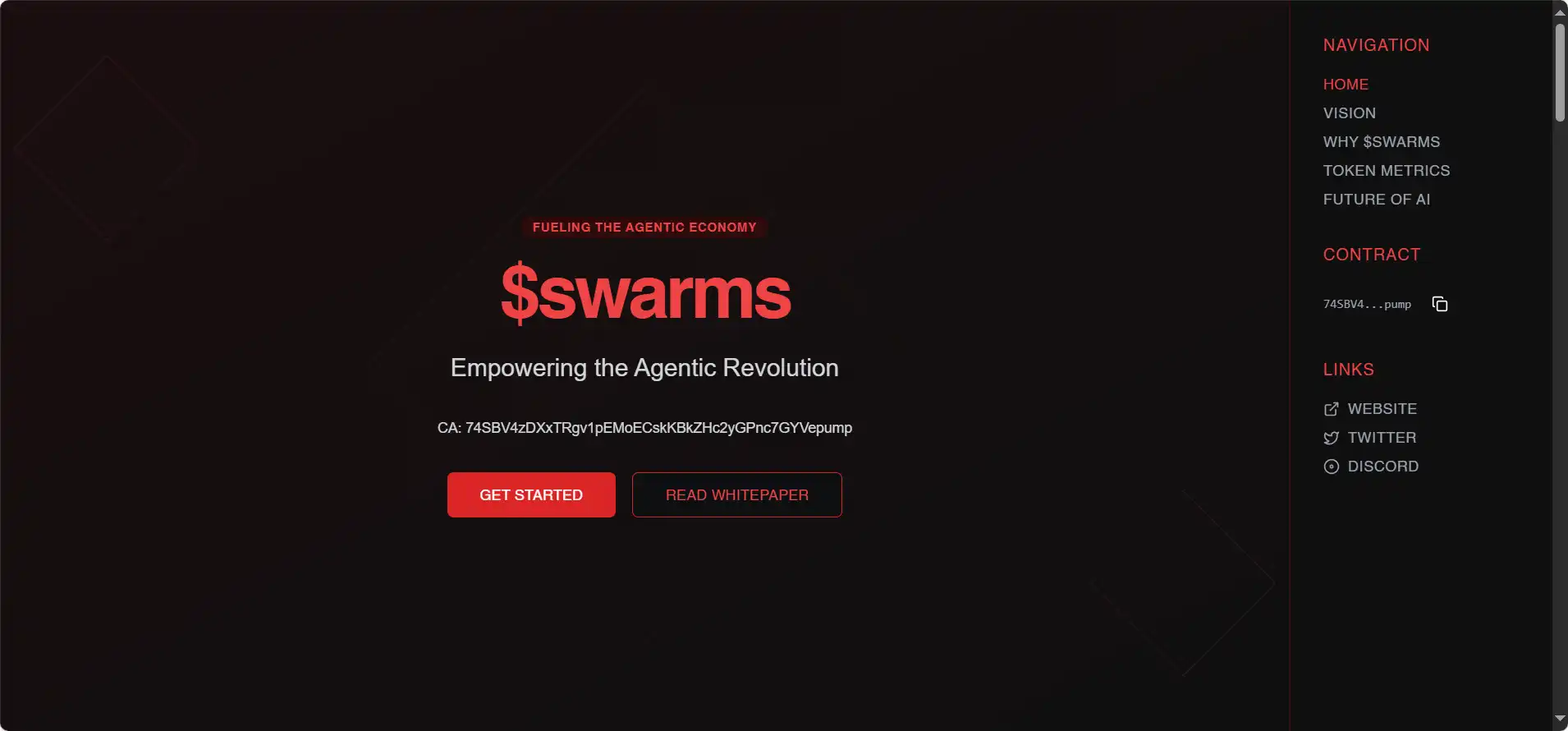
Building upon the success of $arc, the well-established $swarms, donning a golden robe, saw immediate market acceptance of its narrative without hesitation. During the "Black Friday" of an across-the-board altcoin plunge, $swarms, even in the most panic-inducing hours, merely consolidated sideways before directly surging past a $70 million market cap.
By synthesizing information provided on Swarms' official website and technical documentation, we have gained a preliminary understanding of what the Swarms framework aims to achieve.
Note: Meme token prices are highly volatile, posing significant risks. Investors should thoroughly assess the risks and participate cautiously. This article merely shares information based on market trends, and the author and platform do not guarantee the completeness or accuracy of the content. Additionally, this article does not provide any investment advice.
Another Wave of Tech Geeks Joining the Fray?
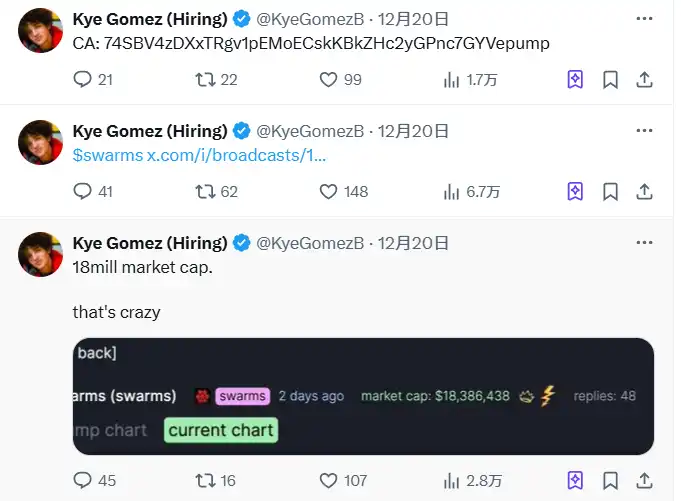
In addition to the clearly labeled token address on the Swarms website homepage, Swarms framework developer @KyeGomezB continued to discuss token-related news on the same day.
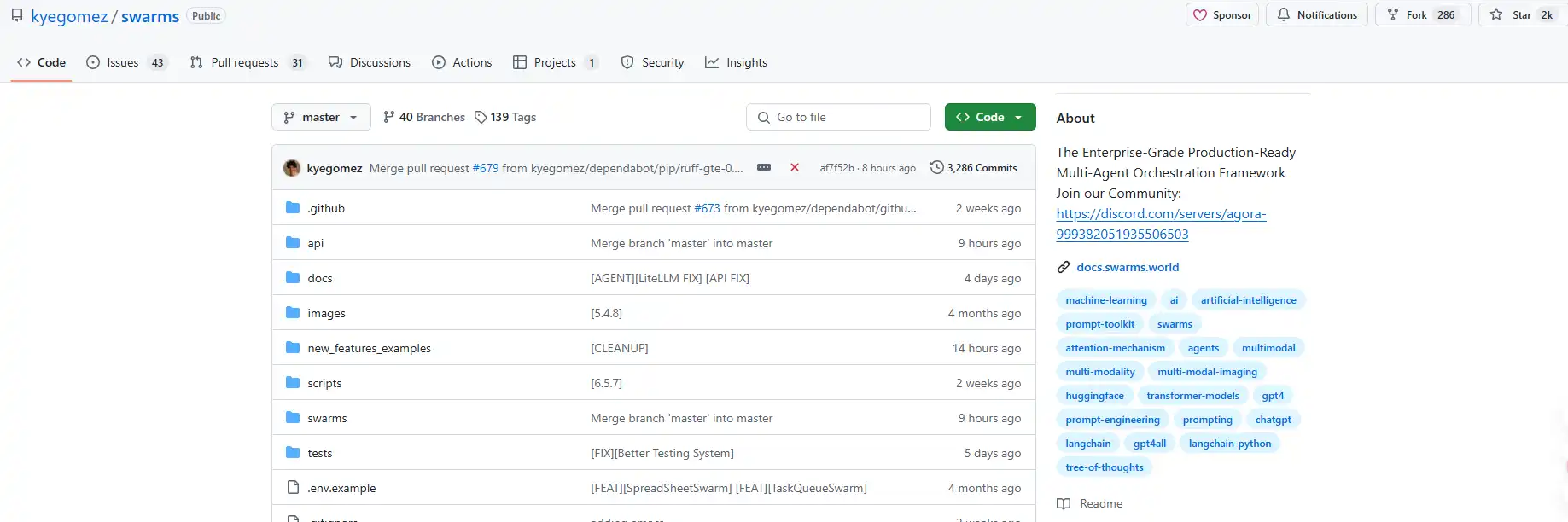
According to Kye Gomes' Github page, the Swarms framework has received over 2000 stars (Arc's rig framework currently has 1300 stars).
With Github validation, at least the hardcore technical identity of the $swarms token has been established.
Enterprise-Grade Multi-Agent Collaboration Framework
The Swarms framework was not originally designed specifically for Web3 Crypto Native, its core positioning is just as the original meaning of "Swarms" – a swarm, an enterprise-grade multi-agent collaboration framework. It is more than just a simple AI development tool; instead, it is a complete solution focused on addressing the real-world problems enterprises face in the AI deployment process.
In practical applications, Swarms provides a complete toolchain that enables enterprises to easily build and manage collaboration between multiple AI agents. These AI agents can be different language models, specialized tools, or custom intelligent agents that, under Swarms' scheduling, can seamlessly cooperate to complete complex business tasks.
From a technical architecture perspective, the Swarms framework includes the following core components:
· Task Scheduling System: Responsible for decomposing complex tasks and allocating them to suitable AI agents
· Agent Management Module: Manages the lifecycle and status of each AI agent
· Communication Middleware: Ensures accurate and efficient information exchange between agents
· Monitoring and Logging System: Real-time tracking of the entire system's operational status
At the enterprise application level, Swarms offers:
· High Availability Guarantee: Automatic fault tolerance and recovery mechanisms
· Comprehensive Monitoring System: Real-time tracking of AI agent performance and status
· Flexible Scalability: Easy addition of new AI capabilities and business logic
· Security Considerations: Robust permission management and data protection mechanisms
To understand how Swarms works, we can use an analogy of a symphony orchestra:
Imagine a large orchestra performing a symphony. A traditional AI solution is like an all-around player trying to play all instruments at once. On the other hand, Swarms allows each "musician" (AI agent) to focus on their own expertise, collaborating under the direction of a "conductor" (Swarms framework). The sheet music is the standardized task flow of the whole system, and the rehearsal is the ongoing optimization process of the system.
For example, in an e-commerce scenario, when a user needs personalized shopping recommendations, the system automatically coordinates multiple specialized agents. The user profiling agent deeply understands the user's needs, the product recommendation agent selects the most suitable products based on this, the sentiment analysis agent is responsible for organizing user feedback, and finally, the chatbot agent integrates this information into friendly suggestions for the user. These agents each do their own job but can also seamlessly collaborate, ultimately providing precise service to the user.
How is it different from other projects in the same field?
As products in the AI framework field, whether it's $ai16z&$ELIZA with the ELIZA framework or $arc based on the rig framework, their prices demonstrate the market's recognition of the underlying infrastructure concept.
So, is the Swarms framework in a competitive relationship with the other two projects, or can they complement each other?
Twitter user @tmel0211 summarized the possible connections between the three frameworks:
1. The logical evolution of standards and frameworks from ELIZA to RIG (ARC) and then to Swarms makes sense. ELIZA focuses on lightweight rapid deployment to create AI Agents, ARC aims to use Rust language to enhance resource optimization and performance when working with AI Agents, while Swarms aims to build a framework that decomposes complex tasks into multiple AI Agents collaborating. Its mechanism for mixing multiple agents, flexible combination of serial and parallel processes, and multi-layered Memory processing architecture make sense in terms of the necessary technological evolution and development direction.
2. Theoretically, Swarms can integrate ARC, and ARC can optimize ELIZA. All three frameworks have a modular design philosophy, and their technological visions are increasingly grand. This may be a concern of being too conceptual. Still, as the saying goes, the current standard frameworks are far from the point of judging superiority and determining winners and losers. One should observe the completeness of the framework codebase and the landing of monolithic AI applications based on their frameworks. If you can't decide on early technological advantages and disadvantages, focus on observing the application scenarios; technology may float in the air, but the application interaction experience will always land on the ground.
Clearly, whether it's ELIZA, RIG, or Swarms, their feasibility and room for expansion are still in the early stages. Different language frameworks focus on solving various issues in the large-scale adoption of AI, and "collaboration" is also a theme that cannot be avoided among future frameworks.
Founder Under Scrutiny, Token Price Volatility
While the market initially embraced the $swarms narrative, things did not always go smoothly.
On the day when the $swarms token was skyrocketing, Shaw, the founder of $ai16z, publicly criticized Swarms framework developer @KyeGomezB on Twitter, stating, "I really don't like publicly pointing out others' issues. Doing so poses a huge risk to our project and makes many people nervous, and I don't want to undermine the hard-working developers. But some people will steal others' work and try to take credit for it." and referenced a 23-year-old Reddit post to argue Kye's plagiarism. The post mentioned a Github repo that may contain traces of stealing others' work, and this repo belongs to Swarms developer Kye.
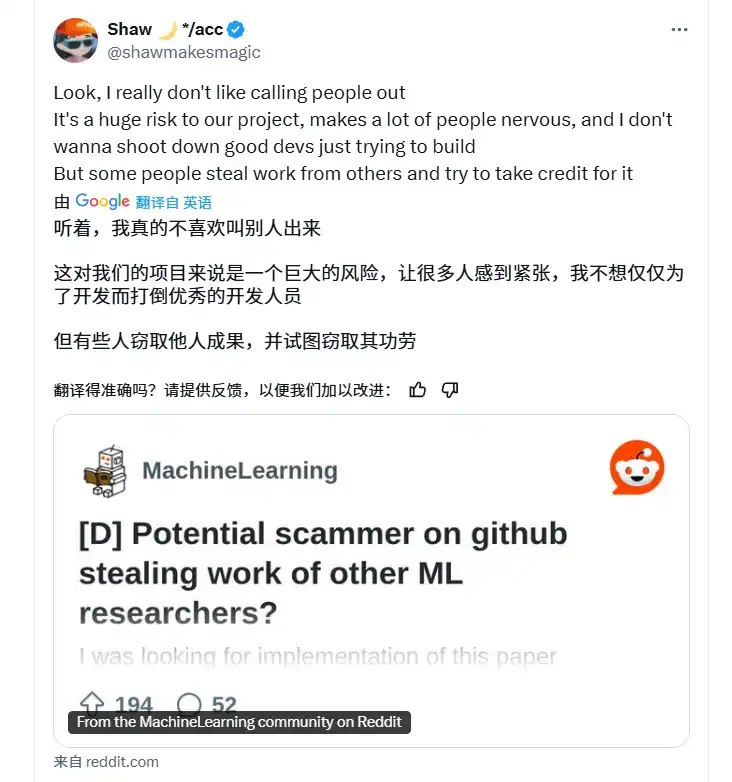
Shaw's FUD also caused the $swarms token price to almost halve. However, in the face of this FUD, Swarms founder Kye was also defiant. While rebutting on Twitter, he launched a new token $mcs based on the Swarms framework through the Medicalswarm application, intending to prove that his framework is not useless but indeed has "something."
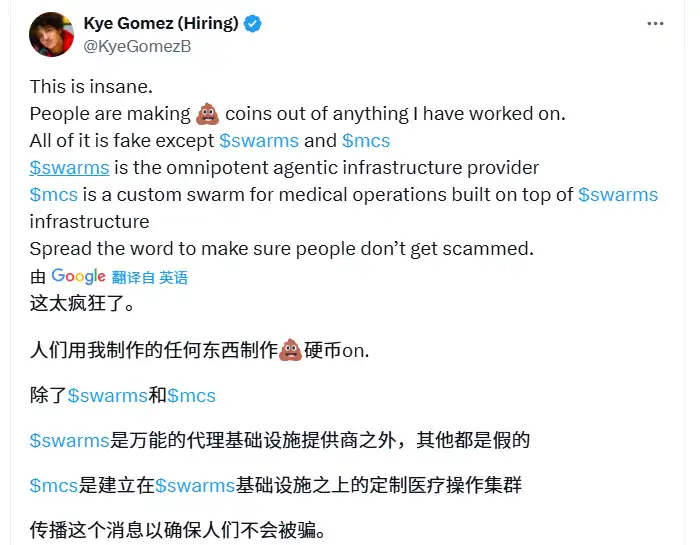
Perhaps Kye was not familiar with the AI Meme play, and at a time when the Swarms consensus was not yet solidified and the token price was still declining, launching a new token was seen as a gimmick by many confused players, who believed that the $swarms Dev team was giving up on it, making Swarms not worth playing anymore. Therefore, the launch of $mcs did not initially save $swarms, but instead caused a deeper drop, with the market cap plummeting from a high of $74 million to $6 million at one point, along with the new token $mcs.
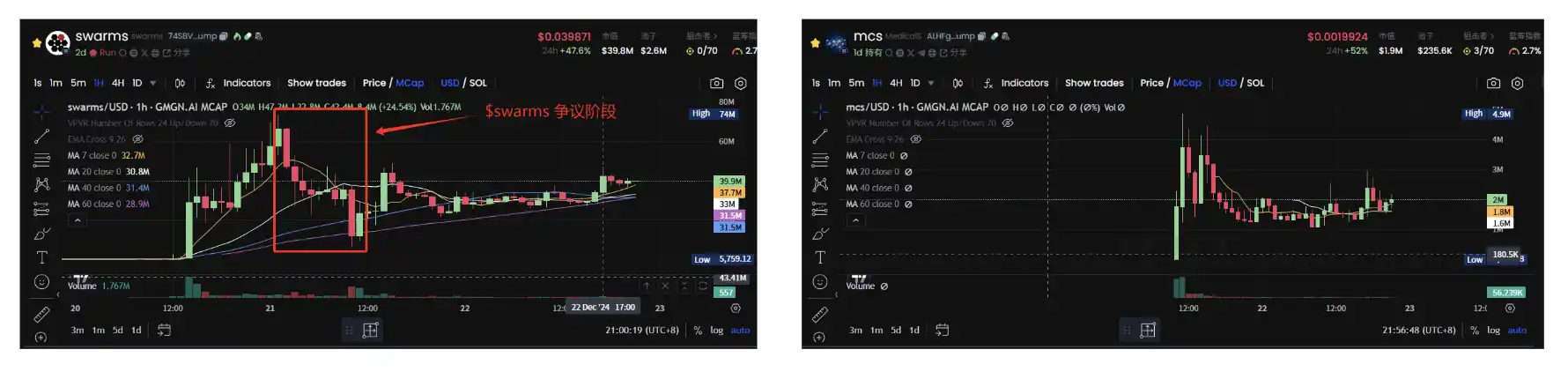
However, the inexperienced Kye realized that his approach might have been wrong when he saw this momentum. He urgently started a live broadcast to announce that he was indeed serious about development and proceeded to lock his holdings of $swarms tokens for a year during the live stream. Perhaps the founder really wanted to prove himself amidst various FUD or had someone guiding him, taking advantage of the unstable consensus to make such a move to gain support. In any case, this series of ups and downs indeed washed away many early players, and as the market regained its senses, they began to re-enter $swarms, gradually stabilizing the market cap at around $30 million.
Summary
At the time of writing, the price of $swarm has gradually stabilized, with a market cap still around 40 million.
$Swarm's "quick script" is somewhat similar to $arc. As a technically oriented token, after gaining traction, the market aggressively buys in, quickly reaching a market cap of tens of millions. However, as profit-taking exits, market understanding permeates, and community consensus coalesces, some time is needed. Such tokens inevitably experience fluctuations in the early stages.
Whether this project is truly as promising as the founder claims, the market will ultimately make a judgment in line with its merits.
You may also like

Consumer-grade Crypto Global Survey: Users, Revenue, and Track Distribution

Prediction Markets Under Bias

Stolen: $290 million, Three Parties Refusing to Acknowledge, Who Should Foot the Bill for the KelpDAO Incident Resolution?

ASTEROID Pumped 10,000x in Three Days, Is Meme Season Back on Ethereum?

ChainCatcher Hong Kong Themed Forum Highlights: Decoding the Growth Engine Under the Integration of Crypto Assets and Smart Economy

Why can this institution still grow by 150% when the scale of leading crypto VCs has shrunk significantly?

Anthropic's $1 trillion, compared to DeepSeek's $100 billion

Geopolitical Risk Persists, Is Bitcoin Becoming a Key Barometer?

Annualized 11.5%, Wall Street Buzzing: Is MicroStrategy's STRC Bitcoin's Savior or Destroyer?

An Obscure Open Source AI Tool Alerted on Kelp DAO's $292 million Bug 12 Days Ago

Mixin has launched USTD-margined perpetual contracts, bringing derivative trading into the chat scene.
The privacy-focused crypto wallet Mixin announced today the launch of its U-based perpetual contract (a derivative priced in USDT). Unlike traditional exchanges, Mixin has taken a new approach by "liberating" derivative trading from isolated matching engines and embedding it into the instant messaging environment.
Users can directly open positions within the app with leverage of up to 200x, while sharing positions, discussing strategies, and copy trading within private communities. Trading, social interaction, and asset management are integrated into the same interface.
Based on its non-custodial architecture, Mixin has eliminated friction from the traditional onboarding process, allowing users to participate in perpetual contract trading without identity verification.
The trading process has been streamlined into five steps:
· Choose the trading asset
· Select long or short
· Input position size and leverage
· Confirm order details
· Confirm and open the position
The interface provides real-time visualization of price, position, and profit and loss (PnL), allowing users to complete trades without switching between multiple modules.
Mixin has directly integrated social features into the derivative trading environment. Users can create private trading communities and interact around real-time positions:
· End-to-end encrypted private groups supporting up to 1024 members
· End-to-end encrypted voice communication
· One-click position sharing
· One-click trade copying
On the execution side, Mixin aggregates liquidity from multiple sources and accesses decentralized protocol and external market liquidity through a unified trading interface.
By combining social interaction with trade execution, Mixin enables users to collaborate, share, and execute trading strategies instantly within the same environment.
Mixin has also introduced a referral incentive system based on trading behavior:
· Users can join with an invite code
· Up to 60% of trading fees as referral rewards
· Incentive mechanism designed for long-term, sustainable earnings
This model aims to drive user-driven network expansion and organic growth.
Mixin's derivative transactions are built on top of its existing self-custody wallet infrastructure, with core features including:
· Separation of transaction account and asset storage
· User full control over assets
· Platform does not custody user funds
· Built-in privacy mechanisms to reduce data exposure
The system aims to strike a balance between transaction efficiency, asset security, and privacy protection.
Against the background of perpetual contracts becoming a mainstream trading tool, Mixin is exploring a different development direction by lowering barriers, enhancing social and privacy attributes.
The platform does not only view transactions as execution actions but positions them as a networked activity: transactions have social attributes, strategies can be shared, and relationships between individuals also become part of the financial system.
Mixin's design is based on a user-initiated, user-controlled model. The platform neither custodies assets nor executes transactions on behalf of users.
This model aligns with a statement issued by the U.S. Securities and Exchange Commission (SEC) on April 13, 2026, titled "Staff Statement on Whether Partial User Interface Used in Preparing Cryptocurrency Securities Transactions May Require Broker-Dealer Registration."
The statement indicates that, under the premise where transactions are entirely initiated and controlled by users, non-custodial service providers that offer neutral interfaces may not need to register as broker-dealers or exchanges.
Mixin is a decentralized, self-custodial privacy wallet designed to provide secure and efficient digital asset management services.
Its core capabilities include:
· Aggregation: integrating multi-chain assets and routing between different transaction paths to simplify user operations
· High liquidity access: connecting to various liquidity sources, including decentralized protocols and external markets
· Decentralization: achieving full user control over assets without relying on custodial intermediaries
· Privacy protection: safeguarding assets and data through MPC, CryptoNote, and end-to-end encrypted communication
Mixin has been in operation for over 8 years, supporting over 40 blockchains and more than 10,000 assets, with a global user base exceeding 10 million and an on-chain self-custodied asset scale of over $1 billion.

$600 million stolen in 20 days, ushering in the era of AI hackers in the crypto world
Vitalik's 2026 Hong Kong Web3 Summit Speech: Ethereum's Ultimate Vision as the "World Computer" and Future Roadmap
On the same day Aave introduced rsETH, why did Spark decide to exit?
Full Post-Mortem of the KelpDAO Incident: Why Did Aave, Which Was Not Compromised, End Up in Crisis Situation?

After a $290 million DeFi liquidation, is the security promise still there?
ZachXBT's post ignites RAVE nearing zero, what is the truth behind the insider control?




 App
App