
 Buy Crypto
- Markets
 Futures
- Spot
- Copy Trade
- Earn
- More
Coin Metrics: 2024 Crypto Milestones

Original Article Author: Tanay Ved, Coin Metrics
Original Article Translation: Shanou Ba, Golden Finance
The year 2024 is coming to an end, and this year stands in stark contrast to the crypto winter of 2022. We want to take a moment to look back on this extraordinary year for the cryptocurrency industry.
2024 can be considered one of the most impactful years in cryptocurrency history in many ways, starting from the launch of a Bitcoin ETF to Bitcoin's triumphant breakthrough above $100,000 post-election.
In this article, we revisit the significant developments that shaped the digital asset industry in 2024 from a data-driven perspective.
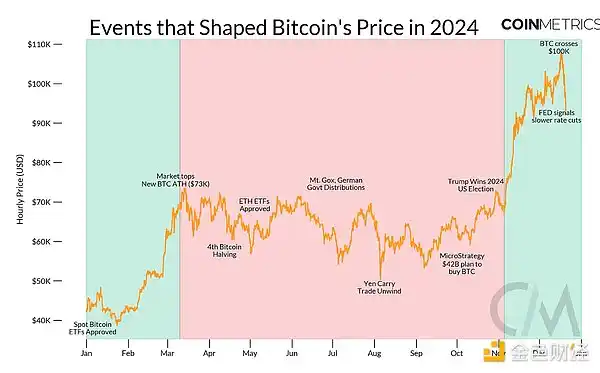
Fueled by the explosive success of the Bitcoin ETF in January, the cryptocurrency market experienced a strong growth phase in the first quarter, with Bitcoin surging to a historical high of $73,000. This was followed by a relatively calm consolidation phase characterized by a weakening catalyst and a significant redistribution of the major market participants' supply. As 2024 draws to a close, optimism has returned with the support of the U.S. government for cryptocurrency and the beginning of a rate-cutting cycle.
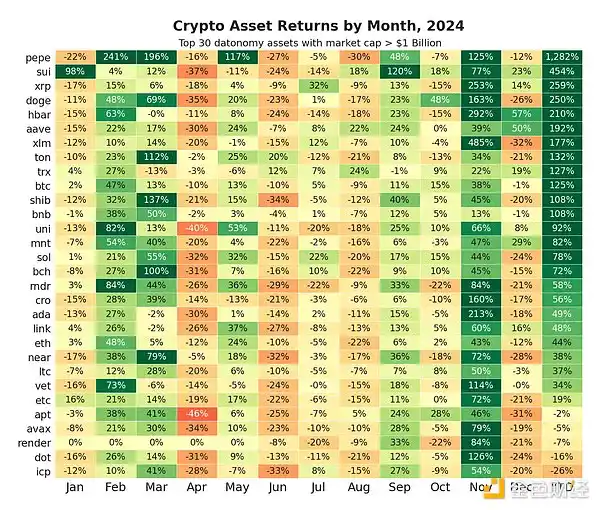
Bitcoin (BTC) has undoubtedly been the focus this year, with a year-to-date gain of 125%, outperforming both traditional asset classes and cryptocurrencies. Solana (SOL) has led the market multiple times in this cycle, ending the year with a 78% gain, while Ethereum (ETH) has continued to underperform, with a 44% increase for the year.
The chart above displays the top 30 crypto assets in the datonomy TM domain, with a market cap exceeding $10 billion. Driven by retail enthusiasm, meme coins like DOGE and PEPE have garnered widespread attention, while "dinosaur coins" like Ripple (XRP) and Stellar (XLM) have unexpectedly made a comeback. Alternative Layer-1 assets like SUI and mature DeFi protocols like Aave have also gained attention, reflecting investor sentiment and the thematic rotation shaping the 2024 market.
Q1: ETF Gate Opens, Memecoin Mania, Ethereum Scaling with Blob
The introduction of physically-backed Bitcoin ETFs triggered a wave of mass adoption, opening the floodgates to Wall Street. The assets under management (AUM) of the 11 issuers now exceed $105 billion, with these vehicles holding over 1.2 million Bitcoins. This is equivalent to 5.6% of Bitcoin's current supply, and the demand on corporate balance sheets has further accelerated the rate at which supply is being absorbed. In less than a year since their launch, physically-backed Bitcoin ETFs have seen strong inflows, cementing their position as the most successful debut in the history of any ETF category.
The weekly traffic showed a continuous accumulation, with net additions peaking at over $20 billion during peak weeks, despite occasional outflows during the summer market consolidation period.


As Bitcoin drove institutional adoption and lifted the overall market, meme coins began attracting significant attention, leading to an uptrend driven by extreme risk. In early March, meme coins' spot trading volume reached $130 billion, with the market capitalization of major meme coins hitting $600 billion.

While mature large-cap memecoins saw some growth, most of the activity originated from a plethora of newly launched meme coins on Solana. A platform named pump.fun emerged as the epicenter of memecoin explosive growth in the first quarter, facilitating the creation of over 75,000 tokens and propelling active wallets on Solana to a record-breaking 2.06 million at the time. Although these heightened activities failed to sustain, meme coins made a comeback, with November's trading volume surpassing $230 billion. New AI-driven platforms like Virtuals on Base injected fresh vigor into this phenomenon.

March also marked a significant milestone for Ethereum as Ethereum deployed EIP-4844 in the Dencun upgrade. Shortly after, Ethereum's Layer 2 Rollup adopted a new blob transaction fee market in parallel with the mainnet. This laid the groundwork for Ethereum to expand its execution capabilities with the help of Layer 2 solutions like Base, Optimism, and Arbitrum while reducing settlement costs at Layer 1, making transactions on the network more affordable. Demand for blob remained robust, with Ethereum consistently reaching its target capacity of three blobs per block just seven months after its launch.
While this made the Ethereum ecosystem more accessible, it could be argued that the devaluation of fees at Layer 1 hindered ETH's value accrual and led to a more fragmented user experience. However, there is no sign of stagnation in the space, with prominent exchanges like Kraken and Uniswap, Deutsche Bank, and multinational corporations (Sony) driving Layer 2 development, and an imminent increase in blob capacity.
Q2: Summer Market: Season of Plenty
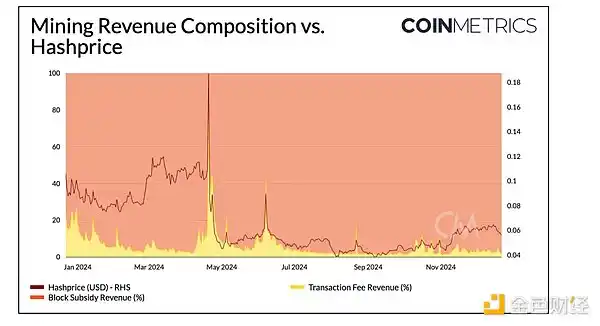
The second quarter was characterized by a consolidation phase, with the market experiencing range-bound volatility due to a lack of catalysts. In April, Bitcoin underwent its quadrennial halving event, reducing the daily issuance from 900 coins to 450 coins. Similar to the halving event, this signaled a turning point for the mining industry, forcing miners to adapt to the reduction in block rewards. This event spurred the upgrade to more efficient ASIC hardware, triggered further consolidation in the mining sector, and prompted some miners to repurpose their infrastructure for AI data centers to diversify their income streams.
As shown in the chart below, transaction fees have become a key part of mining revenue, partially offsetting the decline in block subsidies. Nonetheless, the overall hash price (daily USD income per TH/s) remains under pressure, reflecting miners' increasing reliance on network activity to sustain profitability.
Exacerbating these challenges is additional supply pressure. Most notably, the long-awaited Mt. Gox bankruptcy asset distribution has seen thousands of BTC re-enter the market. Similarly, the German government has sold over 50,000 seized BTC from a criminal investigation, adding to selling pressure and exacerbating the supply-side dynamics. Despite these sell-offs, Bitcoin's liquidity has shown resilience, absorbing the supply without causing significant disruptions to market stability. Looking ahead, as FTX creditors are set to receive cash distributions in 2025 and potentially re-enter the market, selling pressure may ease.
Q3: The Spring of Stablecoins and Tokenization
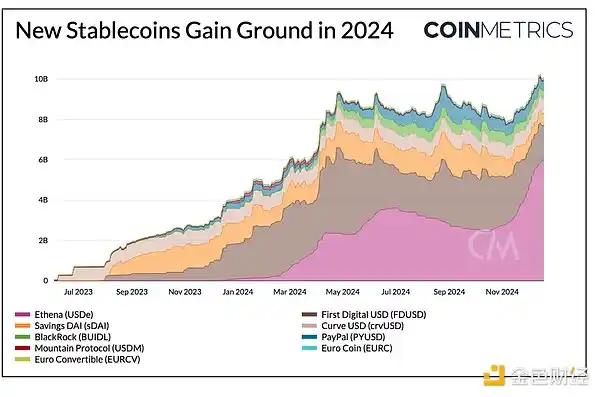
Stablecoins are recognized as the "killer app" of cryptocurrencies, with their global significance beginning to permeate beyond the cryptocurrency industry. Stablecoins continue to export the US dollar worldwide, with a total supply exceeding $210 billion. USDT ($138 billion) and USDC ($42 billion) still dominate, and most stablecoin supplies lean towards the Ethereum network, with a stablecoin supply of $122 billion. Overall, stablecoins facilitated $1.4 trillion in monthly (adjusted) transfer volume in November.
While the role of stablecoins as an exchange medium and store of value in emerging economies has been widely explored, their practical development in payment and financial service infrastructure has gained further momentum with Stripe's acquisition of Bridge. Furthermore, 99% of stablecoins are pegged to the dollar, with Tether and Circle directly investing nearly $100 billion in purchasing US Treasury bonds, solidifying their position as a key tool in maintaining the dollar's global dominance.

Meanwhile, BlackRock has entered the tokenization space, launching the BlackRock Institutional Digital Liquidity Fund (BUIDL), investing in dollar-equivalent assets like cash and US Treasury securities. BUIDL's supply quickly reached $500 million, expanding the landscape of tokenized securities on public blockchains. The ecosystem expanded in 2024, offering stablecoins with varying risk profiles, liquidity, collateral, and savings mechanisms. Ethena's USDe stood out, growing from a market cap of $91 million to $6 billion, becoming the third-largest stablecoin, leveraging positive financing rates in the market's upward trend to provide attractive yields for holders. Concurrently, the First Digital USD (FDUSD) has gained prominence as a source of liquidity and widely used quote currency on exchanges.
Regulatory agencies' focus on stablecoins continues to grow, reflecting the increasing importance of stablecoins in the global financial system. The EU has implemented specific requirements for stablecoins under the Markets in Crypto-Assets (MiCA) regulation, which has begun reshaping the stablecoin industry tied to the euro.
Q4: Election Fever
The 2024 U.S. presidential election had a profound impact on the digital asset market, propelling BTC above $100,000 for the first time. Specialized coins within Coin Metrics' datonomy TM realm (including meme and privacy coins) and smart contract platforms were standout areas, with returns of 129% and 84% respectively since the election.

Prior to the election, we also witnessed the rise of prediction markets like Polymarket, which played a key role in harnessing collective wisdom to predict election outcomes. At its peak, Polymarket had over $450 million in open interest. Though the platform's activity has since subsided, it showcased the utility and potential of information markets on public blockchains.
Post-election, market sentiment was bullish, fueled by government support for cryptocurrency contrasting sharply with previous SEC regulatory hurdles. Demand for ETFs and corporate bonds drove Bitcoin's surge, with MicroStrategy holding 444,262 BTC funded through stock and convertible bond issuances. Institutional interest in the derivatives market reached new highs, reflected in CME's Bitcoin futures open interest hitting a record $22.7 billion, totaling over $52 billion, alongside the introduction of options-based ETFs.
Despite the strong momentum, uncertainties persist regarding the implementation and timeline of crypto-friendly policies. While there are signs indicating a more supportive regulatory environment for cryptocurrency, such as appointing cryptocurrency advocates to key positions like the Chair of the SEC and Crypto Czar, the specific regulatory framework remains unclear. Market enthusiasm was also dampened by expectations of interest rate cuts, with participants cautiously optimistic about 2025.
Nevertheless, 2024 laid a solid foundation: the launch of physically-backed Bitcoin ETFs, accelerated stablecoin adoption, significant advancements in on-chain infrastructure and applications, and a pro-crypto government taking office as the easing cycle begins. As we move into the next year, stay tuned for our 2025 Cryptocurrency Outlook Report, where we will explore key themes and trends shaping the year ahead.
You may also like

a16z: 5 Ways Blockchain Helps AI Agent Infrastructure

Morning News | The Hong Kong Securities and Futures Commission announced the regulatory framework for secondary market trading of tokenized investment products; Strategy increased its holdings by 34,164 bitcoins last week; KAIO completed a strategic fi...

What Is an XRP Wallet? The Best Wallets to Store XRP (2026 Updated)
An XRP wallet lets you safely store, send, and receive XRP on the XRP Ledger. Learn what wallets support XRP and discover the best XRP wallets for beginners and long-term holders in 2026.

What are the Top AI Crypto Coins? Render vs. Akash: 5 Gems Solving the 2026 GPU Crisis
What are the best AI crypto coins for the 2026 cycle? Beyond the hype, we analyze top tokens like RNDR, AKT, and FET that provide real-world solutions to the global GPU shortage and the rise of autonomous agents.

What Is a Token in AI? What Is an AI Token + 3 Gems You Can't Miss in 2026
The era of AI hype has transitioned into an era of utility. As we move through Q2 2026, the market is no longer rewarding "narrative-only" projects. At WEEX Research, we are seeing a massive capital rotation into Decentralized Compute (DePIN) and Autonomous Agent coordination layers. This guide analyzes which AI tokens are capturing institutional liquidity and how to spot high-conviction setups in a maturing market.

Consumer-grade Crypto Global Survey: Users, Revenue, and Track Distribution

Prediction Markets Under Bias

Stolen: $290 million, Three Parties Refusing to Acknowledge, Who Should Foot the Bill for the KelpDAO Incident Resolution?

ASTEROID Pumped 10,000x in Three Days, Is Meme Season Back on Ethereum?

ChainCatcher Hong Kong Themed Forum Highlights: Decoding the Growth Engine Under the Integration of Crypto Assets and Smart Economy

Why can this institution still grow by 150% when the scale of leading crypto VCs has shrunk significantly?

Anthropic's $1 trillion, compared to DeepSeek's $100 billion

Geopolitical Risk Persists, Is Bitcoin Becoming a Key Barometer?
Annualized 11.5%, Wall Street Buzzing: Is MicroStrategy's STRC Bitcoin's Savior or Destroyer?
An Obscure Open Source AI Tool Alerted on Kelp DAO's $292 million Bug 12 Days Ago

Mixin has launched USTD-margined perpetual contracts, bringing derivative trading into the chat scene.
The privacy-focused crypto wallet Mixin announced today the launch of its U-based perpetual contract (a derivative priced in USDT). Unlike traditional exchanges, Mixin has taken a new approach by "liberating" derivative trading from isolated matching engines and embedding it into the instant messaging environment.
Users can directly open positions within the app with leverage of up to 200x, while sharing positions, discussing strategies, and copy trading within private communities. Trading, social interaction, and asset management are integrated into the same interface.
Based on its non-custodial architecture, Mixin has eliminated friction from the traditional onboarding process, allowing users to participate in perpetual contract trading without identity verification.
The trading process has been streamlined into five steps:
· Choose the trading asset
· Select long or short
· Input position size and leverage
· Confirm order details
· Confirm and open the position
The interface provides real-time visualization of price, position, and profit and loss (PnL), allowing users to complete trades without switching between multiple modules.
Mixin has directly integrated social features into the derivative trading environment. Users can create private trading communities and interact around real-time positions:
· End-to-end encrypted private groups supporting up to 1024 members
· End-to-end encrypted voice communication
· One-click position sharing
· One-click trade copying
On the execution side, Mixin aggregates liquidity from multiple sources and accesses decentralized protocol and external market liquidity through a unified trading interface.
By combining social interaction with trade execution, Mixin enables users to collaborate, share, and execute trading strategies instantly within the same environment.
Mixin has also introduced a referral incentive system based on trading behavior:
· Users can join with an invite code
· Up to 60% of trading fees as referral rewards
· Incentive mechanism designed for long-term, sustainable earnings
This model aims to drive user-driven network expansion and organic growth.
Mixin's derivative transactions are built on top of its existing self-custody wallet infrastructure, with core features including:
· Separation of transaction account and asset storage
· User full control over assets
· Platform does not custody user funds
· Built-in privacy mechanisms to reduce data exposure
The system aims to strike a balance between transaction efficiency, asset security, and privacy protection.
Against the background of perpetual contracts becoming a mainstream trading tool, Mixin is exploring a different development direction by lowering barriers, enhancing social and privacy attributes.
The platform does not only view transactions as execution actions but positions them as a networked activity: transactions have social attributes, strategies can be shared, and relationships between individuals also become part of the financial system.
Mixin's design is based on a user-initiated, user-controlled model. The platform neither custodies assets nor executes transactions on behalf of users.
This model aligns with a statement issued by the U.S. Securities and Exchange Commission (SEC) on April 13, 2026, titled "Staff Statement on Whether Partial User Interface Used in Preparing Cryptocurrency Securities Transactions May Require Broker-Dealer Registration."
The statement indicates that, under the premise where transactions are entirely initiated and controlled by users, non-custodial service providers that offer neutral interfaces may not need to register as broker-dealers or exchanges.
Mixin is a decentralized, self-custodial privacy wallet designed to provide secure and efficient digital asset management services.
Its core capabilities include:
· Aggregation: integrating multi-chain assets and routing between different transaction paths to simplify user operations
· High liquidity access: connecting to various liquidity sources, including decentralized protocols and external markets
· Decentralization: achieving full user control over assets without relying on custodial intermediaries
· Privacy protection: safeguarding assets and data through MPC, CryptoNote, and end-to-end encrypted communication
Mixin has been in operation for over 8 years, supporting over 40 blockchains and more than 10,000 assets, with a global user base exceeding 10 million and an on-chain self-custodied asset scale of over $1 billion.

$600 million stolen in 20 days, ushering in the era of AI hackers in the crypto world
Vitalik's 2026 Hong Kong Web3 Summit Speech: Ethereum's Ultimate Vision as the "World Computer" and Future Roadmap
a16z: 5 Ways Blockchain Helps AI Agent Infrastructure
Morning News | The Hong Kong Securities and Futures Commission announced the regulatory framework for secondary market trading of tokenized investment products; Strategy increased its holdings by 34,164 bitcoins last week; KAIO completed a strategic fi...
What Is an XRP Wallet? The Best Wallets to Store XRP (2026 Updated)
An XRP wallet lets you safely store, send, and receive XRP on the XRP Ledger. Learn what wallets support XRP and discover the best XRP wallets for beginners and long-term holders in 2026.
What are the Top AI Crypto Coins? Render vs. Akash: 5 Gems Solving the 2026 GPU Crisis
What are the best AI crypto coins for the 2026 cycle? Beyond the hype, we analyze top tokens like RNDR, AKT, and FET that provide real-world solutions to the global GPU shortage and the rise of autonomous agents.
What Is a Token in AI? What Is an AI Token + 3 Gems You Can't Miss in 2026
The era of AI hype has transitioned into an era of utility. As we move through Q2 2026, the market is no longer rewarding "narrative-only" projects. At WEEX Research, we are seeing a massive capital rotation into Decentralized Compute (DePIN) and Autonomous Agent coordination layers. This guide analyzes which AI tokens are capturing institutional liquidity and how to spot high-conviction setups in a maturing market.



 App
App