
ChatGPT's Second Anniversary: Where Does the Opportunity Lie for Decentralized AI? DeepBrain Chain (DBC) Has the Answer


ChatGPT has just celebrated its two-year anniversary since launch. In these two years, the world has seen many changes, with the resurgence of AI technology being a significant force. OpenAI quickly became a focal point, sparking concerns and controversies. Elon Musk publicly criticized OpenAI, stating that its operations were not as "open" as its name implies. From data collection to algorithms and data usage, its processes are full of opacity, resembling a "black box." While recognizing the convenience that AI technology brings to production, we now also need to realize: Can artificial intelligence technology be open-sourced?
In the traditional AI development path, high computational costs, centralized data storage, and technological barriers have placed multiple restrictions on developers. This is where the field of cryptography, or more accurately, blockchain technology, can come into play. On November 28, Google Cloud, a tech giant with abundant resources, and the crypto project DeepBrain Chain held a decentralized AI event to specifically discuss this issue and opportunity.
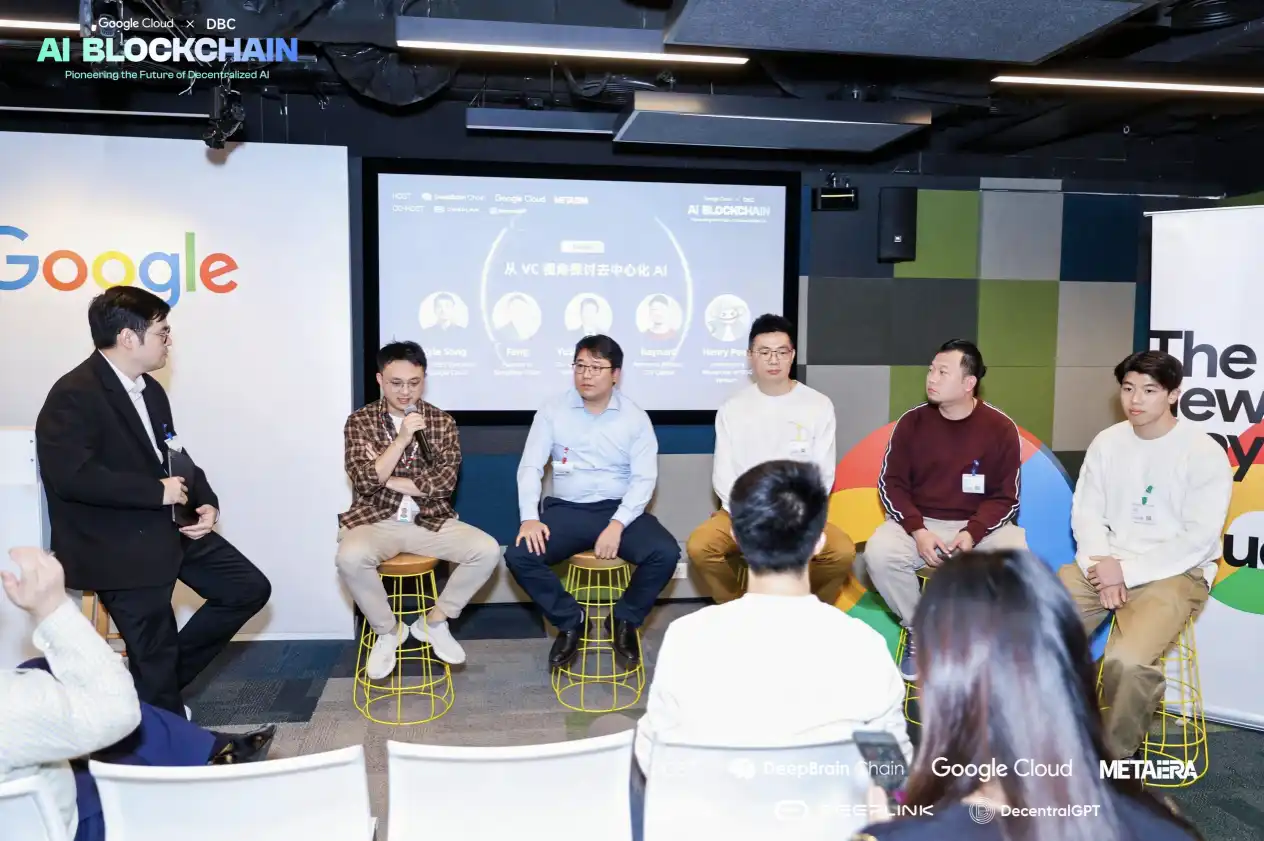
DeepBrain Chain (referred to as DBC) was established in 2017, driven by the DeepBrain Chain Foundation and the DeepBrain Chain Council to promote DBC's development. In 2021, DBC 1.0 GPU, a distributed GPU computing power network, went online, and DBC 2.0 is the world's first AI public chain. After 7 years of development, the public chain testnet was launched in August of this year, with the mainnet scheduled to go live in mid-December.
DBC 2.0: The First Decentralized AI Public Chain
The field of artificial intelligence is already highly competitive, but decentralized AI technology still has room for development in current practical applications. DeepBrain Chain, as a pioneer in the early layout of AI technology in the crypto field, has now made initial progress in technology development, mechanism design, and ecosystem construction.
How to Balance Decentralized AI Performance, Cost, and Resource Bottlenecks?
Firstly, DBC 2.0 is compatible with the EVM smart contract standard, supporting developers to issue tokens, deploy smart contracts, and develop decentralized AI applications based on its public chain. This allows any AI project to easily achieve decentralization through the DBC ecosystem and maintain long-term stable operation.
In terms of public chain performance, DBC supports 1000 transactions per second and has a block time of only 6 seconds, providing robust support for building complex AI applications. Moreover, each transaction costs less than $0.0001 in Gas fees, significantly reducing development costs. Additionally, DBC is fully compatible with the EVM, allowing existing DApps to seamlessly migrate to the platform, further lowering the technical barrier for developers.
Secondly, DBC 2.0 adopts a decentralized AI model for operation. Ethereum's founder Vitalik has warned that relying on centralized AI models may lead to users being bound by data and algorithms, while DBC 2.0 addresses this issue by supporting the fully decentralized deployment and operation of AI models.
The traditional development of decentralized AI projects typically requires funding in the tens of millions of dollars and takes 3-4 years. In contrast, DBC's efficient development tools shorten the development cycle to 3 months and reduce costs to the million-dollar level through simple API interfaces and AI container deployment functionality. More importantly, decentralized model operation effectively protects user privacy and avoids the risk of data leakage.
Thirdly, DBC 2.0 provides GPU free trials and high-performance support. By launching a token-based mining mechanism, DBC enables developers to trial GPU resources for free, significantly shortening the development cycle. The efficient resource integration capability, reducing the traditional timeline from 3 to 4 years to just 3 months, provides strong technical support for the rapid implementation of decentralized AI.
The high cost of computing power has always been the biggest bottleneck for the AI industry, especially for small and medium-sized AI companies, as the purchase and rental costs of GPU resources deter them. DBC 2.0 offers a new solution path where developers only need to issue their own token and launch a GPU mining mechanism to freely access GPU resources, breaking away from the traditional high-cost model. Furthermore, miners receive token rewards for contributing computing power. This mining incentive model not only alleviates developers' financial burden but also attracts more computing power to join, promoting ecosystem expansion. This inclusive model allows more small and medium-sized AI projects to use high-quality computing resources at low cost, thereby driving innovation and development in the AI industry.
In summary, DBC has not only optimized resource allocation but has also provided a new development platform for AI projects with efficiency, security, and low cost through decentralization and economic incentives.
From Cloud Gaming to Decentralized Inference Network, Comprehensive Coverage in Diverse Scenarios
The above has introduced some of the core advantages of DBC 2.0, a decentralized AI public chain. Building upon this, DBC has also developed a group of high-quality ecosystem projects, showcasing how to drive AI technology beyond boundaries and bring revolutionary changes to the global market.
As one of the core projects in the DBC ecosystem, DeepLink integrates AI and blockchain technology to provide a low-latency rendering solution for cloud gaming. By involving GPU providers in the "Orion Hunt" competition, DeepLink has brought over 2000 GPU nodes to DBC, not only driving the overall ecosystem's resource expansion but also paving a low-cost, high-performance path for the cloud gaming industry.
When it comes to the layout of decentralized AI models, DecentralGPT has become a star project of DBC. Positioned against OpenAI, DecentralGPT adopts an open-source approach, emphasizing data privacy and transparency, aiming to provide users with more autonomy in AI services. Its recent launch of a multi-million dollar GPU competition has not only attracted GPU providers from around the world but also further solidified DBC's resource advantage in the decentralized AI field, helping to grow the entire ecosystem.
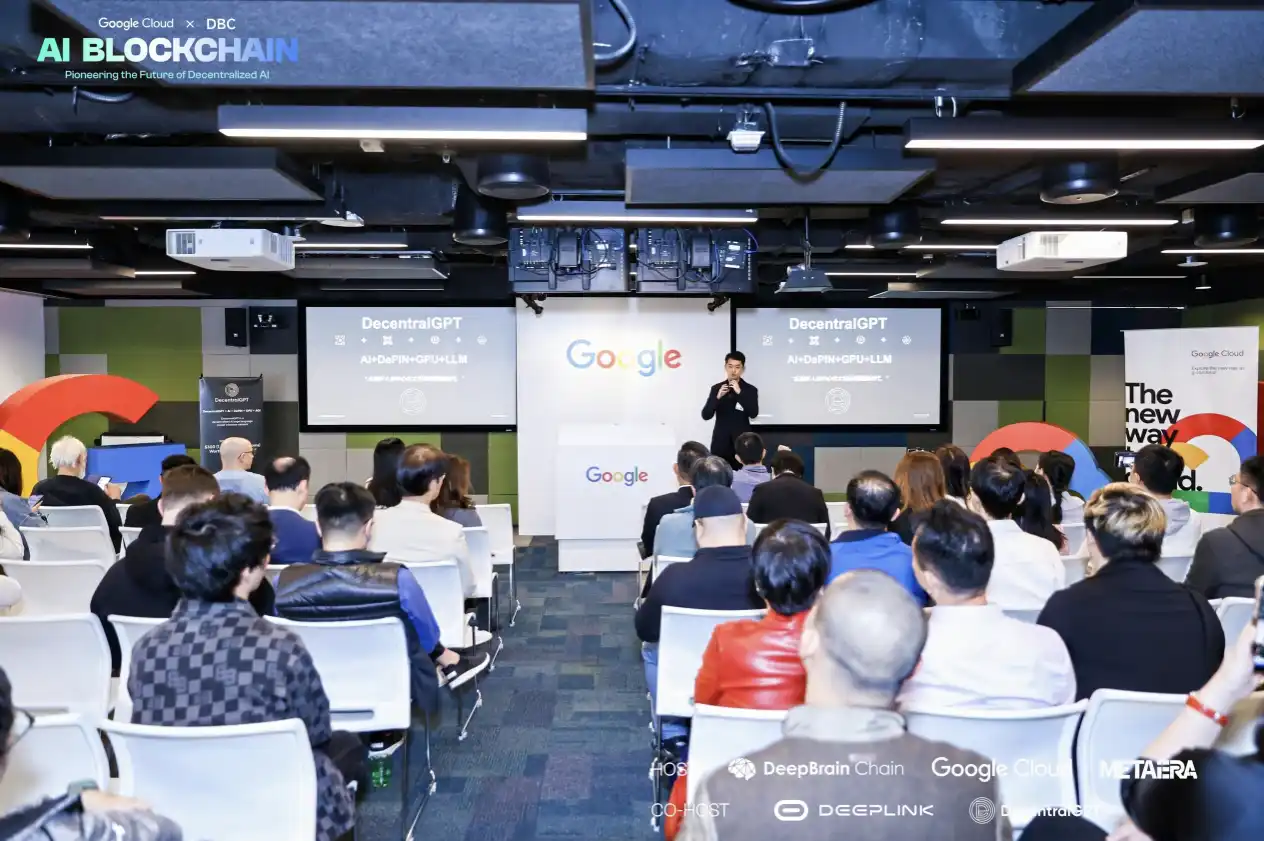
DecentralGPT Analyst Ze Ren Li on the Value of "DecentralGPT: Decentralized AI Large Language Model" Speech
The DBC ecosystem is not limited to core technical breakthroughs but also widely covers diverse scenarios through a series of innovative projects. SuperImage uses decentralized AI for image generation, supporting various text-to-image models, allowing users to generate high-fidelity artwork in seconds, providing a new realm of possibilities for digital creation. Meanwhile, DRCpad focuses on the primary market trading of AI nodes, laying a solid foundation for DBC's decentralized AI ecosystem through project filtering and incubation of high-quality projects.
In addition, DBC's business collaboration with HYCONS CLOUD has expanded to fields such as artificial intelligence, autonomous driving, biomedicine, and cloud gaming, providing a convenient collaboration channel for enterprises and developers in need of GPU resources. This resource-sharing model lowers the barrier to computing power for various industries and drives technological inclusivity.
At the infrastructure level, DBC also provides comprehensive tool support. DBCSCAN, as its EVM browser, has launched its testnet, supporting smart contract deployment and transaction queries. DBCWallet is feature-rich, covering POS staking, governance voting, treasury proposals, etc., providing developers and users with a complete ecosystem operation platform. These tools and platforms further enhance the user experience and development convenience of the DBC ecosystem.
DBC's ecosystem AI projects also span a wide range of areas from AI financial forecasting to AI scientific exploration. For example, AIDF positions itself as a decentralized financial forecasting platform, AITalk focuses on AI conversation interaction, DeepVideo and Hyper 3D explore the potential of video generation and 3D model generation, respectively. Whether for gaming like GameNPC and GamerGPT or for education and scientific research like MathAI and BioFold, these projects together outline various perspectives of the DBC decentralized AI ecosystem.
Overview of DBC 2.0 Tokenomics
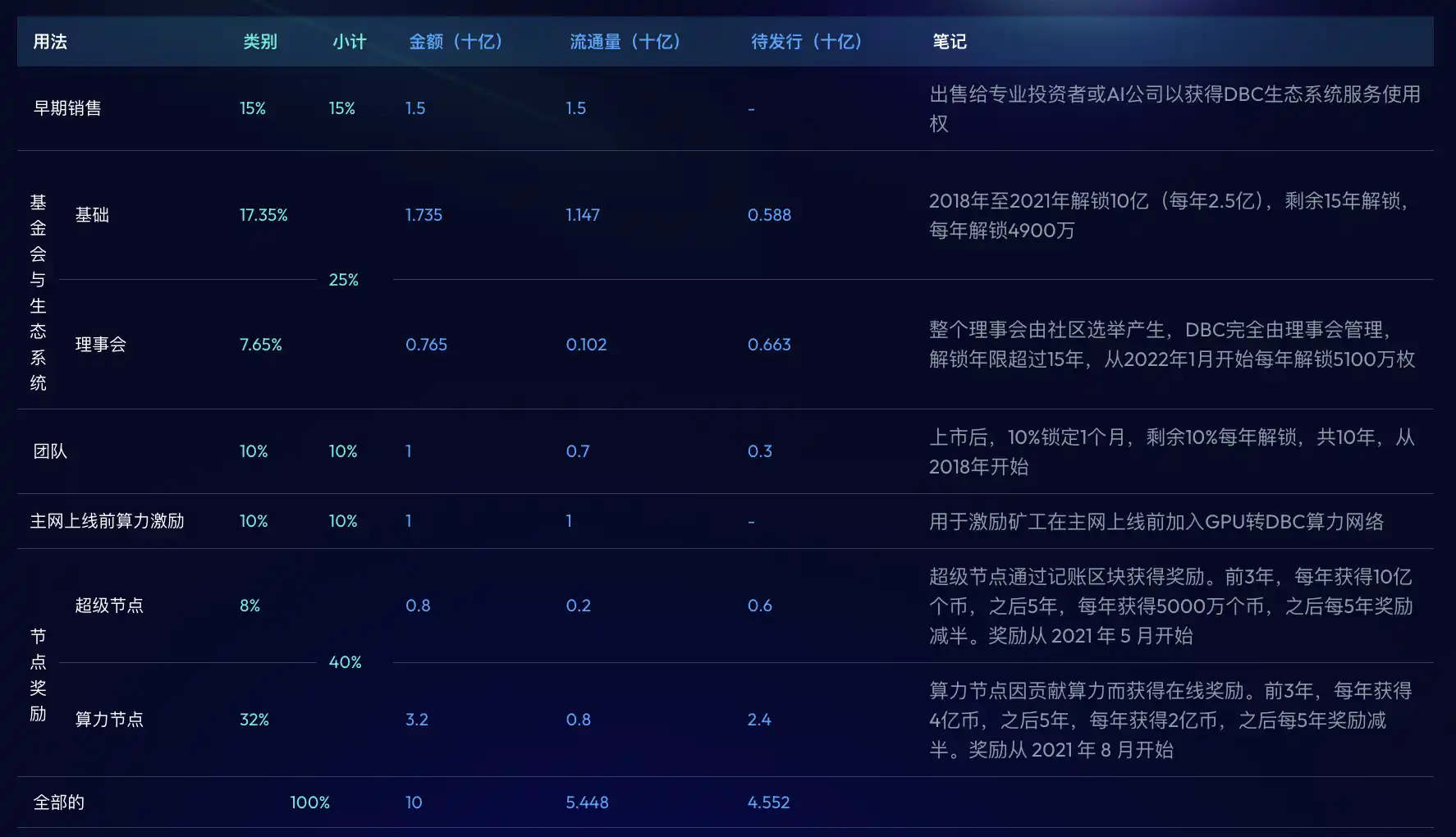
The total supply of DBC (DeepBrainChain) tokens is 10 billion, with a fixed supply that will never increase, and is expected to be fully issued in approximately 100 years. DBC adopts a deflationary model, where the GPU leasing fee paid by users will be burned based on different proportions of the total GPU count: when the network's GPU count is below 5,000, the burn rate is 30%; when it exceeds 5,000, the rate increases to 70%; and when it reaches or exceeds 10,000, the burn rate rises to 100%.
Users need to purchase DBC tokens through a trading platform or other channels to pay for GPU leasing fees. This mechanism ensures that each GPU lease will reduce the circulating supply of DBC in the market. Additionally, miners need to stake DBC to provide GPU services, with an initial stake of 1,000 DBC per GPU (currently valued at $4). As the number of GPUs increases, the total staked DBC amount will also increase accordingly. As of now, the total DBC staked by GPU miners network-wide has reached 74,680,376 tokens, accounting for 1.33% of the total issuance.
DBC POS Supernodes are required to stake DBC to receive block rewards, with the current total staked DBC across the network being 1,466,792,420, accounting for 26.14% of the total DBC issuance.
Furthermore, DBC tokens also serve as the governance token of the DeepBrainChain network. The network elects 21 committee members through a POS mechanism to collectively manage the Ecosystem Development Fund. The Committee DAO holds elections every four months, and all candidates are ranked based on the number of votes received, with each DBC being equal to one vote. The treasury funds managed by the Committee DAO are used to support ecosystem development, further driving the sustainable operation and growth of the DeepBrainChain network.
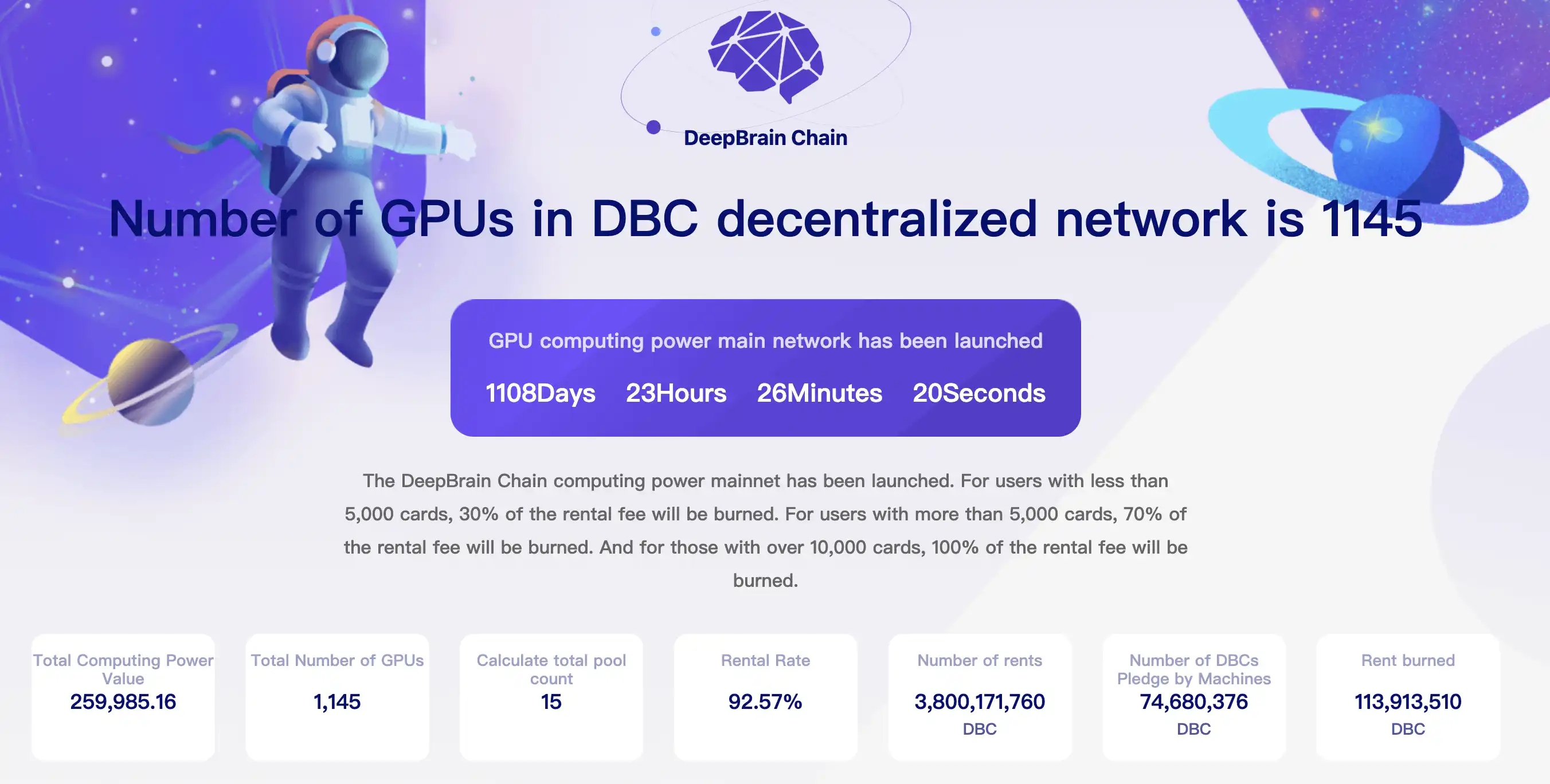
As mentioned earlier, the DBC 2.0 Testnet was launched in August. With several months passed, how is the current performance?
According to the official information, the current DBC total hash rate has reached 259,985.16, with over 1145 GPUs, a GPU leasing rate of 92.58%, and GPU leasing consuming over 113 million DBC, demonstrating the high efficiency of its resource utilization.
The more ecological applications there are, the greater the ecosystem's demand for GPU. The more DBC transactions used per day, the more DBC destroyed, and the greater the value of DBC.
Take the cloud internet cafe application as an example. Cloud internet cafe users need to purchase coins on the transaction market to use GPU. For every additional GPU, 30% of the tokens purchased from the transaction market will be destroyed. If there are 1000 cloud internet cafes, each cafe has 100 machines, each machine is used for 10 hours a day, paying $0.1 per hour, with 30% being destroyed. Tokens worth $900,000 are destroyed every month.
Based on a coin price of $0.002USDT, over 400 million coins need to be destroyed in a month. At the same time, to support 1000 cafes, 70,000 machines are needed, and an additional 7 billion coins need to be staked.
Traditional Tech Giants and the Symphony of Decentralized AI
At the intersection of artificial intelligence and blockchain technology, the DBC AI public chain is starkly contrasting with traditional decentralized computing power projects. Decentralized computing power projects mainly target centralized AI enterprises, with competitors including giants such as Google and Microsoft, providing computing power support to centralized AI through GPU rental. However, this market competition is extremely fierce, with almost all tracks dominated by centralized enterprises, resulting in an internal competition characterized by high computing costs and limited price flexibility.
In contrast, the DBC AI public chain serves AI developers, opening up a brand-new decentralized AI market. With empowering developers at its core, DBC provides infrastructure for the decentralized AI ecosystem, helping developers rapidly refactor business models, thereby avoiding the dilemma of low user migration costs and intense price competition in the centralized AI model. This strategy not only fills the gap in the decentralized AI market but also opens up a new blue ocean for AI technology exploration and innovation.
Meanwhile, DeepBrain Chain has also partnered with tech giant Google Cloud. The conference on November 28, themed "Driving the Future of Decentralized AI," showcased the interim results of this collaboration, outlining the vision of traditional tech giants collaborating with decentralized technology platforms to forge the future.
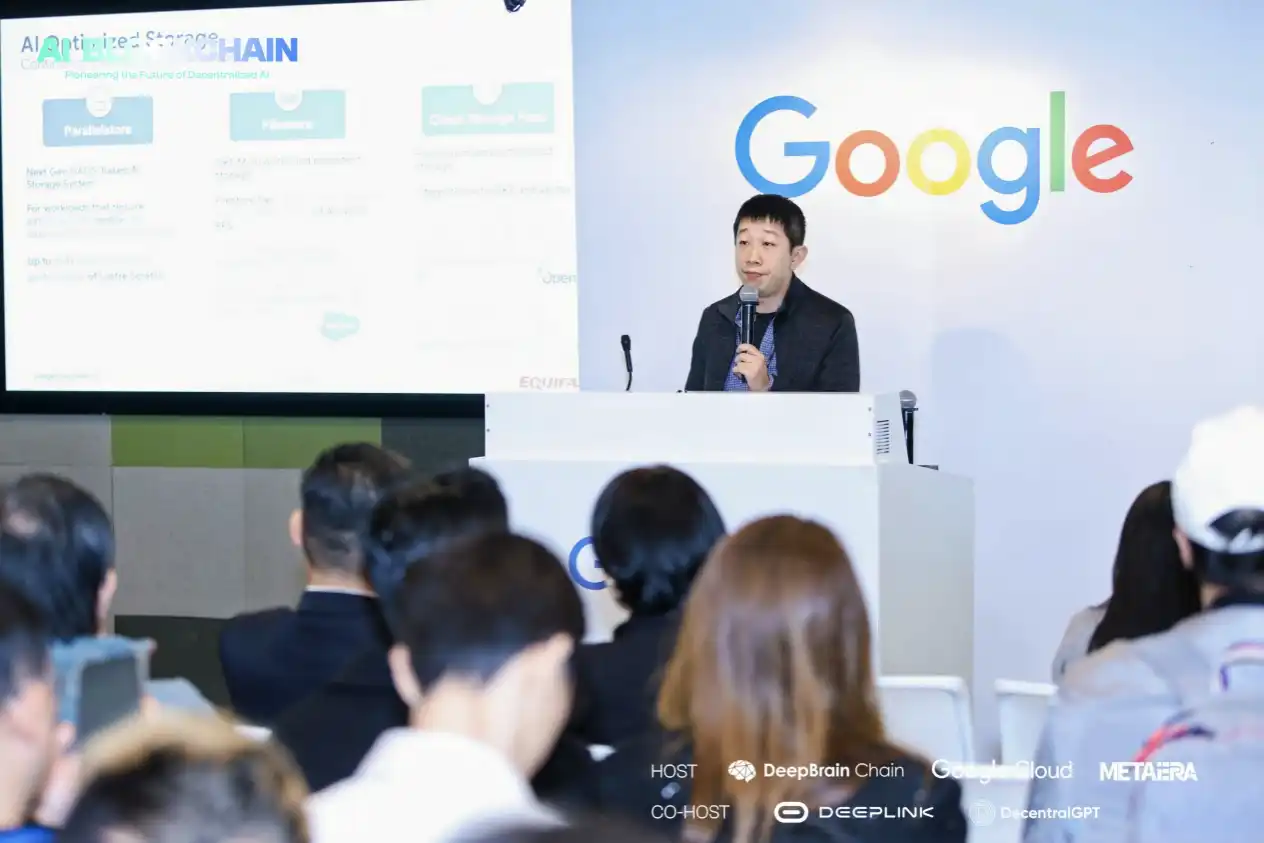
Google Cloud Solutions Architect Leon Li on "Decentralized AI: Leveraging GPU for Distributed Inference on Google Cloud" keynote speech
First of all, Google Cloud provides powerful computing power support for the DBC ecosystem. A decentralized AI network requires a large number of GPU resources, and for miners lacking GPU devices, Google Cloud's GPU service has become an important supplement, allowing more participants to easily join the DBC ecosystem. At the same time, it has brought new user growth points and business models to Google Cloud.
Google Cloud has also reduced the barrier to entry for users through its "one-click mining" feature, allowing users to run AI model images and participate in mining various AI tokens on the DBC AI public chain without requiring a deep technical background. This convenience has attracted more developers and users, further expanding the scale of the decentralized AI ecosystem and laying the foundation for the popularization of AI technology.
It is reported that DeepBrain Chain is establishing a special fund to incubate more innovative deAI projects. The success of these projects will further drive the prosperity of the DBC chain itself, forming a virtuous cycle of mutual promotion between the ecosystem and infrastructure.
Google Cloud will continue to empower DeepBrain Chain with technology and resources, while DeepBrain Chain, through the innovation of decentralized AI technology, attracts more developers and users to join, collectively driving the rapid growth of this emerging market. This partnership model injects new momentum into the decentralized AI ecosystem and opens up new development paths for the global AI market.
You may also like

Champion's Final Bow: FC Barcelona vs Real Betis – Celebrate the Title with a Home Finale

Best Oil Trading Platform for Crypto Users in 2026

5 Futures Trading Strategies Smart Traders Use to Cut Crypto Fees and Boost Futures Returns

What Is TradFi? How Crypto Traders Can Now Access Crude Oil, Gold, and Global Markets

How WEEX Bridges Crypto and Football: A Deep Look at the LALIGA Partnership Inside the WEEX App
WEEX is not just a LALIGA sponsor. It’s a true partner. From iPhone Dynamic Island to LALIGA-themed app icons and smart posters, see how WEEX brings football passion into every trade — and builds a real bridge between crypto and sports.

FC Barcelona vs Real Madrid Preview: El Clásico – Can Barça Clinch the Title at Spotify Camp Nou?
FC Barcelona vs Real Madrid El Clásico match preview for May 11, 2026. Barça need just 1 point to win LALIGA. Can Madrid delay the trophy? Full preview inside.

At the Stripe conference, I saw the future of the AI economy

Miners welcome a new life

Seven Important Judgments by Claude Code's Founder at the Sequoia Conference

The payment moment of AI agents: Who will become the Stripe of the machine economy?

Morning Report | MoonPay acquires Solana's execution layer DFlow; Strategy releases Q1 financial report; Manta Network announces the termination of Manta staking program

Rented Tracks: What is this wave of stablecoin FX hot money really paying for?

Dialogue Velocity Eric: What is the stablecoin track that the CFO really wants?

Strategy should have said that selling coins is not ruled out

How MegaETH Achieved a TVL of 700m Within a Week of TGE? Analyzing the Packaging Strategy

Futures Trading Hours: Trade Cryptocurrency 24/7 and Earn Back Up to 45% in Trading Fees
Learn futures trading hours and the best time to trade crypto futures. Discover 24/7 market insights, peak trading sessions, and how to earn back up to 45% in fees.
Why is a16z Crypto raising another $2.2 billion to heavily invest in Web3?
Polymarket Underlying Algorithm Explained
Champion's Final Bow: FC Barcelona vs Real Betis – Celebrate the Title with a Home Finale
Best Oil Trading Platform for Crypto Users in 2026
5 Futures Trading Strategies Smart Traders Use to Cut Crypto Fees and Boost Futures Returns
What Is TradFi? How Crypto Traders Can Now Access Crude Oil, Gold, and Global Markets
How WEEX Bridges Crypto and Football: A Deep Look at the LALIGA Partnership Inside the WEEX App
WEEX is not just a LALIGA sponsor. It’s a true partner. From iPhone Dynamic Island to LALIGA-themed app icons and smart posters, see how WEEX brings football passion into every trade — and builds a real bridge between crypto and sports.
FC Barcelona vs Real Madrid Preview: El Clásico – Can Barça Clinch the Title at Spotify Camp Nou?
FC Barcelona vs Real Madrid El Clásico match preview for May 11, 2026. Barça need just 1 point to win LALIGA. Can Madrid delay the trophy? Full preview inside.


