
BTC Eight Green Candles Reach $76K, What Is the Logic Behind Outperforming Gold in the Midst of Battle?


Original Article Title: "BTC Records Eight Consecutive Green Candles, Touches $76K - What's the Logic Behind Outperforming Gold in the Midst of War?"
Original Article Author: ChandlerZ, Foresight News
Bitcoin touched $76,000 during intraday trading on March 16, setting a new six-week high after eight consecutive green daily candles with a nearly 4% 24-hour gain. This price level is approaching a key resistance area that has held since late January. Since the outbreak of the US-Iran conflict on February 28, Bitcoin has risen by nearly 20%, while gold has seen a 3% decline, and the S&P 500 has dropped by around 2%. Bitcoin's relative performance has outpaced almost all mainstream assets.
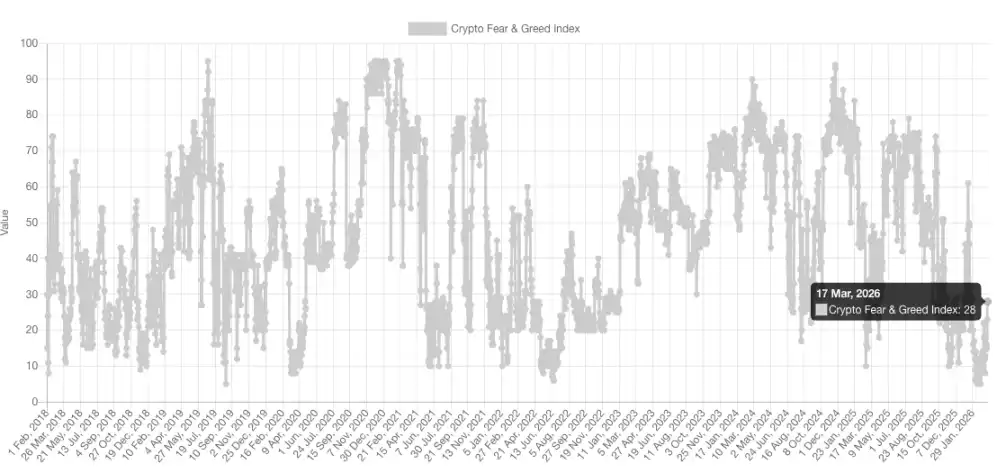
In terms of liquidation data, according to Coinglass, the global open interest contracts saw $610 million in liquidations over the past 24 hours, with $485 million in short liquidations. Data from Alternative.me shows that the market sentiment has shifted from "extreme fear" to "fear," with today's crypto fear and greed index rising to 28 (yesterday it was at 23, indicating "extreme fear").
On March 16, all three major indices closed higher. The Dow Jones Industrial Average rose by 387.94 points to close at 46,946 points, a gain of 0.83%; the S&P 500 rose by 1.01% to 6,699 points; and the Nasdaq rose by 1.22% to close at 22,374 points. The improvement in market sentiment was primarily due to a cooling of geopolitical risks. US Treasury Secretary Scott Bessent stated on CNBC that the US is allowing Iranian oil tankers to pass through the Strait of Hormuz, marking the first time a tanker has passed since the start of the conflict.
WTI crude oil futures traded in a range of $92.93 to $94.17 per barrel, while Brent crude opened at $105.26 per barrel. Previously, there were concerns that a blockade of the Strait of Hormuz could disrupt about 20% of global oil shipments, causing oil prices to surge to a three-year high. As expectations for a calming of the situation increased, the upward momentum in oil prices was curbed.
Pressured by a strengthening US dollar, spot gold fell to around $5,010 per ounce, pulling back from recent highs. Silver followed the adjustment in the precious metals sector. The divergence between gold and Bitcoin is worth noting, as both have been bought as safe-haven assets since the start of the conflict, but Bitcoin's performance has started to outshine gold.
Three Logics Driving Bitcoin's Upside
First, Geopolitical Risk Easing Releases Risk Appetite. The Strait of Hormuz crisis was the biggest constraining variable in the market over the past three weeks. Soaring oil prices imply rising inflation expectations, which are highly unfavorable for liquidity-sensitive assets. With signals of the strait reopening, the market has started to reprice.
Second, Bitcoin is Playing the Role of a Non-Dollar Safe Haven Asset. During this round of US-Iran conflict, Bitcoin did not fall in sync with the stock market but instead strengthened against the trend. A report by Fortune magazine pointed out that since the start of the war, Bitcoin has outperformed all mainstream safe-haven assets such as gold and stocks. This contrasts with Bitcoin's performance during the early stages of the 2022 Russia-Ukraine war, indicating a shift in market perception of Bitcoin's properties.
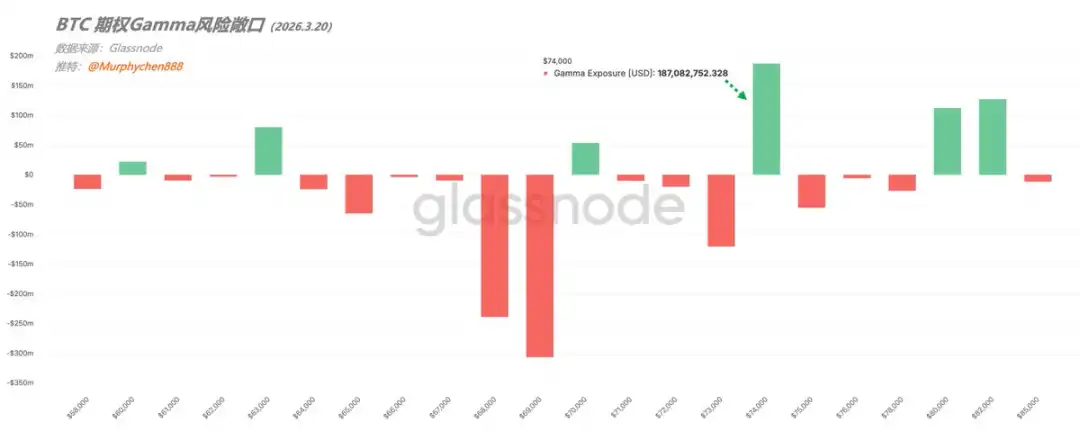
Third, Option Structures are Creating a Magnet Effect at $75,000. Crypto analyst Murphy pointed out that near $74,000, there is approximately $180 million in Long Gamma exposure for options expiring on March 20. Market maker hedging behavior will suppress volatility, causing the price to tend to oscillate in that range, objectively forming resistance.
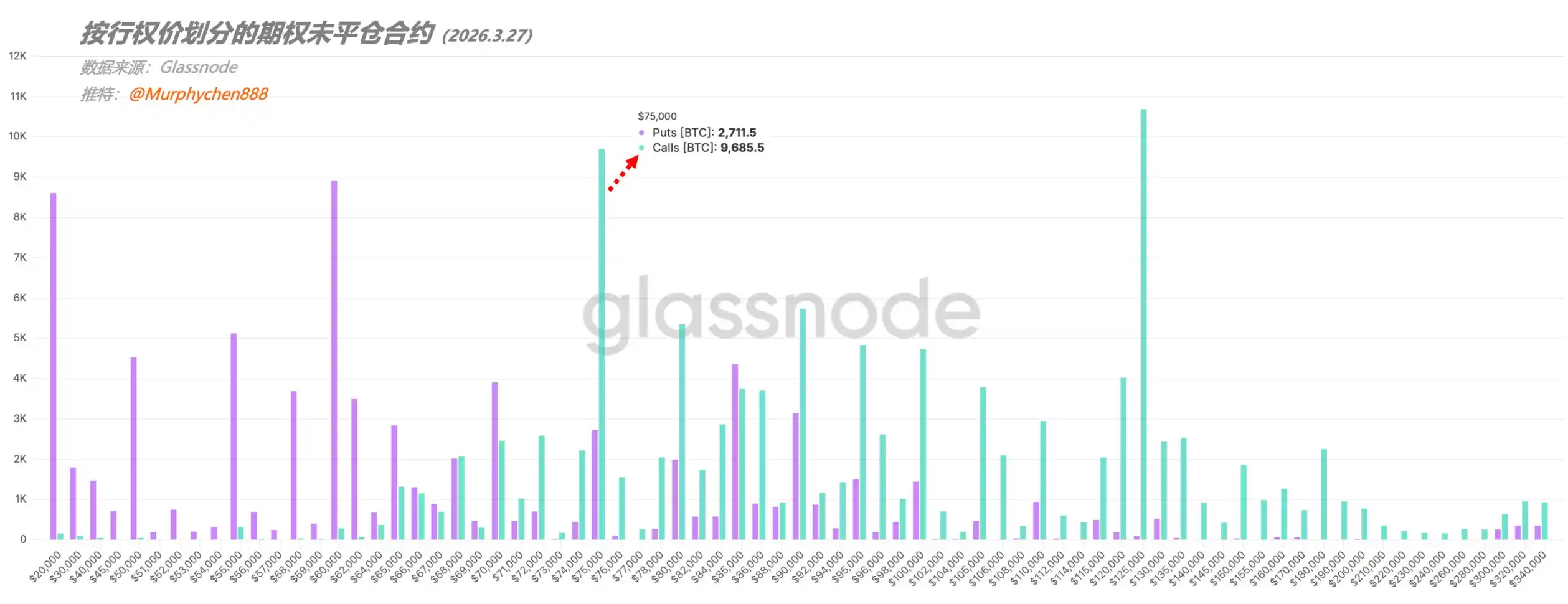
However, after March 20, a significant change in the structure for the next major expiry date on March 27 has emerged. The $75,000 strike price has gathered an Open Interest of 9,685 BTC for Calls, with only 2,711 BTC for Puts, showing a Call absolute advantage. More importantly, from February 28 to March 14, the Call Net Premium at this strike price has surged rapidly from $5.8 million to $19.8 million, when Bitcoin was still in the range of $66,000 to $68,000, indicating funds were positioning for upside potential at lower levels.
Looking at the Gamma Risk Exposure, there is approximately -$2.56 billion Short Gamma structure near $75,000. In a Short Gamma environment, the closer the price is to the strike, the quicker market makers' Delta changes, forcing continuous hedging in the direction of the price, buying on the uptrend, creating a typical "Gamma Magnet Effect."
There is a $420 million Long Gamma exposure at $80,000, where market makers' hedging direction shifts, suppressing volatility, forming a strong resistance. Around $65,000 to $67,000, there is $390 million in Long Gamma providing a buffer, but the OI in this area is significantly weaker than at $75,000 and $80,000, classifying it as a buffer zone rather than strong support.
FOMC Emerges as the Greatest Uncertainty Variable
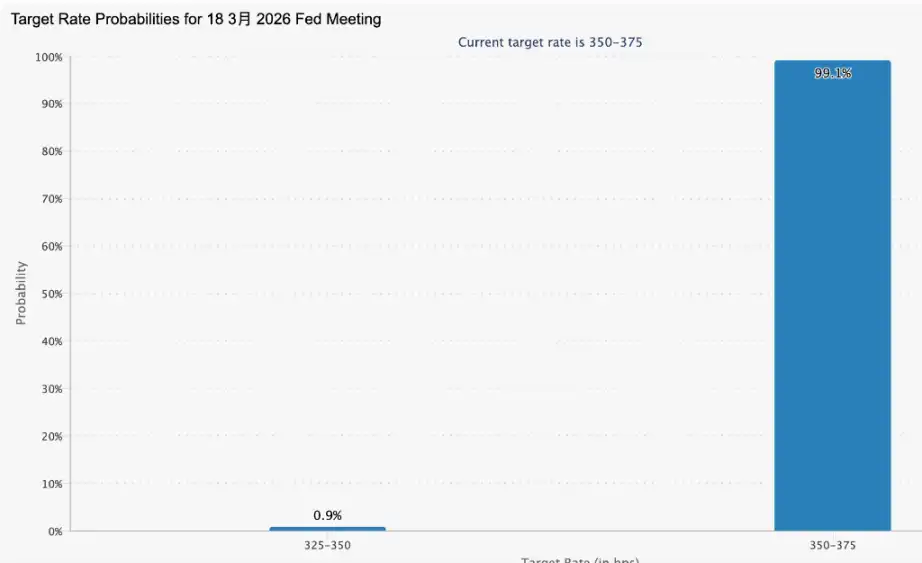
The Fed's monetary policy meeting this week is at an impasse, possibly the most direct pressure test for Bitcoin in the near term. CME FedWatch data shows that the market expects a probability of over 99% for maintaining the interest rate unchanged (3.50%-3.75%).
Historically, Bitcoin has experienced a price drop after 7 out of 8 FOMC meetings in 2025, with an average decline of 14%. There was only one brief price increase after a meeting. In January 2026, as the Fed kept the interest rate as expected, Bitcoin plummeted from $90,400, breaking below $60,000 before finally rebounding.
However, the current policy environment is more complicated than before. Brent crude oil surpassed $100 per barrel, reigniting inflationary pressures; February's nonfarm payroll unexpectedly weakened, putting pressure on the labor market outlook. The conflicting signals from the two major targets have sharply limited the monetary policy space.
For Fed Chair Powell, this will be the penultimate meeting before the end of his term in May. The next interest rate adjustment may have to wait until Kevin Warsh, Trump's nominated Fed Chair, formally takes over the Fed. There is also a unique political pressure as a federal judge rejected the Department of Justice's subpoena to the Fed last week, but prosecutors have announced an appeal, which could disrupt the confirmation process for Trump's nominee, Kevin Warsh. Powell's term ends in May, but according to court documents, he has stated that he "cannot resign while a criminal investigation is pending."
For Bitcoin, if Powell can instill confidence in the inflation trend during the press conference or hint at a rate cut window later this year, it would be the most bullish scenario. However, if he reiterates a hawkish stance or uses ambiguous wording under political pressure, the short-term downside risk will also significantly rise.
You may also like

Morning Report | BitMine increased its holdings by 126,971 ETH last week; trader Eugene announced his exit from the crypto market

Wang Chuan: How can one not feel anxious after the neighbor Old Wang made thirty times profit by investing in storage stocks? (Seven) - A quarter-century cycle

Cryptocurrency CEXs are flocking to sell US stocks, and traditional brokerages are facing an "uninvited guest."

$75 billion in foreign capital has fled, and South Korean retail investors have absorbed it all using leverage

Japan’s Three Megabanks Plan Joint Stablecoin Issuance in Fiscal 2026
MUFG, SMBC, and Mizuho reportedly plan to jointly issue fiat-pegged stablecoins in fiscal 2026, signaling Japan’s growing push into bank-led digital payment infrastructure.

Humanity Discloses H Token Dual-Chain Attack Details, With Losses on Ethereum and BSC Exceeding $36 Million
Humanity said the H token attack across Ethereum and BSC caused more than $36 million in losses after leaked ProxyAdmin keys enabled malicious contract upgrades and token minting.
White House Discusses CLARITY Act With Law Enforcement Ahead of Senate Vote
The White House discussed the CLARITY Act with law enforcement ahead of a Senate vote, focusing on illicit finance risks and developer protections.

Bitcoin Trading Guide 2026: Strategies for Experienced Traders

What Is XAUT and PAXG? Why Tokenized Gold Is Booming in 2026

Will the SpaceX IPO Hurt Bitcoin? Here's What Traders Are Watching

Foreign selling in the South Korean stock market accelerates, with cumulative net sales reportedly reaching $75 billion this year
On June 9, The Kobeissi Letter, citing Goldman Sachs data, reported that global investors are selling South Korean stocks at an unusually rapid pace. In the latest trading session, foreign investors sold about $801 million worth of Kospi constituent stocks again; total foreign outflows last week reached about $10 billion, and the market has been in net foreign selling on nearly every trading day over the past month. According to the data cited in the report, foreign investors have sold about $75 billion worth of South Korean stocks so far this year. Meanwhile, South Korean retail and institutional investors together recorded roughly $69 billion in net buying over the same period, suggesting that the market’s main buying support has come from domestic capital rather than returning overseas funds. The information currently disclosed still mainly comes from The Kobeissi Letter’s retelling and Goldman Sachs data summaries, while public details on the statistical period and the specific definition of “selling” remain relatively limited.

Fortune Warns of Strategy’s Financing Structure Risks as Bitcoin Premium Narrows
Fortune warned that Strategy’s Bitcoin treasury model faces growing financing risks as MSTR’s net asset premium narrows and preferred stock dividend pressure increases.

Ferrari Challenge Le Mans: Carl Moon to Dominate in WEEX Livery

Sahara AI Responds to SAHARA’s Sharp Drop: No Contract or Product Security Issues Found, Internal Investigation Underway
Sahara AI responded to SAHARA’s 60% price drop, saying no token contract or product security issues have been found and an internal investigation is underway.

WEEX Deposit/Withdrawal Dynamic Island: Your Asset Status, Always in Sight
Scaling Crypto Derivatives: The Digital Asset Infrastructure Behind High-Volume Trading
In the fast-moving digital asset ecosystem, derivatives platforms face an extreme architectural test. High-leverage futures markets demand more than just standard security—they require absolute operational precision, zero-latency matching engines, and ironclad structural scalability, all while navigating intense market volatility.
As global platforms scale to meet these demands, the industry is shifting away from rigid, monolithic setups toward a more agile, "decoupled" infrastructure philosophy.
The Blueprint for High-Volume Copy TradingFor elite global exchanges like WEEX (founded in 2018), this architectural choice becomes critical when scaling high-volume retail features like social copy trading. When thousands of users automatically mirror the real-time strategies of elite traders simultaneously, it triggers sudden, monumental spikes in concurrent transactional volume.
To prevent execution latency or settlement bottlenecks during these peak volatility events, a platform's primary engine must remain entirely dedicated to risk management, copy-trade synchronization, and order matching.
The Architectural Rule: New-generation platforms must separate front-end user execution engines from heavy backend infrastructural overhead to eliminate operational friction.
By separating these layers, platforms can maintain complete sovereignty over their trading environments and user experiences while strategically aligning with institutional-grade infrastructure ecosystems. This strategic framework allows modern exchanges to leverage advanced Digital Asset Custody infrastructure such as Cobo’s behind the scenes, ensuring that backend wallet management scales elastically alongside trading spikes.
Capitalizing on Market Momentum and 400× LeverageIn a derivatives arena where platforms offer up to 400× leverage on perpetual contracts, capital efficiency and market agility are core business metrics. To capture market momentum, an exchange needs the ability to rapidly expand its asset offerings, supporting everything from legacy crypto assets to sudden, trending altcoins across a massive library of trading pairs.
Adopting a flexible, scalable Wallet-as-a-Service (WaaS) solution such as Cobo’s could completely rewrite the development timeline for high-growth exchanges. Instead of spending months of engineering capital building out custom backend wallet architectures for every new blockchain network, platforms can deploy localized infrastructure in days.
This agility allows platforms to instantly scale their listings to over a thousand trading pairs without compromising security or delaying time-to-market. It mirrors the exact operational advantages seen during high-velocity market events, similar to how advanced wallet infrastructure empowers platforms during sudden asset surges; allowing exchanges to pass that speed and liquidity directly to their global user base.
A Mature Foundation for GrowthThe synergy between trusted infrastructure ecosystems and global trading platforms represents the natural evolution of a maturing crypto market. As WEEX continues to scale its global spot and derivatives offerings for over 6 million users, adopting robust backend paradigms proves that platforms no longer have to compromise between cutting-edge trading velocity and uncompromised structural security.

Get Paid to Onboard? Try WEEX’s New Homepage with Rewards for Registration, Deposit & Trade
WEEX Custom Layout: Build Your Perfect Trading Workspace in Seconds
Morning Report | BitMine increased its holdings by 126,971 ETH last week; trader Eugene announced his exit from the crypto market
Wang Chuan: How can one not feel anxious after the neighbor Old Wang made thirty times profit by investing in storage stocks? (Seven) - A quarter-century cycle
Cryptocurrency CEXs are flocking to sell US stocks, and traditional brokerages are facing an "uninvited guest."
$75 billion in foreign capital has fled, and South Korean retail investors have absorbed it all using leverage
Japan’s Three Megabanks Plan Joint Stablecoin Issuance in Fiscal 2026
MUFG, SMBC, and Mizuho reportedly plan to jointly issue fiat-pegged stablecoins in fiscal 2026, signaling Japan’s growing push into bank-led digital payment infrastructure.
Humanity Discloses H Token Dual-Chain Attack Details, With Losses on Ethereum and BSC Exceeding $36 Million
Humanity said the H token attack across Ethereum and BSC caused more than $36 million in losses after leaked ProxyAdmin keys enabled malicious contract upgrades and token minting.


