
Blob Space Exhausted, Is Ethereum L2 Also on the Brink of Collapse?

Original Article Author: gauthamzzz, Co-Founder of PolynomialFI
Original Article Translation: zhouzhou, BlockBeats
Editor's Note: This article discusses the Blob space scarcity issue faced by Ethereum Layer 2 (L2). As the L2 chain grows, multiple L2s compete for limited Blob storage, leading to skyrocketing fees and increased user costs. Even with the Pectra upgrade increasing the Blob count to 6, the problem can only be temporarily alleviated but not fundamentally resolved. Solutions include short-term Pectra upgrades, mid-term PeerDAS implementation, and long-term DA scaling. However, it is still uncertain whether these solutions can be implemented in a timely manner.
Below is the original article content (reorganized for better readability):
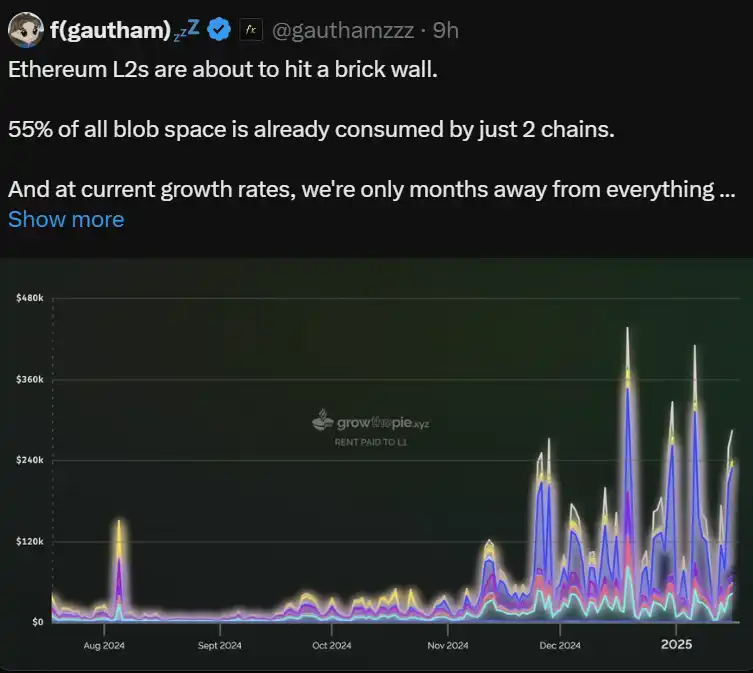
Ethereum L2 is about to face a bottleneck. Currently, 55% of all Blob space has been consumed by just two chains, and at the current growth rate, we are only a few months away from a complete collapse.
The following is what is happening
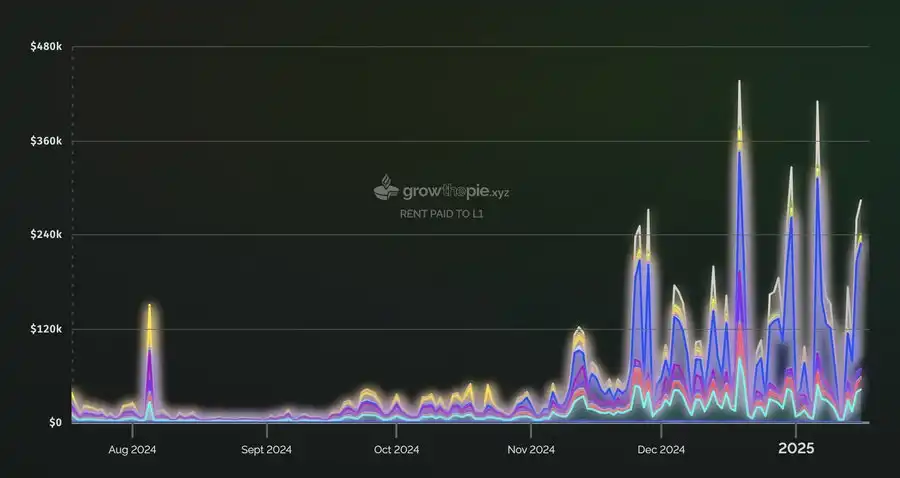
First, let's understand what is collapsing: Blobs = L2's special storage Current limit = 3 Blobs per block Reality = dozens of L2s vying for these 3 spots. It's like a highway with only 3 lanes, and 50 evolving cities are fighting for these lanes.
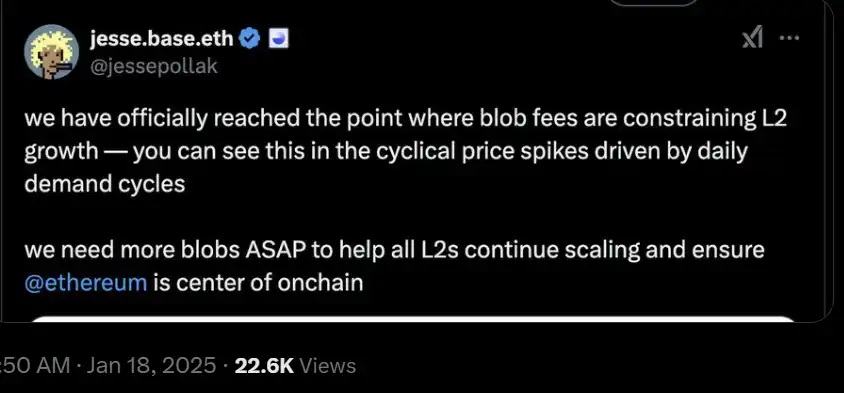
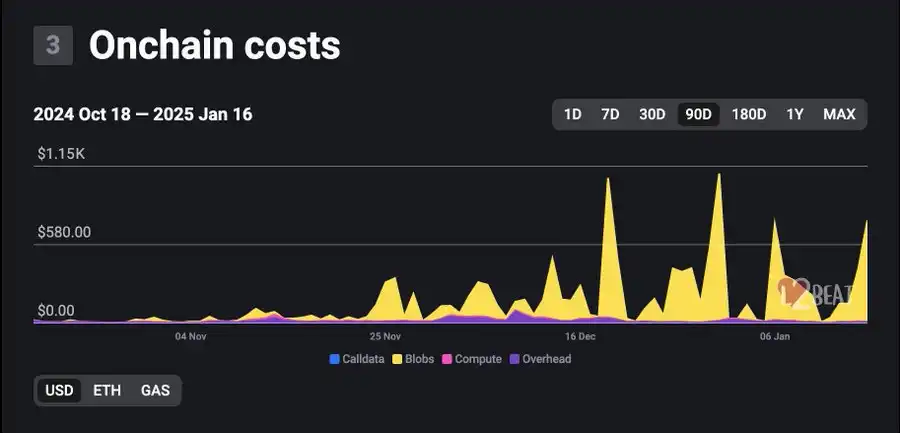
Day-to-day data clearly shows a problem, Blob fee spikes:
• During transaction times
• During airdrops
• When new L2 launches operations
Each spike = higher user cost
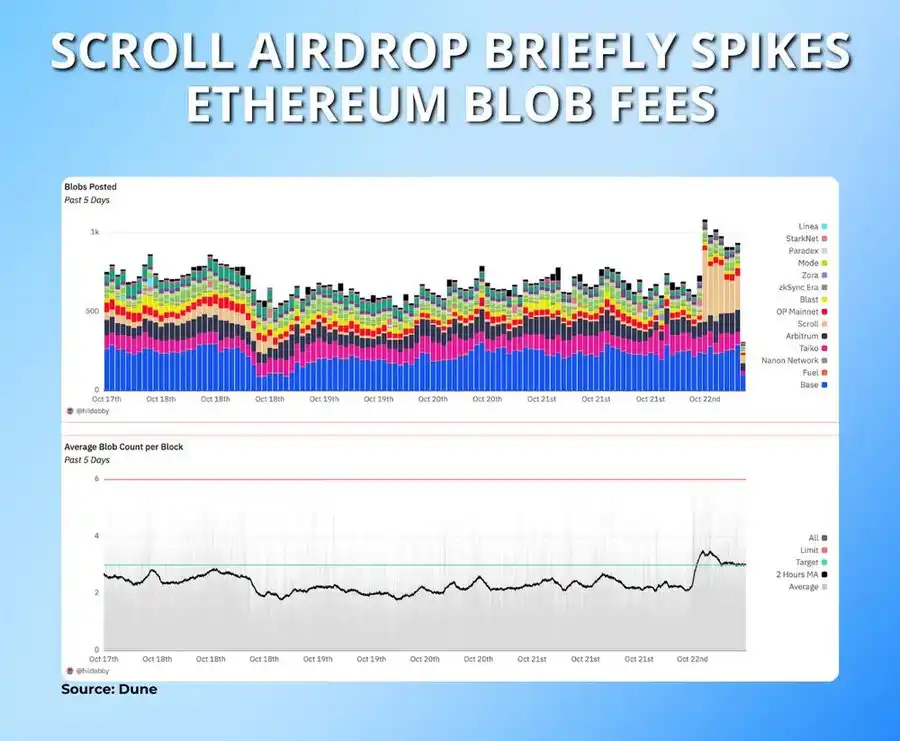
Even the Pectra upgrade (increasing Blob count to 6) cannot save us. At the current growth rate, we will reach maximum capacity in May 2025. And that's assuming no change in growth. (Sidenote: Growth won't stay the same—it's accelerating).

The Real Challenge
Issue: L2 Competing for Limited Blob Space
Approach: Increased Demand → Base Fee Rise
Reason: Each Transaction Requires Blob Space
Any L2 optimization cannot solve this fundamental bottleneck.
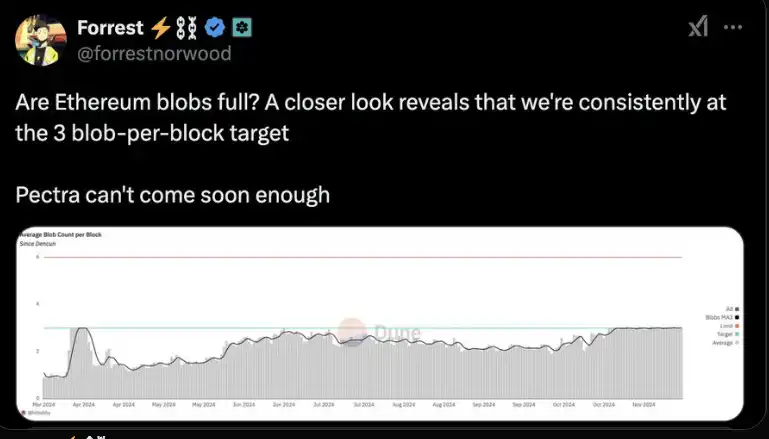
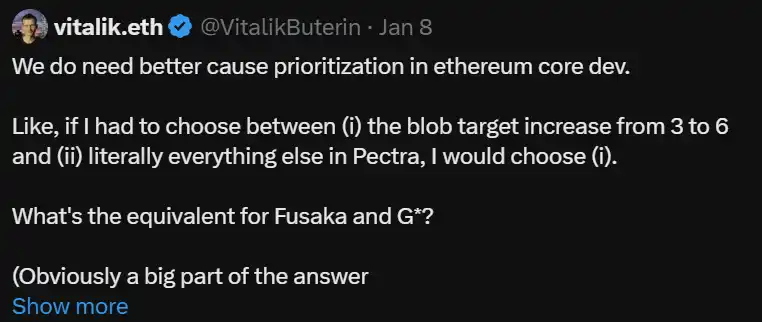
Core developers know this is a key issue. Vitalik Buterin said increasing the Blob count from 3 to 6 is more important than all other Pectra upgrades combined. But doubling the capacity will only give us a few more months, not years.
Solutions Under Research
Short Term: Double Blob Space (Pectra)
Mid Term: PeerDAS Implementation
Long Term: Advanced DA Expansion
But will they arrive before we hit the bottleneck? This issue is affecting everyone:
• DEX transaction costs are rising
• Perpetual protocols face skyrocketing base fees
• Users are paying more for basic transaction fees
At PolynomialFi, our base fees have increased by 300% in recent months.
A Glimmer of Hope?
This crisis has emerged because people are truly starting to use Ethereum L2. But if we don't address it soon, users may look elsewhere.
Summary
• Blob space is nearing its limit
• Next crisis expected within 6 months
• Urgent need for scaling solutions
• Every L2 user is impacted
If you want Ethereum to scale, this is the battle to watch.
You may also like

Pantera Capital Partner: How Tokenization is Restructuring the Private Equity and Early Investment Ecosystem?

New York Proposes Stricter Stablecoin Issuer Rules Aligned With Federal GENIUS Act
NYDFS proposed stricter stablecoin issuer rules aligned with the GENIUS Act, covering reserves, custody, redemption timelines, audits, and capital buffers.
Every exchange is a "Universal Exchange."

The counterattack of traditional finance: Alliance chains are quietly reviving

CryptoQuant Says Bitcoin Profitable Supply Is Near 45% Pressure Zone as On-Chain Data Points to Market Repricing
CryptoQuant said Bitcoin’s profitable supply is nearing the 45% pressure zone, signaling rising market stress, unrealized losses, and a possible on-chain repricing phase.

Bitcoin Falls Below 200-Week Moving Average as On-Chain Data Shows Over Half of Supply in Loss
Bitcoin dropped below its 200-week moving average as on-chain data showed over 50% of circulating supply is now in loss, signaling rising market stress.

CFTC Reportedly Plans New Prediction Market Rules Focused on Manipulation Risk and Public Interest Review
The CFTC is reportedly preparing new prediction market rules focused on manipulation risk, public interest review, and retail trader protections.

Meet the new WEEX trial fund—your gateway to greater profits

WEEX Labs Lands at Dutch Blockchain Week: A Disruptive Crypto × AI Conversation Sets Sail in Amsterdam

SK Hynix Reportedly Plans U.S. ADR Listing as Early as August, With SEC Approval Possible in Late June
SK Hynix may pursue a U.S. ADR listing as early as August, with SEC approval reportedly possible in late June amid strong AI chip supply chain demand.

SpaceX vs Tesla vs xAI: Which Elon Musk Trade Has the Biggest Upside in 2026?
OpenAI Reveals It Has Confidentially Submitted an S-1 to the SEC, Keeping the Door Open for a Future IPO
On June 9, according to an OpenAI announcement, the company recently confidentially submitted a draft S-1 registration statement to the U.S. Securities and Exchange Commission (SEC), beginning the preliminary compliance process for a potential initial public offering. OpenAI said it chose to disclose this proactively because it expected the news might leak; however, the company has not yet set a specific listing timeline, and related arrangements may still take some time.

Latest research from 13 top universities including Cornell University: The current state, challenges, and misconceptions of the fusion of Crypto and AI
Deconstructing Anthropic: The Best AI Company, Possibly Also a Type of Organizational Invention
Apollo and Blackstone Reportedly Back $35 Billion Anthropic Chip Financing as Deal Details Remain Unclear
On June 9, according to currently available news alerts, Apollo and Blackstone Group participated in a $35 billion financing for an Anthropic “chip project.” Based on the original wording of the report, the funding has already been raised, but public information remains limited. The financing structure, use of proceeds, project entity, and whether Apollo and Blackstone participated through equity, debt, or project financing have not yet been disclosed.

Humanity Protocol Security Incident Escalates: More Than $31 Million Stolen From Related Addresses as Attacker Continues Selling H for ETH
On June 9, according to monitoring by Onchain Lens, more than $31 million has been stolen from addresses linked to Humanity Protocol, and the attack is still ongoing, with the hacker continuously swapping H tokens for ETH. Project founder Terence Kwok later confirmed the security incident on X, saying the issue involved a private key leak.

Bloomberg: As Bitcoin Weakens, Stablecoins and RWA Continue to Drive Expansion in Crypto Businesses
In June, Bloomberg reported that despite Bitcoin falling below $60,000 last week, wiping out about $235 billion in market value within seven days, and dropping close to 50% from last year’s peak, some core businesses in the crypto industry are still expanding, mainly in stablecoins, real-world asset tokenization (RWA), payments, and infrastructure. The report also noted that overall altcoin activity has contracted significantly: altcoin market capitalization has fallen from a peak of about $431 billion in November 2021 to around $170 billion, and among the tens of millions of tokens issued in recent years, fewer than 1,700 still maintain meaningful trading activity.

Galaxy Deep Research Report: How Hyperliquid's HIP-4 Upgrade Changes the Landscape of Prediction Markets?
Pantera Capital Partner: How Tokenization is Restructuring the Private Equity and Early Investment Ecosystem?
New York Proposes Stricter Stablecoin Issuer Rules Aligned With Federal GENIUS Act
NYDFS proposed stricter stablecoin issuer rules aligned with the GENIUS Act, covering reserves, custody, redemption timelines, audits, and capital buffers.
Every exchange is a "Universal Exchange."
The counterattack of traditional finance: Alliance chains are quietly reviving
CryptoQuant Says Bitcoin Profitable Supply Is Near 45% Pressure Zone as On-Chain Data Points to Market Repricing
CryptoQuant said Bitcoin’s profitable supply is nearing the 45% pressure zone, signaling rising market stress, unrealized losses, and a possible on-chain repricing phase.
Bitcoin Falls Below 200-Week Moving Average as On-Chain Data Shows Over Half of Supply in Loss
Bitcoin dropped below its 200-week moving average as on-chain data showed over 50% of circulating supply is now in loss, signaling rising market stress.

Popular coins
Latest Crypto News


