
Bitcoin On-Chain User Attrition at 30%, ETF Hemorrhage at $4.5 Billion: What's Next for the Next 3 Months?

Original Title: Bitcoin looks busy but 31% of its users vanished as ETFs bleed $4.5B in 2026
Original Author: Oluwapelumi Adejumo, CryptoSlate
Original Translation: Deep Tide TechFlow
Deep Tide Synopsis: Trading volume has not collapsed, but active addresses have been shrinking for six months, dropping to a five-year low. This "surface busy, internal hollow" divergence is a contrary signal to the structural health of the bull market.
The article cross-validates three sets of data from Glassnode, Santiment, and CryptoQuant, proposing three future scenarios suitable as a reference framework for assessing BTC's current trend.
Full Text:
Bitcoin's network activity has been weakening for six consecutive months, but this trend has not been reflected in many traders' first-glance core metrics.
A clearer signal is not transaction volume—transaction volume has remained relatively stable—but rather, the breadth of participation. Even as the network continues to process a similar amount of transactions, the number of on-chain active addresses has been declining.
In a price discovery increasingly dominated by ETFs and derivatives markets, this divergence is crucial. It means: Bitcoin's on-chain footprint is narrowing, while market exposure continues elsewhere to be active.
As the bear market persists, this trend has become increasingly hard to ignore.
Glassnode data shows that in mid-August 2025, the eight-day moving average of Bitcoin's active addresses was around 778,680. As of February 23, this number had dropped to around 535,942, a decrease of about 31%.
CryptoQuant has also identified a low network activity for six consecutive months, describing the current stage as a continued period of on-chain participation weakness.
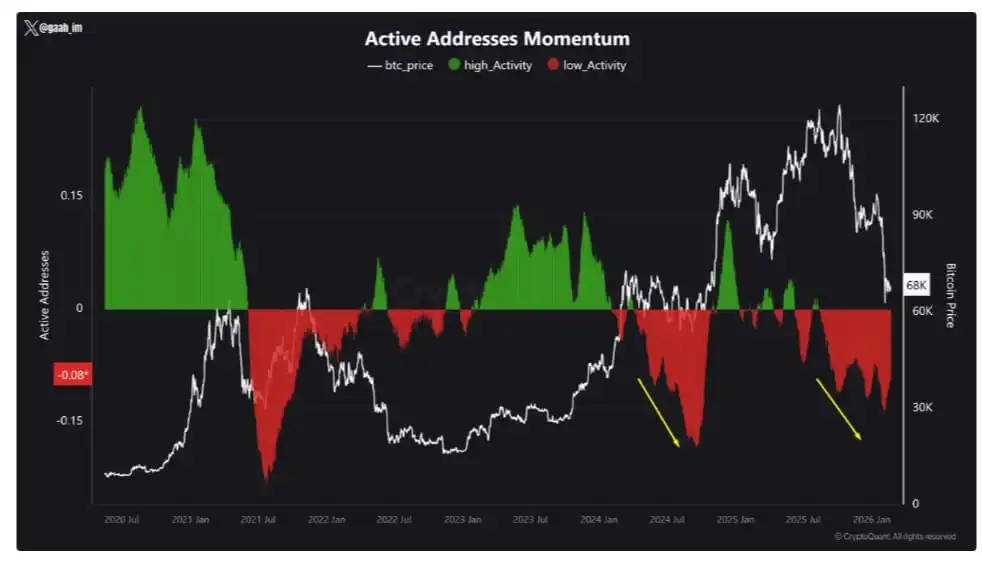
Bitcoin Active Addresses Momentum
Source: CryptoQuant
The last time the market saw a similar pattern was in 2024 — Bitcoin then experienced about a 30% pullback.
This does not mean a replay is certain now, but it reinforces a historical rule: Long-term network softness often coincides with a weakening market confidence.
Breadth Down, But Throughput Unbroken
Bitcoin's transaction count did not drop in sync with active addresses.
In mid-August 2025, the average daily transaction count was about 444,000. Blockchain.com data shows it's been around 439,000 over the past 30 days.
Hourly data still fluctuates, ranging from about 289,000 to 702,000, but the overall throughput trend has not collapsed.
This deviation is key to understanding the current situation.
If transaction volume stays steady while active addresses decline, it indicates fewer entities are conducting an equivalent amount of on-chain activity.
Several factors could cause this, none of which require retail influx. Exchanges and custodians can batch withdrawals; whales can consolidate transfers; institutional fund flows could be handled through fewer wallets; operational activities may also cause a brief surge in transaction counts without true user re-engagement.
The result is: the chain still appears busy, but the underlying participants are shrinking.
This is why breadth declining is more telling than raw throughput. Flat transaction counts may disguise a market increasingly dominated by repeat traders, large institutions, and operational fund flows.
In this scenario, Bitcoin's chain is still functioning normally, but the breadth of user participation it represents is becoming less genuine.
Blockchain analytics firm Santiment provides a more straightforward description from a longer time perspective.
The firm states that since February 2021, the unique addresses transacting Bitcoin have decreased by 42%, and new addresses created have decreased by 47%.
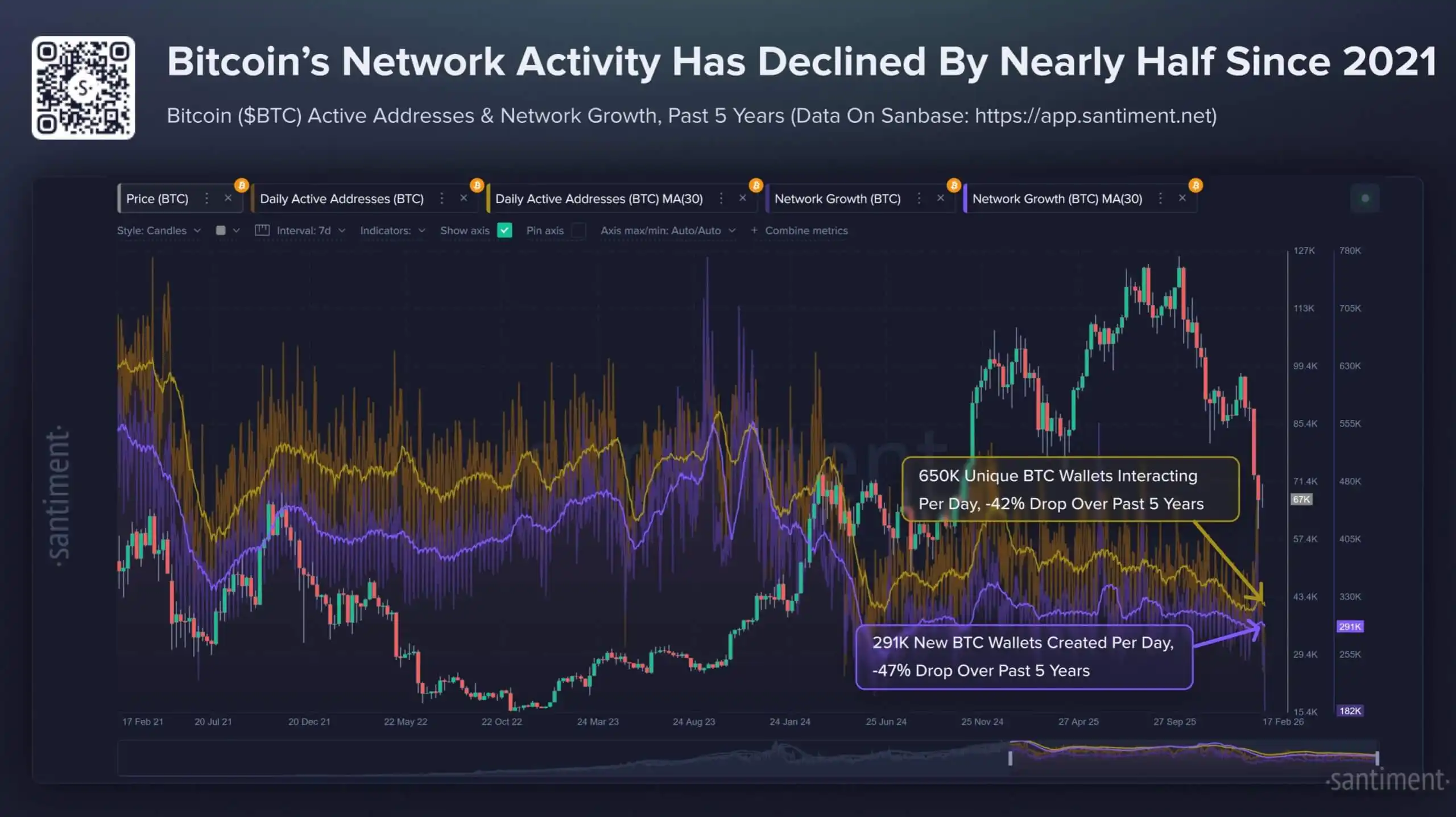
Santiment does not qualify this as evidence that crypto is dead or that a multi-year bear market is locked in, but it does describe a bearish divergence throughout 2025 — Market value rising while Bitcoin's utility metrics weaken.
This tension is now reflected in a six-month trend. Price and market narrative may continue, but the chain itself is becoming increasingly quiet.
Low Fees Point to Shrinking Block Space Demand
Fee data further confirms that Bitcoin Layer 1 is currently in a state of weak demand.
Mempool.space data shows that the network's recent average transaction fee is around $0.24, roughly equivalent to 1.8 sats/vB.
For a network that has experienced sustained block space competition during past price cycles, this fee level is low. Based on the current transaction pace, this fee level implies that the network's daily fee income is less than $100,000.
In contrast, block subsidies currently amount to around 450 BTC per day, making fee income a very small percentage.
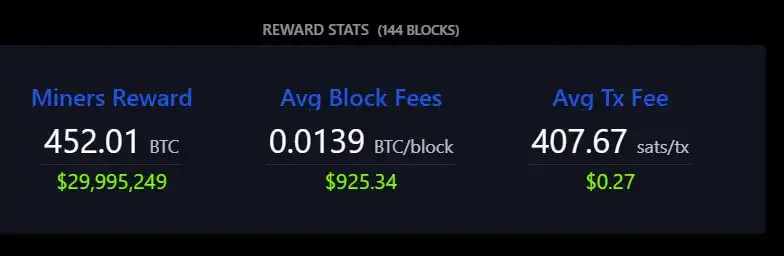
Bitcoin Average Block Fees
Source: Mempool.space
This is not an immediate security issue nor does it mean that Bitcoin's security model is facing recent pressure.
This is because block subsidies still dominate miner revenue. However, it does point to a long-term reality that Bitcoin has not yet been forced to confront in this stage of the current cycle.
The topic of transitioning to a fee-supported security budget recurs every cycle, but in the current environment, this transition has not been tested—due to the weak fee demand itself.
In practical terms, the current quiet fee market continues to postpone this discussion.
The chain has not faced sustained congestion pressure, and users have not engaged in fierce bidding wars to get onto the chain. This situation can quickly change in volatile events, speculative frenzies, or new demand shocks, but it has not occurred yet.
Currently, block space is in a noticeably low utilization state compared to previous bull market stages, aligning with the broader backdrop of declining overall participation.
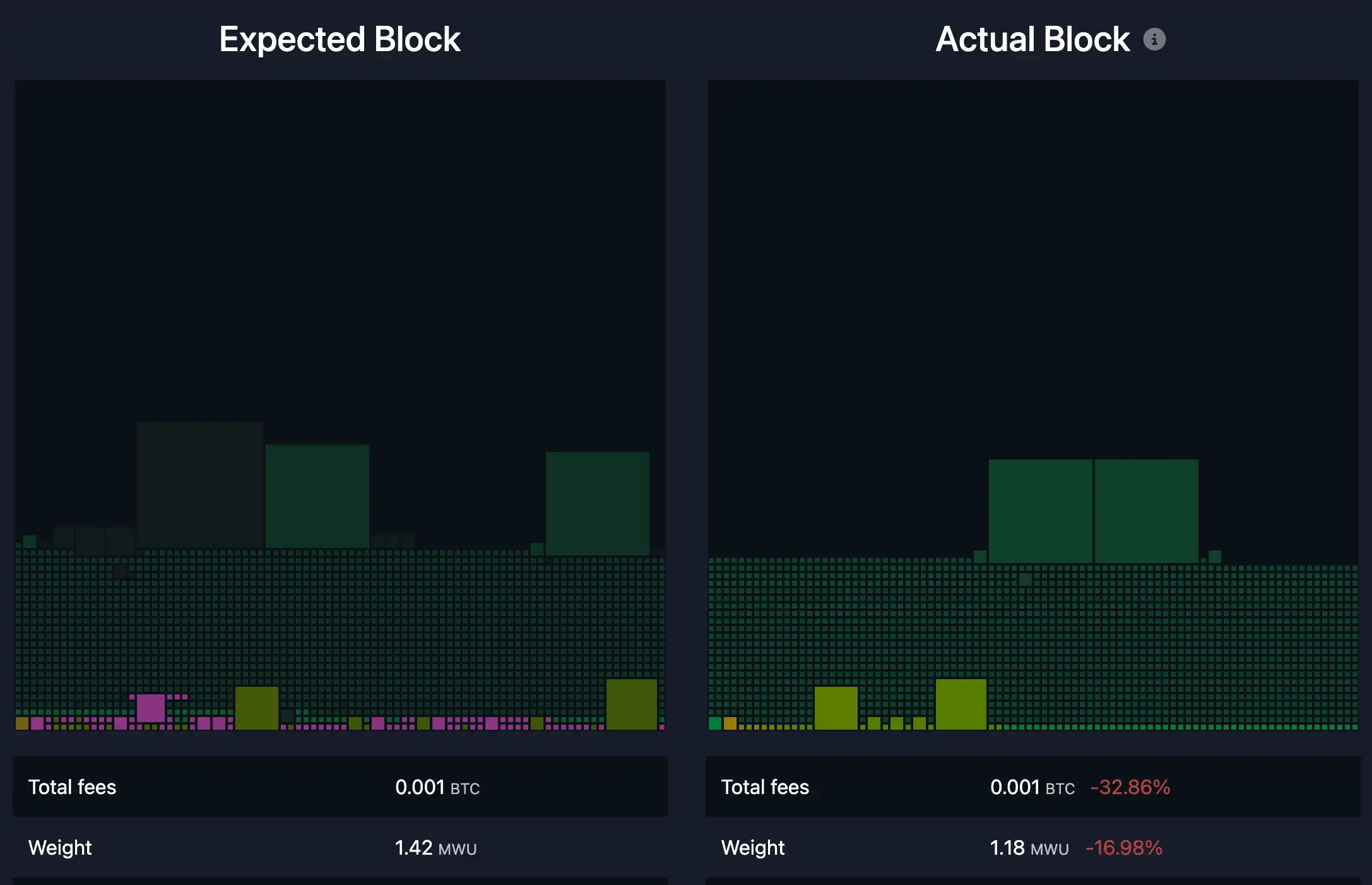
Bitcoin's Empty Mempool
Source: Mononaut
CryptoQuant's analysis also aligns with this fee environment, as low network activity is typically associated with decreased market interest in assets and a general period of losses.
As interest wanes, new participants decline, self-initiated transfers decrease, and fee pressure subsides.
Bitcoin remains an active trading financial asset, but the chain itself no longer reflects broad user participation.
The Macro Environment and ETF Fund Flows are Changing Bitcoin's Trading Behavior
The macro backdrop helps explain why this trend continues.
Bitcoin is becoming more like a macro-sensitive high-beta asset, particularly shining during risk-off periods.
In the past year, U.S. inflation has cooled, with the year-on-year CPI growth rate in January 2026 at 2.4%; the Fed's target rate range was quoted at 3.50% to 3.75% by the end of January.
In a less complex market environment, cooling inflation may support a clearer rebound in risk assets.
However, market attention is focused on several volatility catalysts, including tariff policy uncertainty. This factor has driven sharp swings in rates and the dollar, keeping overall risk appetite unstable.
In this environment, both retail and institutional investors tend to reduce their trading frequency. Retail participation decreases, trader turnover declines. Institutions may hold positions but are more inclined to adjust exposure through off-chain settlement products.
This is why spot Bitcoin ETFs have become key narrative players.
Coinperps data shows that U.S. Bitcoin ETFs have seen continuous net outflows for multiple weeks, with outflows of around $3.8 billion over the past five weeks and about $4.5 billion year-to-date.
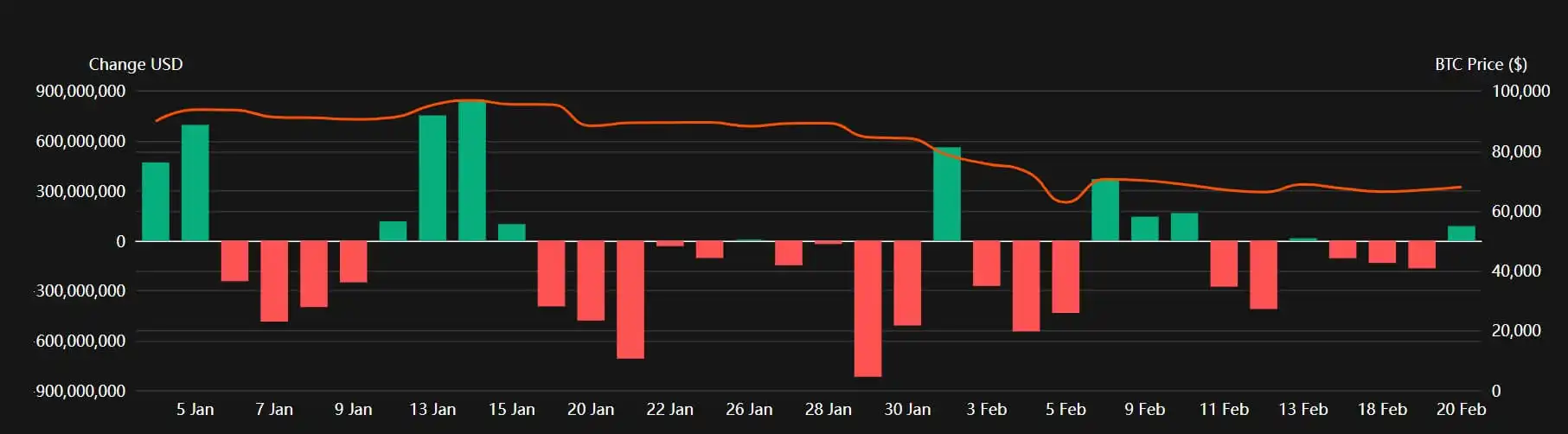
Daily Fund Flows for U.S. Bitcoin ETFs in 2026
Source: Coinperps
This has shifted activity from self-custody wallets to broker accounts.
This also explains why the market can remain active while the chain grows quieter. Positions are still changing hands, but more turnover is occurring off-chain.
This marks a significant shift in Bitcoin's role. It is increasingly resembling a financial product wrapped in an institutional shell, while Layer 1 is being more selectively leveraged for settlement, storage, and periodic transfers.
Simultaneously, the daily transactional energy in the crypto space is flowing elsewhere, particularly towards stablecoins.
Coin Metrics identifies stablecoins as a core driver of on-chain activity, with the total stablecoin supply nearing $300 billion and transaction volume steadily rising.
If stablecoins on other chains take on more daily settlement needs, Bitcoin's Layer 1 would naturally become more specialized in function.
This, in itself, does not weaken Bitcoin's investment thesis, but it certainly alters its form.
Three Scenarios for the Next Three to Six Months
The recent six-month decline in network breadth has laid out three potential paths for Bitcoin's future trajectory.
The first is a continuation of apathy, which in a risk-off market environment appears to be the baseline scenario.
In this scenario, active addresses remain low (in the 450K to 600K range), transaction counts remain volatile but not collapsing, fees stay low, and ETF flows remain steady or slightly negative.
Here, Bitcoin could still experience sharp volatility due to macro headlines, but on-chain participation does not confirm a broad-based recovery. The asset's trading logic appears more like a macro tool rather than a network transitioning into a new expansion phase.
The second is a liquidity thaw, representing a more optimistic path.
If inflation continues to cool, loose expectations stabilize risk appetite, ETF flows may shift from net outflows to sustained net inflows. In this environment, the growth of active addresses will be a key confirmation signal.
A rise to 650K to 800K active addresses would signify that participation breadth is recovering, not just a resurgence of price momentum. This appears more like a classic cyclical recovery—price gains supported by the growth in on-chain user participation.
The third is a structural substitution scenario, which may be the most intriguing.
In this scenario, Bitcoin's price rises, but on-chain breadth remains persistently low. ETFs, derivatives, and custodial settlements continue to dominate, while stablecoins take on more transactional demand elsewhere in the crypto space.
Here, Bitcoin is increasingly looking like a digital macro asset and settlement layer rather than a chain with widespread retail activity.
This scenario would mark the evolution of Bitcoin's role, reflecting a profound shift that has taken place compared to years ago.
You may also like

Track Markets At a Glance: New WEEX Price Widgets for iOS & Android
To streamline your market data access, WEEX has officially launched "Market Watchlist" desktop widgets

The billion-dollar lesson: The focus of DeFi security is shifting from code to operational governance

A Brief Analysis of Stablecoin Licenses and On-Chain Funding
BVNK Founder: Three Stages of Stablecoin Development

The truth about Trump's son's Bitcoin game: he made a staggering $100 million while retail investors lost $500 million

What Is Futures Trading? Hours, Platforms, and How to Start Trade Futures(2026 Guide)
Learn how to start futures trading, understand trading hours, and choose the best futures trading platform. Includes real data, strategies, and ways to maximize returns with rebates.

The Rise of Composable RWA

MAGA Up 350% in 24 Hours, PEPE Up 46% in One Day: Which Memecoins Are Next in 2026?
MAGA +350% in 24hrs. PEPE +46% in one day. RAVE +4,500% then -90%. In 2026's memecoin market, the gains are real. So are the traps? Here's how to tell the difference before you buy.

RCD Espanyol vs Real Madrid: Can the Pericos Delay the Inevitable?
RCD Espanyol vs Real Madrid lineups, standings, and stats for May 3, 2026. Real Madrid visits RCDE Stadium as Barcelona closes in on the LALIGA title. Full preview inside.
MegaETH goes live with an FDV exceeding 2 billion USD. Which ecological projects are worth paying attention to?

Dialogue with "Wood Sister" Cathie Wood: The next bull market is about to arrive
Can prediction markets win the competition for perpetual contracts?

Who is trading on Trade.xyz?

Binance quietly placed a bet on a leading large model company

Best Crypto Discord Server 2026: Why Jacob’s Crypto Clan Is Gaining Massive Attention
Jacob’s Crypto Clan has grown into one of the most active crypto Discord communities, with over 45K members and continuing to expand. This rapid growth reflects strong demand for structured trading insights and real-time collaboration.

Tom Lee Buying ETH: Why Wall Street’s Loudest Ethereum Bull Keeps Doubling Down
Tom Lee keeps buying ETH through every dip, every drawdown, and every moment of market doubt. Inside the strategy that's turning Ethereum into a treasury asset — and what it signals for the rest of the market.

Stripe Sessions 2026: AI Agent, Global Payments, and Invisible Crypto Infrastructure

Where will South Korea's cryptocurrency taxation head?
Track Markets At a Glance: New WEEX Price Widgets for iOS & Android
To streamline your market data access, WEEX has officially launched "Market Watchlist" desktop widgets
The billion-dollar lesson: The focus of DeFi security is shifting from code to operational governance
A Brief Analysis of Stablecoin Licenses and On-Chain Funding
BVNK Founder: Three Stages of Stablecoin Development
The truth about Trump's son's Bitcoin game: he made a staggering $100 million while retail investors lost $500 million
What Is Futures Trading? Hours, Platforms, and How to Start Trade Futures(2026 Guide)
Learn how to start futures trading, understand trading hours, and choose the best futures trading platform. Includes real data, strategies, and ways to maximize returns with rebates.


