
 Buy Crypto
- Markets
 Futures
- Spot
- Copy Trade
- Earn
- More
Binance Latest Report: 2024 Rate Cut Cycle Approaching, Comprehensive Analysis of the Fed Policy Impact

Original Title: The Fed, Interest Rates, and the Economy: A Primer
Original Source: Binance Research
Original Translation: Deep Tide TechFlow
Introduction
In today's ever-changing global economic landscape, the monetary policy direction of the Federal Reserve sets the tone for the global financial markets. In September 2024, the Fed cut interest rates for the first time since 2020, initiating a new rate-cutting cycle.
Binance Research recently released a report that delves into the origins of the Fed's interest rate policy and its impact on the economy and various assets.
Starting from economic theory, the report combines latest data and historical experience to systematically analyze the relationship between interest rates, inflation, employment, and other core economic indicators. Additionally, it provides a comprehensive analysis of the performance of different asset classes such as stocks, bonds, commodities, and cryptocurrencies during a rate-cutting cycle, offering investors clear decision-making references.
Deep Tide TechFlow has summarized the key information from the report as follows.
Key Points
· Latest Rate-Cut Dynamics: The Federal Reserve announced a 0.5% rate cut in September 2024, followed by an additional 0.25% cut in November, marking the first rate cut action since the COVID-19 response measures in March 2020. The market expects further rate cuts of 1-2 percentage points in 2025, with a 62% probability of another 0.25% rate cut in December.
· Policy Background Analysis: The Federal Reserve adheres to a "dual mandate" principle, aiming to promote maximum employment and maintain price stability (with a 2% inflation target). In mid-2022, inflation briefly surpassed 9%, prompting the Fed to take aggressive rate hike measures, raising rates to the highest level in 20 years. As inflation gradually cools down, the Fed has initiated a new round of rate cuts.
· Interest Rate Transmission Mechanism: As the "price of money," interest rates affect the market through two main channels:
- Reducing borrowing costs, making it easier for market participants to access funds while lowering the burden of existing debts
- Lowering the risk-free interest rate, prompting investors to seek other investment channels to seek higher returns
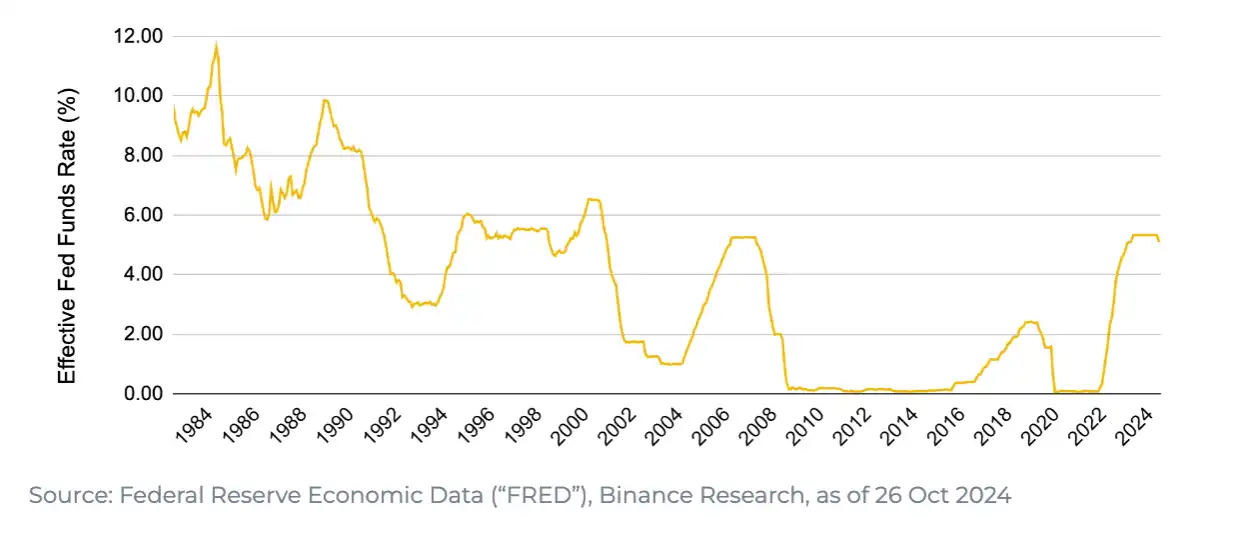
· Historical Trend: The US interest rate has shown a structural downward trend over the past 50 years, from 8-10% in the 1980s to near-zero interest rates in the 2010s, and more recently to above 5%.
· Asset Performance Analysis:
- The stock market (S&P 500) generally experiences an upward trend after rate cuts, but there may be exceptions during economic recessions
- Commodities have a complex relationship with interest rates, influenced by factors such as inventory costs, yield volatility, and exchange rates
- Bond prices have a clear inverse relationship with interest rates
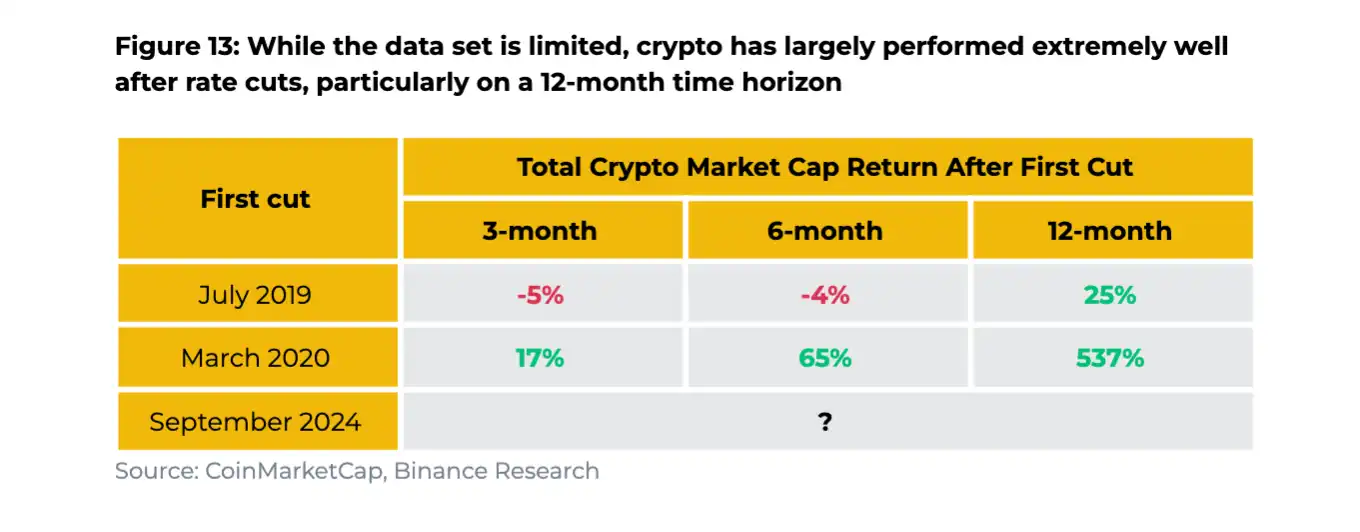
- Although cryptocurrency has limited historical data, it has shown strong performance during rate-cutting cycles, such as a 537% growth in the 12 months following the rate cut in March 2020
Policy Shift: The Global Central Bank Rate-Cutting Era Begins
On September 18, 2024, the Federal Reserve lowered the federal funds target rate range by 0.5 percentage points to 4.75-5.00%, marking its first rate cut since March 2020 in response to the COVID-19 pandemic. Prior to this, in response to rising inflation, the Fed aggressively raised rates from March 2022 to July 2023, then maintained rates unchanged in eight consecutive meetings until this rate cut. The November 0.25% rate cut further confirmed the onset of a new rate-cutting cycle.
The Fed's policy actions have always revolved around its dual mandate: promoting maximum employment and maintaining price stability. In the post-pandemic period, rapid price increases saw mid-2022 inflation briefly exceeding 9%, prompting the Fed to initiate its most aggressive rate-hiking cycle in 20 years, raising the target rate from 0-0.25% during the pandemic to 5.25-5.50%. As inflation gradually cools, the Fed has started shifting toward a more accommodative stance. The current market expects a 1-1.5 percentage point rate cut in 2025, with a 62% probability of a 0.25% rate cut in December (38% probability of no change).
The interplay between inflation, rate cuts, and the broader economic system (including asset performance) is intricate and warrants close attention from market participants.
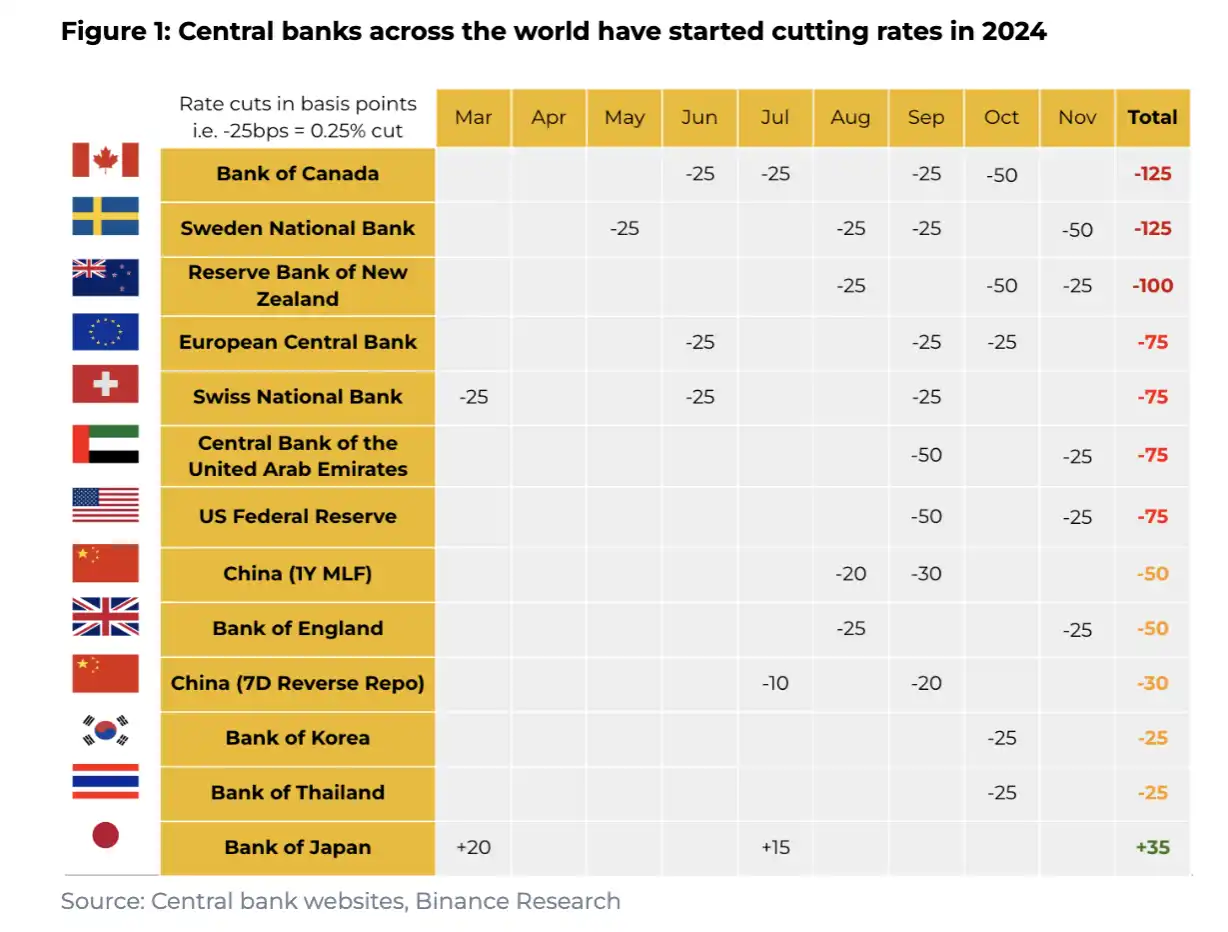
It is worth noting that in 2024, several global central banks have embarked on a rate-cutting process, a trend that will have a profound impact on global financial markets.
Basic Concept: Interest Rate and Economic Mechanism
Warren Buffett once said, "Interest rates are the gravity of the financial universe." Let's start from the most basic concept to understand how interest rates affect the economic mechanism.
Basic Principle of Interest Rates
• Core Definition: Interest rate is fundamentally the "price of money"
Raising Interest Rates = Money becomes more expensive
Lowering Interest Rates = Money becomes cheaper
Two Major Impacts of the Current Rate Cut Environment
1. Debt and Lending Effect
· Businesses and institutions can obtain financing at a lower cost, promoting investment expansion
· The interest burden of existing debt is reduced, improving cash flow
· Consumer borrowing costs decrease, stimulating consumption and housing demand
· Overall economic activity is boosted, contributing to economic growth
2. Yield Effect
· The yield of risk-free assets such as government bonds decreases
· Investors are forced to seek other investment channels for higher returns
· Valuations of risky assets such as stocks and real estate receive support
· Funds shift from low-risk assets to high-risk assets
Key Economic Variables
1. Inflation
· The Federal Reserve has set 2% as the long-term inflation target
· It exceeded a high of 9% in mid-2022
2. Employment Situation
· The current unemployment rate is maintained at a relatively healthy level of 4.1%
· Non-farm payroll data is released on the first Friday of each month, a key market indicator
3. Market Environment and External Factors
· Corporate Earnings: Quarterly financial reports and expectations are a barometer of market confidence
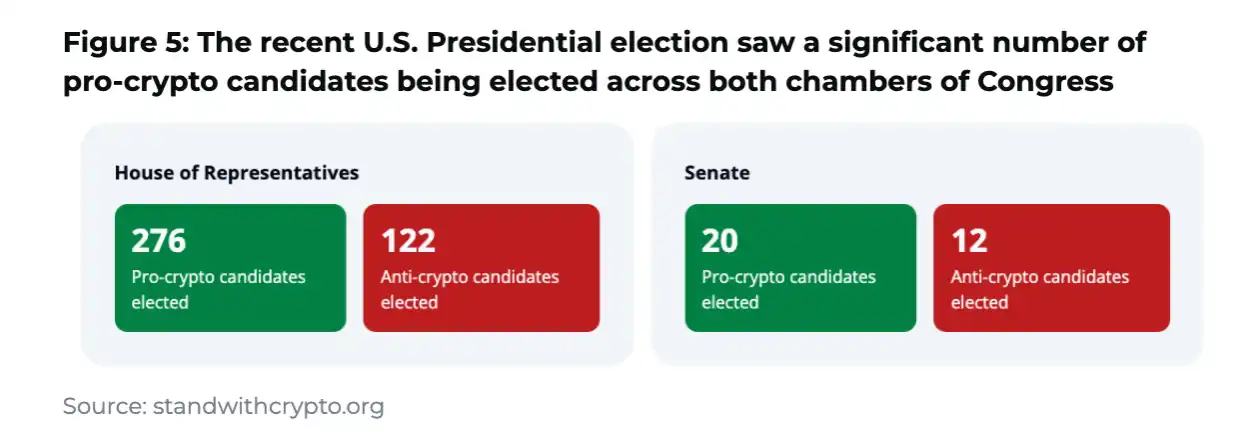
· Regulatory Policy: Regulatory stance on financial innovation including cryptocurrency (as shown in the chart below, green represents a significant increase in crypto-friendly individuals in the U.S. House and Senate post-election)
· Geopolitics: External impacts such as international trade relations, regional conflicts, etc.
· Macroeconomic Indicators: Including trade balance, consumer confidence, PMI, etc.
Historical Perspective: Past Fed Rate Cut Cycles and Asset Performance
Interest Rate Trends
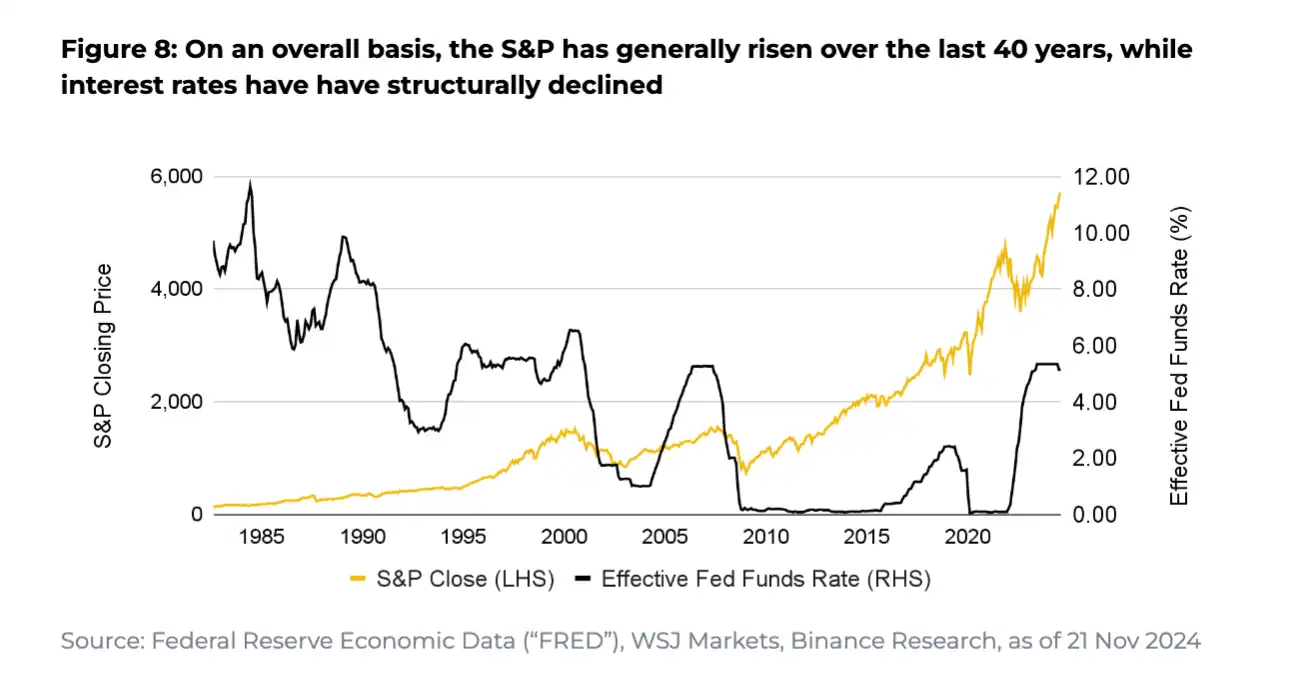
Over the past 50 years, U.S. interest rates have shown a structural downward trend:
· 1980s: Maintained at high levels of 8-10%
· 2010s: Near-zero interest rate levels
· Recent: Rose to above 5%
· September and November 2024: Initiation of a new rate cut cycle
Historical Performance of Various Assets
1. Stock Market (S&P 500)
· Overall Trend: Typically rises post-rate cuts
Specific Performance:
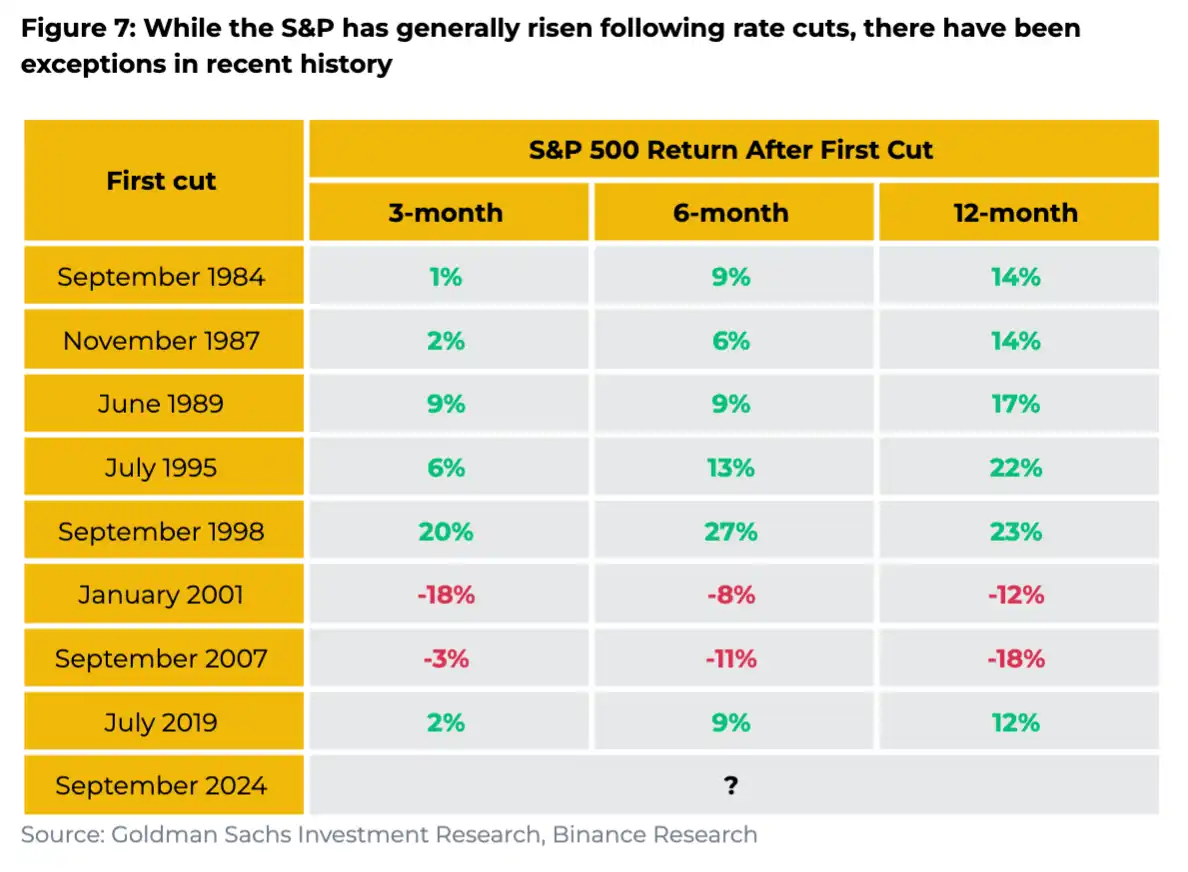
September 1984 First Rate Cut: 3 months +1%, 6 months +9%, 12 months +14%
July 1995 Rate Cut: 3 months +6%, 6 months +13%, 12 months +22%
Special Cases: Negative returns observed in 2001 and 2007 (during economic recessions)
January 2001: 12 months -12%
September 2007: 12 months -18%
2. Commodities
· Influencing Factors:
Inventory Cost: Interest Rates Impact Holding Costs
Yield Characteristics: No Fixed Income
USD Exchange Rate: Commodities Mostly Priced in USD
· Inflation Linkage:
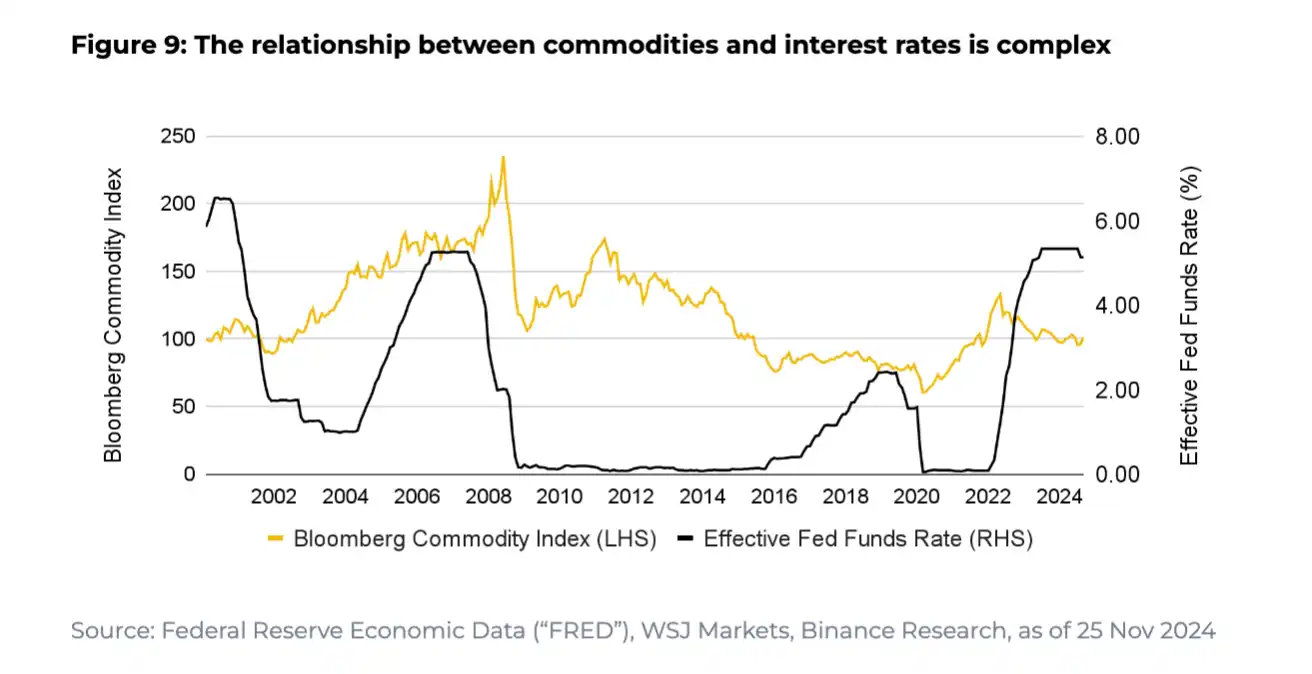
- Typically Regarded as a Leading Indicator of Inflation
- Commonly Used as an Inflation Hedge Tool
3. Bonds
· Core Characteristic: Exhibits a Clear Inverse Relationship with Interest Rates
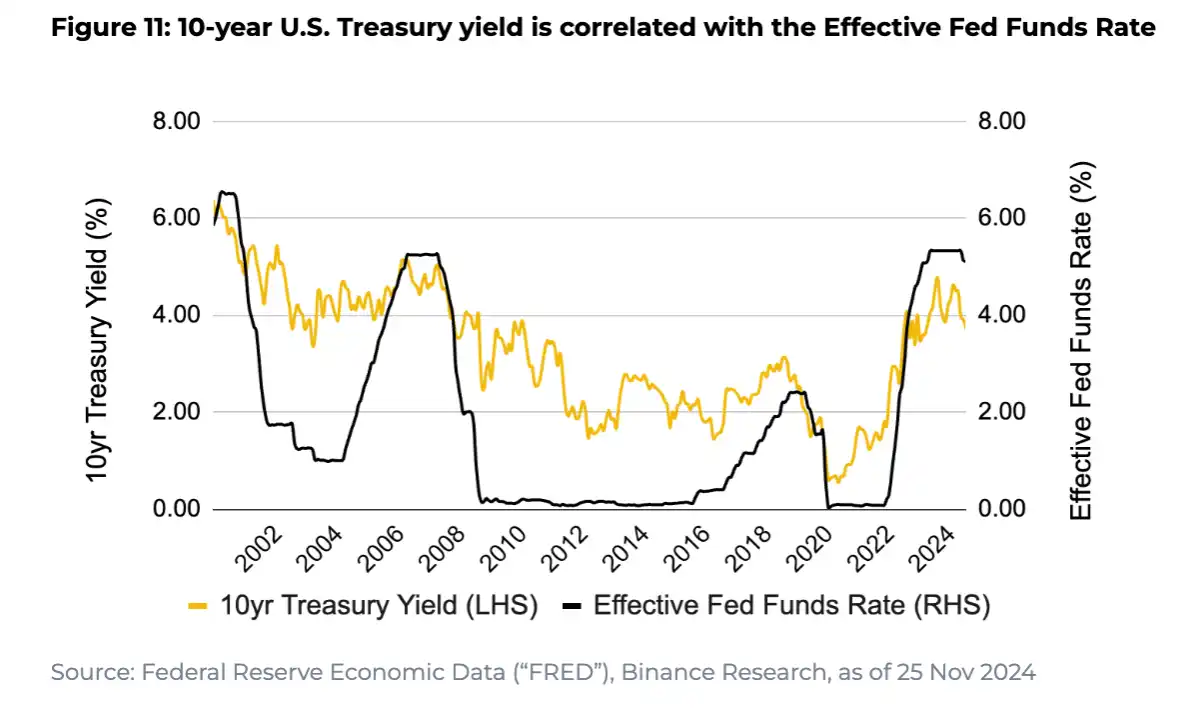
· Operational Mechanism:
- Interest Rate Increase → Bond Price Decrease
- Interest Rate Decrease → Bond Price Increase
Ten-Year Treasury Yield: Highly Correlated with the Federal Funds Rate
4. Cryptocurrency
· Historical Data: Only Experienced Two Rate Cut Cycles (Second Half of 2019 and March 2020)
· Performance Highlights:
July 2019 Rate Cut: 12-Month +25%
March 2020 Rate Cut: 12-Month +537%
· Special Considerations:
- Short Sample Period
- Relatively Small Market Size, High Volatility
- Influenced by Multiple Factors, Not Just Interest Rate Changes
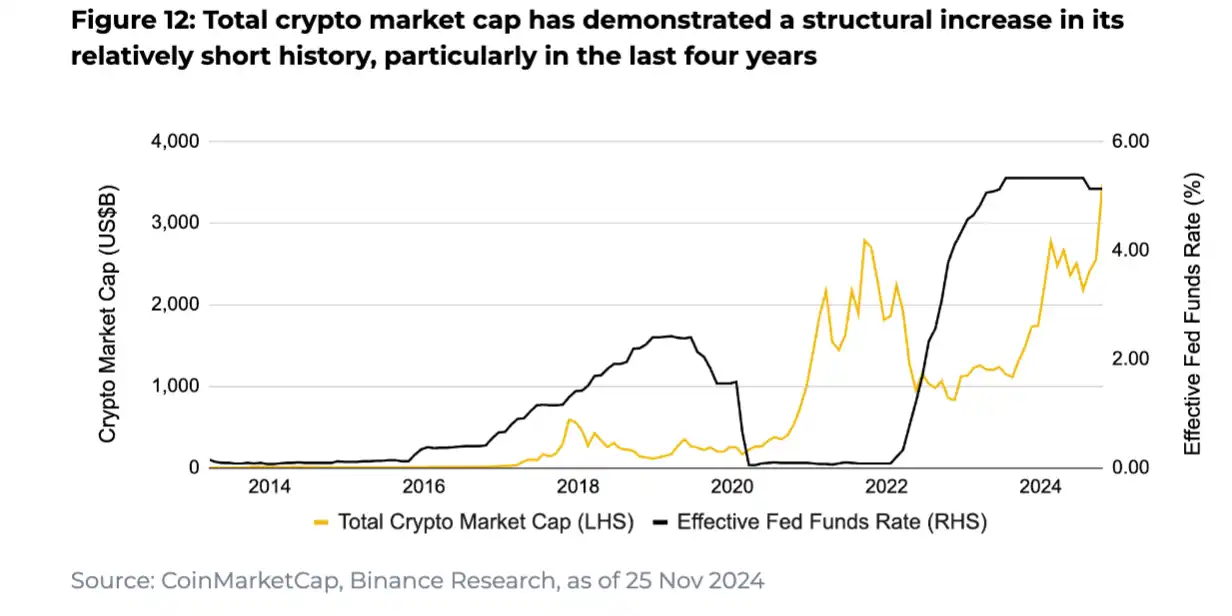
This historical review shows that while rate cuts typically support asset prices, the specific performance varies by asset class and macro environment. Especially during an economic downturn, even rate cuts may not be able to prevent asset price declines, indicating that investors need to consider multiple factors comprehensively rather than making investment decisions solely based on rate cuts.
Conclusion: Global Rate Cut Cycle Initiated, Market Opportunities and Challenges Coexist
As the report shows, September 2024 became the fourth-largest rate cut month of the century, with 26 central banks globally implementing rate cut policies. This trend continued into October and November, marking the start of a new cycle in global monetary policy. As the most influential central bank globally, the Fed's two rate cuts in September and November not only had far-reaching impacts but also heralded the possibility of even broader policy easing in 2025.
From a historical perspective, a rate-cutting cycle often reduces the cost of money, improves the market's liquidity environment, and thereby provides support for asset prices. However, this rate-cutting cycle has its uniqueness: Global inflation has significantly fallen from its peak in 2022, but there is still a need to be vigilant against the risk of inflation rebound; the labor market remains relatively stable, with the unemployment rate staying at a healthy level of 4.1%; geopolitical tensions have added additional uncertainty.
Looking ahead to 2025, the market broadly expects the Fed to continue cutting rates by 1-1.5 percentage points. In this context, major central banks worldwide may follow the Fed's lead to further improve the liquidity environment. However, while investors seize opportunities, they also need to stay cautious: Different asset classes may perform differently during a rate-cutting cycle, and simply following the rate cuts may not achieve the desired returns. It is recommended that investors, with a full understanding of the fundamentals, focus on structural opportunities, make prudent allocations, to better cope with this new market environment.
You may also like

The Evolutionary History of Contract Algorithms: A Decade of Perpetual Contracts, the Curtain Has Yet to Fall

Kicked out by PayPal, Musk aims to make a comeback in the cryptocurrency market

Solana ETF News: What Is a Solana ETF and Why Is Goldman Sachs Betting $108 Million on SOL?
Solana ETF news today shows Goldman Sachs disclosed a $108M position while total SOL ETF inflows reached $1.45B. Analysts now expect up to $6B in institutional demand as Solana trades 71% below its all-time high.

Bitcoin ETF News Today: $2.1B Inflows Signal Strong Institutional Demand for BTC
Bitcoin ETFs news recorded $2.1B inflows over 8 consecutive days, marking one of the strongest recent accumulation streaks. Here’s what the latest Bitcoin ETF news means for BTC price and whether the $80K breakout level is next.
Michael Saylor: Winter is Over – Is He Right? 5 Key Data Points (2026)
Michael Saylor tweeted yesterday “Winter‘s Over.” It is short. It is bold. And it has the crypto world talking.
But is he right? Or is this just another CEO pumping his bags?
Let us look at the data. Let us be neutral. Let us see if the ice has really melted.

WEEX Bubbles App Now Live Visualizes the Crypto Market at a Glance
WEEX Bubbles is a standalone app designed to help users quickly understand complex crypto market movements through an intuitive bubble visualization.

Polygon co-founder Sandeep: Writing after the chain bridge chain explosion

Major Upgrade on Web: 10+ Advanced Chart Styles for Deeper Market Insights
To deliver more powerful and professional analysis tools, WEEX has rolled out a major upgrade to its web trading charts—now supporting up to 14 advanced chart styles.

Morning Report | Aethir secures a $260 million enterprise contract with Axe Compute; New Fire Technology acquires Avenir Group's trading team; Polymarket's trading volume surpassed by Kalshi

Why a Million-Follower Crypto KOL Chooses WEEX VIP?
Discover why top crypto KOL Carl Moon partnered with WEEX. Explore the WEEX VIP ecosystem, 1,000 BTC protection fund, and exclusive rewards for serious traders.

CoinEx Founder: The Crypto Endgame in My Eyes

Spark Coin (SPK): Explodes 73% as Aave Bleeds $15B, A Good Investment Now?
Spark coin (SPK) surged 73% as $15 billion fled Aave after the KelpDAO hack. This article explains what Spark is, why it’s pumping, and whether it is a good investment right now.

As Aave's building collapses, Spark's high-rise is rising

RootData: Q1 2026 Cryptocurrency Exchange Transparency Research Report

What Is Memecoin Trading? A Beginner's Guide to How It Works, the Risks, and 2026's Hottest Tokens
Memecoins surged 30%+ at the start of 2026 while Bitcoin was flat. RAVE spiked 4,500% then crashed 90% in days. MAGA jumped 350% overnight. This guide explains exactly how memecoin trading works — and how to not blow up your account doing it.

Trump Extends Ceasefire: Bitcoin Hits $79K — What Crypto Traders Need to Know Right Now
Bitcoin surged past $79,000 after Trump extended the ceasefire indefinitely. We break down exactly what happened, how every major crypto reacted, and what traders should watch next — including the one level that could unlock an $85,000 BTC rally.

CHIP Crypto Price Prediction 2026: Can USD.AI's GPU Lending Token Reach $1?
CHIP's 24-hour trading volume hit $1.87 billion on a $236 million market cap — an 8x ratio that almost never happens on legitimate tokens. We explain what's driving it, what USD.AI actually does for GPU tokenization, and whether CHIP belongs in your AI crypto portfolio.
RootData: Q1 2026 Web3 Industry Investment Research Report
The Evolutionary History of Contract Algorithms: A Decade of Perpetual Contracts, the Curtain Has Yet to Fall
Kicked out by PayPal, Musk aims to make a comeback in the cryptocurrency market
Solana ETF News: What Is a Solana ETF and Why Is Goldman Sachs Betting $108 Million on SOL?
Solana ETF news today shows Goldman Sachs disclosed a $108M position while total SOL ETF inflows reached $1.45B. Analysts now expect up to $6B in institutional demand as Solana trades 71% below its all-time high.
Bitcoin ETF News Today: $2.1B Inflows Signal Strong Institutional Demand for BTC
Bitcoin ETFs news recorded $2.1B inflows over 8 consecutive days, marking one of the strongest recent accumulation streaks. Here’s what the latest Bitcoin ETF news means for BTC price and whether the $80K breakout level is next.
Michael Saylor: Winter is Over – Is He Right? 5 Key Data Points (2026)
Michael Saylor tweeted yesterday “Winter‘s Over.” It is short. It is bold. And it has the crypto world talking.
But is he right? Or is this just another CEO pumping his bags?
Let us look at the data. Let us be neutral. Let us see if the ice has really melted.
WEEX Bubbles App Now Live Visualizes the Crypto Market at a Glance
WEEX Bubbles is a standalone app designed to help users quickly understand complex crypto market movements through an intuitive bubble visualization.


 App
App