
Aptos Accuses Monad of Plagiarism: Tech Theft or Traffic Riding?




Perhaps influenced by the official announcement of HyperEVM launching, Monad, a competitor in the L1 space, finally couldn't sit still. Just one day after the launch of HyperEVM, this project which raised a $225 million investment led by Paradigm in April last year finally launched its testnet.
However, amid a wave of community excitement and various airdrop tutorials, another L1 competitor, Aptos, directly posted on the social media platform X, accusing Monad of copying Aptos's technology. Thus, a war of words began.
The Debate
This dispute over technical originality was first sparked by Aptos's Research Director, Alexander Spiegelman: "I don't understand why Monad is spending so much time copying Aptos's technology. Everything is open source, and there have already been many peer-reviewed papers. Instead of being secretive, it's better to shamelessly copy directly."
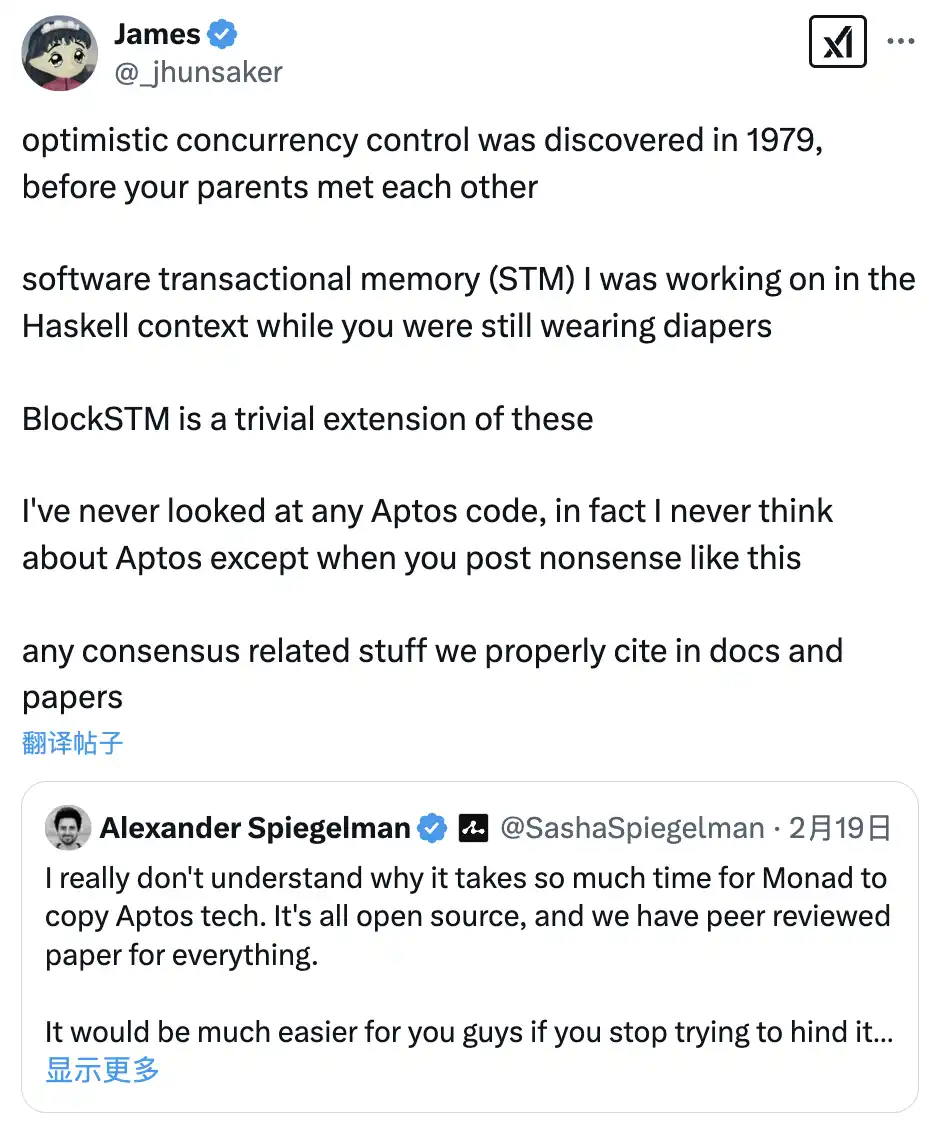
At a time when Monad was in the spotlight, co-founder James Hunsaker naturally couldn't stand someone ruining the party and directly fired back in the comments: "Optimistic Concurrency Control (OCC) was discovered in 1979 when your parents hadn't even met. I had already been studying Software Transactional Memory (STM) in a Haskell environment long ago, while you were still in diapers. BlockSTM is a simple extension of these things. I have never seen any Aptos code. In fact, if you hadn’t spread this nonsense, I wouldn’t have even thought about Aptos. Anything related to consensus, we will correctly reference in documentation and papers."
Seeing Hunsaker's denial, Spiegelman once again presented the facts and reasoned: "There's no need to attack individuals instead of addressing the issue. We all know how and why Monad was created. BlockSTM is one of the very few (if not the only one) STM put into production. Before BlockSTM, nothing could really achieve efficiency. With your background, you should know this. Although there are thousands of papers, nothing truly achieves scalability. BlockSTM is a breakthrough, and BlockSTM v2 is the future." Then, he didn't forget to show off his own qualifications: "By the way, I don’t know about you, but when I was a baby, I didn't even wear diapers yet."

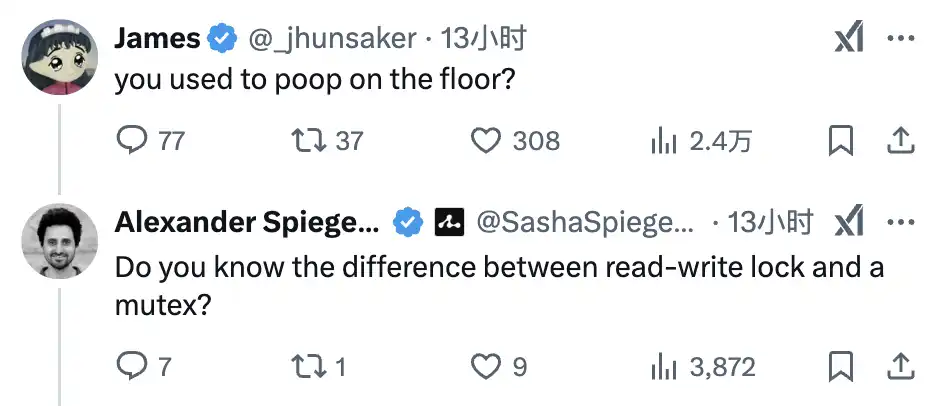
The smell of gunpowder grew stronger, Hunsaker directly skipped the technical issue and retorted, "Were you crawling on the ground before?" At this point, Spiegelman was already extremely speechless and helplessly countered, "Do you know the difference between a reader-writer lock and a mutex lock?" This time, Hunsaker on the other side did not reply anymore.
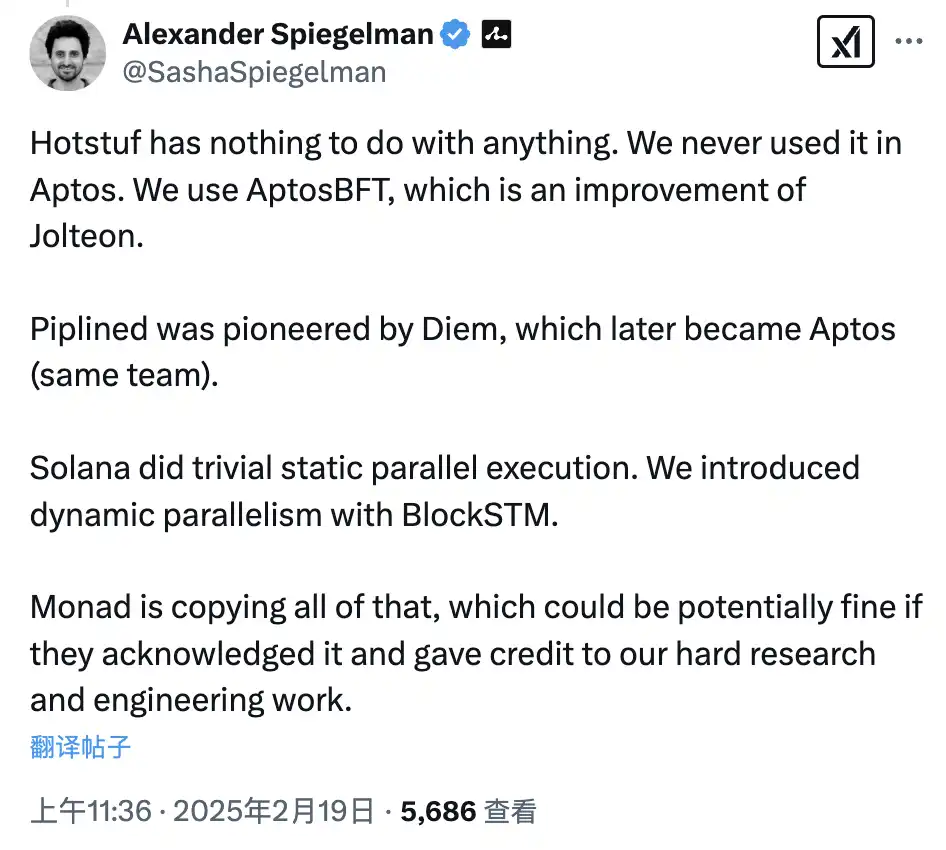
Later, in the comment section, Spiegelman joked, "I think by the time you finally go online in 2029, we will all know the truth." He then muttered, "Monad is replicating our technology. If they can acknowledge and give us due recognition for our hard work in research and engineering, then perhaps it can be accepted."

New Public Chain Plagiarism Incidents: Is It a "Crypto Sector Feature of Open Source Culture"?
Plagiarism controversies surrounding new public chains are not uncommon in the cryptocurrency field. Sonic's high-performance design was once questioned for imitating Solana's PoH and pipeline architecture. Sui and Aptos, sharing the same origin as Diem, saw disputes over the similarities between the Move language and parallel execution, igniting a "brotherly feud." Aleo's zk-SNARKs were accused of directly copying zkSync's ZKP framework. Berachain's modular architecture and IBC function were seen by the Cosmos community as a "luxury fork," while Mantra's RWA tokenization model was believed to have drawn inspiration from Ondo Finance's successful experience.
The crypto industry upholds the spirit of open source, with most projects making their code public. In the current cryptocurrency market where the saying "time is money" is manifested to the extreme, the phenomenon of "fast fish eating slow fish" is common. In such an environment, the open-source culture has fostered some projects that directly Ctrl C+Ctrl V code. Even in non-crypto fields, disputes have arisen in the early development of the Linux kernel over code contributions.
Related reading: "Blast Accused of Copying OP Code: Is There Chaos Behind the "L2 Pipeline"?"
This open-source culture has greatly reduced the barrier to entry for new public chains, allowing new projects to quickly iterate on the shoulders of giants. In the debate between Monad and Aptos, Aptos's BlockSTM open-sourcing has provided a reference for the industry, from which Monad may potentially draw. However, Hunsaker argues that their technology is based on earlier OCC and STM and represents the industry's overall progress, reflecting the common logic of new public chains: open-source achievements are public resources, and borrowing is natural. The open-source culture enables new public chains to launch high-performance solutions in a short period of time, but it has also made it difficult to resolve the issue of originality and ownership.
Airdrop occurring as Testnet Goes Live: Competing for Technology or Traffic?
The timing of this debate is quite coincidental as it coincides with the launch of the Monad testnet, adding a subtle layer of complexity. The testnet is a crucial moment for Monad to attract developers, validate the technology, and build community trust, yet Aptos's accusations have shifted the focus from Monad's technical showcase to the standoff between the two.
As an emerging L1 that has not yet launched its mainnet, Monad, backed by last year's Paradigm's $2.25 billion investment and the narrative of being the "Ethereum High-Performance Evolutionist," has accumulated a significant community expectation. For this testnet, the Monad team was well prepared, triggering a set of combos to maintain community attention and goodwill as soon as it went live. The Monad team announced on social media that they had sent test tokens to over 8.8 million active Ethereum addresses, Backpack Wallet had already supported the Monad testnet, and Wormhole had officially launched on the Monad testnet.

For Monad, the testnet launch is not only an opportunity for technical validation but also a critical window to attract EVM developers and users. If they can deliver on the promise of 10,000 TPS, Monad is poised to establish itself in the L1 race, potentially threatening the market position of high-performance chains like Aptos. On Platform X, the community's high expectations for the testnet have escalated the hype, with users calling it a "scientist's money-making project" and numerous airdrop tutorials popping up. This momentum is the narrative capital that Monad needs to protect and amplify.
On the other hand, Aptos's research director, Spiegelman, chose to launch the accusations on the day of the testnet, perhaps with considerations of market competition. Although the debate on who the true technology original is remains inconclusive, Aptos's decision to launch an attack when Monad was gaining a wave of traffic has clearly paid off. As the community eagerly watches, Aptos's native token APT has shown a strong price increase. At the time of writing, according to market data, APT has surged by 7% in the past 24 hours, briefly reaching $7.
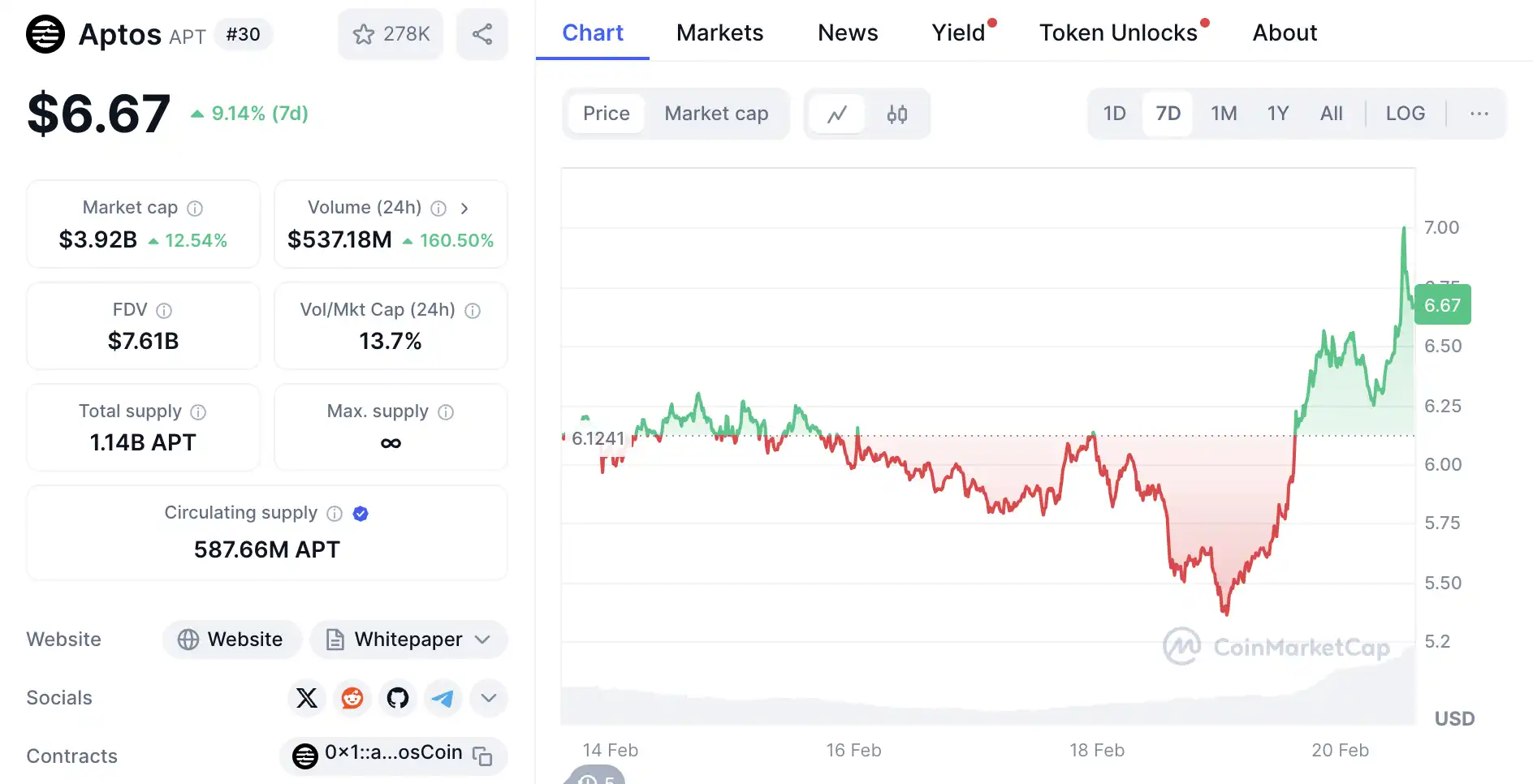
The recent Aptos move may win more than just a price pump. In the crypto market, attention is a scarce resource. Since January when Coinbase's listing roadmap added Aptos Network's USDC, there hasn't been much news about Aptos this year. This accusation has to some extent redirected the market's attention to Aptos's open-source contributions and technical expertise, throwing some shade on the hot project Monad.
In the face of this controversy, neither Monad nor Aptos's official accounts have made a statement yet. BlockBeats will continue to track the developments of this event.
You may also like

Cryptocurrency market makers collectively seek change as it becomes increasingly difficult to make money

a16z Crypto Partner: Cash flow is the moat

Citibank releases "2030 Asset Tokenization Market Outlook": 6 major trends may create a $8.2 trillion market

The trillion-dollar valuation test: Are the three major super IPOs a celebration for tech stocks or a nightmare for the crypto market?

Morning Report | Digital Asset completes $355 million financing led by a16z Crypto; Meta completes operational separation from Manus

Morning News | CME Group launches Nasdaq Cryptocurrency Index futures; Asset management giant Janus Henderson strategically invests in Ethena

Bitcoin Layer 2 Network Botanix: Why Did We Choose to Dissolve?

Why did Oracle deliver the strongest financial report in history, yet its stock price fell?
When the P2P illicit funds from ten years ago turned into 60,000 bitcoins

Dialogue with OmenX Founder: Why does the prediction market need an evolution from "spot" to "derivatives"?
Galaxy in-depth report: Is Solana still worth paying attention to?

Young people in South Korea make a "final effort" in the epic bull market
The pricing controversy of Trade.xyz exposes the fatal weakness of Pre-IPO perpetual contracts
How much longer can Ethereum's last big buyer hold on?

World Cup 2026 Coming – WEEX Celebrates with $1M Prize Pool & Michael Owen Live

Morning Report | OpenAI has submitted an S-1 registration statement draft to the U.S. SEC; Morpho completes $175 million financing

Galaxy Deep Research Report: How Hyperliquid's HIP-4 Upgrade Changes the Landscape of Prediction Markets?

Latest research from 13 top universities including Cornell University: The current state, challenges, and misconceptions of the fusion of Crypto and AI
Cryptocurrency market makers collectively seek change as it becomes increasingly difficult to make money
a16z Crypto Partner: Cash flow is the moat
Citibank releases "2030 Asset Tokenization Market Outlook": 6 major trends may create a $8.2 trillion market
The trillion-dollar valuation test: Are the three major super IPOs a celebration for tech stocks or a nightmare for the crypto market?
Morning Report | Digital Asset completes $355 million financing led by a16z Crypto; Meta completes operational separation from Manus
Morning News | CME Group launches Nasdaq Cryptocurrency Index futures; Asset management giant Janus Henderson strategically invests in Ethena


