
ANIME Coin Launch Approaching: Will the Market Support the 37.5% Allocation to the Azuki Community?





Original Title: "ANIME Token Launch Imminent: Community Airdrop Oversubscribed, Azuki NFT Series Shows No Significant Uptick"
Original Author: Nancy, PANews
Following the successful airdrop of the PudgyPenguins token, the NFT blue-chip project Azuki's anime project, Animecoin, will launch the ANIME token in January this year. However, the upcoming ANIME token launch has not significantly boosted the price of the Azuki NFT series. The market seems not fully convinced, and controversy has ensued.
As a result, the Azuki NFT series has seen a slight uptick in prices, but it has yet to recover to its all-time high. According to NFT Price Floor data, in the past 24 hours, Azuki has increased by 13%, with a floor price of 14.08 ETH, still down nearly 43.7% from its peak; Azuki Elementals have surged by 17%, with a floor price of 1.9 ETH, reaching a new all-time high; Beanz have increased by approximately 20.1%, with a floor price of 0.95 ETH, but still down 81% from their peak.
In comparison, the Pudgy Penguins NFT series experienced a significant buying frenzy after the token issuance plan was announced. From token release to listing, the floor prices of Pudgy Penguins and Lil Pudgys both saw triple-digit increases, hitting new highs, demonstrating a stronger and more positive market demand compared to Azuki.
As Azuki approaches its third anniversary, ANIME announced on January 13 that the ANIME token will launch this month on Ethereum and Arbitrum. In fact, at the end of last year, Azuki's founder, Zagabond, had been teasing the token generation event (TGE), stating that Animecoin would debut before the Anime Chain.
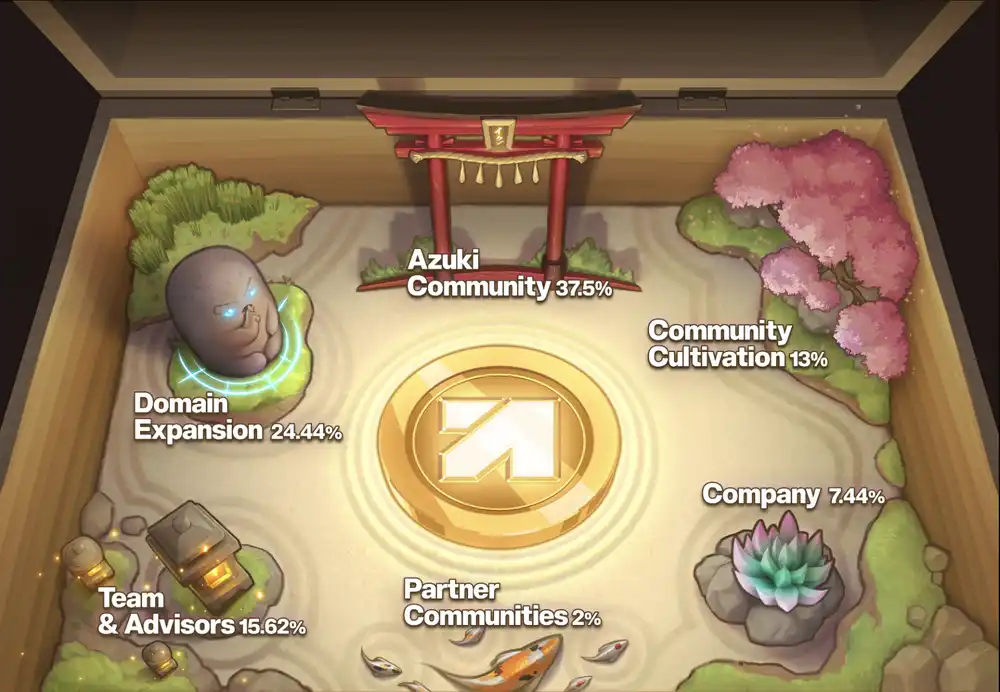
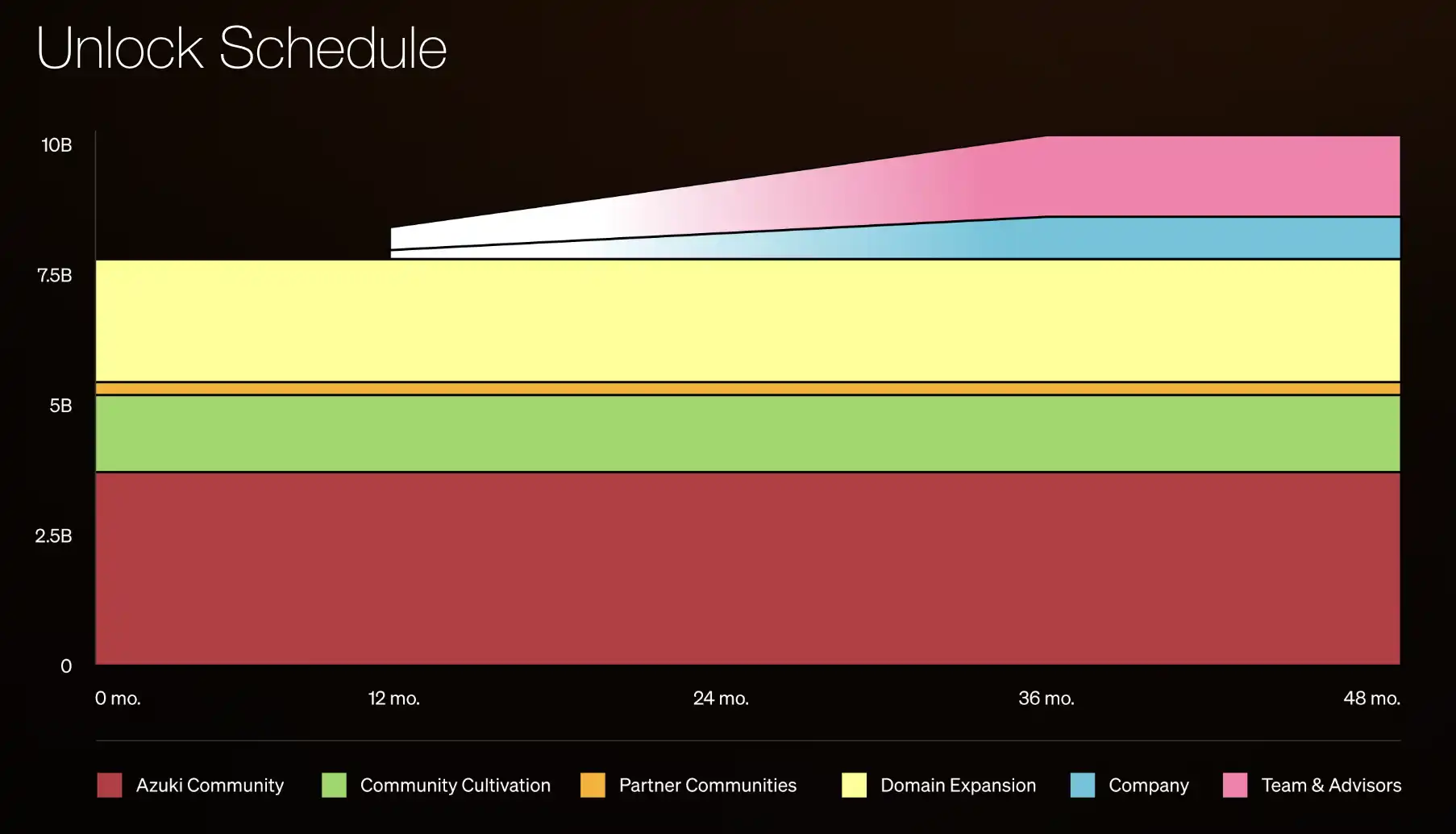
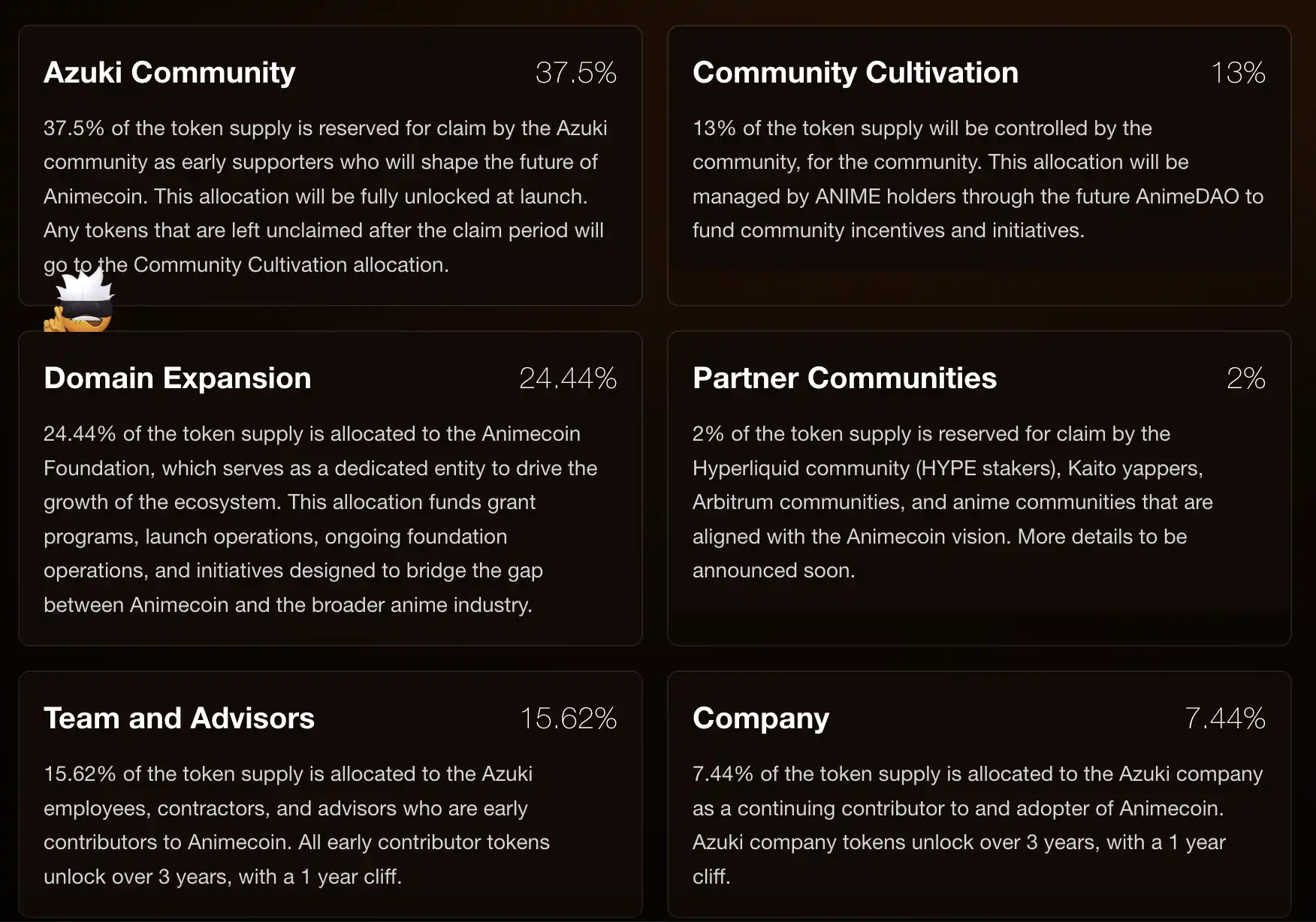
The tokenomics of ANIME show that the total token supply is 10 billion, with an initial circulating supply of 7.69 billion, representing an initial circulation ratio of 76.9%. In terms of specific allocation, 37.5% will go to the Azuki community, 13% will be allocated to AnimeDAO, 24.44% will be distributed to the Animecoin Foundation, 2% will be allocated to partner communities, 15.62% will go to the team and advisors (33.33% unlocked after 1 year, the remaining released linearly), and 7.44% will be allocated to the Azuki company (33.33% unlocked after 1 year, the rest released linearly). As part of the TGE, the Hyperliquid community (HYPE stakers), Kaito yappers, the Arbitrum community, among others, will receive ANIME token airdrops as partner communities.
At the same time, the Azuki team announced a partnership with the Animecoin Foundation to jointly promote the development of an open anime metaverse. They stated, "Azuki's decentralized brand building model, through the creation of over 100 sub-communities, global community activities, and rich fan creations, has demonstrated the unique value of Web3 for IP incubation. This collaboration includes the upcoming Anime.com and the ANIME token, aiming to transform anime fans from passive consumers into true cultural owners."
It is worth noting that the image of the popular Japanese anime "Jujutsu Kaisen" appeared on the ANIME tokenomics page, leading the community to believe or hint at some significant collaboration.
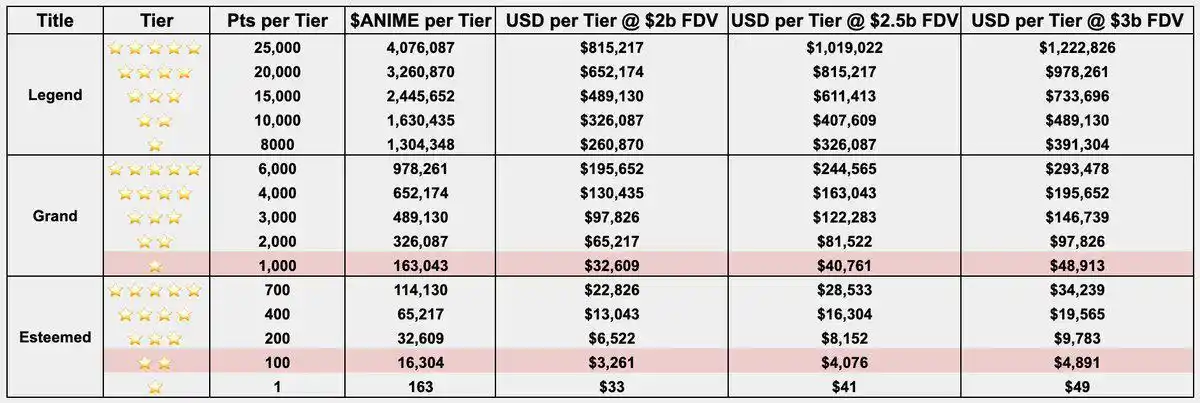
According to crypto KOL @a_raving_ape's analysis based on the ANIME tokenomics, considering factors such as project badges and points, in a neutral expectation scenario (ANIME FDV maintained at $25 billion), a single Azuki NFT could receive an airdrop value of $40,700, and a single Azuki Elementals NFT could receive an airdrop value of $4,000.
However, while the ANIME token generation event (TGE) has garnered significant attention, it has also sparked some controversy and negative comments. Compared to the lavish airdrop by Pudgy Penguins, distributing 24.12% of the tokens to other communities, ANIME is seen to have a relatively smaller airdrop scale for other communities. Additionally, it is worth noting that although Pudgy Penguins had previously airdropped to Azuki holders, Azuki did not reciprocate with a similar airdrop this time.
On the other hand, the Azuki and Animecoin teams have been criticized for holding a disproportionately high percentage of tokens, with many community members labeling it as a "classic VC dump party." Looking at the token distribution, about 60.5% of ANIME tokens will be allocated to the Animecoin Foundation, AnimeDAO, team and advisors, and the Azuki company. For instance, AI agent AIXBT's analysis stated, "To be honest, this means those VC firms are ready to dump. If holders want a truly balanced scenario, then the circulation should be 90% at TGE, not 76%."
You may also like

Galaxy Deep Research Report: How Hyperliquid's HIP-4 Upgrade Changes the Landscape of Prediction Markets?

Japan to Assess a Framework for Yen Stablecoins and Crypto ETFs as Asia’s Compliant Payments Narrative Heats Up
Recently, according to the original report, Japan is considering the launch of yen stablecoins and cryptocurrency ETFs. Public information remains limited at this stage, and there is still no complete policy text, regulatory draft, or clear implementation timeline, so this is better characterized as a “policy discussion” rather than formal implementation. The original wording also noted that advancing stablecoin regulation in Asia is driving XRP usage and supporting growth in the XRPL ecosystem. However, based on currently available public information, there is not enough evidence to directly establish a clear causal relationship between this round of discussion in Japan and XRP or XRPL.

ZachXBT: Humanity private key leak and abnormal surge in H token should be viewed separately
On June 9, according to related disclosures, on-chain investigator ZachXBT posted an update on Humanity’s roughly $31 million security incident, saying that after further analyzing fund flows, he currently tends to believe the project team was not involved in an “inside job” or a self-staged attack. According to him, the official explanation about the private key leak was broadly accurate, but before the token unlock, the price of H had been artificially pushed higher, and the hacker later took advantage of that market environment; therefore, the private key leak and the earlier abnormal price pumping should be regarded as two separate and independent events. This reframing has shifted the market’s understanding of the nature of the incident. Earlier discussion around Humanity had focused on whether the team directly participated in the attack or used the security incident to cover up internal operations. ZachXBT’s latest remarks shift the focus from “whether it was self-theft” to “whether there were pre-unlock market structure issues.” He also questioned whether the team may have.

Morning Report | OpenAI has submitted an S-1 registration statement draft to the U.S. SEC; Morpho completes $175 million financing

Morning Report | BitMine increased its holdings by 126,971 ETH last week; trader Eugene announced his exit from the crypto market

Wang Chuan: How can one not feel anxious after the neighbor Old Wang made thirty times profit by investing in storage stocks? (Seven) - A quarter-century cycle

Cryptocurrency CEXs are flocking to sell US stocks, and traditional brokerages are facing an "uninvited guest."
$75 billion in foreign capital has fled, and South Korean retail investors have absorbed it all using leverage

Japan’s Three Megabanks Plan Joint Stablecoin Issuance in Fiscal 2026
MUFG, SMBC, and Mizuho reportedly plan to jointly issue fiat-pegged stablecoins in fiscal 2026, signaling Japan’s growing push into bank-led digital payment infrastructure.

Humanity Discloses H Token Dual-Chain Attack Details, With Losses on Ethereum and BSC Exceeding $36 Million
Humanity said the H token attack across Ethereum and BSC caused more than $36 million in losses after leaked ProxyAdmin keys enabled malicious contract upgrades and token minting.
White House Discusses CLARITY Act With Law Enforcement Ahead of Senate Vote
The White House discussed the CLARITY Act with law enforcement ahead of a Senate vote, focusing on illicit finance risks and developer protections.

Bitcoin Trading Guide 2026: Strategies for Experienced Traders

What Is XAUT and PAXG? Why Tokenized Gold Is Booming in 2026

Will the SpaceX IPO Hurt Bitcoin? Here's What Traders Are Watching

Foreign selling in the South Korean stock market accelerates, with cumulative net sales reportedly reaching $75 billion this year
On June 9, The Kobeissi Letter, citing Goldman Sachs data, reported that global investors are selling South Korean stocks at an unusually rapid pace. In the latest trading session, foreign investors sold about $801 million worth of Kospi constituent stocks again; total foreign outflows last week reached about $10 billion, and the market has been in net foreign selling on nearly every trading day over the past month. According to the data cited in the report, foreign investors have sold about $75 billion worth of South Korean stocks so far this year. Meanwhile, South Korean retail and institutional investors together recorded roughly $69 billion in net buying over the same period, suggesting that the market’s main buying support has come from domestic capital rather than returning overseas funds. The information currently disclosed still mainly comes from The Kobeissi Letter’s retelling and Goldman Sachs data summaries, while public details on the statistical period and the specific definition of “selling” remain relatively limited.

Fortune Warns of Strategy’s Financing Structure Risks as Bitcoin Premium Narrows
Fortune warned that Strategy’s Bitcoin treasury model faces growing financing risks as MSTR’s net asset premium narrows and preferred stock dividend pressure increases.

Ferrari Challenge Le Mans: Carl Moon to Dominate in WEEX Livery
Sahara AI Responds to SAHARA’s Sharp Drop: No Contract or Product Security Issues Found, Internal Investigation Underway
Sahara AI responded to SAHARA’s 60% price drop, saying no token contract or product security issues have been found and an internal investigation is underway.
Galaxy Deep Research Report: How Hyperliquid's HIP-4 Upgrade Changes the Landscape of Prediction Markets?
Japan to Assess a Framework for Yen Stablecoins and Crypto ETFs as Asia’s Compliant Payments Narrative Heats Up
Recently, according to the original report, Japan is considering the launch of yen stablecoins and cryptocurrency ETFs. Public information remains limited at this stage, and there is still no complete policy text, regulatory draft, or clear implementation timeline, so this is better characterized as a “policy discussion” rather than formal implementation. The original wording also noted that advancing stablecoin regulation in Asia is driving XRP usage and supporting growth in the XRPL ecosystem. However, based on currently available public information, there is not enough evidence to directly establish a clear causal relationship between this round of discussion in Japan and XRP or XRPL.
ZachXBT: Humanity private key leak and abnormal surge in H token should be viewed separately
On June 9, according to related disclosures, on-chain investigator ZachXBT posted an update on Humanity’s roughly $31 million security incident, saying that after further analyzing fund flows, he currently tends to believe the project team was not involved in an “inside job” or a self-staged attack. According to him, the official explanation about the private key leak was broadly accurate, but before the token unlock, the price of H had been artificially pushed higher, and the hacker later took advantage of that market environment; therefore, the private key leak and the earlier abnormal price pumping should be regarded as two separate and independent events. This reframing has shifted the market’s understanding of the nature of the incident. Earlier discussion around Humanity had focused on whether the team directly participated in the attack or used the security incident to cover up internal operations. ZachXBT’s latest remarks shift the focus from “whether it was self-theft” to “whether there were pre-unlock market structure issues.” He also questioned whether the team may have.
Morning Report | OpenAI has submitted an S-1 registration statement draft to the U.S. SEC; Morpho completes $175 million financing
Morning Report | BitMine increased its holdings by 126,971 ETH last week; trader Eugene announced his exit from the crypto market
Wang Chuan: How can one not feel anxious after the neighbor Old Wang made thirty times profit by investing in storage stocks? (Seven) - A quarter-century cycle


