
AI Market Cools Off, Is Venice Based on DeepSeek Still an Ideal Pump and Dump Target?


Original Article Title: The AI Dispatch #4 - The Bottomless Pit
Original Article Author: Castle Labs, Web3 Ecosystem Partner
Original Article Translation: Ashley, BlockBeats
Editor's Note: The article reviewed the market fluctuations of AI projects, pointing out that emerging crypto projects often experience a rapid growth followed by a correction, a process that helps filter out projects with long-term value. Despite many AI projects suffering a significant market cap decline, Venice AI has shown long-term potential due to its decentralized, uncensored nature, and innovative tokenomics. However, Venice's launch process has also sparked controversy, especially regarding team operations and transparency.
The following is the original content (slightly reorganized for better readability):
AI Market Review
The road has been long and bumpy. The market volatility of the past few months has made everyone forget that conventional markets do not only go up. After experiencing a massive surge, the AI sector is now undergoing a severe correction. This is normal for the emerging narratives in crypto: they first experience unprecedented growth by attracting industry attention.
This leads to frenzy — but ultimately to a correction. Once this correction happens, we can distinguish which projects are truly worth investing in. The correction is actually the Darwinian evolution process that crypto projects go through.

In fact, 90% of AI projects may eventually go to zero. Once this happens, we will know if this narrative is sustainable (spoiler: we believe it is), and this usually occurs when everyone has either left the market or exposed too little. The pain might continue, but we are far from over.
The total market cap of AI agents has been completely decimated. From $15 billion just a few weeks ago, it has now experienced over a 60% pullback, with the market cap dropping to less than $7 billion.
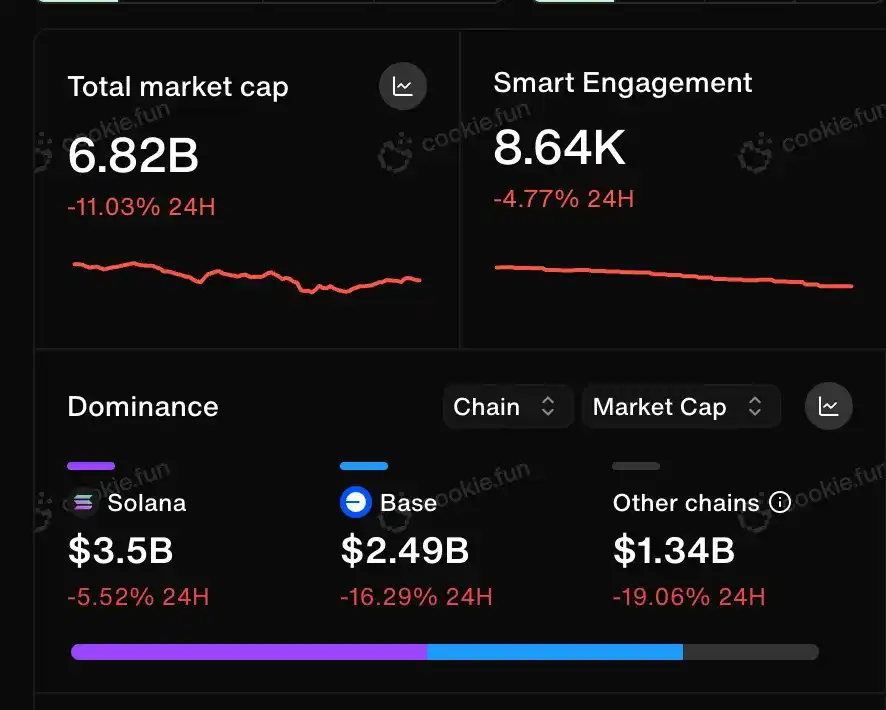
This is reflected in the prices of top launchpads and agents:
· AI16Z: From over $2 to $0.35
· ZEREBRO Devastation: Dropped to 0.05
· FARTCOIN: Once Again Falls Below 0.70
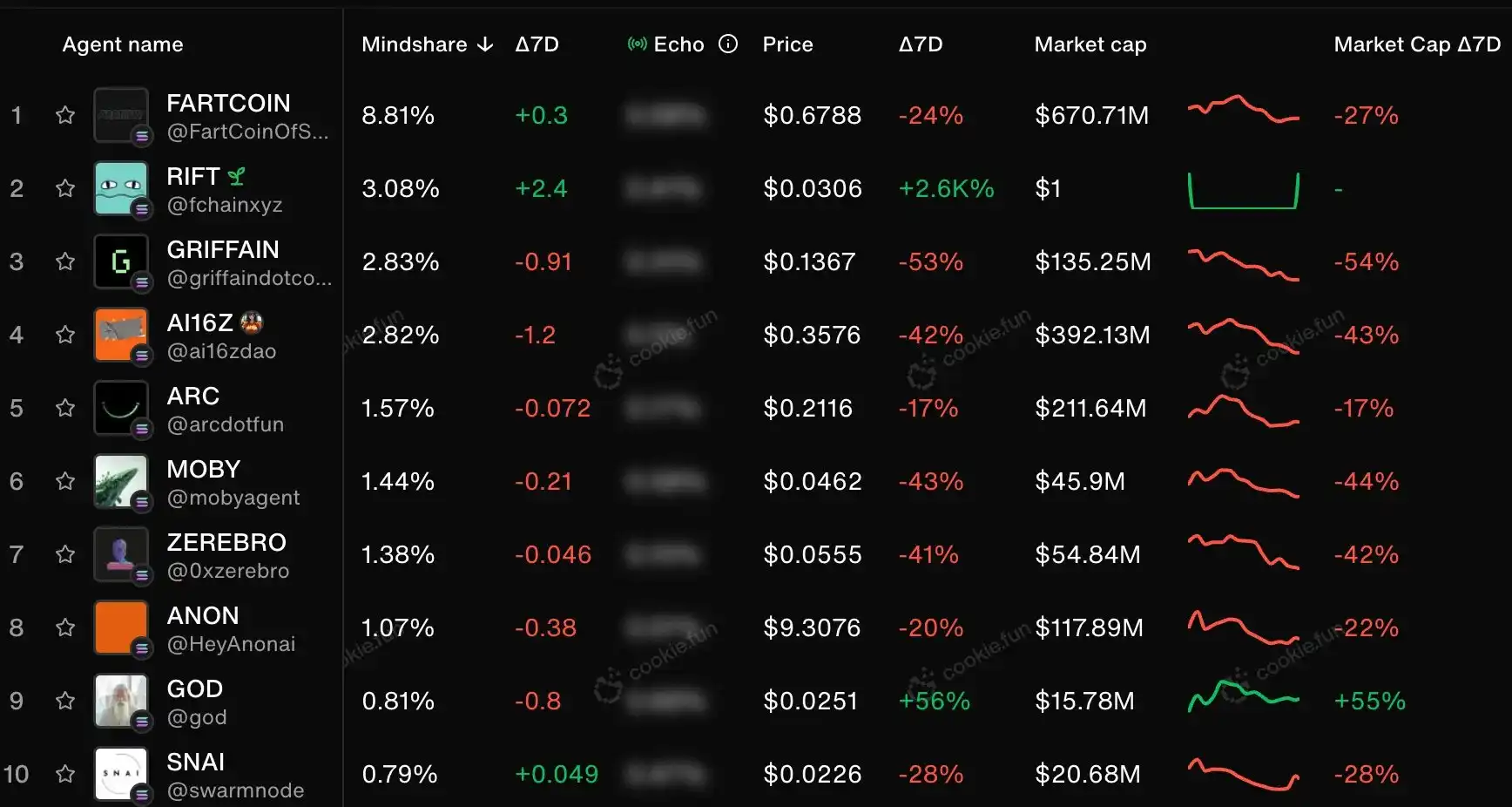
The only agent whose market value has increased in the past week is $GOD. Well, that's not surprising either; after all, he is omnipotent.
In this chaotic situation, Solana seems to be gaining a competitive advantage against Base:
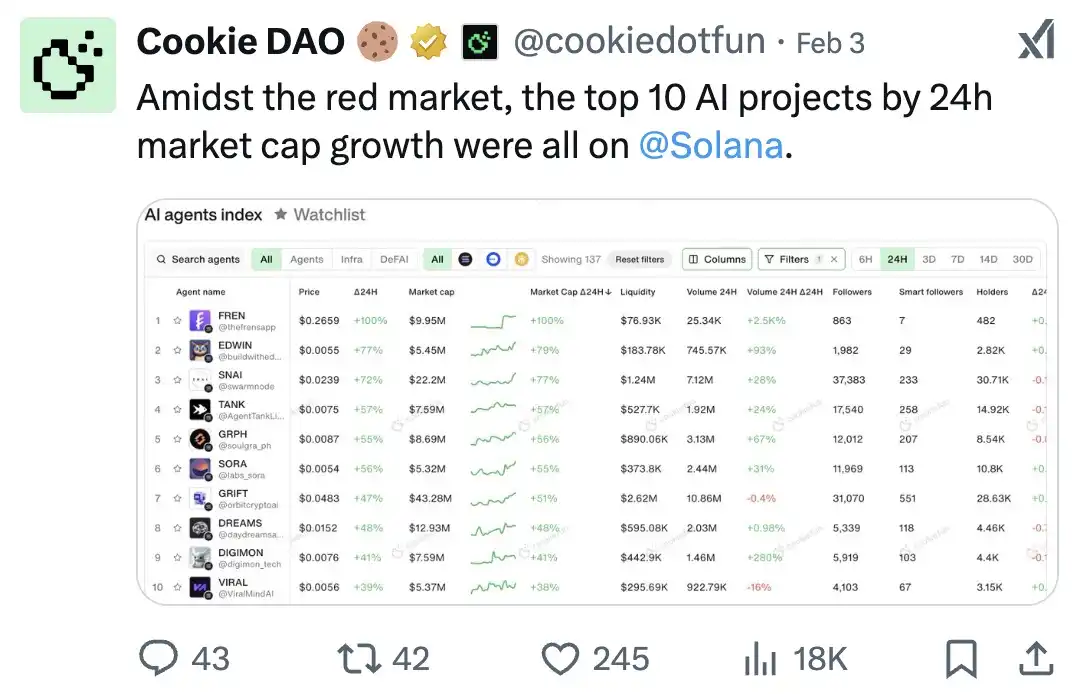
However, when there is blood in the water, it is usually the best time to buy. Although the price is falling, innovation in the AI field is at a historical high.
Venice AI & VVV: AI Inference Based on DeepSeek

Venice AI, launched in May 2024, is a private and uncensored generative AI platform designed to serve as an alternative to mainstream AI services like ChatGPT. In a world where AI interactions are increasingly monitored, Venice ensures user privacy by preventing data surveillance, censorship, and payment friction. The platform has experienced rapid growth, with over 450,000 registered users, over 50,000 daily active users, and 15,000 inference requests per hour.
Venice AI Team
Venice is led by Erik Voorhees, a legendary figure in the crypto industry who played a key role in Bitcoin adoption in 2013 and later expanded to a cryptocurrency exchange and gaming platform. His expertise in decentralized finance and user sovereignty makes him a strong advocate for permissionless AI.
The project's COO, Teana Baker-Taylor, brings deep experience from major crypto companies like Crypto.com, Binance, Circle, and HSBC, adding credibility and execution power to Venice's mission.
Venice Product Overview
Venice AI allows users to perform three main activities leveraging different open-source AI models:
· Text Dialogue: LLama, Dolphin, Qwen, or Deepseek
· Image Generation: Fluently, FLUX, Pony Realism, and Stable Diffusion
· Code Development: Deepseek, LLama, and Qwen

Recently, the global spotlight has been on the Deepseek AI model, proving that open-source solutions can compete with the most famous closed-source solutions like ChatGPT, and even more competitively. Providing a user experience with Venice as smooth as that offered by large tech companies' closed-source solutions.
How to Unlock AI Inference at Zero Cost with VVV
VVV is the native token of Venice, designed to eliminate the cost barrier associated with AI inference. Users do not need to pay per request; instead, they can:
· Stake VVV to gain a proportional share of Venice's computing power.
· Earn staking rewards while using AI, creating a negative marginal cost structure.
· Monetize unused computing resources by reselling computing power.
This model transforms AI inference into an ownership-based resource rather than a pay-per-use service.
Tokenomics and Dynamic Supply
· Total VVV Supply of 100 Million – 50% airdropped to early users and AI/crypto community projects.
· 14% Annual Inflation Rate – New tokens allocated to stakers to reward network usage.
· No Presale or VC Allocation – Venice provides liquidity directly on Aerodrome, ensuring transparency.
· Growth in Resource Value – With the increase in AI computing power, the inference capacity per staked VVV increases, making it a deflationary AI asset in terms of utility.
Bullish Case: Venice Aligns with the Crypto+AI Trend
· AI Inference as a Scarce Commodity – Inference is the "fuel" of AI, and as demand for AI agents skyrockets, access to computing power will become a high-value asset.
· Permissionless and Uncensored AI – Unlike centralized models that restrict content and monitor users, Venice operates in a censorship-resistant manner, aligning with the sovereignty ideals of crypto.
· Native Cryptocurrency Staking – Stakers earn rewards while using AI, transforming typical expenses into income-generating assets.
· Scalability and Network Effect – Venice's API adoption will drive VVV demand, aligning its value with the expansion of the AI industry.
Venice AI and VVV represent a revolutionary shift in the way AI compute access and monetization are approached.
Venice-Related Controversies
The launch process of the Venice AI project has not been without controversy, especially surrounding the actions of team members and market participants. Wintermute and Kbit received a significant amount of $VVV tokens before the project went live, accounting for 5.5% of the total supply. Wintermute sold $1.4 million worth of tokens before the Coinbase listing, while Kbit deposited $8.8 million to Coinbase.
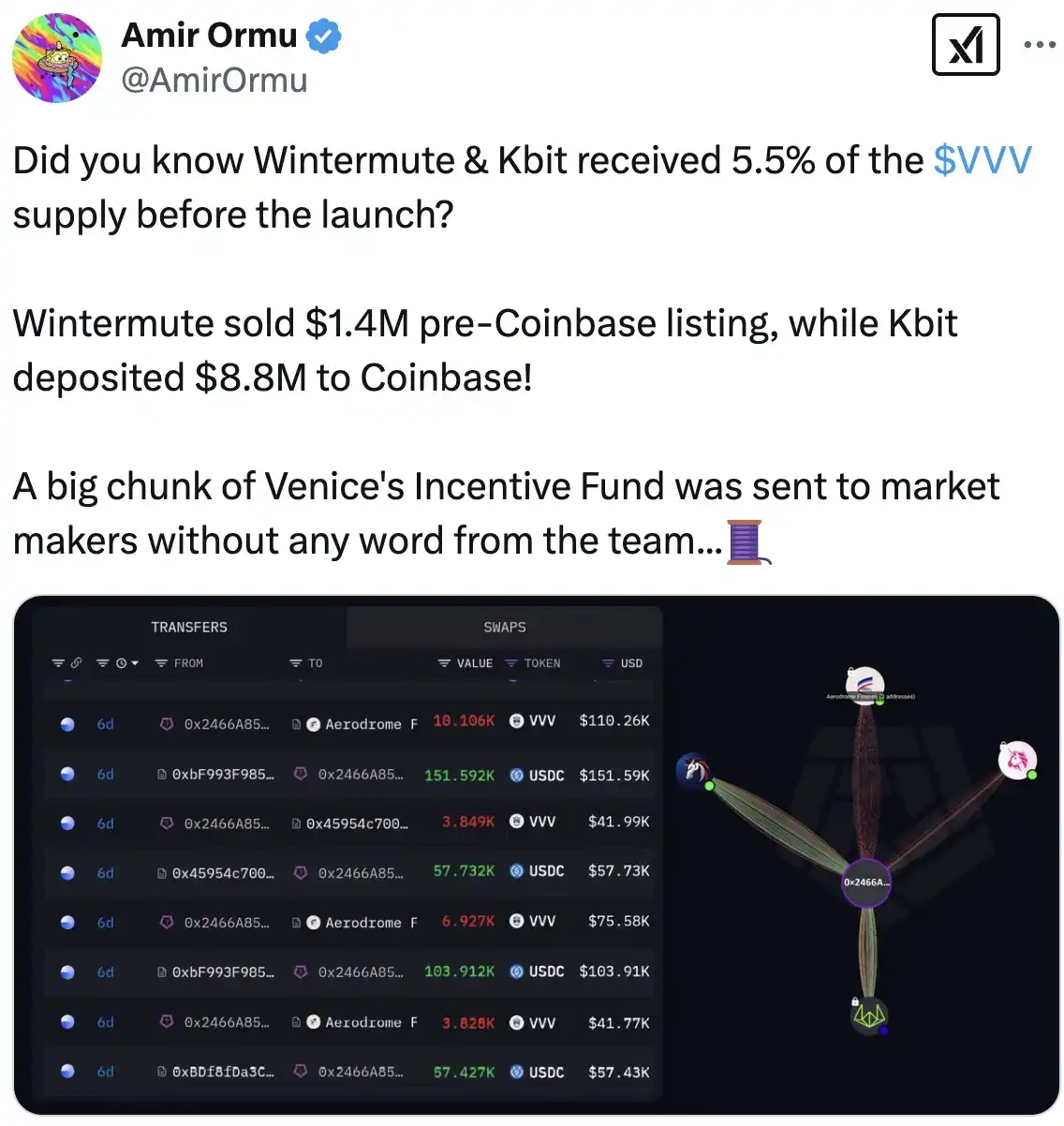
Furthermore, a large portion of the funds in Venice's incentive fund was transferred to a liquidity provider without any explanation from the team, raising questions about the project's transparency.
Source: Original Tweet
You may also like

Dialogue with OmenX Founder: Why does the prediction market need an evolution from "spot" to "derivatives"?

When the P2P illicit funds from ten years ago turned into 60,000 bitcoins

Morning News | CME Group launches Nasdaq Cryptocurrency Index futures; Asset management giant Janus Henderson strategically invests in Ethena

Why did Oracle deliver the strongest financial report in history, yet its stock price fell?

Bitcoin Layer 2 Network Botanix: Why Did We Choose to Dissolve?

Morning Report | OpenAI has submitted an S-1 registration statement draft to the U.S. SEC; Morpho completes $175 million financing

Galaxy Deep Research Report: How Hyperliquid's HIP-4 Upgrade Changes the Landscape of Prediction Markets?

Latest research from 13 top universities including Cornell University: The current state, challenges, and misconceptions of the fusion of Crypto and AI
Deconstructing Anthropic: The Best AI Company, Possibly Also a Type of Organizational Invention

Every exchange is a "Universal Exchange."

The counterattack of traditional finance: Alliance chains are quietly reviving
Pantera Capital Partner: How Tokenization is Restructuring the Private Equity and Early Investment Ecosystem?

Mastercard Launches Agent Pay for AI, Plans to Record AI Agent Payment Authorizations on Polygon
Mastercard launched Agent Pay for AI, a new payment protocol designed to help AI agents make small payments such as pay-per-use access to data and APIs. The system plans to record human-granted AI agent permissions on Polygon, focusing on verifiable authorization, identity, and payment controls.

Curve Deploys Llamalend v2 on Optimism With 250,000 OP Incentives
Curve launched Llamalend v2 on Optimism with 250,000 OP incentives from the Optimism Foundation. The upgrade expands Llamalend beyond its earlier crvUSD-focused model, adding broader collateral support, LlamaRisk market reviews, and the ability to use Curve LP tokens as collateral.

Raydium Old Liquidity Pool Reportedly Exploited, With $1.34 Million Moved to Ethereum and Tornado Cash
An old Raydium liquidity pool was reportedly exploited for around $1.34 million in USDC, RAY, and wSOL, with the stolen funds bridged to Ethereum and deposited into Tornado Cash. The incident highlights the tail risks of legacy DeFi pools, old contracts, and cross-chain fund laundering paths.
Kalshi Executive Challenges “SBF Backed AI Unicorns” Narrative, Says Leopold Aschenbrenner Was Key Figure
Kalshi executive John Wang questioned the “SBF backed AI unicorns” narrative, saying Leopold Aschenbrenner was the key figure behind major AI investment decisions.

New York Proposes Stricter Stablecoin Issuer Rules Aligned With Federal GENIUS Act
NYDFS proposed stricter stablecoin issuer rules aligned with the GENIUS Act, covering reserves, custody, redemption timelines, audits, and capital buffers.

CryptoQuant Says Bitcoin Profitable Supply Is Near 45% Pressure Zone as On-Chain Data Points to Market Repricing
CryptoQuant said Bitcoin’s profitable supply is nearing the 45% pressure zone, signaling rising market stress, unrealized losses, and a possible on-chain repricing phase.
Dialogue with OmenX Founder: Why does the prediction market need an evolution from "spot" to "derivatives"?
When the P2P illicit funds from ten years ago turned into 60,000 bitcoins
Morning News | CME Group launches Nasdaq Cryptocurrency Index futures; Asset management giant Janus Henderson strategically invests in Ethena
Why did Oracle deliver the strongest financial report in history, yet its stock price fell?
Bitcoin Layer 2 Network Botanix: Why Did We Choose to Dissolve?
Morning Report | OpenAI has submitted an S-1 registration statement draft to the U.S. SEC; Morpho completes $175 million financing


