
 Buy Crypto
- Markets
 Futures
- Spot
- Copy Trade
- Earn
- More
After Microsoft rejected Bitcoin, what will Amazon and other technology giants do?

Original title: Why tech giants like Amazon may hesitate to adopt Bitcoin
Original author: DANIEL RAMIREZ-ESCUDERO
Original translation: Lawrence, MarsBit
Big tech companies have a lot of cash on hand. Currency depreciation makes them lose purchasing power. Is Bitcoin a financial solution to fight inflation? Amazon is the next to decide.

Big tech companies such as Amazon have a lot of cash on hand ($87 billion last year), but the purchasing power of this cash is declining as the currency depreciates.
The National Center for Public Policy Research (NCPPR), a think tank in Washington, DC, has submitted a proposal to shareholders to adopt Bitcoin as a solution. However, it is not clear whether the tech giants will benefit from it.
NCPPR has been pursuing this strategy at Microsoft and Amazon. At both companies, the think tank argues that including Bitcoin in its treasury would protect cash assets and shareholder value from inflation.
The proposal argues that the Consumer Price Index (CPI) holds inflation at 4.95%, an “extremely poor indicator” of true monetary depreciation, and suggests that actual inflation could be twice that.
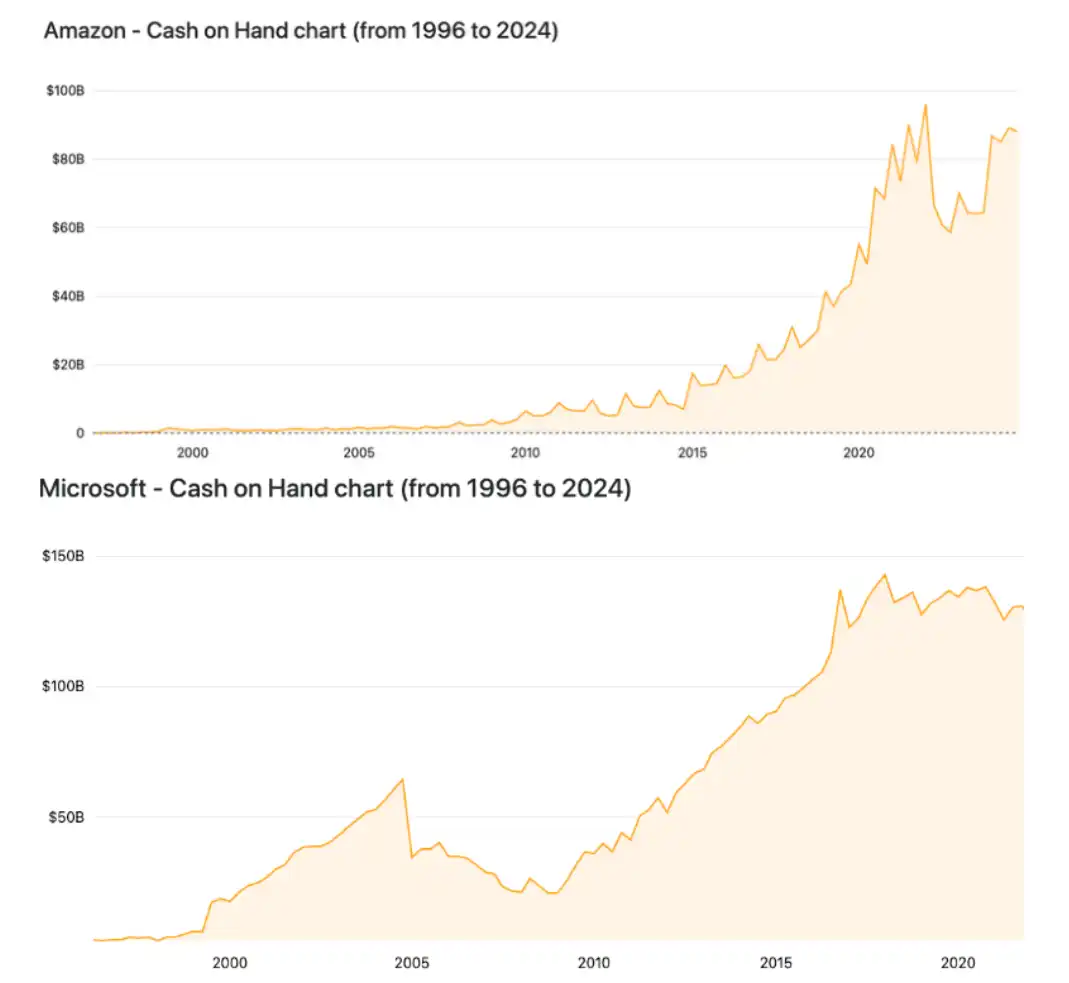
Microsoft and Amazon’s cash reserves from 1996 to 2024. Source: Companiesmarketcap
Microsoft has $78 billion in cash on hand, while Amazon has $87 billion. While Bitcoin could offer a potential hedge, does the risk outweigh the benefit?
Despite support from orange pill expert and business intelligence company MicroStrategy chairman Michael Saylor, Microsoft shareholders overwhelmingly voted down the NCPPR’s bitcoin reserve proposal, indicating that its alleged volatility was a negative factor.
Next up is Amazon. Will the vote be different this time?
Amazon isn’t as conservative a tech company as Microsoft
Nick Cowan, CEO of fintech firm Valereum, told Cointelegraph that Microsoft and Amazon may have similarities as tech giants, but their styles are very different.
“Amazon’s shareholder vote may indeed be different than Microsoft’s due to its reputation for innovation and risk tolerance.”
While Microsoft has historically been more conservative in its fiscal and strategic approach, Amazon has a track record of adopting emerging technologies and exploring new investments.
“Unlike Microsoft, Amazon’s higher propensity to innovate may align with Bitcoin’s diversification potential,” Cowan said.
Amazon will likely vote on the NCPPR proposal at its annual shareholder meeting in May 2025. The proposal urges the company to allocate more than the usual 1-2% of its portfolio to risky assets.
"Amazon should at least evaluate the benefits of holding a portion (even as little as 5%) of its Bitcoin assets."
Cowan believes this proportion is unlikely to be achieved. "A 5% Bitcoin allocation is ambitious and probably unrealistic for a company of Amazon's size," he said. "While Bitcoin provides diversification, its volatility and lack of tangible returns make it difficult to justify at such a level." He believes that "smaller experimental allocations similar to Tesla's approach may gain more shareholder support."
Tesla's purchase of Bitcoin in 2021 has brought significant profits to the company. Tesla initially purchased $1.5 billion worth of Bitcoin, but sold 70% of its initial holdings in 2021.
Nevertheless, Tesla still holds its Bitcoin reserves (9,720 BTC), which is valued at over $1.3 billion, according to BitcoinTreasuries.NET.
Amazon has billions of dollars in cash, so it could easily allocate a similar amount to Tesla.
While the NCPPR may sincerely want Amazon and Microsoft to adopt Bitcoin, Cowen believes the broader strategy is to amplify the message that Bitcoin can be considered an inflation hedge to "create potential momentum for institutional acceptance of Bitcoin."
NCPPR did not immediately respond to Cointelegraph’s request for comment.
Do tech giants need Bitcoin to enrich their wealth?
MicroStrategy has seen remarkable results in incorporating Bitcoin into its core financial strategy.
The company began buying Bitcoin on August 11, 2020, acquiring 21,454 BTC for $250 million. Since then, its share price has soared from $14 to $411, and its market capitalization has risen from $1.3 billion to nearly $100 billion.
Michael Saylor’s bet on Bitcoin as a hedge against inflation has far exceeded expectations, so why don’t tech giants follow Saylor’s financial model?
However, MicroStrategy’s approach is significantly different, using a lot of leverage, so its strategy is much riskier than Tesla’s buy-and-hold strategy.
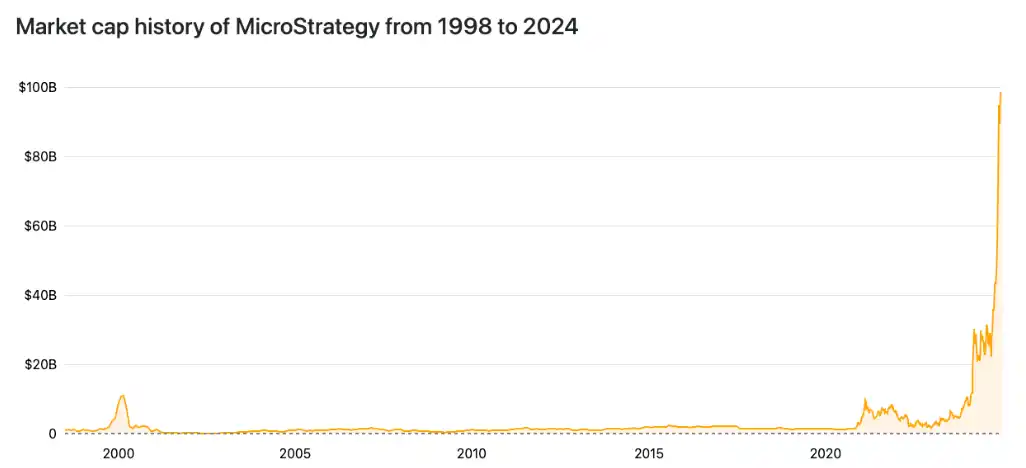
MicroStrategy’s market cap history from 1998 to 2024. Source: Companiesmarketcap
In addition, the ratio of Bitcoin to its total market cap turns its stock into a leveraged Bitcoin proxy.
According to the article, Amazon’s market cap is $2.4 trillion and Microsoft’s is $3.3 trillion, so its Bitcoin adoption effect would not be similar to MicroStrategy’s.
Cowen believes that Amazon is in no rush to adopt Bitcoin because its “core business is strong.” While reallocating some or all of its cash reserves into Bitcoin could provide a hedge against inflation, there are risks in deviating from its current financial strategy, which some shareholders may see as a potential burden on its profitable business model.
“The opportunity cost of holding a volatile asset like Bitcoin instead of investing in R&D or acquisitions would weigh heavily in a decision like this.”
“Putting a significant portion of funds in Bitcoin could impact Amazon’s ability to fund key growth areas like AWS, AI development, and logistics infrastructure,” he said. The shareholder vote will need to “strike a balance between speculative asset acquisitions and investments in key innovations that will determine Amazon’s competitive advantage.”
Bitcoin environmental issues could hold back shareholders
Big tech companies also have to consider public perception, as mainstream media has a big influence on their brands and stock prices. While Bitcoin's reputation has improved significantly, it is still associated with speculative trading assets, potential abuses and environmental issues.
"A negative PR narrative could obscure potential economic benefits, especially given Amazon's focus on ESG initiatives and its need to remain broadly appealing to stakeholders."
Amazon has revolutionized commerce by delivering goods quickly to your door. However, according to a 2022 report by environmental group Oceana, the impact of this model on the environment is alarming, generating more than 709 million pounds of plastic waste.
The company has pledged to achieve net zero carbon emissions by 2040, a decade ahead of the goals of the Paris Agreement.
The high energy consumption of Bitcoin mining has been heavily criticized by environmentalists. However, as mining infrastructure comes under more thorough scrutiny, that narrative is changing. Despite this shift, the risk of a PR backlash remains.
Amazon shareholders must decide whether the company can achieve positive results similar to Tesla or MicroStrategy by using Bitcoin to hedge against inflation, or whether it should avoid risk and focus on its core business model.
You may also like

Consumer-grade Crypto Global Survey: Users, Revenue, and Track Distribution

Prediction Markets Under Bias

Stolen: $290 million, Three Parties Refusing to Acknowledge, Who Should Foot the Bill for the KelpDAO Incident Resolution?

ASTEROID Pumped 10,000x in Three Days, Is Meme Season Back on Ethereum?

ChainCatcher Hong Kong Themed Forum Highlights: Decoding the Growth Engine Under the Integration of Crypto Assets and Smart Economy

Why can this institution still grow by 150% when the scale of leading crypto VCs has shrunk significantly?

Anthropic's $1 trillion, compared to DeepSeek's $100 billion

Geopolitical Risk Persists, Is Bitcoin Becoming a Key Barometer?

Annualized 11.5%, Wall Street Buzzing: Is MicroStrategy's STRC Bitcoin's Savior or Destroyer?

An Obscure Open Source AI Tool Alerted on Kelp DAO's $292 million Bug 12 Days Ago

Mixin has launched USTD-margined perpetual contracts, bringing derivative trading into the chat scene.
The privacy-focused crypto wallet Mixin announced today the launch of its U-based perpetual contract (a derivative priced in USDT). Unlike traditional exchanges, Mixin has taken a new approach by "liberating" derivative trading from isolated matching engines and embedding it into the instant messaging environment.
Users can directly open positions within the app with leverage of up to 200x, while sharing positions, discussing strategies, and copy trading within private communities. Trading, social interaction, and asset management are integrated into the same interface.
Based on its non-custodial architecture, Mixin has eliminated friction from the traditional onboarding process, allowing users to participate in perpetual contract trading without identity verification.
The trading process has been streamlined into five steps:
· Choose the trading asset
· Select long or short
· Input position size and leverage
· Confirm order details
· Confirm and open the position
The interface provides real-time visualization of price, position, and profit and loss (PnL), allowing users to complete trades without switching between multiple modules.
Mixin has directly integrated social features into the derivative trading environment. Users can create private trading communities and interact around real-time positions:
· End-to-end encrypted private groups supporting up to 1024 members
· End-to-end encrypted voice communication
· One-click position sharing
· One-click trade copying
On the execution side, Mixin aggregates liquidity from multiple sources and accesses decentralized protocol and external market liquidity through a unified trading interface.
By combining social interaction with trade execution, Mixin enables users to collaborate, share, and execute trading strategies instantly within the same environment.
Mixin has also introduced a referral incentive system based on trading behavior:
· Users can join with an invite code
· Up to 60% of trading fees as referral rewards
· Incentive mechanism designed for long-term, sustainable earnings
This model aims to drive user-driven network expansion and organic growth.
Mixin's derivative transactions are built on top of its existing self-custody wallet infrastructure, with core features including:
· Separation of transaction account and asset storage
· User full control over assets
· Platform does not custody user funds
· Built-in privacy mechanisms to reduce data exposure
The system aims to strike a balance between transaction efficiency, asset security, and privacy protection.
Against the background of perpetual contracts becoming a mainstream trading tool, Mixin is exploring a different development direction by lowering barriers, enhancing social and privacy attributes.
The platform does not only view transactions as execution actions but positions them as a networked activity: transactions have social attributes, strategies can be shared, and relationships between individuals also become part of the financial system.
Mixin's design is based on a user-initiated, user-controlled model. The platform neither custodies assets nor executes transactions on behalf of users.
This model aligns with a statement issued by the U.S. Securities and Exchange Commission (SEC) on April 13, 2026, titled "Staff Statement on Whether Partial User Interface Used in Preparing Cryptocurrency Securities Transactions May Require Broker-Dealer Registration."
The statement indicates that, under the premise where transactions are entirely initiated and controlled by users, non-custodial service providers that offer neutral interfaces may not need to register as broker-dealers or exchanges.
Mixin is a decentralized, self-custodial privacy wallet designed to provide secure and efficient digital asset management services.
Its core capabilities include:
· Aggregation: integrating multi-chain assets and routing between different transaction paths to simplify user operations
· High liquidity access: connecting to various liquidity sources, including decentralized protocols and external markets
· Decentralization: achieving full user control over assets without relying on custodial intermediaries
· Privacy protection: safeguarding assets and data through MPC, CryptoNote, and end-to-end encrypted communication
Mixin has been in operation for over 8 years, supporting over 40 blockchains and more than 10,000 assets, with a global user base exceeding 10 million and an on-chain self-custodied asset scale of over $1 billion.

$600 million stolen in 20 days, ushering in the era of AI hackers in the crypto world
Vitalik's 2026 Hong Kong Web3 Summit Speech: Ethereum's Ultimate Vision as the "World Computer" and Future Roadmap
On the same day Aave introduced rsETH, why did Spark decide to exit?
Full Post-Mortem of the KelpDAO Incident: Why Did Aave, Which Was Not Compromised, End Up in Crisis Situation?

After a $290 million DeFi liquidation, is the security promise still there?
ZachXBT's post ignites RAVE nearing zero, what is the truth behind the insider control?






 App
App