
$2.5 Billion, Tesla Buys Ticket to Chip Arms Race Bottom Tier


Elon Musk is going to make his own chips. Not in terms of design—Tesla has been designing its own chips for seven years. This time it's about manufacturing. He announced a commitment of about $25 billion to build a chip super factory named Terafab, targeting a 2nm process, producing 100,000 wafers per month, integrating logic chips, memory, and advanced packaging in the same facility.
The reason behind this is not complicated. Tesla's appetite for computing power has grown so large that external foundries can't keep up anymore. Each generation of their self-driving chips sees a three- to five-fold increase in computing power, with Optimus robots and Robotaxis set for mass production. The global leading-edge wafer capacity has long been dominated by Apple, Qualcomm, NVIDIA. Relying on outsourcing contracts to secure capacity is just a stopgap measure; building their own fab is the endgame.
$25 billion. In any other industry, this amount could buy the entire supply chain. In semiconductor manufacturing, it's not even enough to build a standard 2nm wafer fab.
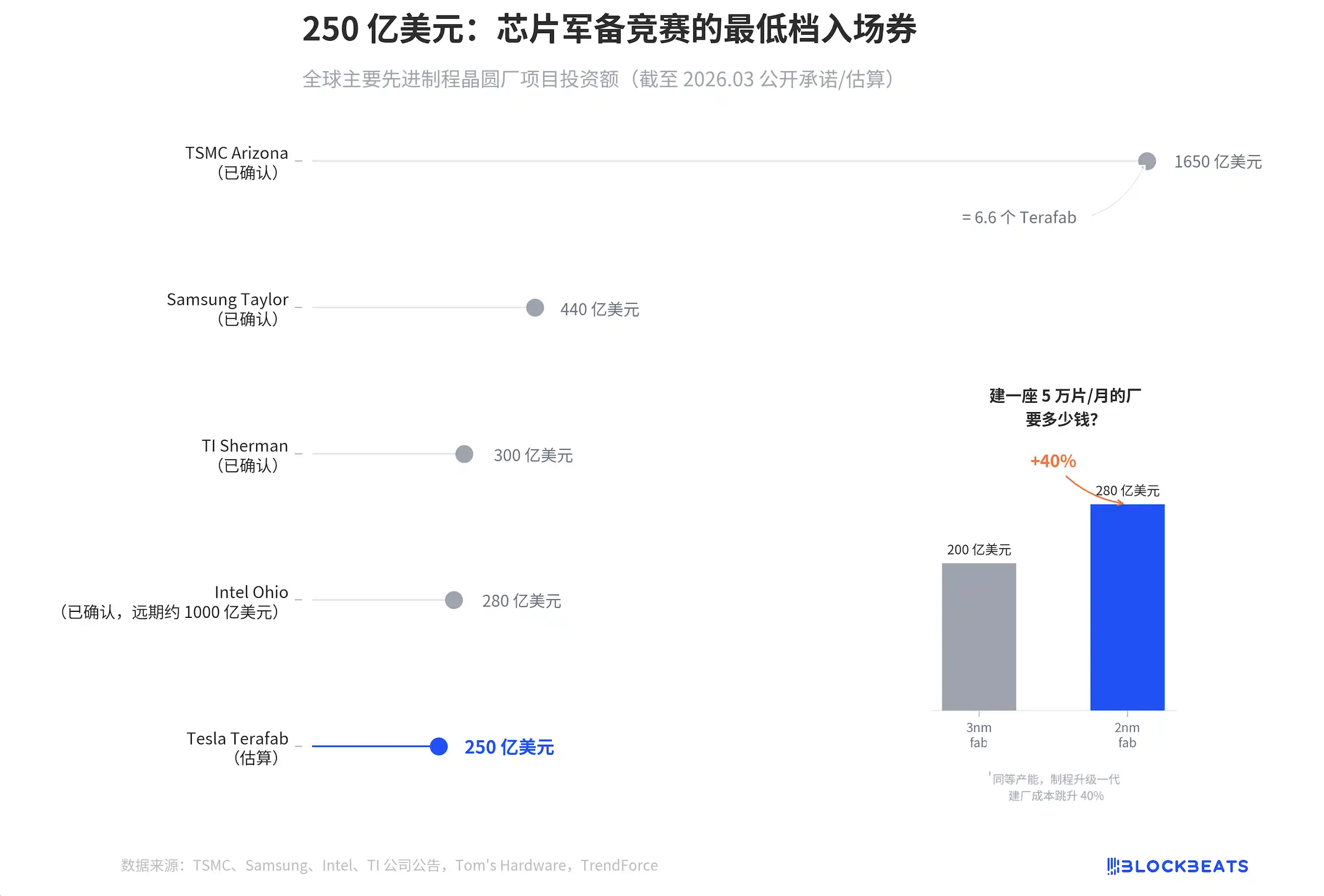
According to various company announcements and industry media reports, the total investment in the world's largest chip foundries includes $165 billion for TSMC's Arizona fab, $44 billion for Samsung's Taylor fab, $30 billion for Texas Instruments' (TI) Sherman fab, and $28 billion for Intel's Ohio fab. Tesla is at the bottom of the list. Moreover, according to estimates from various media outlets like Tom's Hardware, their $25 billion is still just an external estimate; Musk himself has not confirmed the precise number.
Even more crucial is the small image on the right. According to industry research, building a fab with a monthly output of 50,000 wafers, at a 3nm process, costs $20 billion, while at a 2nm process, it costs $28 billion. Going from 3nm to 2nm, the cost of constructing a fab jumps by 40%.
Tesla aims to achieve a monthly production of 100,000 2nm wafers with $25 billion. Based on industry standards, just one 50,000 wafers/month 2nm fab would cost $28 billion. Tesla aims to do the work of less than one standard fab with the money for two fabs and a packaging plant. This is not a budget; it's a wish list.
However, what truly makes Terafab breathtaking is not the money but the production capacity target.
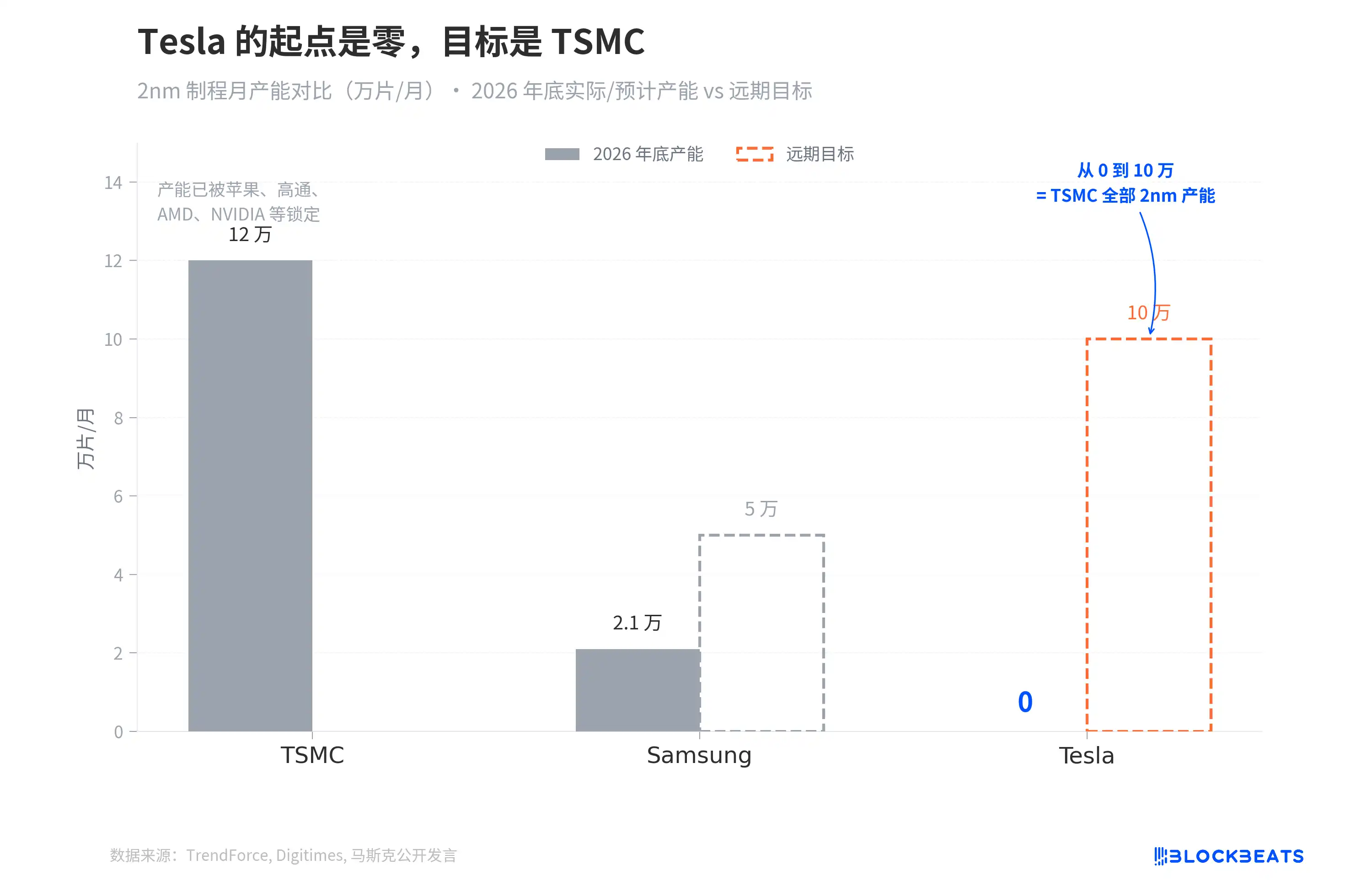
According to industry research firm TrendForce, TSMC's 2nm capacity is expected to reach 100,000 to 130,000 wafers per month by the end of 2026, but this capacity has already been secured by Apple, Qualcomm, AMD, NVIDIA. According to Digitimes, Samsung's 2nm capacity is only 21,000 wafers per month, with a long-term goal of 50,000.
Tesla started from zero. The goal is 100,000.
Going from 0 to 100,000 wafers per month is equivalent to catching up from scratch to TSMC's entire capacity on the most advanced process node worldwide. TSMC started building fabs in Arizona in 2021 and it took three and a half years to ramp up its first 4nm fab. TSMC has accumulated thirty years of manufacturing experience in Taiwan.
Tesla's speed in car manufacturing is indeed faster than anyone's expectations. However, the margin of error in wafer fabrication and vehicle manufacturing is not in the same league. A car's defect can be recalled, but a defect on a wafer means thousands of chips are scrapped.
Understanding why Terafab emerges in 2026 requires looking at a longer timeline.
In 2019, Tesla's Chief Architect of Autopilot Chips, Jim Keller, led the team to deliver HW3. This was Tesla's first fully self-developed autonomous driving chip, manufactured on Samsung's 14nm process, with 144 TOPS. By 2023, HW4 upgraded to Samsung's 7nm process, more than tripling the computing power. According to TrendForce, by 2026 with AI5, transitioning to 3nm and 2nm dual-line production, the computing power is heading straight for 2000 to 2500 TOPS. Moreover, the GPU and ISP are completely stripped out, with the entire chip optimized only for transformer inference.
Each generation sees a three to fivefold increase in performance. But the foundry strategy is also evolving in parallel. From HW3's "Samsung-only" approach to AI5's "TSMC and Samsung dual-sourcing," and then to AI6. According to reports from TechCrunch and Bloomberg, AI6 directly signed a $16.5 billion long-term contract with Samsung to secure production capacity until 2033.
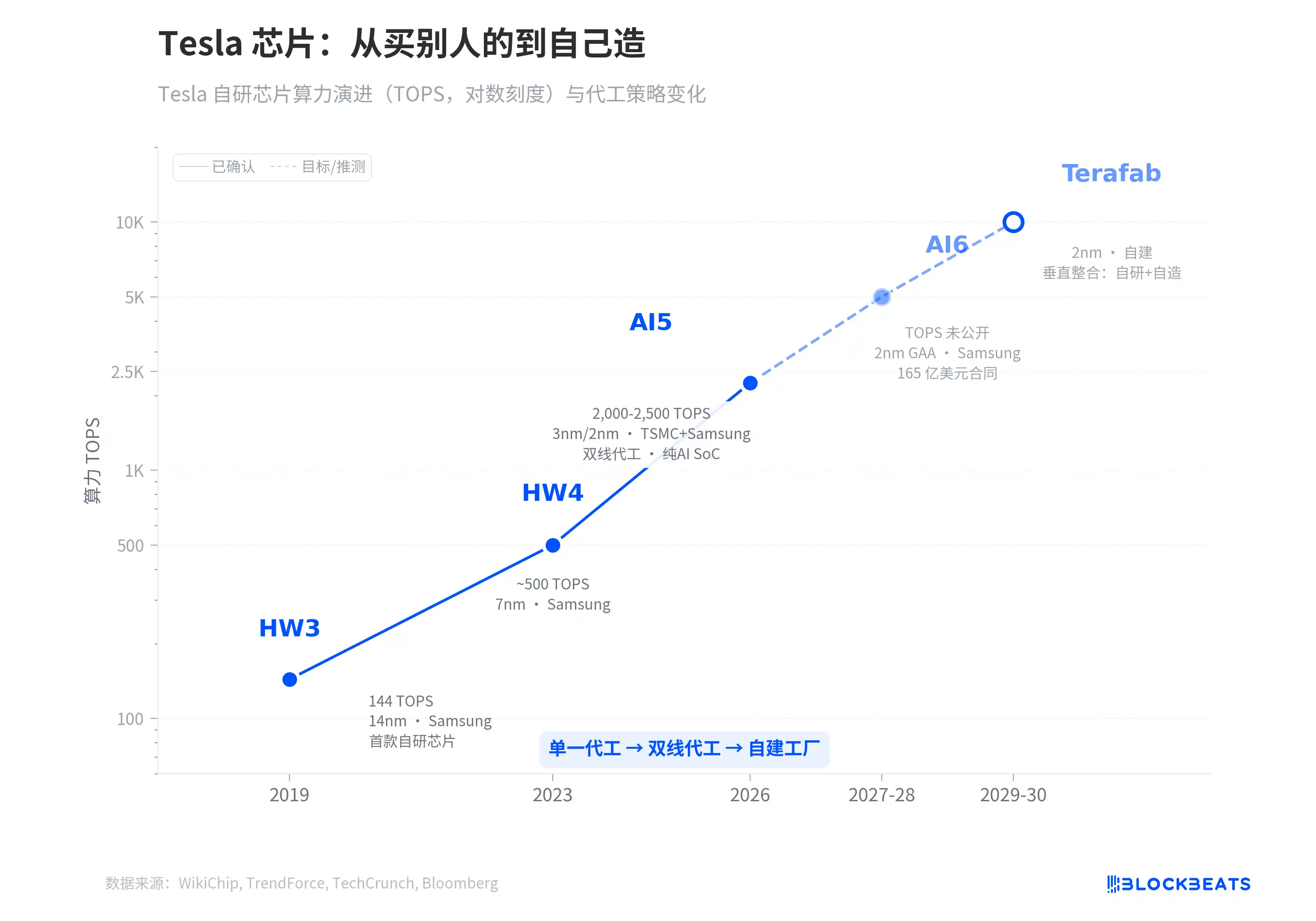
Terafab is a natural extension of this trajectory. As reported by Tom's Hardware, Tesla's AI6 contract last year essentially revived Samsung's Taylor fab, a $40 billion fab that had been put on hold due to "no customers." When your chip demand is large enough to support someone else's wafer fab, the next question is, why not build your own.
The AI6 and Terafab nodes on the dotted line segment in the chart are not labeled with specific TOPS because the specifications for these two generations have not been made public. But the trend is clear. Tesla's chip's computing power curve is exponential, and the reliance on foundries has reached an unavoidable point.
The remaining question is time.
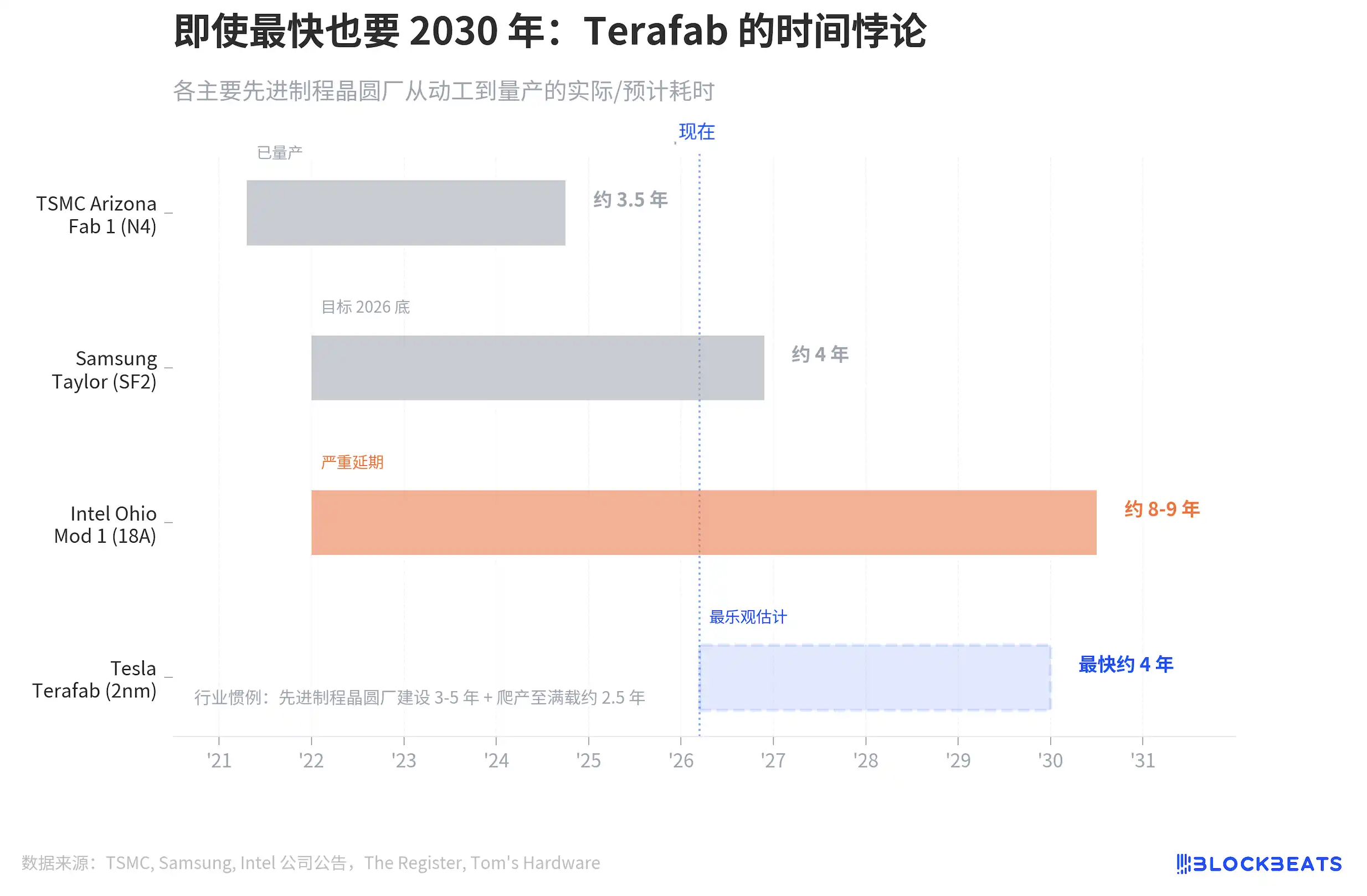
TSMC Arizona Fab 1 took about 3.5 years from groundbreaking to mass production, setting an industry record, but TSMC has thirty years of manufacturing accumulation. Samsung Taylor spent about 4 years, with a pause in the middle due to lack of customers. According to The Register, Intel Ohio is the most tragic, starting in 2022 and now delayed to 2030 to 2031.
Industry convention is construction takes 3 to 5 years, plus 2.5 years to ramp to full load. Even with TSMC's speed given to Tesla, Terafab will not be able to produce chips until late 2029 at the earliest.
This happens to coincide with Tesla's AI chip bottleneck timeframe. AI5's dual-line foundry can support until 2027 to 2028, and AI6's Samsung contract covers until 2033. But if the mass production scale of Optimus robots and Robotaxis explodes in 2029 as Musk plans, external foundry capacity is likely to be insufficient. Terafab doesn't need to produce chips by 2026; it needs to be ready by 2030.
Musk also openly discussed the possibility of collaborating with Intel. Intel has its most advanced 18A process (equivalent to the industry's 2nm level) and idle capacity urgently in need of external customers, while Tesla has clear chip demands and money. If this line goes through, Terafab will not be starting from scratch but will be a marriage of mutual needs.
$25 billion doesn't buy much certainty in chip manufacturing. But it buys a ticket. A ticket that turns Tesla from the largest chip buyer into a chip manufacturer. Looking back at this chart in three years, it will either be the starting point of Tesla's vertical integration strategy or Musk's most expensive pie in the sky.
You may also like

SK Hynix Reportedly Plans U.S. ADR Listing as Early as August, With SEC Approval Possible in Late June
SK Hynix may pursue a U.S. ADR listing as early as August, with SEC approval reportedly possible in late June amid strong AI chip supply chain demand.

SpaceX vs Tesla vs xAI: Which Elon Musk Trade Has the Biggest Upside in 2026?

OpenAI Reveals It Has Confidentially Submitted an S-1 to the SEC, Keeping the Door Open for a Future IPO
On June 9, according to an OpenAI announcement, the company recently confidentially submitted a draft S-1 registration statement to the U.S. Securities and Exchange Commission (SEC), beginning the preliminary compliance process for a potential initial public offering. OpenAI said it chose to disclose this proactively because it expected the news might leak; however, the company has not yet set a specific listing timeline, and related arrangements may still take some time.

Latest research from 13 top universities including Cornell University: The current state, challenges, and misconceptions of the fusion of Crypto and AI
Deconstructing Anthropic: The Best AI Company, Possibly Also a Type of Organizational Invention
Apollo and Blackstone Reportedly Back $35 Billion Anthropic Chip Financing as Deal Details Remain Unclear
On June 9, according to currently available news alerts, Apollo and Blackstone Group participated in a $35 billion financing for an Anthropic “chip project.” Based on the original wording of the report, the funding has already been raised, but public information remains limited. The financing structure, use of proceeds, project entity, and whether Apollo and Blackstone participated through equity, debt, or project financing have not yet been disclosed.

Humanity Protocol Security Incident Escalates: More Than $31 Million Stolen From Related Addresses as Attacker Continues Selling H for ETH
On June 9, according to monitoring by Onchain Lens, more than $31 million has been stolen from addresses linked to Humanity Protocol, and the attack is still ongoing, with the hacker continuously swapping H tokens for ETH. Project founder Terence Kwok later confirmed the security incident on X, saying the issue involved a private key leak.

Bloomberg: As Bitcoin Weakens, Stablecoins and RWA Continue to Drive Expansion in Crypto Businesses
In June, Bloomberg reported that despite Bitcoin falling below $60,000 last week, wiping out about $235 billion in market value within seven days, and dropping close to 50% from last year’s peak, some core businesses in the crypto industry are still expanding, mainly in stablecoins, real-world asset tokenization (RWA), payments, and infrastructure. The report also noted that overall altcoin activity has contracted significantly: altcoin market capitalization has fallen from a peak of about $431 billion in November 2021 to around $170 billion, and among the tens of millions of tokens issued in recent years, fewer than 1,700 still maintain meaningful trading activity.

Galaxy Deep Research Report: How Hyperliquid's HIP-4 Upgrade Changes the Landscape of Prediction Markets?
Binance Research: RWA Market Expected to Expand Nearly 6x from Early 2025, with Public Equities and Onchain Payments Heating Up Together
In June, Binance Research said in its monthly market report that the real-world asset (RWA) market is expected to grow by about 589% from the beginning of 2025. Bond- and money market fund-related RWA expanded by about $6.5 billion, up 83% year over year, while publicly traded equity RWAs grew by about 422%. The report also noted that monthly crypto debit card transaction volume exceeded $747 million in May, up 48.6% year to date.

Japan to Assess a Framework for Yen Stablecoins and Crypto ETFs as Asia’s Compliant Payments Narrative Heats Up
Recently, according to the original report, Japan is considering the launch of yen stablecoins and cryptocurrency ETFs. Public information remains limited at this stage, and there is still no complete policy text, regulatory draft, or clear implementation timeline, so this is better characterized as a “policy discussion” rather than formal implementation. The original wording also noted that advancing stablecoin regulation in Asia is driving XRP usage and supporting growth in the XRPL ecosystem. However, based on currently available public information, there is not enough evidence to directly establish a clear causal relationship between this round of discussion in Japan and XRP or XRPL.

ZachXBT: Humanity private key leak and abnormal surge in H token should be viewed separately
On June 9, according to related disclosures, on-chain investigator ZachXBT posted an update on Humanity’s roughly $31 million security incident, saying that after further analyzing fund flows, he currently tends to believe the project team was not involved in an “inside job” or a self-staged attack. According to him, the official explanation about the private key leak was broadly accurate, but before the token unlock, the price of H had been artificially pushed higher, and the hacker later took advantage of that market environment; therefore, the private key leak and the earlier abnormal price pumping should be regarded as two separate and independent events. This reframing has shifted the market’s understanding of the nature of the incident. Earlier discussion around Humanity had focused on whether the team directly participated in the attack or used the security incident to cover up internal operations. ZachXBT’s latest remarks shift the focus from “whether it was self-theft” to “whether there were pre-unlock market structure issues.” He also questioned whether the team may have.

Morning Report | OpenAI has submitted an S-1 registration statement draft to the U.S. SEC; Morpho completes $175 million financing

Morning Report | BitMine increased its holdings by 126,971 ETH last week; trader Eugene announced his exit from the crypto market

Wang Chuan: How can one not feel anxious after the neighbor Old Wang made thirty times profit by investing in storage stocks? (Seven) - A quarter-century cycle
Cryptocurrency CEXs are flocking to sell US stocks, and traditional brokerages are facing an "uninvited guest."
$75 billion in foreign capital has fled, and South Korean retail investors have absorbed it all using leverage

Japan’s Three Megabanks Plan Joint Stablecoin Issuance in Fiscal 2026
MUFG, SMBC, and Mizuho reportedly plan to jointly issue fiat-pegged stablecoins in fiscal 2026, signaling Japan’s growing push into bank-led digital payment infrastructure.
SK Hynix Reportedly Plans U.S. ADR Listing as Early as August, With SEC Approval Possible in Late June
SK Hynix may pursue a U.S. ADR listing as early as August, with SEC approval reportedly possible in late June amid strong AI chip supply chain demand.
SpaceX vs Tesla vs xAI: Which Elon Musk Trade Has the Biggest Upside in 2026?
OpenAI Reveals It Has Confidentially Submitted an S-1 to the SEC, Keeping the Door Open for a Future IPO
On June 9, according to an OpenAI announcement, the company recently confidentially submitted a draft S-1 registration statement to the U.S. Securities and Exchange Commission (SEC), beginning the preliminary compliance process for a potential initial public offering. OpenAI said it chose to disclose this proactively because it expected the news might leak; however, the company has not yet set a specific listing timeline, and related arrangements may still take some time.
Latest research from 13 top universities including Cornell University: The current state, challenges, and misconceptions of the fusion of Crypto and AI
Deconstructing Anthropic: The Best AI Company, Possibly Also a Type of Organizational Invention
Apollo and Blackstone Reportedly Back $35 Billion Anthropic Chip Financing as Deal Details Remain Unclear
On June 9, according to currently available news alerts, Apollo and Blackstone Group participated in a $35 billion financing for an Anthropic “chip project.” Based on the original wording of the report, the funding has already been raised, but public information remains limited. The financing structure, use of proceeds, project entity, and whether Apollo and Blackstone participated through equity, debt, or project financing have not yet been disclosed.


